Why These 10 Perth Restaurants Get Location Right
Locatalyze Research Team
Location intelligence, Locatalyze
Ten Perth restaurants. Ten different answers to one question: what is actually going to bring people to this door, on a Tuesday as well as a Saturday? Not one of them sits in a postcode that would, on its own, explain the result. Each picked a site whose demand, access, competition and rent matched the thing it was trying to sell — and accepted a specific cost for doing so. This is a location-intelligence read of those ten sites, not a food ranking, and it makes no claim about any venue’s private financial results.
How to read this article
**FACT** — supported by a named, linked source: ABS Census, CBRE, JLL, Tourism Research Australia, government announcements, or a venue’s own published information. **ANALYSIS** — Locatalyze’s interpretation of that evidence. **INFERENCE** — a reasonable reading that is not proven. We flag the difference in the text rather than blurring it. Where a number cannot be verified, we say so instead of estimating one.
What this is not
This is not a claim that any named restaurant is profitable, nor that its location caused its success. Private trading figures, rent deals and margins are not public, and we do not estimate them. What is observable is the site: its catchment, access, anchors, competitors, published trading pattern and physical form. That is what we analyse. Read our [methodology](/methodology) for how Locatalyze scores locations.
Key takeaways
The suburb is not the location
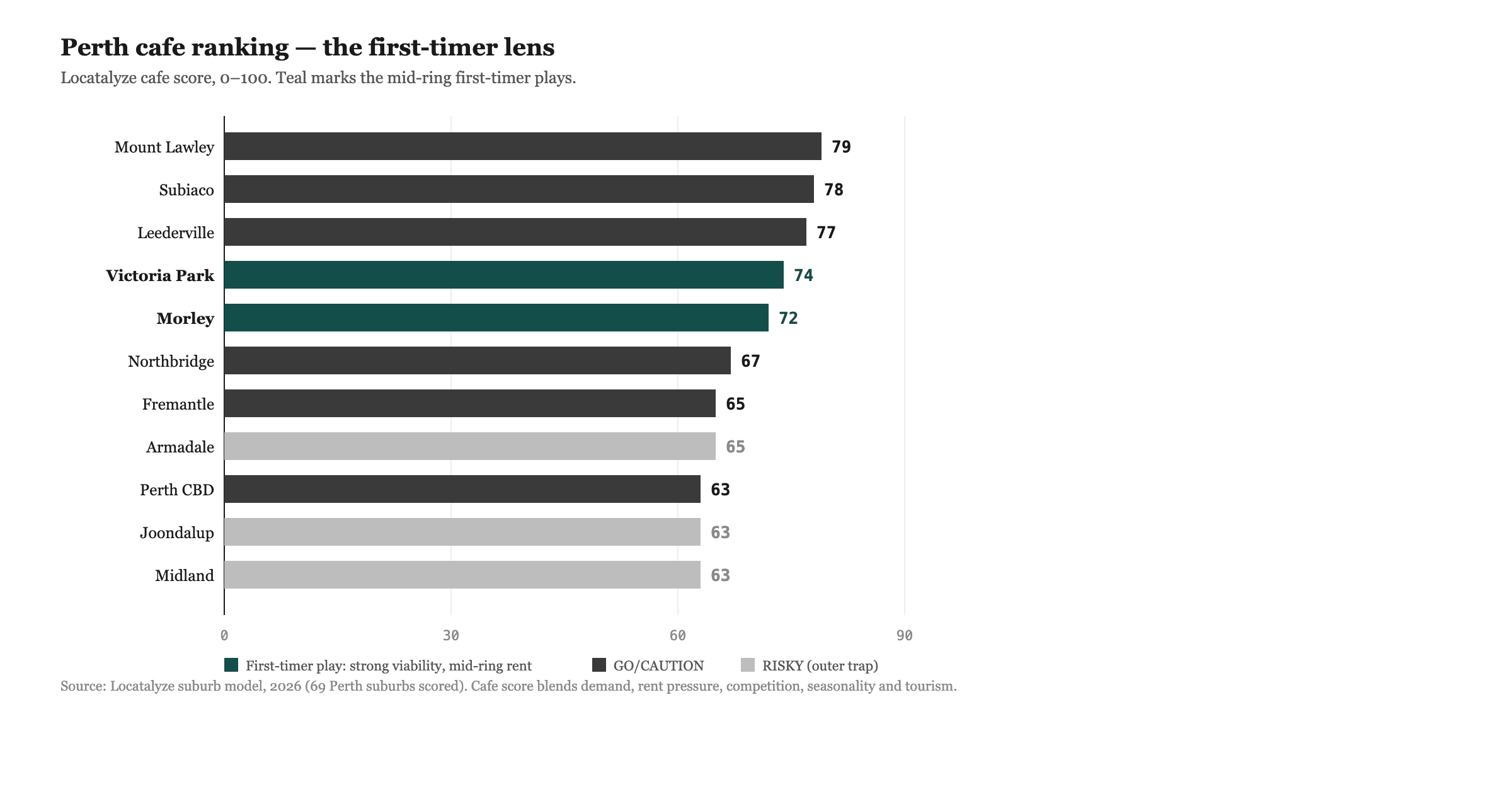
Locatalyze publishes a suburb-level score for every Perth suburb we cover. It is deterministic: a restaurant score is built from five factors — demand strength at 32%, rent pressure at 22%, competition density at 18%, seasonality risk at 14% and tourism dependency at 14% — and a suburb verdict follows from fixed thresholds. Composite 69 or above is GO, 60 to 68 is CAUTION, below 60 is RISKY. There is no editorial thumb on the scale.
So here is an uncomfortable result. Of the ten Perth restaurants in this article, six sit in suburbs our model currently rates CAUTION. The lowest-scoring suburb in the set, Caversham at 60 out of 100 for restaurants, contains a winery restaurant that is one of the best-known dining destinations in the state. Perth CBD scores 64 and hosts two of the ten, at opposite ends of the price range.
That is not a fault in the model. It is the model answering the question it was built to answer. A suburb score describes the base rate for an average operator taking an average site in that suburb with an average concept. It is a screening layer. It tells you what the suburb will do for you if you do nothing unusual. Every venue below does something unusual — and the unusual thing is almost always a specific answer to where its customers come from.
A suburb score tells you the base rate. The address, the format and the daypart tell you whether you beat it.
The table below carries the Locatalyze restaurant score for each venue’s suburb, on the August 2026 data vintage. On a phone it scrolls sideways.
Burswood is deliberately absent from our suburb layer, and the gap is instructive rather than embarrassing. That layer scores walkable retail catchments — strips, high streets, town centres. Burswood’s hospitality is almost entirely inside one privately controlled precinct with its own access, parking, hotels and internal competitors. Scoring it as a suburb would produce a number that describes nothing an operator could lease. When a model has nothing useful to say, the honest output is silence, not a plausible-looking figure.
What a restaurant location actually has to do
Strip away the vocabulary and a restaurant location has four jobs. It has to produce enough people who want your specific offer. It has to produce them at the hours you can afford to be open. It has to let them reach you without friction they will not tolerate. And it has to do all of that at a rent your realistic covers can carry. Most site decisions that go wrong fail one of those four tests in a way that was visible before the lease was signed.
Count demand engines, not people
A demand engine is a repeatable reason a population is near your door. In Perth the practical list is short: residents within walking distance, workers in nearby offices or institutions, visitors on holiday or a day trip, transit flows through a station or bus interchange, an anchor such as a hospital, stadium, university or hotel, and destination pull, where people travel specifically to you.
The number that matters is not how many people pass the door. It is how many independent engines you are running on. A site with one engine is a site with one failure mode. Australian CBDs learned this expensively in 2020 and 2021, when venues that ran purely on office workers found out what a single-engine location does when the engine stops. Our analysis across the ten sites below is that every durable one either runs two or more engines, or runs one engine so large that it substitutes for diversity.
Match the engine to the daypart you can staff
Published trading hours are the cheapest location research available and almost nobody reads them properly. They are a public statement about which dayparts a venue believes it can fill profitably. When a well-run restaurant closes on Mondays, that is not laziness — it is a judgement that the site does not produce Monday demand at a price that clears wages.
The grid below is built entirely from the ten venues’ own published hours, checked in September 2026. The spread is wide: from four trading days to seven, and from a single lunch service to breakfast, lunch and dinner every day. Read down the columns and the logic becomes visible. Venues serving captive or resident populations trade broad and often. Venues serving destination or visitor demand trade narrow and concentrate their labour where the demand actually is.
Separate access from visibility
These are different properties and Perth leases price them as if they were the same thing. Visibility is whether people notice you exist. Access is whether reaching you is easy once they have decided to come. A destination restaurant with a booking system has already solved visibility through reputation and search, so it is paying for frontage it does not use. A high-volume lunch trader with no booking system depends on being seen at 12:15pm and cannot substitute reputation for sightlines.
The practical test: if you removed your shopfront window and replaced it with a door and a small sign, would your covers fall? If the honest answer is no, you should not be paying a frontage premium. Three of the ten venues here trade from an arcade, an upper floor or a side street, and one of them moved off a prime retail mall by choice.
Rent is a claim on covers you have not sold yet
A lease converts an assumption about demand into a fixed obligation. That asymmetry is the whole risk. The arithmetic that matters before signing is not rent as a percentage of hoped-for revenue; it is the number of covers per trading week the site must produce, at your real average spend, for rent and wages to clear. Do that calculation with your worst plausible daypart mix, then walk the street at that daypart and count. Our guide to why a cheaper lease is often the more expensive location works through the failure mode in detail.
The evidence backdrop
FACT: four-year survival for Australian cafés, restaurants and takeaway food services was 51% for the period June 2021 to June 2025, against 63% for all Australian businesses ([Tourism Research Australia](https://www.tra.gov.au/en/tourism-industry-analysis/tourism-businesses-in-australia)). ANALYSIS: location does not explain that gap on its own — labour, food costs, capital structure and operating skill all sit inside it. It is, however, the input that is hardest to change after you open.
The ten sites, and what each one teaches
These are not the ten best restaurants in Perth and the list is not ordered by quality. They were selected because together they cover the distinct ways a hospitality location can work in this city: a heritage anchor, an office arcade, an arterial cuisine cluster, a tourism harbour, a heritage back street, a suburban arcade, a beachfront, a wine-region estate, a fringe corner site and a private resort. Several are well known. That is a feature — you can walk most of them in a weekend and check our reading against what you see.
1. Wildflower — Perth CBD — the anchored destination with no front door
Wildflower occupies Level 4 of COMO The Treasury, inside the State Buildings at the corner of St Georges Terrace and Barrack Street (State Buildings). There is no shopfront and effectively no impulse trade. The dining room is reached through a hotel, and it trades lunch on three days and dinner on five.
The signal is that the building is doing the work a shopfront normally does. The State Buildings are a restored heritage complex that combines a luxury hotel, bars, restaurants and retail under one address — an anchor that generates its own reason to visit. Wildflower rents attention from that anchor rather than from the footpath, and it adds a view of the city and the Swan River that no ground-floor tenancy on the Terrace can offer.
The trade-off is dependence and constraint. A venue inside someone else’s precinct inherits that precinct’s access rules, opening character and reputation, and it cannot decide unilaterally to become something else. It is also fully exposed to the CBD’s weakest attribute: Perth’s central catchment is a working population that leaves. FACT: the ABS 2021 Census counted 13,670 usual residents in the suburb of Perth (SAL51230), against 170,188 people who worked in the City of Perth local government area, only 4.8% of whom also lived there (profile.id, Census 2021 place of work). ANALYSIS: a fine-dining room in that setting cannot rely on the daytime population it sits inside; it has to pull people back into the city after they have already left it once.
What an operator can take from this: if your concept creates its own demand, buy the anchor and skip the frontage. The premium you would pay for a visible ground-floor tenancy on St Georges Terrace buys visibility that a booking-led restaurant converts poorly. Wildflower’s three-lunch, five-dinner week is the visible evidence that it is not chasing volume — it is protecting a price point.
Locatalyze take: our model scores Perth CBD 64 out of 100 for restaurants, a CAUTION. That reflects a real market — CBD retail vacancy in Perth was 18.5% in H1 2026, the highest of Australia’s major cities (CBRE). A CAUTION on the suburb is compatible with a strong result at one address, and the reason is that this address is not really renting the CBD. It is renting a destination inside it. Check the Perth CBD location read before you assume the reverse.
2. Nao Japanese — Perth CBD — the queue is the frontage
Nao is a ramen bar in the Equus Arcade, which runs between Hay Street and Murray Street in the Perth CBD; third-party listings place it at Shop 191, 580 Hay Street. It is small — Broadsheet describes it as “just a sliver of a shop” — and owner Naoki Kobayashi has been making the noodles in-house since the business opened in 2003, using around 30 kilograms of flour a day (Broadsheet).
The instructive fact is not the queue. It is the move. Nao began on Murray Street and relocated into the arcade, later moving again to the upper end of the same arcade. A business whose entire model depends on lunchtime volume voluntarily left prime street-level retail for an internal walkway — and the volume followed. ANALYSIS: that is the clearest proof available that Nao’s demand was never generated by its frontage. It was generated by the product, and frontage was a cost it could shed.
The trade-off is that this is the narrowest position in the entire set. Nao runs on one engine — CBD workers — at one daypart. Third-party listings consistently show weekday trade closing in the early evening with no Saturday service; the venue does not publish hours on a first-party site, so treat the exact times as unverified. INFERENCE: a single-engine, single-daypart site is highly exposed to anything that changes office attendance, and the last five years supplied a live demonstration of that risk.
What an operator can take from this: a queue is a rent negotiation asset. If your covers are demonstrably portable, you can trade visibility for floor cost and put the difference into product or margin. The condition is brutal and non-negotiable — the demand has to actually be portable, and most operators overestimate how much of theirs is. Nao proved it by moving twice and surviving both times.
3. Good Fortune Roast Duck House — East Victoria Park — competitors as the anchor
Good Fortune trades at 884 Albany Highway in East Victoria Park and at 354 William Street in Northbridge, both Wednesday to Monday, closed Tuesdays, opening late morning and closing at 9pm (Good Fortune). Albany Highway is an arterial road, not a pedestrian strip: traffic moves at speed, parking is off-street and behind, and the strip runs for kilometres.
On paper that should be a poor restaurant location. Arterial roads convert badly for impulse dining. What makes it work is agglomeration. Albany Highway through Victoria Park is one of Perth’s best-known eating strips, dense with independent restaurants for kilometres, and for cuisine-led dining that density is an asset rather than a threat. Customers choose the street first and the venue second, which means the strip’s combined marketing budget is working for every tenant on it. ANALYSIS: in destination-cuisine categories, nearby competitors raise your traffic; in convenience categories, they divide it. Knowing which category you are in is the whole decision.
There is a second, quieter location advantage. Good Fortune also supplies roast meats wholesale to other restaurants. ANALYSIS: that turns kitchen floor space on an arterial road into a production asset with a second revenue channel, so rent per square metre is judged against two income streams rather than one. It is a calculation a small, expensive tenancy cannot run, and it is one reason cheap floor area on a busy road can beat expensive floor area on a busy footpath.
The trade-off is price ceiling and dependence on the cluster. Value-led cuisine strips build customer expectations that cap your average spend, and the strip’s reputation is a shared asset you do not control. FACT: ABS 2021 Census recorded East Victoria Park with 10,569 residents and a median weekly household income of $2,100, above the Western Australian median of $1,815 (ABS QuickStats) — a solid resident base, but not a premium-spend one.
What an operator can take from this: if you sell a cuisine people travel for, cluster deliberately; if you sell convenience, do not. Locatalyze take: our model rates Victoria Park 68 out of 100 for restaurants with a GO verdict, the strongest suburb verdict in this set alongside Subiaco. See the Victoria Park location read for the rent bands and competition detail behind it.
4. Little Creatures — Fremantle — one engine, made enormous
Little Creatures reopened at 40–42 Mews Road on the Fremantle Fishing Boat Harbour on 12 March 2026, after a $10 million redevelopment. The rebuilt venue holds more than 1,300 patrons across four distinct spaces, keeps the original Great Hall as a brewhouse and visitor hub, and has direct harbour access for arrivals by boat (Perth is OK; Little Creatures). It trades seven days, 11am until late.
This is the clearest example in the set of the second strategy: rather than diversifying engines, make one engine so large that it substitutes for diversity. The engine is visitor demand to Fremantle. FACT: Fremantle took the Gold award for Australia’s Top Tourism Town in 2025 from the Australian Tourism Industry Council, and its mayor put day-trip volume at “nearly a million day trippers to Fremantle each year” (City of Fremantle). ANALYSIS: a 1,300-capacity venue on a working harbour with an operating brewery attached is not a restaurant that happens to be near a tourist attraction. It is the attraction, which is why the brewery tour, the merchandise store and the harbour berth all matter commercially.
The trade-offs are scale risk and weather. A venue built for 1,300 has a fixed cost base sized for peak conditions, and Perth’s outdoor-led hospitality carries genuine seasonal and weather sensitivity. Every wet Sunday in July is a real revenue event at that footprint. Tourism demand also arrives unevenly across the week and the year in a way resident demand does not.
What an operator can take from this: scale is a bet on the reliability of one engine. It is defensible when the engine is structural — a harbour, a heritage precinct, a stadium — and reckless when the engine is fashion. Locatalyze take: our model rates Fremantle 67 out of 100 for restaurants, a CAUTION, and the seasonality and tourism-dependency factors are doing most of that work. That is the correct read for a median operator in Fremantle, and Little Creatures is not a median operator. See the Fremantle location read.
Comparing two Perth sites with different demand engines? Run each address through Locatalyze and see the demand, competition and rent-pressure read side by side before you negotiate.
Free location score, map, data confidence and PROCEED / VERIFY / AVOID recommendation. Modelled financials stay optional.
Analyse a Perth address5. Bread in Common — Fremantle West End — the back street that heritage made valuable
Bread in Common occupies a converted 1898 pharmaceutical warehouse at 43 Pakenham Street, in Fremantle’s West End, and has traded there since 2013. It runs seven days, noon until 10pm and 11pm on Fridays and Saturdays (Bread in Common). Pakenham Street is not the tourist spine — that is South Terrace and the harbour, several blocks away.
The site sits inside one of the most protected urban areas in Western Australia. FACT: the Fremantle West End was entered on the State Register of Heritage Places in 2017 as the largest single place on the register, covering roughly 250 buildings across about 200,000 square metres (ABC News). ANALYSIS: heritage protection at that scale is a supply control. It caps how much competing floorspace can be created nearby and it guarantees the streetscape a destination venue is trading on will still be there in fifteen years. That is a genuine, durable location asset, and it is not available in a suburb where any warehouse can be replaced by apartments.
The trade-off is that the same protection makes the building expensive to adapt and slow to change. Heritage fabric constrains kitchen ventilation, accessibility works and any expansion, and it moves both capital cost and approval time in the wrong direction. Being off the tourist spine also means the venue must be a reason to walk, not a convenience on the way to somewhere else — a standard it has to meet every single service.
What an operator can take from this: a secondary street inside a protected precinct can outperform the primary street outside one. You are buying scarcity and permanence rather than passing trade. Verify two things before you believe it: that your concept actually generates deliberate visits, and that the heritage constraints on the specific building will not eat your fit-out budget. FACT: ABS 2021 recorded Fremantle with 9,251 residents and a median weekly household income of $1,822, close to the WA median (ABS QuickStats) — the local resident base is small and unremarkable, which is another way of saying this venue is not living on it.
6. Lulu La Delizia — Subiaco — an arcade address run like a booking system
Lulu La Delizia trades from Shop 5 and 6 at 97 Rokeby Road, Subiaco — inside Forrest Walk, an arcade off the main street. It serves lunch on Thursdays and Fridays and dinner Tuesday to Saturday, runs two nightly sittings, takes a credit-card pre-authorisation against no-shows, and keeps walk-ins to the courtyard (Lulu La Delizia).
Read that operating model as a location document and it is completely coherent. An arcade tenancy has almost no impulse trade, so the venue does not plan for any. Instead it converts a reputation into a reservation book, then uses two sittings to extract two revenue events per table per night from a small floor. ANALYSIS: the pre-authorisation is not a customer-service position, it is a yield-protection mechanism. When your covers are booked rather than walked in, a no-show is unrecoverable, because there is no passing trade to backfill the table.
Subiaco supplies the underlying conditions. FACT: ABS 2021 recorded Subiaco with 9,940 residents and a median weekly household income of $2,219, against $1,815 for Western Australia (ABS QuickStats). The suburb also carries a weekday medical and office population around Perth Children’s Hospital and a rail station on the main line. ANALYSIS: that is a genuine multi-engine catchment, which is why our model rates Subiaco 74 out of 100 for restaurants with a GO verdict — the highest restaurant score in this set.
The trade-off is fragility of the mechanism. A booking-led model with no walk-in buffer is only as strong as its reputation and its systems; a bad six months of reviews has nowhere to fall back to. Two sittings also compress the guest experience, which caps how far the price point can travel upward.
What an operator can take from this: choose the site and the demand-capture model together, not in sequence. An arcade site with a walk-in model is a bad business. An arcade site with a booking model, a small floor and a defensible product is a rent saving. The Subiaco location read sets out the Rokeby Road rent bands and the sub-precinct differences that decide which of those two you end up running.
7. The Shorehouse — Swanbourne — the view has an operating cost
The Shorehouse sits at 278 Marine Parade on Swanbourne Beach, occupying more than 1,500 square metres of absolute beachfront, and has traded there for over a decade (The Shorehouse). It runs seven days from 8am to 10pm across breakfast, lunch and dinner — the widest trading pattern of any venue in this set.
That pattern is the point. FACT: ABS 2021 recorded Swanbourne with 4,592 residents and a median weekly household income of $3,418 — 1.9 times the Western Australian median of $1,815, and the highest in this set by a wide margin (ABS QuickStats). ANALYSIS: 4,592 affluent residents is a strong local base and nowhere near enough to fill 1,500 square metres seven days a week. The venue must also draw the western suburbs generally, beach visitors, and function and wedding business. Three dayparts, seven days, is what a footprint that size demands, not what it prefers.
The trade-off is weather exposure, which we would call the single most under-priced risk in Perth coastal hospitality. Beachfront venues carry a revenue distribution with a long left tail: the same site that fills every table on a still February evening produces a fraction of that on a wet, blowing July Tuesday, with the same rent and a largely fixed roster. INFERENCE: the wide daypart spread is at least partly a hedge against that volatility — breakfast and function trade are less weather-elastic than sunset dinner.
What an operator can take from this: a view is a premium you pay every month for revenue you receive seasonally. Before signing a coastal lease, model the worst quarter rather than the best one, and check whether the site can carry a second daypart that does not depend on the weather. Locatalyze take: our model rates Swanbourne 64 out of 100 for restaurants, a CAUTION, with seasonality risk the main drag — high income, small population, weather-exposed. See the Swanbourne location read.
8. Sandalford Wines — Caversham — when the catchment is a drive time, not a suburb
Sandalford has been producing wine in the Swan Valley for more than 185 years. Its estate at 3210 West Swan Road, Caversham, runs a cellar door daily from 10am to 5pm and a restaurant that serves lunch Sunday to Thursday and lunch plus dinner on Fridays and Saturdays. The estate also hosts large-scale concerts and functions (Sandalford).
This is the case that most clearly breaks the suburb-first habit. Our model rates Caversham 60 out of 100 for restaurants — the lowest in this set, one point above a RISKY verdict. ANALYSIS: that score is correct and irrelevant. It describes the prospects of an ordinary restaurant serving Caversham residents. Sandalford does not serve Caversham. Its catchment is a drive-time ring covering most of the Perth metropolitan area plus the Swan Valley visitor economy, and its site advantage is land, not frontage — enough land for parking, vineyard, function space and a concert audience. FACT: Western Australia recorded 11 million overnight visitors and more than 29 million day-trip visitors in 2025, with combined visitor spend of $19.2 billion (Tourism WA / AHA(WA)) — day trips, not overnight stays, are the volume a Swan Valley lunch business trades on.
Look at the trading pattern again and the economics become explicit. The restaurant is a lunch business five days a week and adds dinner only on Friday and Saturday. INFERENCE: that is what day-trip tourism demand looks like when an operator responds honestly to it rather than forcing seven-night dinner service on a site that is a forty-minute drive from most of its customers. Revenue that a city restaurant would earn from Tuesday dinner is earned here from cellar door sales, functions and events instead.
The trade-off is capital intensity and weather-and-season exposure at a much larger scale than a shopfront. Estate assets — vineyard, event lawns, parking, function infrastructure — are expensive to hold and produce nothing in a wet week. Concert revenue is lumpy and depends on touring cycles no operator controls.
What an operator can take from this: define your catchment before you look at a single suburb score, because the wrong catchment definition invalidates every number that follows. If people drive to you, resident demographics within a kilometre are decoration. Our explainer on catchment versus trade area sets out how to draw the boundary honestly. The Caversham location read is the suburb view — useful for a local café, not for this.
9. Si Paradiso — Highgate — buying land depth on a strip that prices frontage
Si Paradiso occupies 446 Beaufort Street, Highgate, and combines a dining room, a large courtyard and an underground space. It trades four days: Thursday and Friday from 5pm, Saturday and Sunday from noon (Si Paradiso). Beaufort Street is a well-established Perth hospitality strip, and Highgate sits at its inner end, closest to the CBD and Northbridge.
The signal here is the shape of the site rather than its position on the strip. Most Beaufort Street tenancies are narrow shopfronts sold on frontage metres. This one is deep, with a courtyard that carries a large share of the capacity. ANALYSIS: courtyard area is materially cheaper per seat than conditioned indoor floor, it converts a Perth climate advantage into revenue for much of the year, and it makes a fundamentally different daypart possible — late-evening, drinks-led, event-driven — that a narrow dining room cannot support at the same cost.
A four-day trading week reads as weakness until you look at what those four days are. Thursday and Friday evenings and both weekend days are the highest-yield windows on a night-economy strip. ANALYSIS: concentrating a large venue’s labour and stock into the periods that actually produce revenue is a rational response to a site whose demand is genuinely weekend-shaped. The alternative — opening Monday to Wednesday on a strip that does not produce Monday night demand — burns wages to protect an appearance.
The trade-offs are real and worth naming. Weekend concentration means very little margin for error: a rained-out Saturday cannot be recovered on Tuesday. Large outdoor venues on residential-adjacent strips also carry noise, licensing and amenity risk that a 40-seat dining room does not. FACT: ABS 2021 recorded Highgate with 2,326 residents and a median weekly household income of $1,852, close to the WA median (ABS QuickStats) — this venue is drawing from the wider inner north and the city, not from its own postcode.
What an operator can take from this: on a strip that prices frontage, buy depth. ANALYSIS: land area behind the shopfront is usually cheaper per seat than frontage metres, and it unlocks dayparts that frontage alone cannot. Locatalyze take: our model rates Highgate 63 out of 100 for restaurants, a CAUTION, with competition density on Beaufort Street the main constraint. See the Highgate location read.
10. Nobu at Crown Perth — Burswood — renting an audience, and its competitors
Nobu trades inside Crown Perth on Great Eastern Highway, Burswood, serving lunch and dinner seven days (Crown Perth). The precinct around it holds 32 restaurants and bars, roughly 1,200 hotel rooms across three hotels, a 2,300-seat theatre and a 24-hour casino, and Optus Stadium — a 60,000-seat venue — sits immediately across the parkland.
This is the purest captive-catchment location in the set. The customers are already on site: hotel guests, casino patrons, theatre audiences, conference delegates and stadium crowds. ANALYSIS: an operator in this position is not solving for footfall at all. Access, parking, transport and marketing are handled by the precinct, and event-day demand arrives in enormous, predictable blocks that a street location would have to build for years to approximate.
The trade-offs are unusually sharp. Thirty-two food and beverage outlets under one roof means your competitive set is inside the building, not down the road, and none of it is within your control. Precinct tenancies typically carry commercial terms — turnover components, operating covenants, trading-hour obligations — that street leases do not, and a venue that trades seven days for both lunch and dinner is meeting an availability expectation as much as a demand curve. INFERENCE: you are trading margin and independence for certainty of traffic, and the arithmetic only works if your price point can carry the additional cost of that certainty.
What an operator can take from this: anchor tenancies convert marketing risk into contractual risk. That is a real and sometimes excellent trade, but read the lease as carefully as you read the catchment, because the catchment is guaranteed and the terms are where the money moves. And note the honest limitation in our own data: Burswood is not in the Locatalyze suburb layer, because it is not a walkable retail catchment. A private precinct is analysed as a site, not as a suburb.
The patterns across all ten
Read the ten together and the same handful of decisions keep reappearing, made differently each time. The matrix below places them on two axes that matter more than suburb prestige: how much of their demand is deliberate rather than passing, and how wide a catchment they draw from.
Every one runs two engines, or one very large one
Subiaco gives Lulu residents, a hospital workforce and a rail station. Fremantle gives Bread in Common visitors, residents and a protected precinct. Crown gives Nobu hotel guests, casino patrons and stadium crowds. The exceptions prove the rule rather than breaking it: Nao runs a single engine and manages the exposure by keeping its footprint and cost base tiny; Little Creatures runs a single engine and manages it by being large enough to be the attraction itself. Neither is a middle-sized venue betting everything on one flow, which is the position that actually kills operators.
Frontage is the most overpriced attribute in the set
Wildflower has none. Lulu is in an arcade. Bread in Common is off the tourist spine. Nao gave frontage up on purpose. Sandalford has a driveway rather than a shopfront. That is half the set treating street visibility as optional. ANALYSIS: the common factor is that each has a reliable non-frontage demand-capture mechanism — an anchor, a booking system, a heritage precinct, a product people queue for, or a destination brand. Frontage substitutes for those mechanisms. If you have one, you should not be paying twice.
Trading pattern follows catchment type with unusual consistency
Sites fed by a captive, resident or year-round visitor flow trade seven days: Nobu, The Shorehouse, Little Creatures and Bread in Common. Sites whose demand is concentrated — by occasion, by daypart or by day trip — trade narrow: Si Paradiso four days; Wildflower three lunches and five dinners; Sandalford a lunch business five days a week that adds dinner only on Friday and Saturday. ANALYSIS: this is the most reliable diagnostic in the article, because it is public information that costs nothing to check. Before you commit to a seven-day trading assumption in your model, look at what comparable venues in that precinct actually do, and ask why they stopped.
The affluent suburb is not the strong restaurant suburb
Swanbourne has by far the highest resident income in the set at $3,418 per week, and our model rates it 64 with a CAUTION. Victoria Park, at $2,100 in East Victoria Park, rates 68 with a GO. FACT and ANALYSIS in sequence: income measures capacity to spend, not the volume, frequency or accessibility of demand. A small, wealthy, low-density, weather-exposed catchment is a harder restaurant market than a larger, denser, moderately affluent one with a functioning eating-out culture.
Land beats frontage wherever the format can use it
Si Paradiso’s courtyard, Sandalford’s estate, Little Creatures’ 1,300-patron footprint and The Shorehouse’s 1,500 square metres are all the same move at different scales: buy area, not window. ANALYSIS: Perth’s climate makes outdoor capacity productive for a large part of the year, and outdoor area is cheaper per seat to build and condition than indoor floor. The constraint is licensing, noise and amenity approval, which is where these projects actually get stopped.
The strongest sites accept a named, specific cost
None of these locations is unambiguously good. Wildflower accepts precinct dependence. Nao accepts single-engine exposure. Little Creatures accepts scale and weather risk. Bread in Common accepts heritage constraint. Nobu accepts contractual complexity and internal competition. ANALYSIS: that is what a real site decision looks like. An operator who cannot name what their location gives up has usually not finished the analysis, and the unnamed cost tends to arrive in year two.
Five expensive beliefs about Perth locations
"A well-off suburb is a good restaurant suburb"
Household income tells you what a catchment could spend, not what it does spend, how often it eats out, or how many people are within reach at 7pm on a Wednesday. Swanbourne and East Victoria Park sit at opposite ends of the income scale in this set and the lower-income suburb scores higher for restaurants. Use income as one input into demand, never as a proxy for it.
"High foot traffic means high sales"
Footfall is only revenue if the people passing are in a buying state for your specific offer at that hour. Perth’s CBD concentrates the city’s pedestrian retail, and Perth still records the highest CBD retail vacancy of the major cities at 18.5% (CBRE, H1 2026). Nao sits beside those malls, in an arcade, having voluntarily left street level. We have written separately on why high foot traffic can produce low sales and what foot traffic data does not tell you.
"Cheaper rent is safer"
A cheap rent on a site that produces no deliberate visits is a slow, fixed loss rather than a saving. The correct comparison is rent per converting customer, not rent per square metre. Good Fortune’s arterial floorspace is cheap and productive because a second revenue channel and a cuisine cluster convert it; the same rate on an isolated arterial site with no cluster would convert nothing.
"The CBD is always the strongest market"
Perth’s CBD has real strengths and one structural weakness: the catchment leaves. FACT: 13,670 people usually live in the suburb of Perth, while 170,188 worked in the local government area at the 2021 Census and 4.8% of them lived there. FACT: JLL recorded Perth CBD office vacancy at 16.3% in Q1 2026, with prime at 14.7% and no office projects currently under construction. ANALYSIS: a CBD site needs either a daytime-only cost base, like Nao’s, or a reason for people to come back after work, like Wildflower’s. A venue built for both, with neither, is the classic Perth CBD failure.
"Nearby competitors will take my customers"
For destination cuisines, clusters raise everyone’s traffic — Albany Highway and Beaufort Street both work this way. For convenience formats, the same density splits a fixed catchment. The question is never "how many competitors" but "does this category travel". Answer that before you read a competitor count, or the count will mislead you in whichever direction you already lean.
One change worth watching in 2026
FACT: ECU City opened in the Perth CBD on 14 February 2026 — a $853 million campus above the Perth Busport, opposite Yagan Square, with around 8,500 students and staff from first semester and a stated path to 10,000 ([ABC News](https://www.abc.net.au/news/2026-02-14/ecu-opens-first-university-in-perth-cbd/106341816)). ANALYSIS: that is a new, structurally different demand engine at the western end of the city — evening and weekend activity that the office population never produced. INFERENCE: it is also a rent event. Curtin’s Steven Rowley warned in the same coverage of pressure on retail rents in that local area. If you are shortlisting near Wellington Street, model the rent review as carefully as the extra covers.
Which archetype is your site?
The ten sites above are not ten special cases. They are ten instances of a much smaller number of location archetypes, and most Perth hospitality sites belong to one of them. Answer two questions about a site you are weighing and the tool below names the archetype, what you are actually paying for, what it costs you, and the two checks to do first.
Location archetype test
Which of the ten does your site behave like?
Answer two questions about a site you are considering. The result names the archetype it belongs to, what you are actually paying for, what it costs you, and the two things to verify first.
Archetype
Metro destination
Closest in this article: Lulu La Delizia, Subiaco
What you are buying
You are buying the right to convert a reputation into a reservation book. Frontage is close to irrelevant, which means an arcade, a first floor or a side street can be a genuine rent saving.
What it costs you
There is no walk-in buffer. Every no-show is unrecoverable, and a weak six months of reviews has nothing to fall back on.
Verify these two first
- Decide the demand-capture model before the site: bookings, sittings, deposits and cancellation terms are the substitute for passing trade.
- Walk the route from the nearest parking and transit at night. Deliberate visits still fail if the last hundred metres feel wrong.
Archetypes are Locatalyze analysis of the ten sites in this article, not a scored model output. They narrow the question; the address still has to be checked on its own evidence.
The pre-lease checklist
Everything above reduces to a short list of things you can verify before signing. None of it requires paid data. All of it requires leaving the desk.
Twelve checks before you sign a Perth hospitality lease
Allow two weekends and one full working day
Testing a site of your own
Everything in this article was assembled from public evidence: census data, government and industry research, property market reporting and the venues’ own published information. You can do the same work for a site you are considering, and for one address it is a reasonable weekend. It stops being reasonable when you are comparing six shortlisted addresses across three suburbs on a deadline, which is the situation most operators are actually in.
That is the job Locatalyze does. You enter an address, a business type and a monthly rent; the platform assembles the demand, competition, demographic and rent-pressure evidence for that specific frontage and returns a scored, sourced read with the reasoning shown. Financial figures are computed deterministically and never written by a language model — the methodology sets out where that boundary sits and why. For a shortlist across Perth suburbs, the Perth location hub and the Perth restaurant guide are the screening layer; the report is the decision layer.
Test the address, not the suburb
Suburb scores screen the shortlist. Locatalyze reads one specific frontage for demand, competition, catchment and rent pressure, and shows the evidence behind every number.
Analyse a Perth address freeMethod, evidence and limits
Selection: we chose ten venues to span distinct location archetypes rather than to rank quality. Each had to be currently trading, publicly documented, and instructive about a location decision an operator can actually make. Fame was a secondary consideration and in two cases — Good Fortune and Nao — it was not a consideration at all.
Evidence: demographic figures are ABS 2021 Census QuickStats at Suburbs and Localities level, with the area code cited so you can check them. Market figures carry their source and vintage in the text. Venue details — address, trading pattern, capacity, site description — come from each venue’s own published information, checked in September 2026, except where explicitly marked as third-party. Suburb scores are outputs of the Locatalyze suburb model described in our methodology, run on the August 2026 data vintage.
Limits, stated plainly: we do not have access to any venue’s revenue, rent, margins, covers or profitability, and we have not estimated them. We do not claim that any venue is successful because of its location — success in hospitality is over-determined, and food, service, capital and management sit inside every outcome. Trading hours change. Suburb scores move as the underlying data moves. Where a figure could not be verified from a source we trust, it is absent from this article rather than approximated.
Locatalyze is decision-support for location choice. Nothing here is legal, valuation, financial or investment advice, and no venue named in this article is a customer, partner or sponsor. Last checked 6 September 2026.
Sources
Primary and industry sources
Related Locatalyze research
Frequently asked questions
About the author
Locatalyze Research Team
Location intelligence, Locatalyze
The Locatalyze research team builds the location-scoring models behind the platform and writes up what the evidence shows for Australian operators.
Tools first — then a full report for your address
Free rent, viability, and break-even checks. Upgrade when you are ready for competitors, map, and numbers for a specific site.
No signup required for tools