Before You Sign That Lease: A Commercial Checklist for Australian Restaurants and Cafés
Founder, Locatalyze
Most Australian hospitality leases get signed after a solicitor has cleaned up the legal risk — and before anyone has proven the commercial risk. Legal review matters. It is not the same as asking whether this format, at this address, at this all-in rent, can ever clear a workable occupancy ratio. This checklist is the commercial pass you should finish before you fall in love with a room: revenue first, then location evidence, then the lease clauses that move real dollars.
How to use this checklist
Work every section before lease negotiations — not after you have emotionally committed to a space. A fail on revenue viability is a walk-away, not a negotiation tactic. Lease-clause commentary is commercial guidance, not legal advice — confirm wording with your solicitor.
Evidence standard
FACT: ATO coffee-shop small-business benchmarks (2023–24) publish observed rent÷turnover ranges by turnover band — useful as a sanity check for café-format occupancy, not a restaurant statute. FACT: State retail leases legislation (e.g. NSW Retail Leases Act 1994; Victoria Retail Leases Act 2003) governs many retail/hospitality tenancies — exact rights depend on your state and lease. FACT: TRA/ABS hospitality survival — of cafés, restaurants and takeaway trading June 2020, 54% still trading June 2024 — frames why a bad lease is hard to recover from. MODEL: seat×turns×ticket revenue ceiling, the ~0.70 ‘realistic’ haircut, and a 10% all-in rent rule of thumb are illustrative operator arithmetic — not ABS averages. LOCATALYZE ANALYSIS: complete commercial due diligence before negotiation; solicitor review alone is not enough.
1. Revenue viability — can the format carry the rent?
This section cannot be skipped or deferred. It must be completed before you visit the space, before you have a conversation with the property manager, and certainly before you allow yourself to develop any emotional attachment to the location. The question is simple: can this format, at this address, at this rent, ever generate a profitable business? The answer requires three calculations.
The Revenue Ceiling Calculation
MODEL: your revenue ceiling is seats × average table turns per service × average spend per head × services per week at 100% utilisation. Example: a 60-seat room with 1.6 lunch turns at $28 and 1.0 dinner turns at $45 across 14 services/week is about $46,000/week at capacity — a planning ceiling you will not hit every week. Do not underwrite the lease on ‘once we build the customer base’ exceeding that ceiling.
The Realistic Revenue Calculation
MODEL: multiply your ceiling by about 0.70 as a working ‘realistic trading’ figure — what a well-run, established operator might sustain as a share of theoretical maximum in a workable location. That 0.70 is an operator planning haircut, not a published ABS utilisation rate. For the example above: about $32,200 per week. Assess rent against this realistic figure, not the ceiling, and stress-test lower (0.55–0.65) if the strip is unproven or seasonal.
The Maximum Viable Rent
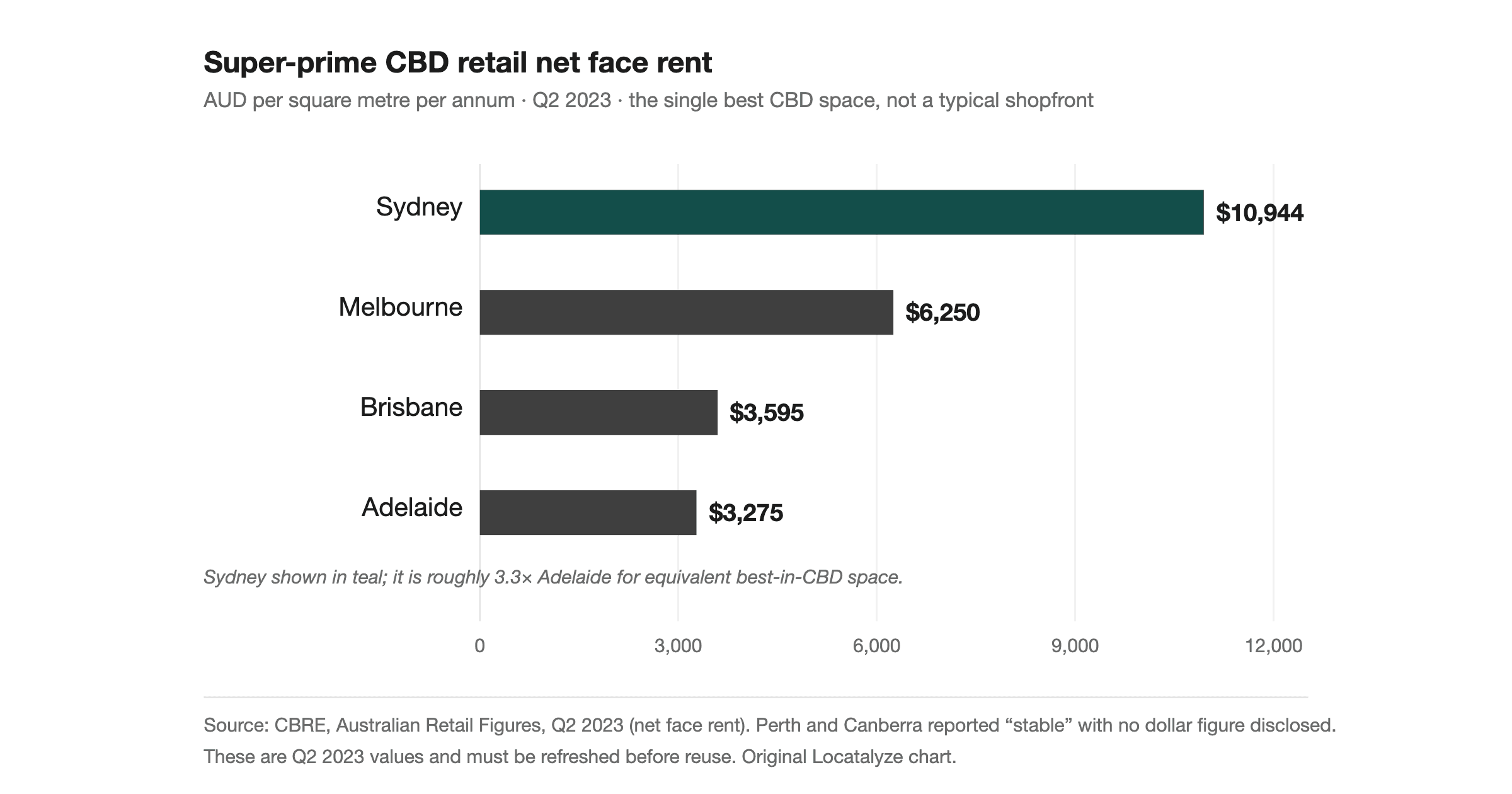
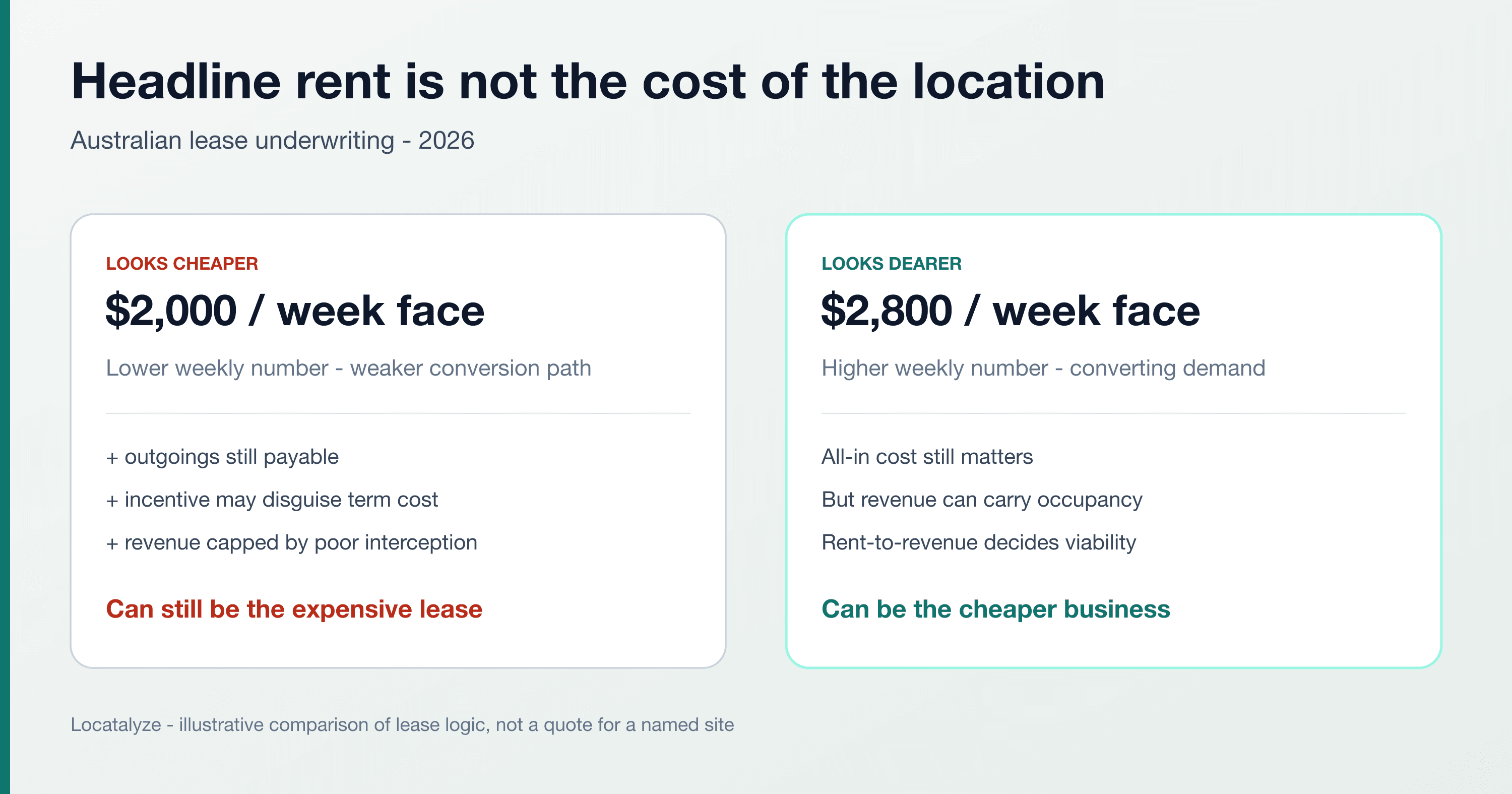
MODEL starting point: realistic weekly revenue × 0.10 ≈ a maximum viable all-in weekly rent (rent + outgoings) for many independent operators — about $3,220/week in the example above. Cross-check against ATO coffee-shop rent÷turnover bands for 2023–24 (observed tax ratios: roughly 10–17% at $65k–$250k turnover, 8–14% at $250k–$600k, 6–10% above $600k). Restaurants are not coffee shops; use the bands as a ceiling check, not a target. If quoted all-in rent needs heroic utilisation to clear those bands, renegotiate or walk. See coffee shop profitability and why a cheaper lease can be more expensive.
Revenue viability checkboxes:
- 1
Have you calculated your revenue ceiling at 100% capacity with honest assumptions about turn rates and average spend?
- 2
Have you calculated your realistic trading figure at 70% of ceiling?
- 3
Have you confirmed your all-in rent (including outgoings — not just base rent) is below 10% of your realistic trading figure?
- 4
Have you modelled trading at 50% of your realistic figure? Can the business survive two consecutive months at that level without structural damage?
Done the rent math. Now test the address.
A good lease cannot fix a weak location. Screen the address for local demand, competition and location risks before you commit. Free score, map and recommendation — payment is not required to begin.
Run a free location screen2. Location evidence — beyond the staged site visit
A site visit is necessary but insufficient. It shows you the space at its best, in the moment the property manager has chosen for you to see it. It tells you almost nothing about Tuesday morning trading, January trading, or what happens when the office building next door relocates its 400 workers in year two of your lease.
Foot Traffic — Volume and Profile
Count foot traffic yourself. Stand outside the location for two hours during your primary trading occasion — not during a weekend when the area looks its best, but during the actual time slot that will determine your weekly revenue. Count the pedestrians. Then honestly assess: what proportion of these people are plausibly your target customer? This means demographic profile, apparent purpose, and time available. A stream of commuters at 8:15am is very different from office workers at 12:30pm, which is very different from tourists on a Sunday afternoon. Each translates to a different conversion rate, a different spend profile, and a different format viability.
Do this across at least three different time periods and two different days of the week. Seasonal variation matters too — if you're scouting in December, visit again in late February when the novelty of the area might look different. The gap between your best trading period and your worst trading period is often the most important commercial characteristic of a location, and it's invisible on a single site visit.
Anchor Business Mapping
Map every business within 200 metres. For each one, classify: is it a traffic generator (brings people to the area as a destination — large employer, transport hub, entertainment venue), complementary (adds dwell time without directly competing — boutique retail, café adjacent to your dinner format), extractor (competes for the same wallet — another restaurant in your price point and meal occasion), or neutral (has no meaningful impact on your trade).
The optimal anchor composition for most restaurant formats: at least one large traffic generator within 150 metres, a complementary retail or service cluster that drives dwell time, and no more than two direct extractors within 200 metres. If the 200-metre radius contains three or more direct extractors and no meaningful traffic generators, you are relying entirely on destination-driven demand — which is much harder and slower to build than intercepting traffic that's already there.
The Development Pipeline Check
This is the step almost nobody takes and the one that most consistently contains information that would change commercial decisions. Council DA registers are publicly available, legally required to be maintained, and searchable by address. Spend two hours checking the pipeline for every approved and pending application within a one-kilometre radius of your candidate location.
What you're looking for: construction projects that will begin in years one or two of your lease and that will reduce access or foot traffic to your location. New residential developments (positive — more potential customers) or new food-and-beverage precincts in those developments (potentially negative — more competition at the time you're trying to establish your business). Infrastructure projects, road closures, utility works. These are not hypothetical risks. They are scheduled, approved, and publicly documented. You just have to look.
Location intelligence checkboxes:
- 1
Have you counted foot traffic during your primary trading period on at least two separate occasions?
- 2
Have you profiled the pedestrian demographic and assessed their match to your format and price point?
- 3
Have you mapped anchor businesses within 200 metres and classified each as generator, complementary, extractor, or neutral?
- 4
Have you checked the council DA register for applications within one kilometre?
- 5
Have you visited the location on a weekday morning at 7:30am and a Sunday evening at 8pm to understand the full range of trading conditions?
3. Competition — map meal occasions, not vibes
Competition assessment requires intellectual honesty that is genuinely difficult when you're excited about a concept. The temptation is to identify differences between your offer and the existing operators and conclude that those differences make the competition irrelevant. "They're Italian, we're Japanese" or "their service is inconsistent, ours will be better" are not competitive analyses. They're optimistic assumptions.
The 1km Meal Occasion Map
Map every food and beverage operator within a one-kilometre walkable radius. Group them not by cuisine but by meal occasion type: weekday lunch, casual weeknight dinner, special occasion dinner, weekend brunch, quick breakfast, late night. For each of your core meal occasions, count how many established, operationally solid operators are already competing for that specific occasion within your catchment. "Established and operationally solid" means open for more than 18 months with visible consistent patronage — not every business in the area, but the ones that have already built occasion loyalty.
If your core meal occasion (say, mid-range casual dinner for two, $80–$100 all-in) is already served by three well-established, popular operators within a 10-minute walk, you are entering a saturated segment. That doesn't make success impossible, but it means you need a genuinely distinctive proposition and the patience and capital to build occasion loyalty from zero against established competition. Most operators don't have both.
The Why-Is-There-No-Competition Assessment
When you identify a location that appears to have no direct competition in your segment, your immediate response should not be "I've found an opportunity." It should be "why is there no competition here?" There are two possible answers. The first: the market genuinely has unmet demand in your segment and you've found a gap. The second: other operators have assessed this corridor and concluded that the demographic doesn't support your format at your price point. The second is more common than the first. Spend time determining which you're looking at before committing.
Competitive landscape checkboxes:
- 1
Have you mapped every food and beverage operator within 1km and grouped them by meal occasion type?
- 2
For each of your core meal occasions, how many established, loyal operators are already serving it?
- 3
If there is no direct competition, have you investigated why and confirmed it's an opportunity rather than a signal?
- 4
Have you assessed the strength of established competitors (years in operation, visible patronage, apparent loyalty) not just their number?
4. Lease clauses that change the dollars
Your solicitor will review these clauses for legal compliance. That is not the same as modelling their commercial implications in dollar terms over the life of your lease. You need to understand both.
Rent Review Mechanism
How does your rent change over the life of the lease? The most common mechanisms are: fixed annual increase (e.g., 3% per year — predictable, easy to model), CPI-linked (tracks the Consumer Price Index — was the standard for many years, became very expensive in 2022–2024 when CPI ran at 5–8%), and market review at intervals (rent is reset to current market rate at specified dates — can go up or down depending on market conditions). Know which mechanism applies to your lease. Have your solicitor model the dollar impact of each scenario over your full lease term. Reject "that's standard" as an answer — standard still has dollar consequences you should understand.
The ratchet clause is a specific variation that deserves particular attention: some leases specify that at a market review, the rent can only be adjusted upward to market rate, never downward. In a softening rental market, this clause prevents you from benefiting from market movements. It is not inevitable. Many landlords will remove it if pushed by a prepared tenant who knows to ask.
Make-Good Obligations
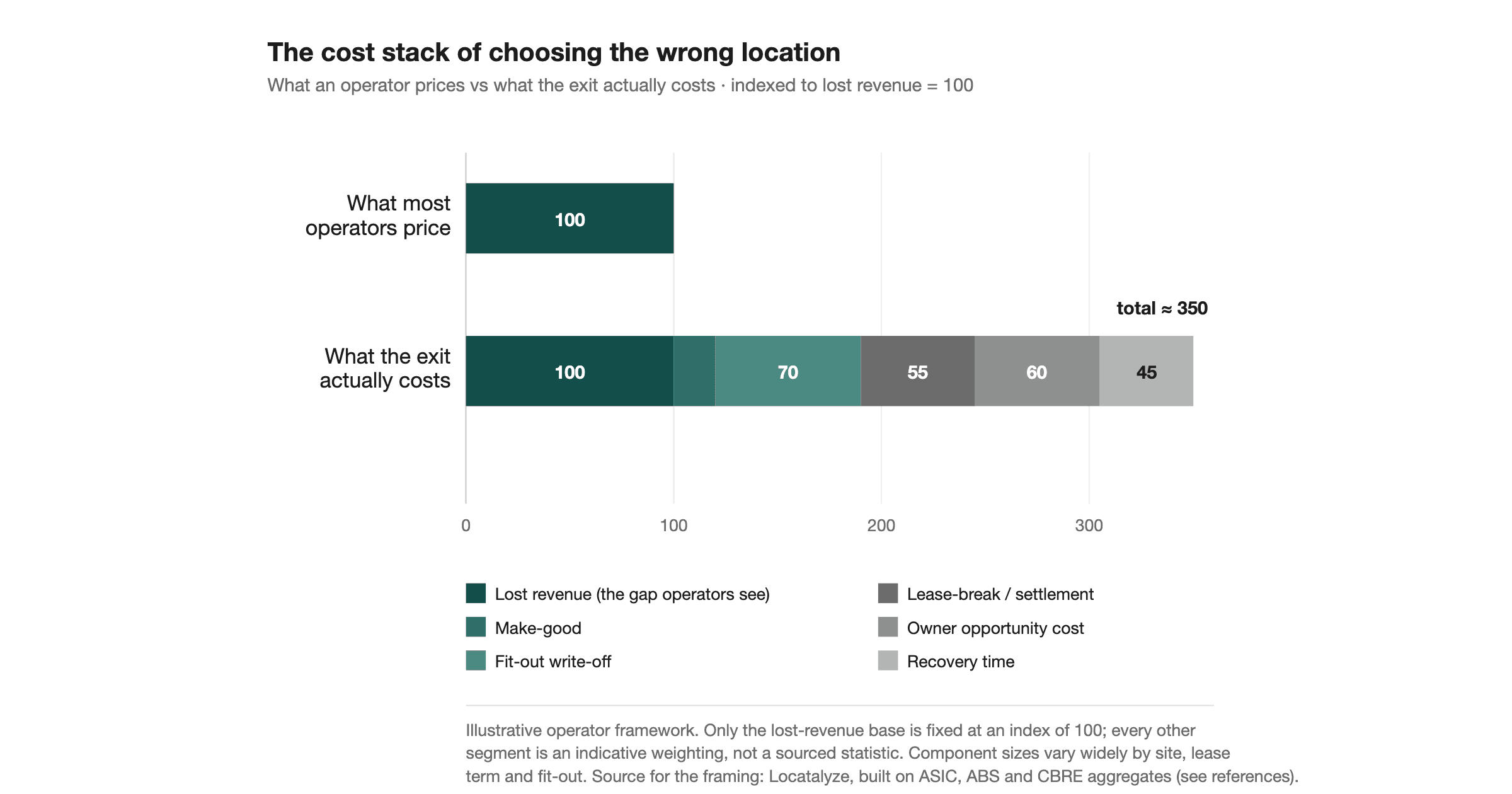
Read the make-good (ILLUSTRATIVE — verify) clause carefully and have your solicitor translate it into specific obligations for your planned fit-out. Then get a quote from a fit-out contractor for what those obligations would cost to fulfil. Add this number to your total lease cost. For a $150,000 kitchen and dining room fit-out in most Australian commercial tenancies, make-good (ILLUSTRATIVE — verify) costs typically range from $40,000 to $85,000, depending on the scope of works and the specificity of the clause. This is a liability that exists from day one of the lease. It should be in your financial model from day one of your planning.
Personal Guarantee
Model your worst-case personal exposure in explicit dollar terms before you sign. Take your weekly rent. Multiply by 52. Multiply by the years remaining on your lease at the point you estimate the highest risk of business failure (if the business doesn't make it, when is that most likely? Month 24? Month 36?). Subtract whatever portion of the remaining liability you think your business assets could cover. The remainder is your personal financial exposure. Look at that number. Decide whether the business opportunity justifies it. That decision should be made clearly and consciously, not discovered retrospectively.
Permitted Use and Assignment Rights
What does your lease permit you to do? If you add a delivery operation to your restaurant, or a catering business, or a retail offering, or a liquor licence you don't currently hold — does the permitted use clause allow it? If your business evolves in any direction over five years (and it will), does your lease keep pace or constrain you? And critically: if you want to sell the business at some point, can the lease be assigned to a new owner? An assignable lease is a material commercial asset when you're selling. A non-assignable lease limits your exit options significantly and reduces the business's value to a potential buyer.
Lease clause checkboxes:
- 1
Have you had your solicitor model the dollar impact of the rent review mechanism over the full lease term in each scenario?
- 2
Have you confirmed whether a ratchet clause exists and whether it's removable?
- 3
Have you got a contractor estimate for make-good costs on your planned fit-out and added it to your total lease cost?
- 4
Have you modelled your worst-case personal guarantee exposure in explicit dollar terms?
- 5
Have you confirmed the permitted use clause covers everything you plan to do now and might do in the next five years?
- 6
Have you confirmed assignment rights and understood what constraints apply to any future business sale?
4B. Negotiation levers worth modelling
Beyond rent review, make-good, guarantees, permitted use and assignment, Australian retail and hospitality leases often hide leverage in incentives and operating costs. Treat these as commercial questions — not optional legal footnotes.
Rent-free periods and incentives
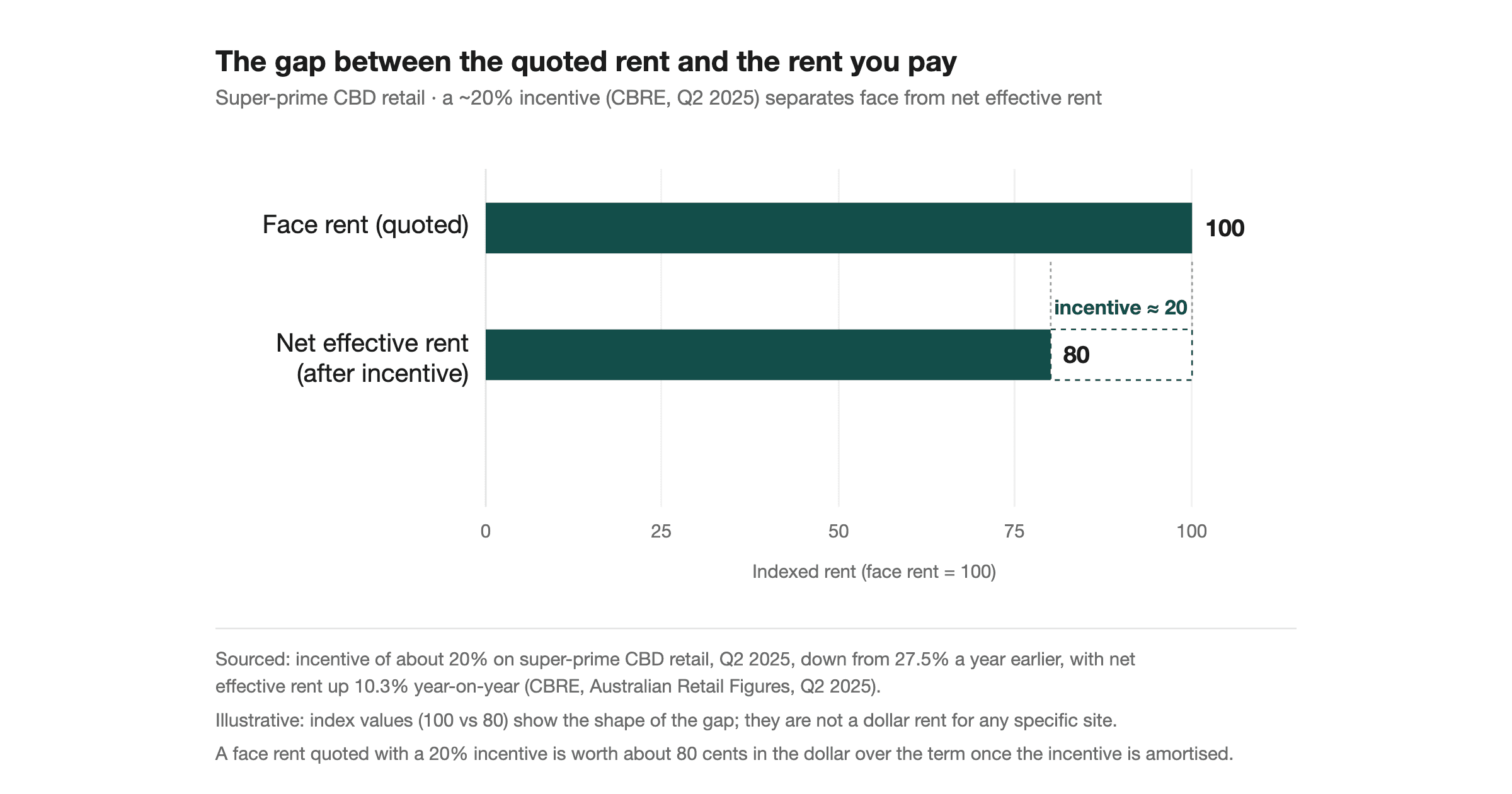
Ask for the gross effective rent, not the face rent. A rent-free fit-out period or landlord contribution can make a high face rent workable — or hide a poor site behind a short honeymoon. Model cash flow after the incentive ends. If the business only works during the rent-free window, the lease is not viable.
Outgoings and hidden occupancy costs
Confirm which outgoings you pay (council rates, insurance, cleaning, marketing levies, after-hours air-conditioning) and whether they are estimated or fixed. Request the last 12 months of actual outgoings for the tenancy or building where available. Occupancy cost is face rent plus outgoings — that is the number that must clear your revenue math.
Exclusivity, options and renewal
If your format depends on being the only café or pizza venue in the centre, ask whether exclusivity is available and how it is worded. Separately, confirm option terms, notice periods and how renewal rent is set. An option that resets to market with no cap can erase the value of a hard-won first-term deal.
Bank guarantees and personal exposure
Bank guarantees and personal guarantees are different risks. A bank guarantee ties up capital; a personal guarantee can follow you after the business fails. Cap duration where possible, seek reduction after a clean trading period, and model worst-case personal exposure in dollars before you sign.
When to involve a lawyer, accountant or commercial adviser
Use a solicitor for lease drafting, guarantee wording, make-good, assignment and any unusual exclusivity or incentive clauses. Use an accountant for cash-flow and tax implications of incentives, fit-out depreciation and guarantee structures. Use a commercial location adviser (or a structured location screen) when the dispute is not legal language but whether the address can trade. Do not ask your solicitor to underwrite demand — that is not their brief.
Australian legal disclaimer
This checklist is general commercial information for Australian operators. It is not legal advice, accounting advice or a substitute for a solicitor reviewing your draft lease. Lease law and retail leasing statutes differ by state and territory. Always obtain independent professional advice before signing or negotiating a binding commitment.
5. Operational reality checks
The operational section of the checklist covers the things that feel too basic to worry about when you're evaluating a space conceptually but that have significant commercial consequences when you're trying to operate from it daily.
Operational checkboxes:
- 1
Have you visited the space at the precise time of day you plan to operate? A café space that feels vibrant at 10am on a Saturday might be cold, dark, and dead at 7am on a Tuesday when you actually need it to generate revenue.
- 2
Have you had a contractor assess the kitchen infrastructure — exhaust and ventilation capacity, three-phase power availability, gas connection, existing equipment serviceability? Infrastructure surprises are the most common cause of fit-out cost overruns, and they're almost always visible before you sign if you look properly.
- 3
Have you spoken directly to neighbouring tenants — not the landlord's property manager, but the actual business owners or managers in adjacent tenancies? Ask specifically: what's the landlord like to deal with on maintenance and repairs? Have there been any building issues? What do they know now that they wish they'd known before signing?
- 4
Have you found out why the previous tenant left? If a food and beverage operator previously occupied the space, call them. Find them on LinkedIn. Send a direct message. Most former operators will tell you the truth about why they left, and that information is frequently decisive.
What this checklist changes in negotiation
Here is the practical benefit of completing this checklist before entering lease negotiation: you walk into the conversation from a structurally different position. You know your maximum viable rent before the landlord quotes you a figure. You know the competitive context of the location. You know what's in the development pipeline. You know the infrastructure risks. You know what make-good will cost.
Completing this checklist before negotiation means you know the rent at which the model breaks. That is walk-away capacity based on arithmetic you can defend — not bluffing. If the landlord cannot move into a viable band, the disciplined outcome is to leave the keys on the table.
The landlord has done this analysis on their side. They know what the space rents for on comparable streets. They know their minimum acceptable return. They know which clauses are genuinely non-negotiable and which ones are concessions they're prepared to make. You should have the equivalent data on your side. This checklist is how you get it.
Done the rent math. Now test the address.
Locatalyze compresses the commercial location questions in this checklist into a free screen for any Australian address — score, map, confidence and recommendation. Modelled financials stay optional.
Run a free location screenSources & verification
Related reading
Companion reading: what choosing the wrong location actually costs is what skipping this checklist looks like in practice, and what foot traffic data doesn't tell you covers the research trap before the lease stage. Rent context: commercial rent per square metre across Australia.
Frequently asked questions
About the author
Prashant GuleriaFounder, Locatalyze
Prashant built Locatalyze to give every Australian restaurant operator the analytical tools that institutional investors apply to commercial real estate decisions.
Tools first — then a full report for your address
Free rent, viability, and break-even checks. Upgrade when you are ready for competitors, map, and numbers for a specific site.
No signup required for tools