Why Busy Streets Often Create Failing Businesses
Locatalyze Research Team
Location intelligence, Locatalyze
The most expensive lease an operator can sign is on a busy street where nobody stops. High foot traffic but low sales is the symptom; the busy street is the cause. Australia's single priciest piece of retail is a pedestrian strip. Pitt Street Mall in Sydney runs at roughly US$795 per square foot per year, up about four per cent on the year, which makes it the most expensive retail strip in the country and the eighth most expensive on earth (Cushman & Wakefield, Main Streets Across the World 2025). It is also one of the most heavily walked spaces in the nation. Both facts are true, and the second is why the first is sustainable for the handful of tenants who can carry it and ruinous for almost everyone else who is told the foot traffic justifies the rent.
That is the trap. A high pedestrian count gets read as proof of demand, the rent gets set against the count, and the operator signs on the assumption that bodies become customers at some natural rate. They do not. High foot traffic but low sales is not an unlucky outcome, it is a recurring pattern with identifiable mechanisms, and the mechanisms are visible before the lease is signed if you know to look for them.
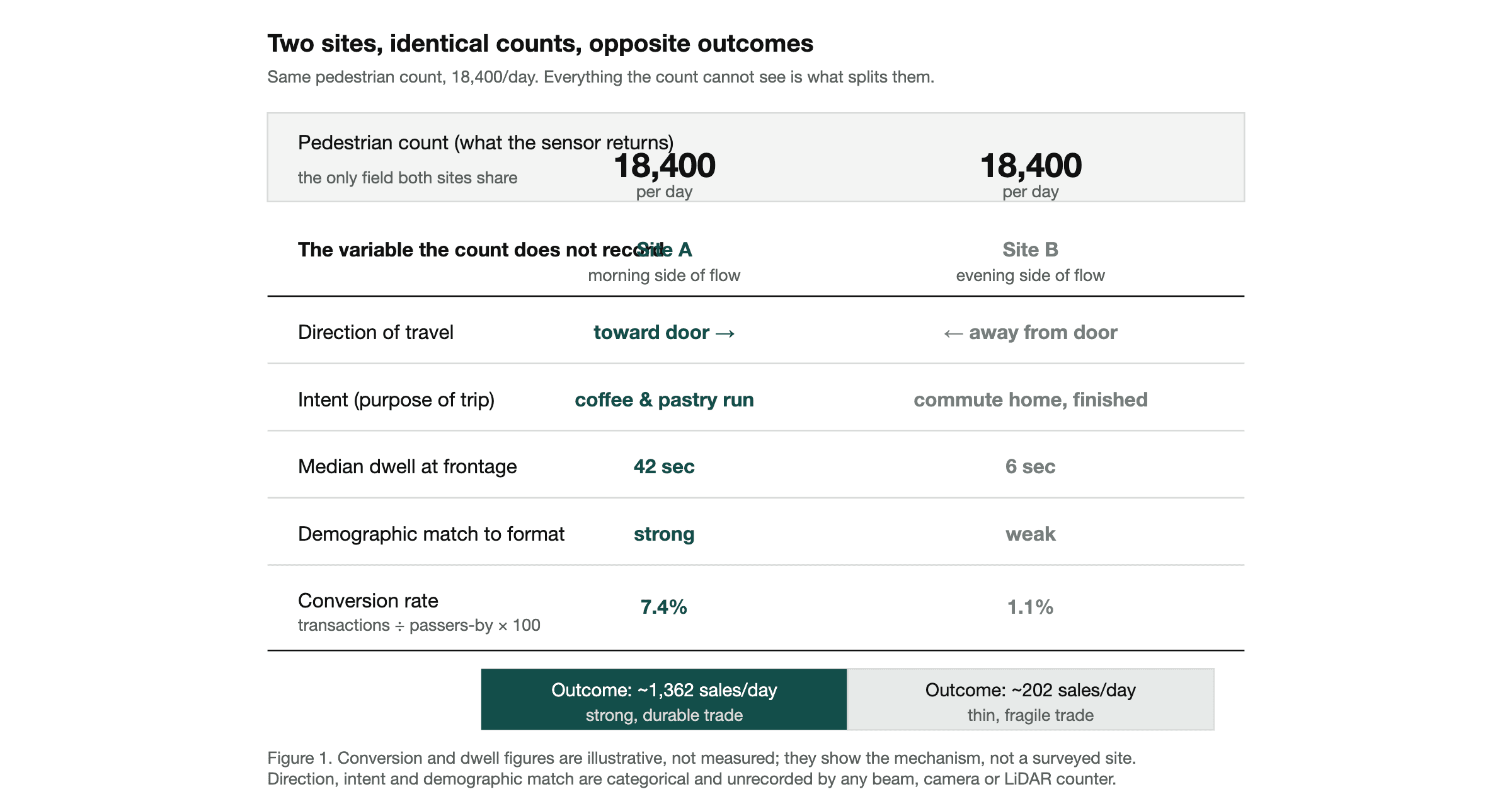
The thesis is the one in the first line. Foot traffic is a vanity metric until you correct for stopping intent. A busy street can be a transit corridor where the entire flow is mid-journey, a no-stop strip with nowhere to pause and no reason to, or a tourist run heavy with the wrong demographic, and in every one of those cases the count looks magnificent while the till stays quiet and the rent does not. The quieter street a block away, with a third of the count and a reason to halt, can be the better business.
Evidence standard
CBD retail vacancy figures are FACT from CBRE Australian CBD Retail Vacancy surveys (H1 2024, H1 2025, H2 2025; H1 2026 national 10.8% aligns with CBRE insights landing + Inside Retail/retailbiz — opened/cross-checked Aug 2026; PDF not opened ungated). City spreads (e.g. Perth vs Sydney) are the load-bearing evidence. Pitt Street Mall USD $795/sf/yr is Cushman & Wakefield Main Streets 2025. The “moderate traffic, working profile” table is LOCATALYZE ANALYSIS / MODEL — illustrative contrast, not a measured tenancy census. Named-strip churn stories are excluded where primary verification failed (stated in-article). Companion pieces: instrument methods in foot-traffic-data; conversion traps here; intent limits in what-foot-traffic-data-doesnt-tell-you.
Vacancy vintage update — H1 2026
H1 2025 CBRE figures used as the deep historical snapshot remain correct: national weighted CBD retail vacancy 11.1%; Perth 21.7%; Brisbane 18.3%. H2 2025 tightened to 10.4% nationally (Perth 18.6%; Brisbane 17.5%). H1 2026 national vacancy was 10.8% (+40 bp), with Perth ~18.5% and Brisbane ~16.7% still the elevated pair versus Sydney’s ~5.3%. The thesis — busy cores can still carry high vacancy when traffic does not stop — holds as rates improve. Do not treat any single half-year as “the” national footfall story.
High foot traffic but low sales, in the vacancy data
If high traffic guaranteed full tenancies, the busiest retail districts in the country would be the fullest. They are not. CBRE's measure of Australian CBD retail vacancy for the first half of 2025 puts the national rate at 11.1 per cent, but the spread underneath that average is the story: Perth at 21.7 per cent and Brisbane at 18.3 per cent against Sydney at 5.0 per cent and Melbourne at 6.9 per cent (CBRE, *Australian CBD Retail Vacancy*, H1 2025). Perth and Brisbane are not quiet places. They are major capital-city CBDs with heavy weekday pedestrian volume, and roughly one shopfront in five sits empty. By H1 2026 the national rate was 10.8% — still with Perth and Brisbane as the elevated pair (about 18.5% and 16.7%) against Sydney near 5.3% (CBRE H1 2026 as reported by Inside Retail (24 Aug 2026) / retailbiz (secondary; CBRE PDF not opened as free primary)). The spread is the point: busy CBDs are not uniformly full.
CBRE. *Australian CBD Retail Vacancy, H2 2025* (national weighted 10.4%; Perth 18.6%; Brisbane 17.5%). February 2026. https://www.cbre.com.au/insights/reports/australian-cbd-retail-vacancy-h2-2025
The mechanism: passing is not stopping
The academic version of the point is precise. A 2019 study in the *Journal of Retailing and Consumer Services* on the value of passing trade found that pedestrian density explains a meaningful share of store-performance variation, but that store entry and purchase are governed by separate behavioural regularities from the raw flow, so footfall and conversion are distinct mechanisms rather than the same thing measured twice (Graham, Khan and Ilyas, 2019). In plain terms, a passer-by has to clear two gates, not one: the decision to enter, and then the decision to buy. A big count fills the footpath. It does nothing on its own to move people through either gate.
What moves them is a set of physical and demographic conditions that a count does not record at all. We have argued the general case separately, that a foot-traffic number measures bodies and not intent. This is the specific application: the situations where a large count and a small register sit a block apart.
The transit-corridor effect
Some busy streets are busy because they are the fastest line between two points people actually want to be. A pedestrianised spine that funnels commuters from a station to an office district carries enormous volume, all of it mid-journey. The flow is a feature of the route, not a pool of demand for the shops on it. Sydney's George Street was pedestrianised through the CBD when the light rail opened in December 2019, which created walkable space and heavy movement; whether that movement converts for any given tenant depends on whether people have a reason to break stride, and a corridor by design discourages exactly that. The mechanism here is sound and the conversion literature supports it; what we do not have is a clean published vacancy figure isolating "pass-through corridor equals failing tenant" for a specific Sydney block, so treat the corridor argument as a mechanism to test on site rather than a number to quote.
No-stop streets
A street can be busy and offer nowhere to halt. No kerbside parking, no loading window, no awning or seating or square to pause in, no anchor that gives a reason to stop on this block rather than the next. Movement without friction is movement that keeps moving. The frontage that converts is the one with a physical reason to slow, and a heavy count on a frictionless street is volume you pay for and cannot bank.
Rent compression
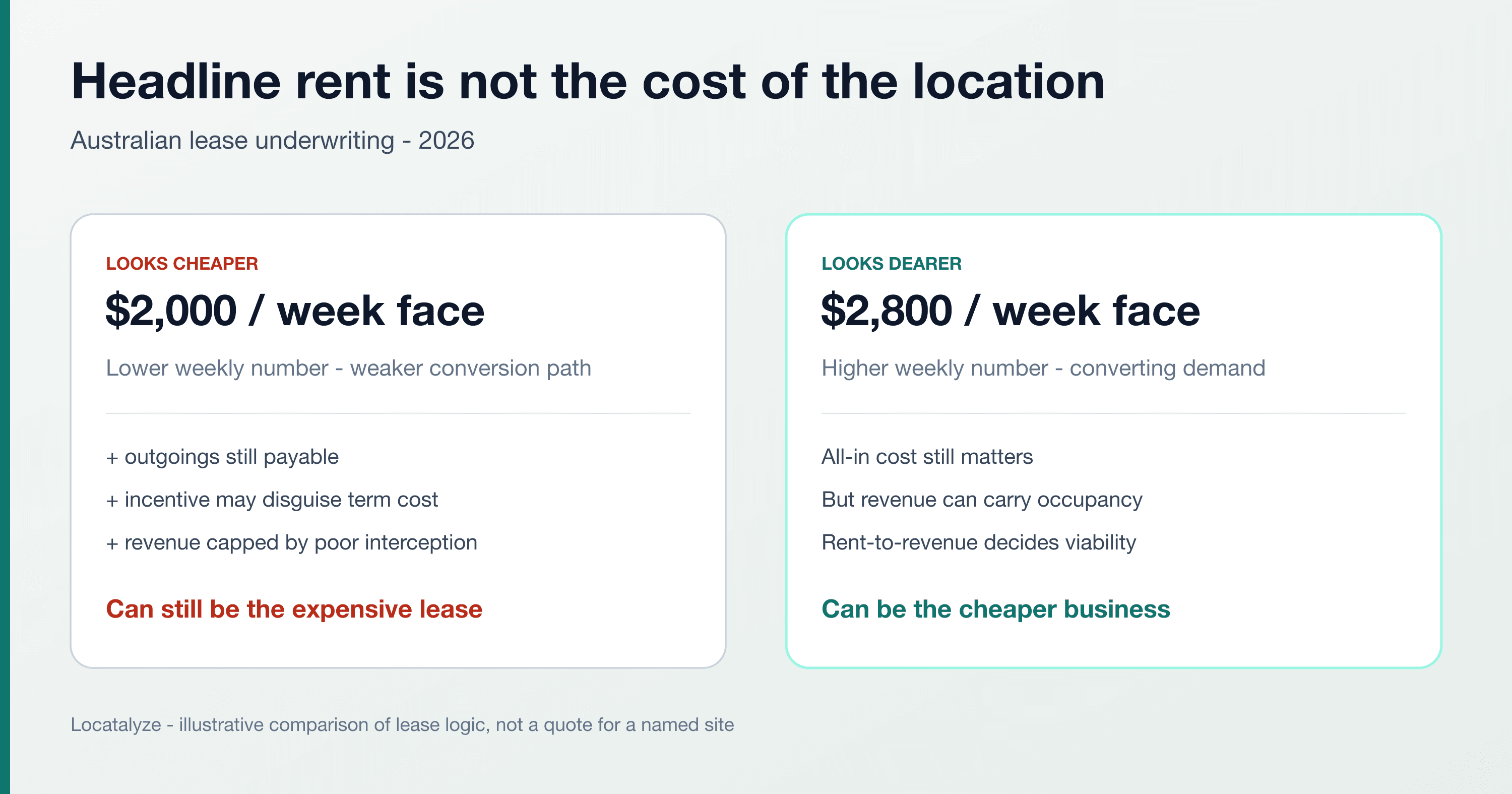
This is the financial mechanism, and it is the quiet killer. On a marquee strip the rent is set against the count, and the count is high, so the rent is high. A business can run perfectly healthy revenue and still fail because occupancy cost consumes the margin. The Pitt Street Mall figure is the extreme illustration, but the logic runs all the way down the prime-strip hierarchy: when the rent is benchmarked to footfall rather than to your conversion, every percentage point of traffic that does not stop is margin you are paying for and not earning. The number that matters is not the headline face rent but the gross effective rent measured against realistic conversion, and on the busiest strips that ratio is often the worst in the city.
Demographic mismatch on tourist strips
Volume drawn by a destination is volume selected for the destination, not for your format. A tourist promenade delivers a heavy count of people in a holiday spending mode, which is excellent for an ice-cream window and structurally hostile to a format that needs repeat local custom. The relevant question is not how many bodies pass but how many of the right ones, which is a catchment-composition question rather than a count, and one we work through in detail in the piece on how far different customers actually travel. The pattern shows up in operator behaviour: trade press has reported retailers favouring quieter southern Gold Coast strips for "lower rents and a more consistent retail spend from residents than traditional shopping hubs such as Broadbeach and Surfers Paradise" (Commercial Real Estate, 2024). Read that as directional colour rather than a vacancy statistic, because a clean current vacancy figure for those marquee strips was not something we could verify.
Busy and failing versus moderate and working
The contrast operators should hold in their heads is not "busy good, quiet bad." It is whether the traffic stops and whether the rent is set against stopping or against passing. The table sets out the two site profiles. The vacancy spread is sourced; the within-walking-distance contrast is an analytical model built on the mechanisms above, not a measured pair of addresses, and it is labelled as such.
There is an honest counter-case, and it sharpens rather than weakens the point. Not every busy strip fails. Melbourne's Bourke Street Mall, a heavily walked pedestrian mall, has reportedly held vacancy near four per cent, supported by flagship anchors and a major redevelopment, against a Melbourne CBD figure around 4.6 per cent (Fitzroys, *Walk the CBD*, 2026; figures surfaced via summary, worth re-verifying against the primary report). A well-anchored, well-mixed mall with reasons to stop is the opposite of a frictionless corridor. The failure pattern is not "busy," it is "high rent plus low stopping," and Bourke Street Mall clears the second test where a tourist promenade or a commuter spine does not.
What the operators who avoid this actually check
The businesses that do not get caught are not luckier. They run a different test. They treat the count as a measure of supply and then ask, separately, whether that supply stops and whether the rent assumes it does. A standing hour on the footpath at the trading times that matter answers most of it: count the share of passers-by who slow, who look in, who enter. A frontage where forty in a thousand break stride is a different asset from one where four do, and the count is identical across both. The hospitality numbers underline why the margin for error is thin here; accommodation and food services was the second-largest source of corporate insolvency in Australia in 2023-24 at around fifteen per cent of all external administrations (ASIC, annual insolvency data, FY2023-24), and a meaningful share of those were paying for traffic that never stopped.
The rent that eats a healthy business
Rent compression is the mechanism operators understand last and pay for first, so it is worth working through with numbers. Treat the figures below as illustrative arithmetic rather than a quoted lease. The point is the ratio, not the dollars.
Picture two cafes of the same size, ninety square metres, run by the same operator with the same menu and the same margins. One sits on a marquee strip where the pedestrian count is enormous and the rent is benchmarked to it; call the rent fourteen thousand dollars a month. The other is on a competent side street a block off the flow, where the count is a third of the marquee figure but the people on it have parked, or live nearby, or came on purpose; call the rent five and a half thousand a month.
The heavy count on the busy strip does pull more bodies past the window. A frictionless corridor converts a smaller share of them, because most are mid-journey, but the sheer volume still lifts the top line. Say the marquee site turns over forty-eight thousand dollars a month and the side-street site, with lower volume and higher stopping intent, turns over forty thousand. The marquee site looks like the better business. It is the worse one. Rent runs at roughly twenty-nine per cent of revenue on the marquee strip against fourteen per cent on the side street, and for a cafe the gap between those two ratios is the gap between a wage and an administrator.
That is the trap in a single calculation. Revenue can be higher on the busy street and the business can still fail, because occupancy cost was set against the count and the count overstated the trade. The healthy-looking top line is what makes the error so common. The operator sees strong sales and cannot work out why nothing is left, when the answer was fixed the day the lease was signed against a pedestrian figure instead of a conversion. The hospitality benchmark most operators are handed is a rent-to-revenue ratio in the high single digits to low teens; a marquee strip routinely pushes a healthy business well past that line, not because the business is weak but because the rent was priced off footfall. The number worth carrying into a leasing conversation is neither the count nor the face rent alone, but the two divided into a realistic revenue. We have set out how to read gross effective rent against the market rather than the headline face figure, which is the same discipline applied to the lease that this piece applies to the footpath.
Why the pattern is structural, not seasonal
It would be convenient to write the busy-CBD vacancy off as a post-pandemic hangover that will heal as cities refill. The data does not cooperate. The Perth and Brisbane high-vacancy pattern shows up across consecutive surveys. In H1 2024, drawn from 5,646 CBD retail outlets across five cities, Perth sat at 25 per cent and Brisbane at 19.2 per cent against a national 12.1 per cent (CBRE, H1 2024). A year later the same cities held 21.7 and 18.3 per cent. The national rate has improved across the period, from 12.1 to 11.1 and on to 10.4 per cent by late 2025, yet the spread between the markets where stopping and rent are aligned and the markets where they are not has been durable. A gap that survives three consecutive readings is the signature of a structural mechanism, not a temporary shock. Busy CBDs carrying one empty shopfront in five are not waiting to recover into full tenancy; they are showing what footfall is worth when the rent assumes more of it converts than actually does, and the people best placed to read that signal are the operators who decline the marquee site rather than the ones already paying for it.
There is a planning-level version of the same signal worth watching. When a council or a major landlord pours capital into a strip, a redevelopment, an anchor tenant, a pedestrianisation, the question for an operator is not whether the works will lift the count, because they almost always do. The question is whether they give people a reason to stop or simply move through more pleasantly. A wider footpath that speeds the commute is a different investment from an anchor that creates a destination, even though both raise the pedestrian figure. The count cannot tell the two apart. The vacancy rate, eighteen months later, can.
Limitations, and what this does not cover
The strongest evidence here is the CBD vacancy spread, which is sourced and consistent across periods, and the academic finding that passing and converting are separate mechanisms. The weakest part, and the one worth naming, is the specific named-strip churn history. We could not verify from primary sources a clean "tenant after tenant failed at this address" record for any named high-traffic location, nor a current retail vacancy figure for Surfers Paradise or a corridor-attributable vacancy figure for George Street, so those arguments are presented as mechanism and judgement rather than cited fact. The Bourke Street Mall and Melbourne figures come from a market summary that should be checked against the primary report before being quoted as hard data. The within-walking-distance comparison in the table is an analytical model, not a measured pair of sites. None of those caveats touches the central claim, which rests on the vacancy spread and the conversion literature: a heavy count is not demand, and the busiest strips are not the safest.
What to do with this
When an agent leads with a pedestrian count, treat it as the question, not the answer. Ask what the people are doing as they pass, whether anything on the block gives them a reason to stop, and what the rent assumes about their stopping. Stand on the footpath and watch feet, not just count them. Compare the marquee strip against the quieter street a block off the flow, where the rent is set to local trade and the customers have a reason to be there rather than a route through. The cheaper street with stopping intent will often out-earn the expensive one without it.
Before you weigh a quoted count against a quoted rent on any specific strip, it is worth seeing how the address scores once demand, competition and rent viability are read together.
Free location score, map, data confidence and PROCEED / VERIFY / AVOID recommendation. Modelled financials stay optional.
Analyse your addressYou can also start with the location analysis hub and the precinct detail for Brisbane and Sydney, where the same pedestrian count earns a different verdict depending on whether anyone stops.
Sources & verification
Cushman & Wakefield. *Main Streets Across the World 2025.* November 2025. https://www.cushmanwakefield.com/en/insights/main-streets-across-the-world
CBRE. *Australian CBD Retail Vacancy, H1 2025.* 2025. https://www.cbre.com.au/press-releases/australia-s-cbd-vacancy-rate-tightens-h1-2025
CBRE. *Australian CBD Retail Vacancy, H1 2024* (5,646-outlet survey), reported by Commercial Real Estate, 27 August 2024. https://www.commo.com.au/news/2024/08/27/cbd-retail-vacancy-rates-continue-tighten-across-most-australia%E2%80%99s-major-cities-cbre
CBRE. *Australian CBD Retail Vacancy, H2 2025* (national weighted 10.4%; Perth 18.6%; Brisbane 17.5%). February 2026. https://www.cbre.com.au/insights/reports/australian-cbd-retail-vacancy-h2-2025
Graham, B., Khan, K., and Ilyas, S. "Estimating the value of passing trade from pedestrian density." *Journal of Retailing and Consumer Services*, vol. 46, 2019, pp. 103–111 (abstract). https://www.sciencedirect.com/science/article/abs/pii/S0969698917304769
ASIC. *Annual insolvency statistics, FY2023-24.* https://www.asic.gov.au/regulatory-resources/find-a-document/statistics/insolvency-statistics/
Fitzroys. *Walk the CBD* (Melbourne CBD retail vacancy), 2026 (figures via summary). https://www.fitzroys.com.au/news/335236-melbourne-cbd-retail-vacancies-down-amid-post-pandemic-transformation
Commercial Real Estate. "New retail hotspots emerging in Gold Coast's southern suburbs." 2024. https://www.commercialrealestate.com.au/news/new-retail-hotspots-emerging-in-gold-coasts-southern-suburbs-924621/
CBRE. *Australian CBD Retail Vacancy, H1 2026* (national 10.8%). Insights landing: https://www.cbre.com.au/insights/reports/australian-cbd-retail-vacancy-h1-2026 (may gate). City splits via Inside Retail, 24 Aug 2026, and retailbiz. Cross-checked 29 Aug 2026. https://insideretail.com.au/stores/openings-closings/new-projects-boost-melbourne-cbd-retail-vacancy-rate-but-other-cities-tighten-202608
Lease trap
Landlords and agents often sell “busy street” as a substitute for economics. Demand a conversion story: who stops, when, and at what ticket — then model rent against that.
Related reading
Frequently asked questions
About the author
Locatalyze Research Team
Location intelligence, Locatalyze
The Locatalyze research team builds the location-scoring models behind the platform and writes up what the data shows for Australian operators.
Tools first — then a full report for your address
Free rent, viability, and break-even checks. Upgrade when you are ready for competitors, map, and numbers for a specific site.
No signup required for tools