Foot traffic data for retail and hospitality: what actually matters, what's noise, and what nobody measures
Locatalyze Research Team
Location intelligence, Locatalyze
A council technician once mounted two pedestrian counters on the same pole, facing the same stretch of footpath, on the same Tuesday. By close of business they disagreed by a margin wide enough to change a leasing decision. Neither device was broken. They were measuring different things and calling both of them "foot traffic".
Evidence standard
City of Melbourne Pedestrian Counting System and City of Sydney walking counts are FACT sources for how those cities instrument streets (coverage is not every strip). Academic papers cited in References are FACT for volume≠conversion. Worked conversion examples without a named Australian field study are MODEL. Locatalyze site reads are LOCATALYZE ANALYSIS. Scope: how counts are made. Decision translation: high-foot-traffic-low-sales and what-foot-traffic-data-doesnt-tell-you.
That is the whole problem in one sentence. The number a leasing agent quotes you, the figure on a council dashboard, the "weekly visits" in a data vendor's report — none of them are counts in the way a turnstile is a count. Every one is a constructed estimate. Something detected a signal, a method decided what that signal meant, and an algorithm or a multiplier turned it into a tidy figure with no error bar attached. The method is the data. Change the method and you change the answer, often by a third or more, before anyone has walked anywhere differently.
This matters because foot traffic data drives real money. Operators sign ten-year leases on the strength of pedestrian numbers. They reject good sites and overpay for bad ones. And the single most decision-relevant fact about a location — not how many bodies pass, but who they are and whether they will actually come in and spend — is the part no headline number contains. A busy footpath outside a transit interchange at 5:40pm is full of people walking away from you as fast as their legs allow. The count looks magnificent. The conversion is close to zero.
My argument is blunt. If you cannot say how a foot traffic number was produced, you should not trust it, and you certainly should not capitalise it into a rent you will pay every month for a decade. The rest of this piece is about how the major methods actually work, where each one lies to you, and what to ask before you let any pedestrian figure into a financial model.
A foot traffic number is a measurement, and measurements have method bias
Start with the thing that gets skipped. A pedestrian "count" is the output of a measurement system, and every measurement system has a characteristic bias baked into its physics. This is not a knock on any vendor. It is how sensing works. A doorway beam, a ceiling camera, a roadside laser and a fleet of mobile phones each perceive the street through a different keyhole, and each keyhole distorts in a predictable direction.
The most common automated counter on Australian footpaths is the passive-infrared (PIR) type — a beam or heat sensor that registers a body breaking its field. It is cheap, low-power and easy to mount. It is also, in the words of a 2022 review of pedestrian-counting technology from the Center for Transportation Research, "notorious for undercounting ... due to occlusion errors" (CTR / UT Austin Report 0-7126-1, 2022). Occlusion is the technical name for the obvious: when two people walk side by side, or a group passes in a clump, the one nearest the sensor hides the others, and the beam counts one body where three went by. The studies the review collates are not flattering. Deviation of roughly 9.5% and 22.5% in one source (Ryus 2014), undercounts of 33–44% in another (Ozan 2021), and 25%–48% in a third (Jones 2010). Crucially, the error is not random. It rises as pedestrian volume rises, because crowds occlude more than stragglers do. The busier the street — the exact streets you most want to lease on — the more the counter underreports, and the more confidently wrong your number becomes.
Set that against a modern 2D-LiDAR counter, which sweeps a laser across the footpath and resolves individual bodies by their time-of-flight returns. A 2020 study in Transportation Research Part C reports that such a sensor "accurately counts more than 97% of pedestrians", with over-count of 0.7% and under-count between 1.3% and 2.7%. Same footpath, same pedestrians, an order of magnitude less error. The figure at the top of this article puts those ranges side by side, and the gap is the point: the sensor, not the street, determines how wrong you are.
This is why "20,000 pedestrians a week" is a meaningless statement on its own. Twenty thousand by which instrument? A PIR beam on a busy strip could be hiding a real figure closer to thirty thousand. A council's manual sample could be a ten-minute observation stretched across an hour. The number without the method is a rumour with a decimal point.
The four methods, and the lie each one tells
There are, broadly, four ways anyone produces a foot traffic figure you are likely to be handed. Each is genuinely useful for something. Each over-reports and under-reports in its own direction, and knowing the direction is most of the skill.
A fixed sensor — camera, LiDAR or PIR beam mounted at a point — gives you continuous, high-resolution counts at exactly one spot. Its strength is time: it sees every hour of every day and captures rhythm, peaks, the difference between a Wednesday and a Saturday. Its weakness is space. It tells you about the three metres it can see and nothing about the corner forty metres away where the actual trade is. A PIR version of this will undercount crowds badly; a camera or LiDAR version is far more accurate but raises cost and, for cameras, privacy questions a council often will not accept.
A council periodic counter is the public-good version — a manual survey or a small automated network run by a city. It is transparent, methodologically documented and free, which is rare and valuable. Its weakness is sampling. A figure built from a short manual observation on two days a year is a snapshot dressed as a trend, and it cannot tell you what happened in the eleven months nobody was counting.
A mobile-device panel — the category Placer.ai and similar vendors occupy — flips the trade-off. Instead of one accurate point, you get broad spatial coverage built from location signals across, in Placer's description, a panel "comprised of tens of millions of mobile devices", with visit figures "aggregated and extrapolated using ... algorithms and machine learning to provide accurate estimates" (Placer.ai "Our Data", accessed 2026-05-31). Read that carefully: these are modelled estimates from a device sample, not direct counts. The strength is enormous — catchment, home location, cross-shopping, dwell time, journeys you could never observe with a beam. The weakness is the sample frame. A phone panel skews toward people who carry a tracked device and skews away from cash-economy, elderly and lower-income foot traffic, and the extrapolation that scales a sample up to a "true" number is a model with assumptions you cannot inspect.
A transaction or transit proxy infers footfall from something correlated with it — card spend in an area, public-transport taps at a nearby station. The appeal is that these are real behaviours, not sensed bodies. The catch is that the proxy is not the thing. Transit taps measure people entering a network, many of whom are leaving your catchment, not arriving in it. Card data measures spending, which is closer to what you care about but is tied up in bank and scheme agreements and rarely available at the granularity a single shopfront needs. I want to be honest here rather than impressive: I am not aware of a public Australian transit-tap or EFTPOS footfall figure I can cite with the same confidence as the sensor studies above, so treat every transaction- or transit-derived footfall number you are shown as analyst judgement, not measured fact, until the provider tells you exactly what was counted and how it was scaled.
Here is the same comparison in one place.
Read the table as a map of biases, not a league table. There is no method that is simply "best". There is a method that is right for the question you are actually asking, and three that will mislead you if you forget what they cannot see.
Case study: how Melbourne and Sydney actually count
The two best-documented public pedestrian systems in Australia are worth studying precisely because they publish their methods. That transparency is the feature. It lets you do the one thing a vendor's black box never will — judge the number against how it was made.
The City of Melbourne Pedestrian Counting System has been running since 2009 and is, on its own terms, careful about what it is. The sensors "record movements, not images", capturing bi-directional pedestrian movements 24 hours a day, every day (City of Melbourne Open Data Portal, accessed 2026-05-31). That continuity is what makes it good. Because it never sleeps, it captures the full daily and weekly rhythm of the city centre rather than a daytime slice, and because it records movements rather than images it sidesteps the privacy objections that kill most camera deployments. The sensor network has grown over the years; older 2021 write-ups described "over 50 intersections", while the live sensor-location dataset on the open-data portal currently holds 137 records on the date I checked. If you operate in central Melbourne, this is among the most trustworthy free pedestrian data you will find anywhere — and you can read the method yourself rather than taking a salesperson's word. It is exactly the kind of public signal that should anchor a serious read on a Melbourne site's pedestrian environment before any rent is discussed.
The City of Sydney walking counts make a different trade and document it just as plainly. The programme covers roughly 100 locations, surveyed between 6am and midnight in fair weather, on one weekday and one weekend day in March and again in October, and it has run since 2013 (City of Sydney Walking Counts, accessed 2026-05-31). The detail that every operator should sit with is how an hourly figure is built: each published hourly count is a ten-minute manual sample multiplied by six. That is a defensible, well-understood survey technique. It is also a reminder that the confident-looking hourly number on the chart is an extrapolation from a ten-minute window, taken in good weather, on two days in a season. The city itself ran four automated continuous counters between February 2020 and June 2025 — a small nod toward the continuous coverage Melbourne built its whole system around.
Put the two side by side and the lesson writes itself. Melbourne buys continuity and pays for sensors; Sydney buys spatial spread and accepts sampling. Neither is wrong. But if you treated a Sydney fair-weather March figure as if it were a year-round all-weather count — or read a single Melbourne sensor as representative of a suburb three kilometres away — you would be misusing data that is, on its own terms, honest. The failure would be yours, not theirs. The same care applies when you are weighing a Sydney location's footfall against the rent being asked.
What nobody puts in the headline: who, and whether they convert
Now the part that actually decides whether a site makes money, and the part no foot traffic headline contains.
A raw count treats every passing body as identical. The street does not. The thirty thousand people crossing a CBD intersection at peak include commuters striding to a station who will never break step, tourists who will, office workers who buy the same coffee at the same time every day, and teenagers with no money and three hours to kill. A pedestrian counter cannot tell them apart. It returns one number, and that number is silent on the only two questions that matter to a P&L: who are these people, and will they come in and spend?
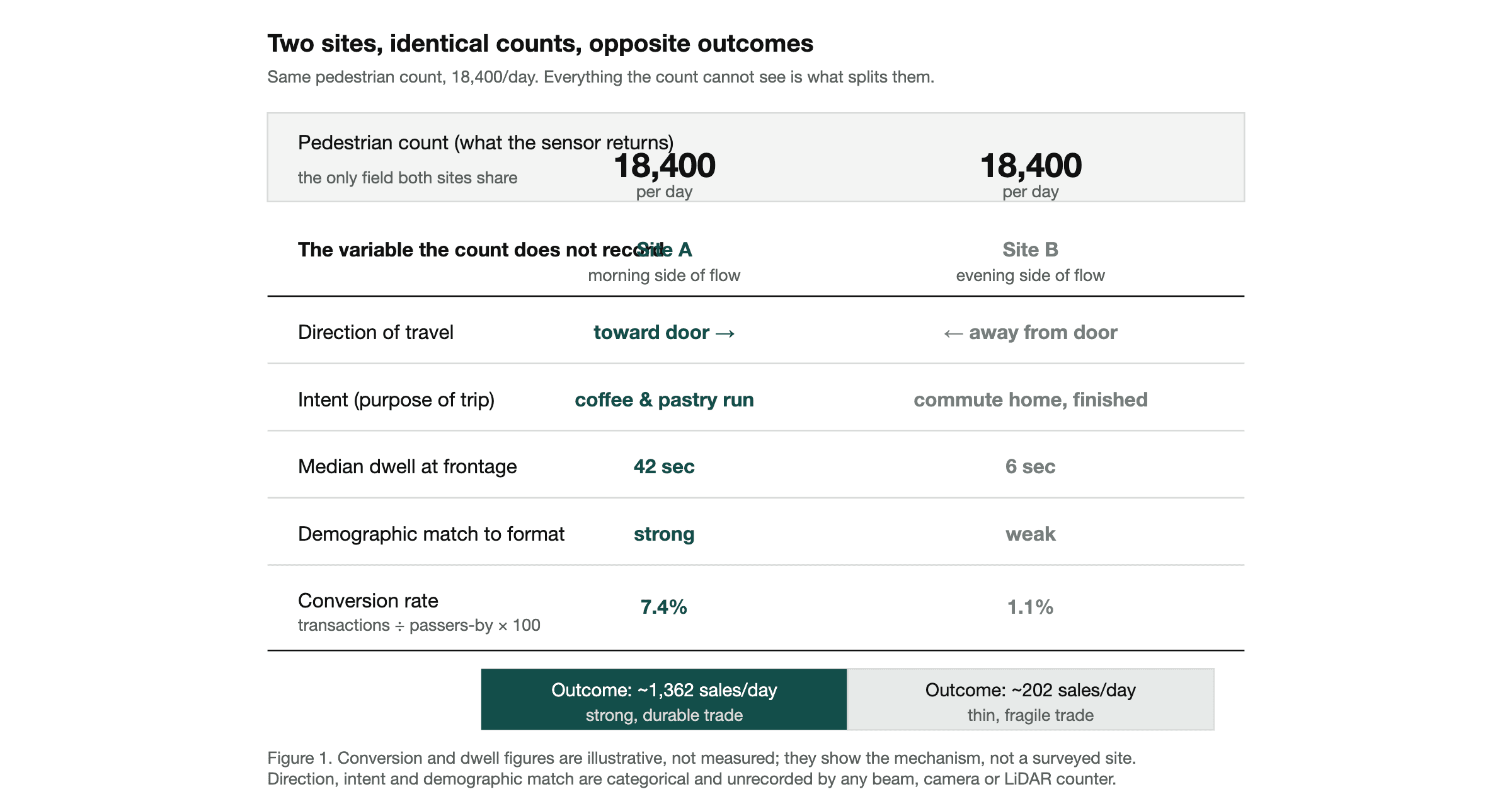
Composition is the first missing layer. The relevant question is never "how many walk past" but "how many of the *right* people walk past, at the times my business is open, walking in a direction and a mood that allows them to stop". A bakery on the morning side of a commuter flow and an identical bakery on the evening side of the same flow will report nearly identical pedestrian counts and earn wildly different revenue, because one sits in the path of people heading toward a coffee-and-pastry moment and the other in the path of people heading home, fed and finished. The count is the same. The catchment composition is opposite.
Conversion is the second, and it is where most foot traffic analysis quietly gives up. The chain from footpath to till has at least four leaks: how many passers-by even notice the storefront, how many are interested, how many enter, and how many buy. A high count with a 1% capture rate loses to a modest count with an 8% capture rate every day of the week, yet the leasing pitch only ever quotes the count. Dwell time is the signal that hints at this — a place where people linger converts far better than a place they march through — and dwell is precisely what a beam counter cannot see and a good device panel can begin to estimate. This is the genuine, narrow case for the modelled mobile-device data the last section was rude about: not for counting bodies, which a sensor does better, but for describing the people and their journeys, which a sensor cannot do at all.
The practical consequence is that foot traffic should never be a standalone metric in a site decision. It is an input to a conversion model, and on its own it is closer to weather than to revenue — real, measurable, and almost useless until you know what you intend to do in it. The serious version of this work joins the count to the catchment, the catchment to the customer, and the customer to the conversion rate your format can realistically achieve. That join is the actual analysis. The count is just the first column. We go into the difference between the area that walks past and the area you actually draw from in our companion piece on catchment versus trade-area analysis, which is the missing half of any honest footfall read.
What this piece does not cover
A few honest boundaries, because a methodology piece that pretends to completeness would be doing exactly the thing it warns against.
This is not a vendor benchmark. I have used Placer.ai's own published description of its data as the cited basis for the device-panel category, and I have deliberately *not* repeated specific sample-size or accuracy percentages that circulate informally about it, because I could not verify them to the standard I am holding the sensor studies to. The error ranges I quote for PIR and LiDAR come from a transport-research context — pedestrian and cyclist counting for planning — and while the physics of occlusion carries directly to a retail footpath, the exact percentages were measured in their own settings, not in front of your shop. Treat them as the right order of magnitude and the right *direction* of bias, not as a guarantee about a specific device on a specific corner. The transaction- and transit-proxy section is, as I flagged, analyst judgement: I have not cited an Australian footfall figure derived from EFTPOS or transit taps because I do not have one I trust, and I would rather say so than manufacture authority. And none of this addresses the legal and privacy frameworks around camera-based counting or device tracking, which are real, jurisdiction-specific, and a separate conversation from measurement accuracy.
A short framework: what to ask before you trust a foot traffic number
Most of judging foot traffic data comes down to refusing to accept a number without its provenance. When someone hands you a pedestrian figure, work through these before it touches a model.
- 1
What instrument produced this, and which way does it bias? Sensor, manual survey, or device-panel model? If it is a PIR beam on a busy strip, assume the true figure is higher. If it is a modelled panel, ask what the sample under-represents.
- 2
What exactly was counted, and over what window? A continuous 24/7 count and a ten-minute fair-weather sample multiplied by six are not interchangeable, even when the headline number matches.
- 3
Where, precisely, was the count taken relative to my door? Footfall decays fast around corners and across roads. A figure forty metres away can be a different business entirely.
- 4
What is missing from the frame? Cash-economy shoppers, device-off pedestrians, overnight and wet-weather traffic, the unsampled months. The absence is part of the data.
- 5
Who are these people, and at what rate would my format convert them? A count without a plausible capture rate and a catchment composition is not yet decision-grade. It is the first column of a spreadsheet, not the answer.
If a provider cannot answer the first two, the number is a rumour and you should price it as one. If they can answer all five, you have something worth building on. That is the standard we hold ourselves to when we assemble a location read — pairing public pedestrian systems like Melbourne's against competition, rent and catchment so the count is interpreted, not just quoted. You can see how that comes together across markets from Brisbane to the major capitals, or run the numbers on a specific address and judge the workings yourself.
When you are ready to pressure-test a real site rather than a hypothetical, bring your own scepticism — it is the most useful thing you can put into the model.
Free location score, map, data confidence and PROCEED / VERIFY / AVOID recommendation. Modelled financials stay optional.
Analyse your addressFrequently asked questions
Is foot traffic data accurate?
It depends entirely on the method, and "accurate" is the wrong frame — every figure is an estimate with a direction of error. A modern 2D-LiDAR counter is accurate for more than 97% of pedestrians (Transportation Research Part C, 2020), while the common passive-infrared beam can undercount crowds by 25–48% (CTR / UT Austin Report 0-7126-1, 2022), and a device-panel figure is a model extrapolated from a sample. Ask which instrument produced the number before you decide whether to trust it.
Why do two foot traffic sources give different numbers for the same street?
Because they are measuring different things and scaling them differently. A council manual sample multiplied up from ten minutes, a continuous sensor that records every hour, and a mobile-device panel that models visits from a sample will rarely agree, and none of them is necessarily "wrong" — they have different biases. The disagreement is information: it tells you how much method uncertainty sits behind the figure.
What's the best way for a small business to measure foot traffic?
For the street outside, start with free public data where it exists — the City of Melbourne and City of Sydney both publish documented pedestrian counts. For your own doorway, a door counter tells you passers-by, but the number that matters is your capture rate: count how many of those who pass actually enter and buy. Conversion, not raw footfall, is what predicts revenue.
Does high foot traffic guarantee a good location?
No. A high count with poor conversion loses to a modest count with strong conversion. What decides revenue is who the pedestrians are, whether your format and trading hours match their journey, and what share you can realistically convert. Treat foot traffic as one input to a conversion model, never as the answer on its own.
Sources & verification
City of Melbourne Pedestrian Counting System and sensor-location dataset, City of Melbourne Open Data Portal, accessed 31 May 2026. <a href="https://www.melbourne.vic.gov.au" rel="noopener" target="_blank">melbourne.vic.gov.au</a>
City of Sydney Walking Counts methodology and published hourly counts, accessed 31 May 2026. <a href="https://www.cityofsydney.nsw.gov.au" rel="noopener" target="_blank">cityofsydney.nsw.gov.au</a>
Placer.ai, "Our Data" (panel description and extrapolation methodology), accessed 31 May 2026. <a href="https://www.placer.ai" rel="noopener" target="_blank">placer.ai</a>
Center for Transportation Research, University of Texas at Austin, Report 0-7126-1 (2022), pedestrian-counting technology review, citing Ryus (2014), Jones (2010) and Ozan (2021). <a href="https://ctr.utexas.edu" rel="noopener" target="_blank">ctr.utexas.edu</a>
Transportation Research Part C (2020), 2D-LiDAR pedestrian-counting accuracy (abstract). <a href="https://www.sciencedirect.com/journal/transportation-research-part-c-emerging-technologies" rel="noopener" target="_blank">sciencedirect.com</a>
How to verify foot traffic yourself
- 1
Count people who enter nearby venues — not only those who walk past.
- 2
Sample breakfast and lunch on two separate weekdays.
- 3
Note directionality (which way people face) and dwell vs transit.
- 4
Compare counts to the rent being asked; premium rent needs conversion, not pedestrians alone.
Locatalyze separates measured vs proxy footfall so you do not mistake a category estimate for a pedestrian count.
See footfall honesty on a report →Related reading
Extensions: what foot traffic data doesn’t tell you covers the blind spots — daytime workforce included — and high foot traffic, low sales is the classic misread.
Frequently asked questions
About the author
Locatalyze Research Team
Location intelligence, Locatalyze
The Locatalyze research team builds the location-scoring models behind the platform and writes up what the data shows for Australian operators.
Tools first — then a full report for your address
Free rent, viability, and break-even checks. Upgrade when you are ready for competitors, map, and numbers for a specific site.
No signup required for tools