Sydney's New 24-Hour Airport Opens 25 October. The Best Business Opportunity May Be One Train Stop Away.
Founder, Locatalyze
At 11am on Sunday 25 October 2026, Jetstar is scheduled to operate the first commercial passenger departure from Western Sydney International Airport. It will be a satisfying television shot: a new terminal, a new runway and the first passengers moving through an airport discussed for decades. For business owners, however, opening day is the least interesting part of the story. The more important question is where the repeat customers will be on Monday morning. The terminal will capture travellers. The airport business park will capture aviation and freight activity. Bradfield is being built for advanced industry and a future city-centre workforce. St Marys already has residents, shops and a heavy-rail interchange, then gains a direct Metro connection to the airport. Orchard Hills and Leppington carry large housing plans, but their demand arrives with occupied homes, not rezoning announcements. These are five different markets moving on five different clocks. Treat them as one airport boom and it becomes easy to pay tomorrow's rent for customers who have not arrived.
Evidence standard
FACT: published WSA / Western Sydney Airport and NSW planning project facts where linked (dates labelled). Precinct sequencing, format advice and lease timing are LOCATALYZE ANALYSIS / FORECAST framing — not government demand guarantees. Population and job figures are only FACT when tied to a named release.
Visual note
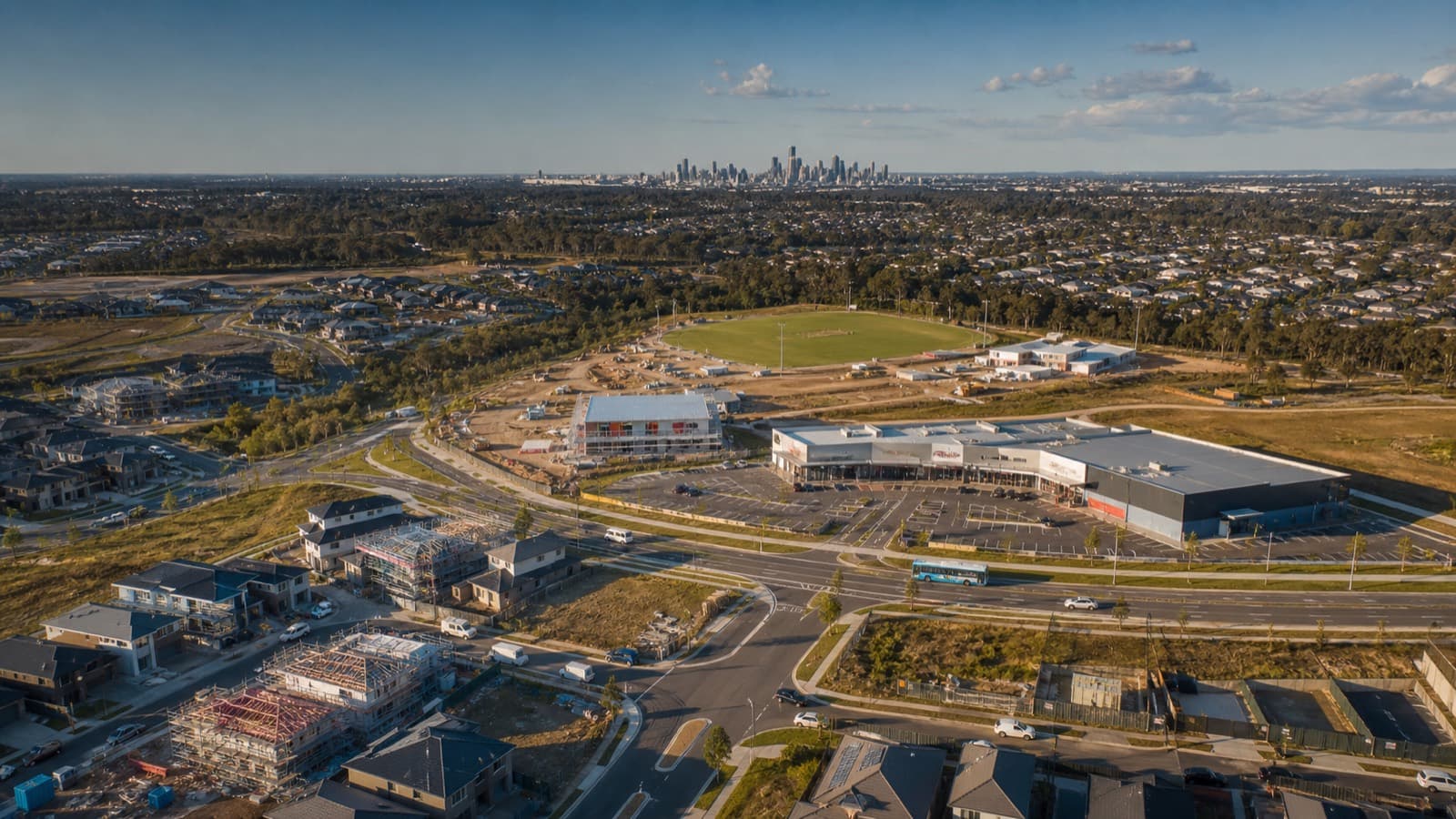
The hero is a Locatalyze editorial rendering of an airport-led growth corridor. It is not a photograph of Western Sydney International Airport and should not be read as a representation of an approved building layout.
Opening day is real. So is the temptation to overstate it.
The launch facts are unusually concrete. The Australian Government says Western Sydney International, or WSI, will open to passenger services on 25 October 2026 and operate without a curfew. Jetstar has announced launch services to Melbourne, the Gold Coast and Brisbane. Air New Zealand is due to begin Auckland flights on 26 October, Singapore Airlines is due to start a daily Singapore service on 23 November, and Qantas has announced domestic services from March 2027. Freight operations begin in late July 2026. Those dates turn a project that has lived in planning documents into an operating piece of infrastructure.
They do not turn the airport into a mature customer market overnight. WSI is designed to serve up to 10 million passengers annually in its initial configuration, but capacity is not opening-year traffic. The airport's 2025 to 2045 Master Plan places the 10 million passenger level in the 2030s and says up to 8,500 airport jobs would be required across the precinct when that level is reached. That is a useful planning horizon. It is not permission to put 10 million passengers into a 2026 sales forecast.
25 Oct 2026
First passenger services, according to WSI and the Australian Government
24 hours
Curfew-free domestic, international and freight operations
23 km
New Metro line from St Marys to Bradfield via six new stations
15 min
Planned Metro journey from Airport Terminal to St Marys
This difference between capacity and actual demand is the first discipline of airport location analysis. It matters for a café deciding whether to trade before dawn, a motel operator assessing room nights, a logistics supplier sizing a depot and a health provider considering a workforce clinic. Each business needs a different slice of the airport economy. None is helped by a single oversized passenger number.
The airport is one project. The business market around it is a sequence of demand events.
The demand sequence: freight, workers, passengers, then city-building
The first demand is operational. Freight, security, maintenance, ground handling, airline preparation and terminal services require people before a broad visitor economy exists. This workforce buys differently from a leisure passenger. It values reliable opening hours, parking, speed, predictable meals, uniforms, vehicle support, training, health services and practical accommodation. A business serving this market needs to know shift changes and employment locations, not just flight schedules.
The second demand is passenger-led. The announced launch network gives the airport meaningful domestic and international connections, but the initial schedule is still a schedule, not a guarantee that every terminal tenancy will enjoy constant volume. A traveller who arrives, collects a car and drives toward the Blue Mountains has a different spending path from a transfer passenger at Kingsford Smith. WSI has five announced car-rental partners and a direct Metro station. Both will help visitors leave the terminal efficiently. That is excellent airport design and a warning for businesses expecting every arrival to linger.
The third demand comes from the wider employment and housing program. NSW planning material says the Aerotropolis could create more than 100,000 job opportunities across its initial precincts by 2056. Bradfield City Centre is planned for capacity of 20,000 jobs and 10,000 homes in the long term. Orchard Hills has a revised Stage 1 proposal for about 5,700 homes and 2,100 jobs. Leppington Town Centre has been rezoned to support about 11,500 homes and 11,000 jobs over 20 years. These numbers matter because they describe the scale of intended development. They must remain attached to their time horizons and planning status.
Western Sydney demand-timing explorer
Find the precinct that matches when your business needs customers
Passenger opening
25 October
25 October 2026
Late July 2026
Freight operations begin
25 October 2026
First passenger services
23 November 2026
Singapore service starts
1. Choose the demand model
Early coffee, meals, uniforms, health, convenience and shift-friendly services.
2. Choose the investment horizon
3. Compare operating fit
Select a precinct to see what must be true before signing.
Framework, not a property forecast
St Marys
Existing residents, rail interchange, airport workers and transfer passengers.
Verified planning or infrastructure fact
The airport Metro is designed to put the terminal about 15 minutes from St Marys, where passengers can interchange with the T1 Western Line.
The trap
The station creates movement, but not every passenger will leave the interchange or spend in the town centre.
Checks before a lease
Count the path between the Metro interchange and the proposed shopfront.
Separate weekday commuter peaks from weekend local trade.
Test trading hours against airport and shift-worker schedules.
Ranking is a Locatalyze operating-fit framework based on demand source and timing. It is not an investment rating. Project facts are drawn from WSI, Sydney Metro and NSW Government planning material linked in the article’s source ledger.
The right airport-corridor suburb depends on your category, rent and repeat-customer catchment. Test the address before the growth story gets built into the lease.
Free location score, map, data confidence and PROCEED / VERIFY / AVOID recommendation. Modelled financials stay optional.
Analyse a Western Sydney locationFive precincts, five different business cases
1. St Marys: the near-term small-business case
St Marys has something the greenfield precincts cannot manufacture quickly: an existing town centre and an existing population. Its station already connects to the T1 Western Line. The new airport Metro is intended to terminate there, putting Airport Terminal about 15 minutes away and creating an interchange between the airport corridor and Sydney's established rail network. That makes St Marys the clearest near-term candidate for businesses that need repeat trade in 2026 rather than a promise of density later.
The opportunity is not simply 'near a station'. The strongest sites will sit on actual transfer and worker paths or serve the local catchment independently when airport traffic is quiet. Early breakfast, quick-service food, allied health, personal services, practical retail, training and meeting-oriented hospitality all have plausible demand sources. A generic premium concept that depends on visitors discovering the high street is less convincing. Most travellers optimise the trip to or from the terminal; they do not automatically become town-centre browsers.
The due-diligence work is physical. Walk the interchange route. Identify which station exits open toward the proposed site. Count the weekday morning, evening and weekend patterns separately. Ask whether a worker finishing at 7am can park, order and leave quickly. St Marys may be the best immediate fit in this corridor, but only the right blocks receive the movement.
2. Airport Terminal and Business Park: direct demand with expensive rules
The airport and its business park offer the purest exposure to aviation demand. They are the logical territory for travel retail, passenger services, airline support, freight-adjacent operations, crew accommodation, vehicle services and around-the-clock food. The 24-hour operating model creates time bands that do not exist at a curfew-constrained airport. For a business genuinely designed around those bands, the location can be strategically powerful.
It can also be unforgiving. Airport businesses often face tender processes, concession arrangements, operating-hour obligations, security requirements, delivery controls and fit-out standards that an ordinary suburban lease does not carry. Labour is harder when the roster starts before public transport or ends after it. Parking costs can become a staff-retention issue. A superb passenger count can still produce a poor profit and loss statement if the concession takes too much revenue or the business must remain open through thin hours.
The launch route list should be modelled flight by flight. Build a demand curve around scheduled departures and arrivals, then apply realistic capture rates by passenger type. Do not divide an annual airport-capacity number by 365 and call it daily foot traffic. For freight or B2B operations, map clients and service-level requirements instead. Direct airport exposure is valuable precisely because it is specific. The model should be equally specific.
3. Bradfield: the strongest long-term story and the easiest place to arrive too early
Bradfield City Centre sits next to the airport and is planned as a 114-hectare centre for advanced manufacturing, research and development, education, professional services, culture, entertainment and housing. Its First Building and Advanced Manufacturing Readiness Facility establish a credible institutional base. The state has opened commercial investment opportunities and describes capacity for 20,000 jobs and 10,000 homes over the long term.
For specialised B2B firms, Bradfield may already be relevant. Engineering services, prototyping support, technical recruitment, compliance, training, industrial software and corporate accommodation can win from a small number of high-value relationships. A mass-market café, gym or everyday retailer faces a different equation. Those formats need a visible daily population, not merely strategic importance.
The best Bradfield lease is likely to contain its own patience. Rent commencement should follow occupancy or a defined delivery event. A smaller first stage with expansion rights is safer than fitting the final footprint immediately. Tenant incentives should recognise that early operators help create the amenity used to attract later employers. A government job-capacity target belongs in the context section of the business case. The revenue model should start with named occupied buildings and contracted workforces.
4. Orchard Hills: a future neighbourhood market, not an airport terminal market
Orchard Hills is one of the six new Metro stations and is intended to serve a future mixed-use centre. The revised Stage 1 rezoning proposal exhibited in 2026 contemplated around 5,700 homes, 2,100 jobs, a town centre and local services. At the time of writing, the department was reviewing submissions and expected the proposal to be finalised in late 2026. That status matters. Proposed homes are neither approved dwellings nor occupied households.
When delivery matures, Orchard Hills is more likely to reward neighbourhood retail, childcare, health, fitness, supermarkets, convenience and family-oriented hospitality than traveller services. Its airport connection is useful, but the enduring demand source should be residents and workers around the station. A business that only makes sense because air passengers might stop there has misunderstood the line.
Track the precinct in layers: planning finalisation, development approval, civil works, dwelling completion, occupancy and then retail habit formation. Each stage removes a different risk. Operators commonly enter growth precincts after seeing earthworks and assume customers are close. In reality, the gap between serviced land and a stable weekly trade pattern can consume years of working capital.
5. Leppington: a resident-led growth centre with an airport halo
Leppington Town Centre was rezoned in June 2026 to support about 11,500 homes and 11,000 jobs over the next 20 years. It already has a station on the T2 Airport, Inner West and South lines, and the plan concentrates housing, jobs, services and open space around that transport asset. This is substantial, useful planning. It is also a long-horizon resident and town-centre story.
Leppington is not on the six-station Western Sydney Airport Metro line. Businesses can still benefit from wider south-west Sydney growth, road connectivity and airport-related employment, but they should not describe the location as a direct airport-station play. The most defensible formats are those that serve occupied households and an emerging local workforce: medical and allied health, family services, everyday retail, casual dining, fitness, education and practical professional services.
A good Leppington analysis starts with the first delivered neighbourhoods, not the ultimate rezoning envelope. Map where households can reach the site today, where competing centres sit, which supermarkets or civic anchors will open first and how long the trip feels at school-run and weekend times. The airport strengthens the regional narrative. Local households still pay the till.
Which business formats have the cleanest demand logic?
The cleanest opportunities are not necessarily the most glamorous. A reliable 5am breakfast offer for shift workers may have stronger opening-year logic than a design-led restaurant in an unfinished precinct. A mobile maintenance provider with airport contracts may outperform a large showroom. A physiotherapy clinic near an established interchange may reach repeat demand sooner than an identical clinic beside future apartments. Infrastructure changes who can reach a location. It does not remove the need to identify who will buy, how often and at what margin.
The lease has to respect the clock
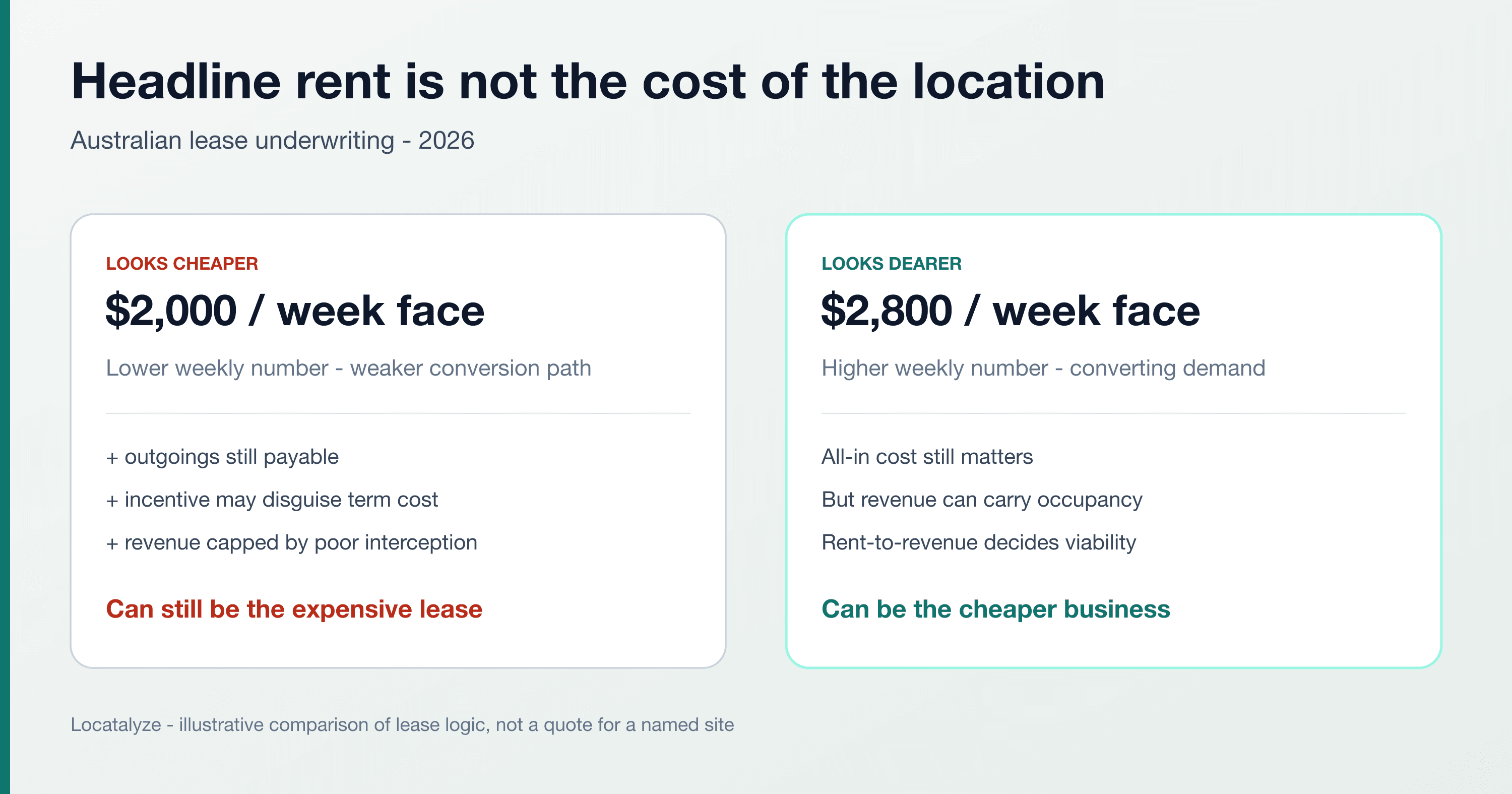
Airport-corridor leases are vulnerable to what might be called narrative rent: the owner prices in the future before the tenant can trade on it. The defence is not a better argument about the master plan. It is a lease structure tied to observable delivery. Useful mechanisms include delayed commencement, stepped rent, a smaller initial footprint, expansion options, fit-out contributions, landlord works, capped outgoings and break rights linked to defined infrastructure or occupancy milestones. The exact legal structure needs a commercial leasing lawyer, but the operating principle is simple: the tenant should not carry every year of timing risk.
A long lease can be an asset when the customer base is established and the rent is supportable. In a new precinct, the same term can turn an incorrect opening-date assumption into a multi-year liability. Ask the agent which completed buildings generate trade today. Ask for occupancy evidence. Visit outside the launch event and outside construction shift changes. Separate passing vehicles from accessible customers. If the landlord's strongest evidence is a 2056 job target, the current rent needs to acknowledge the distance between now and then.
A practical rent condition
Do not pay mature-precinct rent for planned-precinct demand. Your base case should work on customers who are present or contractually committed. Future homes, jobs and passenger growth belong in upside scenarios until delivery can be observed.
A 72-hour location test before you call the agent back
Evidence to collect
- 1
Name the demand source in one sentence. Use 'airport shift workers within a seven-minute drive' or 'occupied households west of the station', not 'airport growth'.
- 2
Build the timeline. Mark what is operating, under construction, approved, proposed and long-term planned. Never merge those stages.
- 3
Count three time bands. For worker businesses, include shift-change periods. For neighbourhood formats, include school-run, evening and weekend trade.
- 4
Trace the customer path. A station, motorway or terminal matters only if people can reach the door safely, legally and conveniently.
- 5
List the first 500 repeat customers. Identify employers, buildings, streets or households rather than using a regional population total.
- 6
Check the competitor response. Existing St Marys and Penrith operators may extend hours, add delivery or open satellite sites as demand changes.
- 7
Model a slow ramp. Hold opening-year passenger, workforce or occupancy assumptions below the long-term plan and test whether working capital survives.
- 8
Make the lease absorb timing risk. Seek commencement triggers, steps, incentives and rights that match the actual development sequence.
What the official data cannot tell you yet
The official material is strong on infrastructure, planning capacity and announced services. It cannot yet show a stable year of passenger behaviour, worker spending, retail conversion, hotel demand or station-exit movement because the system has not operated for a year. No responsible analyst can turn those unknowns into precise opening-year sales without assumptions.
The first twelve months will answer practical questions. How many western Sydney residents switch from Kingsford Smith? How quickly does the international schedule broaden? What share of terminal workers live north, south or east of the airport? Do travellers use the Metro, rental cars or pick-up zones? Which meal periods are underserved? How much business demand stays near the airport rather than returning to Parramatta, Penrith or Liverpool? These are measurable questions, and the businesses that build a simple observation system will learn faster than those relying on headlines.
That uncertainty is not an argument to wait forever. It is an argument for reversible decisions. Test catering before a full venue. Win service contracts before leasing a large depot. Use a small clinic room before committing to a medical centre. Negotiate an option before building the final footprint. The airport creates a rare volume of change, but the best operators will buy evidence in stages.
The Locatalyze verdict
PROCEED with conditions
St Marys has the strongest near-term logic for independent operators who need an established catchment plus airport connectivity. The Airport and Business Park suit direct aviation, traveller and B2B formats when access and concession economics are understood. Bradfield is compelling for specialised firms and patient operators tied to occupied employment, but its long-term job and housing capacity must not be treated as present trade. Orchard Hills and Leppington are resident-led opportunities whose retail timing should follow completed and occupied homes. This works only if the lease is supportable on current or committed demand, the customer path is physically verified, and future growth remains upside rather than the base case. It fails if a business uses airport capacity as opening-year foot traffic, pays mature rent in an early precinct, or opens a full-scale format before its repeat customers exist.
Do not buy the airport story. Test the address.
Locatalyze compares the catchment, competition, access, rent pressure and evidence quality around the site you are actually considering.
Run a free location scoreSources and method
This article separates published project facts from Locatalyze interpretation. Dates, routes, infrastructure dimensions and planning capacities come from government or project-owner material current at 27 July 2026. Precinct recommendations, demand sequencing and lease conditions are Locatalyze's operating framework. They are not government forecasts, property valuations or financial advice.
Primary and authoritative sources
Related reading
Frequently asked questions
About the author
Prashant GuleriaFounder, Locatalyze
Prashant Guleria founded Locatalyze after learning first-hand how quickly a promising business can lose money when the site logic is wrong. He writes for operators who want the evidence before the lease.
Tools first — then a full report for your address
Free rent, viability, and break-even checks. Upgrade when you are ready for competitors, map, and numbers for a specific site.
No signup required for tools