Australia Is Building a New CBD by the Beach. That Does Not Mean Every Business Should Rush In.
Founder, Locatalyze
Maroochydore has something almost no Australian business district can offer: a new centre being built rather than inherited. The streets are planned, the digital infrastructure is embedded, City Hall is open, new offices and a private hospital are changing the employment base, and the long-range development story is substantial. It is easy to turn those facts into a seductive lease pitch. The danger is that a future city and a present customer market are not the same thing. A cafe cannot bank a masterplan. A retailer cannot pay wages with a 15-year jobs forecast. A professional firm may benefit from arriving early, while an evening restaurant in the same building could still be years ahead of its reliable demand. This guide separates the open assets from the announced projects, the regional tourism market from the exact Maroochydore catchment, and strategic potential from first-year cash flow. The opportunity is real. The timing, frontage and business format decide whether it is yours.
Evidence standard
Every material number in this guide is linked to the Australian Bureau of Statistics, Queensland Government, Sunshine Coast Council, Tourism and Events Queensland or another named primary source. Forecasts are labelled as forecasts. Regional figures are not presented as city-centre foot traffic. No unsupported rent range or pedestrian count has been invented.
The headline is true. The shortcut is not.
Sunshine Coast Council describes Maroochydore City Centre as a new central business district created through a Priority Development Area declared in 2013. The Council project page says the wider PDA is approximately 60 hectares and refers to the 53-hectare project area being developed with Walker Corporation. Under the 2020 development agreement, up to $2.5 billion in private investment is expected to flow into the project, with more than 15,000 jobs forecast over its life.
Those are consequential commitments, not a brochure assembled around an empty paddock. Sunshine Coast City Hall opened in December 2022. Foundation Place opened earlier as the first commercial office development. Roads, parks, waterways and digital infrastructure are visible. In March 2026, the Council investment team reported that the 50 First Avenue office tower and Maroochy Private Hospital were moving towards operational debuts. The city centre has crossed from concept into delivery.
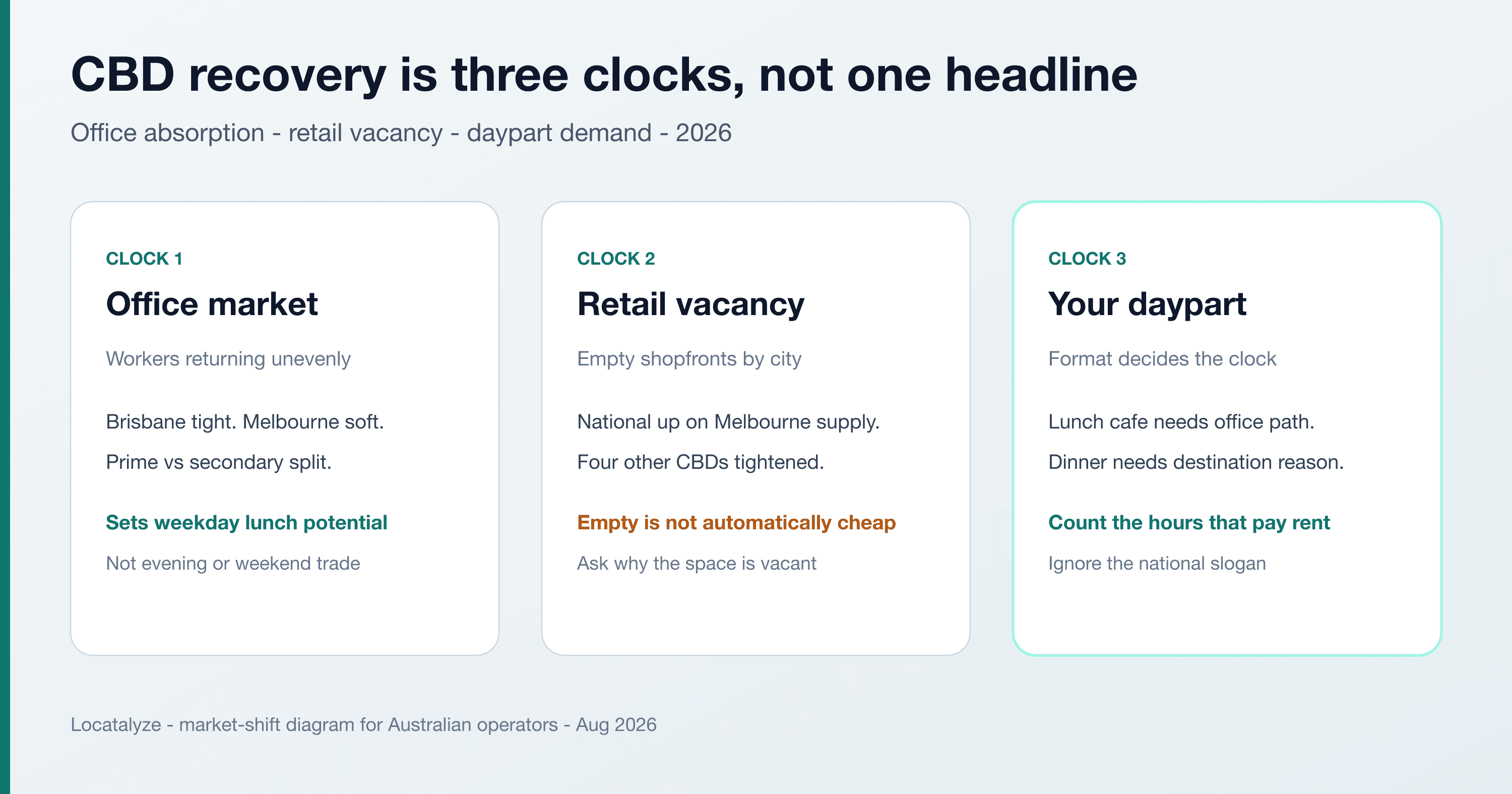
The shortcut begins when that progress is treated as a universal business case. A development can be economically important and still contain weak individual tenancies. Employment can grow without producing the right daypart for a restaurant. Apartments can be occupied without creating browsing retail. A regional visitor economy can be large while most visitors spend their time at beaches, resorts and established dining precincts. Location analysis begins after the big story is accepted, not before.
53 ha
City centre project area cited by Council
$2.5bn
Up to this amount of private investment under the development agreement
15,000+
Jobs forecast over the life of the project, not current workers
Dec 2022
Sunshine Coast City Hall opened
Maroochydore's risk is not that the city-centre story is false. It is that a true long-term story can be used to justify the wrong short-term lease.
Maroochydore timing lab
Match the business to the precinct, not the headline
Choose a format, location type and opening horizon. The result is a fieldwork brief, not a made-up site score.
1. Business format
Repeat workers, morning paths and a lunch population close enough to convert.
2. Precinct type
3. Opening horizon
New city centre / Weekday food / Open now
Timing-sensitive
Office and civic activity can support weekday food, but a future worker target is not the same as today’s walk-past lunch market.
Evidence required before signing
New city centre: four checks for the exact address
Occupied offices and apartments within a practical walk
Movement past the exact frontage by daypart
Construction access, shade and wayfinding
Opening dates for adjacent anchors in writing
The strongest long-term employment story, but the customer base must be measured building by building while the precinct matures.
A suburb story cannot tell you whether the doorway, rent and nearby customer base work together. Test the exact Maroochydore address before you negotiate.
Free location score, map, data confidence and PROCEED / VERIFY / AVOID recommendation. Modelled financials stay optional.
Analyse a Maroochydore locationWhat exists in 2026, and what still belongs to the future
A serious lease decision needs a dated inventory. Start with what a customer, worker or tenant can use now. City Hall is open. Existing commercial buildings are occupied. The street network and public realm are operating. The established Maroochydore economy around Sunshine Plaza, Ocean Street, Cotton Tree and the older commercial grid already generates trips independent of the new centre.
Then create a second list for projects moving through delivery. The March 2026 CBD milestones update described 50 First Avenue and Maroochy Private Hospital as approaching their operational debuts. For a current lease, that wording is not enough. The operator should verify the opening date, occupied floor area, staff numbers, public access and the walking route from each building to the proposed tenancy. A building can be practically complete while its useful customer contribution takes months to form.
Finally, keep a third list for long-term plans. The 15,000-plus jobs figure is a project-life forecast. A Council investment article projected more than 1,000 residents and 3,000 workers in the city centre by 2027. The Wave public transport program includes a future metro-style connection through Maroochydore to the airport. These facts are relevant to strategy and lease flexibility. They do not belong in first-year revenue unless the specific milestone is contracted, dated and likely to operate before the business needs it.
The distinction sounds conservative because it is. New precincts usually produce their best leasing narrative before they produce their most stable weekly routines. That gap is where early operators either secure a defensible position or subsidise the district while waiting for everyone else.
The Sunshine Coast economy is large enough. The catchment question is harder.
Sunshine Coast Council's 2024-25 Regional Economic Development Strategy annual report reported a gross regional product of $26.33 billion, 181,931 local jobs and 38,138 businesses. Those figures establish that the region is not a small tourism town pretending to be an economy. It has a broad base of health, construction, education, professional services, retail, hospitality and other industries.
The same scale creates a common analytical error. Regional population is not a walk-in catchment. The Sunshine Coast is a long, polycentric coastal region. Residents have established shopping, medical, school and dining routines across Caloundra, Kawana, Buderim, Maroochydore, Coolum, Nambour and many smaller centres. A business in the new CBD does not automatically inherit the spending capacity of the whole coast.
The latest ABS regional population release illustrates the geography problem. For 2024-25, Caloundra West - Baringa recorded the largest population increase outside Australia's capital cities, adding about 2,000 people. That is an important Sunshine Coast growth fact. It is not evidence that those households will travel to a Maroochydore cafe three mornings a week. The correct question is where each new household already travels for work, school, services and leisure.
Geography warning
Sunshine Coast regional statistics describe the opportunity pool. They do not describe the customer base outside one Maroochydore shopfront. Convert regional scale into drive-time, walk-time and daypart evidence before using it in a forecast.
Four customer markets sit on top of one another
1. The weekday worker
The new city centre's most direct near-term opportunity is weekday employment. City Hall, commercial offices, health uses and construction activity create different kinds of demand. A council employee can support coffee and lunch on a repeat schedule. A construction workforce may create strong early breakfast trade and then disappear when the building is finished. Hospital staff can create shift-based demand, but only when entrances, rosters and walking routes line up with the tenancy.
Do not use total workers as a single number. Count people who are present on Monday, Tuesday and Friday. Separate staff who bring lunch from those who buy it. Note which side of the road they use, where they park and whether an internal cafe or staff facility captures the transaction first. In an emerging district, 800 workers in the surrounding blocks can be less useful than 250 workers whose entrance faces the door.
2. The resident
Residential delivery changes the city centre from a work zone into a neighbourhood, but occupied apartments do not all behave alike. Owner-occupiers, long-term renters, short-stay guests and downsizers have different spending patterns. A convenience operator needs repeat local baskets. A restaurant needs enough residents who choose the precinct for an evening occasion. Allied health needs a realistic appointment catchment and parking, not simply towers visible from the window.
The published projection of more than 1,000 city-centre residents by 2027 is a useful milestone to verify. It should trigger questions: how many apartments are complete, how many lights are on after 7pm, where do residents currently buy groceries, and which services have already captured their loyalty? The first resident is not the same commercial event as the thousandth.
3. The established regional customer
Maroochydore already has regional pull through Sunshine Plaza, public services, employment and its central position on the coast. This customer is valuable because the trip exists before the new CBD is complete. The challenge is interception. A site near Sunshine Plaza may see enormous vehicle movement while receiving little pedestrian conversion. A service business can benefit from a familiar destination even when a discretionary retailer cannot.
Map the complete journey. Where does the customer park? Which entrance do they use? What reason would make them cross a major road or leave the centre? Can the site be seen before the decision to turn? Adjacency to a regional destination is an asset only when the path is commercially usable.
4. The visitor
Tourism and Events Queensland recorded 2.341 million domestic holiday visitors to the Sunshine Coast region in the year ending December 2025, alongside 184,000 domestic business visitors. Its international snapshot reported $475.5 million in international visitor expenditure for the same year. These are material markets, and they are still regional figures.
A beach holiday does not naturally include the new city centre. A business visitor may spend near a conference, office or hotel, but the proposed exhibition and convention facility is not yet a funded demand anchor. Council's current facility project page explicitly says no state or federal funding commitments have been made and the project cannot proceed without them. Operators should not capitalise an unfunded venue into a lease.
Maroochydore is not one precinct
The most useful way to read Maroochydore is as several overlapping commercial environments. They are close on a map and different in customer purpose. Treating them as one CBD erases the information a tenant needs.
The new city centre: strongest story, highest timing sensitivity
The new centre is where the structural change is most visible. It offers modern buildings, civic activity, a planned mixed-use environment and digital infrastructure that can be genuinely valuable to professional firms. It is also where future language can do the most damage. A polished public realm can look complete in a site inspection even when the useful customer population is thin at the hours your business trades.
For a weekday cafe, count each office entrance at breakfast and lunch across at least three ordinary days. For professional services, test employee commute, client parking and meeting convenience. For retail or dining, return after 6pm and on Sunday. The absence of activity is not a verdict against the precinct. It is a fact that must be priced into the opening date and lease.
Sunshine Plaza edge: destination gravity can stop at the boundary
Sunshine Plaza creates a level of established regional recognition the new centre is still building. The commercial temptation is to assume spillover. Shopping centres are designed to hold attention, parking and spend internally. An external tenancy can sit beside a successful centre and remain invisible to customers whose complete journey happens between a car bay and an internal store.
The strongest edge sites solve a specific need before or after the centre trip, sit directly on a proven pedestrian path, or offer something worth a deliberate detour. Vehicle counts alone are poor evidence. Stand at the proposed frontage and record how many people cross into the site, not how many cars pass it.
Ocean Street: an occasion precinct must survive ordinary weeks
Ocean Street has the clearest night-time identity in central Maroochydore. That makes it legible for dining and entertainment in a way a new office district may not yet be. It also concentrates risk. Venue changes, licensing, security, sound, weather and a heavy Thursday-to-Saturday pattern can make a lively inspection unrepresentative of the full rent week.
Count an ordinary midweek service as carefully as Saturday night. Ask whether the concept can make money on the quiet nights or whether the weekend must carry the entire occupancy cost. An operator buying the precinct's reputation needs to understand how much of that reputation is still producing transactions at the exact end of the street.
Cotton Tree: a real routine with a seasonal overlay
Cotton Tree combines residents, the river, beach activity, parks and visitors. That mix can be excellent for breakfast, casual food and neighbourhood services because it offers reasons to be present outside office hours. It can also flatter a short site visit. School holidays, a sunny weekend or an event can produce movement that disappears in wet weather or during an ordinary working week.
A resilient Cotton Tree business should identify the local repeat customer first and treat visitor trade as an upside layer. Record postcode or customer type during a test period, compare holiday and non-holiday weeks, and observe parking turnover. The view may attract the first visit. The local habit pays the annual rent.
Which business formats fit the opportunity?
Professional services have the clearest early logic
The new city centre's assets align most naturally with firms that value modern office supply, regional centrality, client perception, workforce attraction and digital capability. For these businesses, the location can create value without relying on walk-in trade. The decision still needs practical testing: parking cost, staff commute, lease flexibility, internet redundancy, meeting access and whether the address materially helps win or retain work.
Weekday food can work, but the route is the market
Coffee and lunch are repeat-frequency categories. That makes workers valuable and also makes internal competition dangerous. A lobby kiosk, hospital cafe, staff kitchen or favourite stop on the drive to work can remove the transaction before the customer reaches the street. The winning site is not the one closest to the largest building. It is the one on the path people use at the moment they decide to buy.
Health and allied services need convenience, not novelty
Regional growth and new health infrastructure can support allied health, diagnostics and specialist services. Yet patients value simple access, parking, referrals and continuity. A prestigious new address does not compensate for a difficult turn, an expensive car park or a long walk for a patient with limited mobility. Map referrers and patient origins before comparing fit-outs.
Specialty retail should wait for browsing evidence
Specialty retail needs more than population. It needs discovery, dwell time, complementary neighbours and enough frequency or margin to survive quiet periods. In the new centre, verify that open tenancies create a genuine circuit rather than isolated destinations. Near Sunshine Plaza, prove that customers cross the boundary. In Cotton Tree, separate local demand from visitor curiosity.
Evening dining needs an occasion the precinct already owns
Office districts often overestimate evening conversion. Workers may leave immediately, and residents may dine in an established coastal precinct. A restaurant in the new centre needs a reason to travel there after 6pm: a distinctive product, event, hotel, residential base or cluster of complementary venues. Ocean Street starts with a clearer evening association, while carrying its own concentration and operating risks.
The transport story matters, but not in the way a lease pitch suggests
The Queensland Government's The Wave program is a major long-term change for the Sunshine Coast. The published program combines heavy passenger rail from Beerwah to Birtinya with a metro-style service onward through Mountain Creek and Maroochydore to Sunshine Coast Airport. The Government describes the region's current public transport patronage as less than 3 percent and positions the program as a response to growth and congestion.
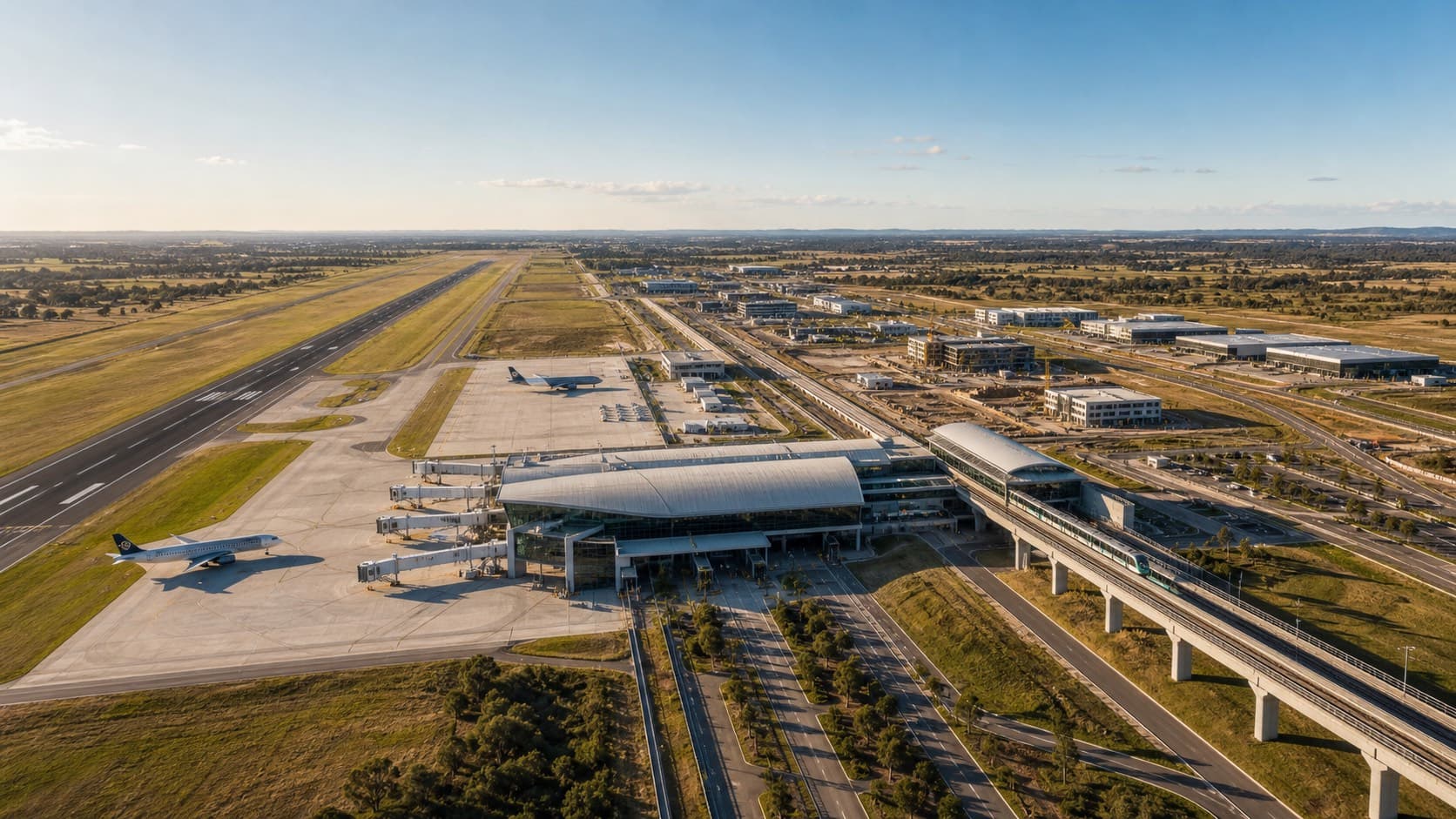
The important 2026 detail is that the heavy rail and metro connection through Maroochydore are planned infrastructure, not an operating customer source. The rail project page says delivery is staged and connects with the future metro-style service. A tenant should not add station foot traffic to a present forecast or accept a rent premium based on a line that customers cannot yet board.
Transport plans still affect the decision. They can make a flexible long lease more strategically attractive, influence which frontage may become important, and change the value of parking over time. The correct use is scenario planning: the business must survive on today's access, with future transport treated as upside.
Tourism is an upside layer, not a universal base case
The Tourism and Events Queensland domestic snapshot shows the scale of the Sunshine Coast holiday market. That demand supports accommodation, coastal dining, attractions and many service businesses. It does not distribute evenly.
A visitor staying in Noosa, Mooloolaba or Caloundra may never enter central Maroochydore. A city-centre operator needs a local visitor reason: a hotel, event, meeting, medical appointment, shopping trip or distinctive destination. The 184,000 domestic business visitors recorded for the region are especially relevant to office and event growth, but still need a Maroochydore-specific reason to be near the tenancy.
Treat tourism in layers. First model repeat residents and workers. Then add verified visitor transactions for the exact precinct. Finally, stress-test shoulder periods and wet weather. If the numbers only work when every regional visitor becomes available, the location does not work.
The rent question cannot be answered with a suburb average
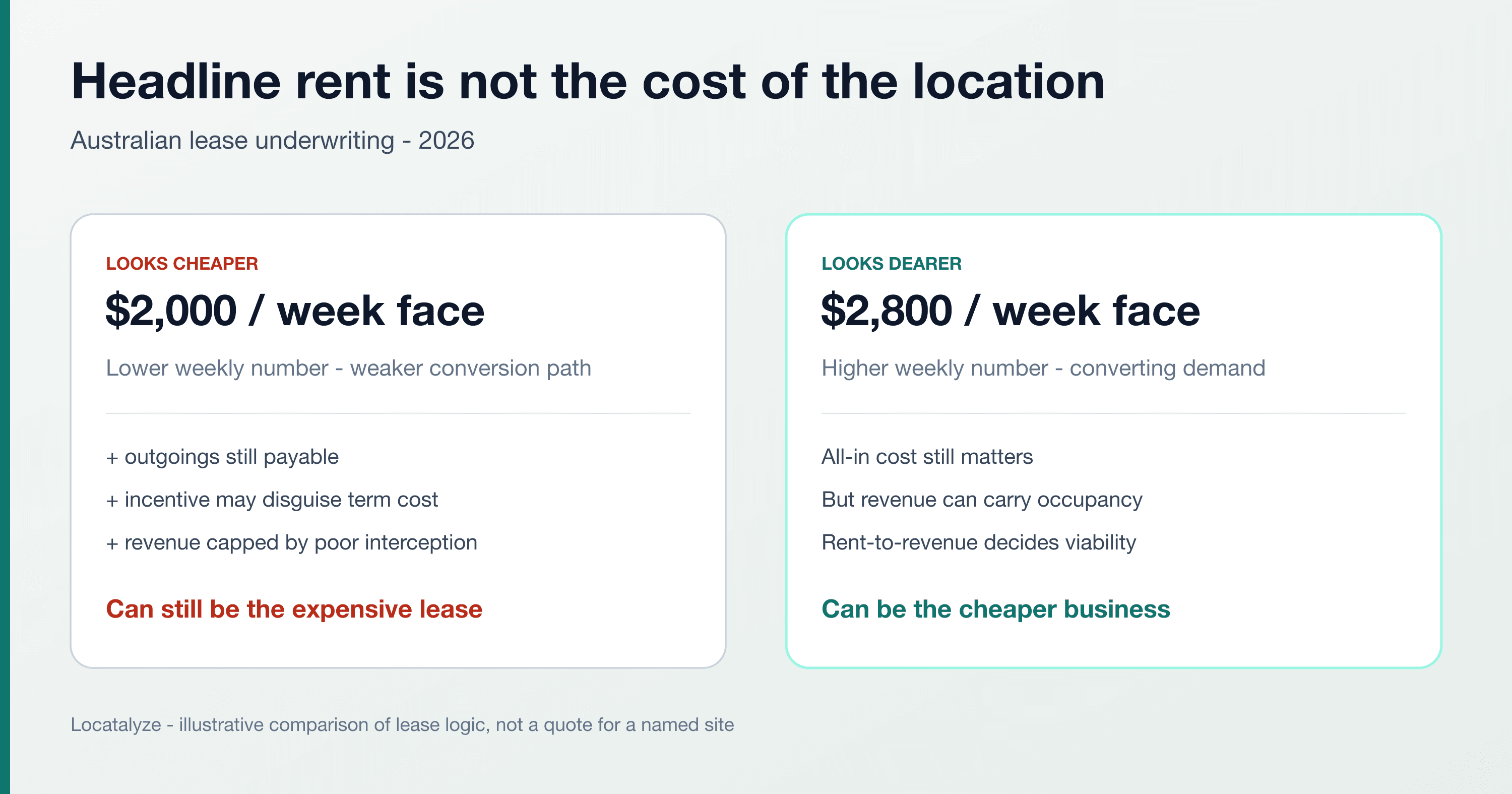
Public, sourceable evidence does not support one trustworthy 2026 rent range for every Maroochydore business format and precinct. Office, retail, medical and hospitality leases use different measures. Incentives, outgoings, fit-out contributions, make-good clauses, permitted use and rent-free periods can change the effective occupancy cost. Quoting a broad weekly number would create confidence without precision.
Use the actual heads of agreement. Convert base rent, outgoings, marketing levies, parking, required trading hours and fit-out finance into a monthly occupancy cost. Deduct incentives over the committed term rather than treating them as free money. Then divide total occupancy cost by conservative monthly sales. For customer-facing businesses, test at least three sales cases and include a slower opening ramp for an emerging precinct.
Early-entry pricing is valuable only if it compensates for early-entry demand. A discounted tenancy that loses cash for two years can be more expensive than a mature location at a higher face rent. Conversely, a flexible lease with strong incentives and a verified worker path can create an excellent position before the broader district is fully formed.
Lease rule
Do not let a long-term infrastructure forecast justify a short-term occupancy cost. The base case must work with open buildings, observed customers and current access. Future projects belong in the upside case.
A seven-day fieldwork protocol for Maroochydore
Before requesting final lease documents
- 1
Define the business's demand window. Write down the three hours that must carry the model and the customer purpose in each hour.
- 2
Map every open anchor within a practical walk or drive. Record entrances, internal competitors, barriers, shade, crossings and parking rather than drawing a simple radius.
- 3
Count the exact frontage on Tuesday, Thursday and Saturday. Use 15-minute intervals and separate passers-by, entries and purchases where observation allows.
- 4
Repeat one count in poor weather and one outside school holidays. Maroochydore's coastal and visitor layers can distort a single good day.
- 5
Verify every future anchor in writing. Ask for expected completion, opening, occupied floor area and public access. Mark anything uncertain as zero in the base case.
- 6
Build the occupancy cost from the heads of agreement, including outgoings, parking, required hours, fit-out finance and make-good obligations.
- 7
Set a failure trigger before signing: a maximum occupancy ratio, minimum weekday transactions, minimum appointments or a pre-sale threshold that can be measured.
The protocol is deliberately ordinary. Good site selection often is. The expensive mistakes happen when a vivid regional narrative replaces counting, lease arithmetic and a clear failure condition.
The verdict: Maroochydore is a real opportunity with different clocks
Maroochydore City Centre is not hype. It is an operating civic and commercial precinct inside a substantial regional economy, with major private development and a credible long-term role. Professional services and selected weekday or health formats can already find a strong fit where access and occupied anchors are proven. Other formats may be early rather than wrong.
The highest-risk decision is a customer-facing lease priced for the finished city while depending on the unfinished one. Specialty retail needs a browsing circuit. Evening dining needs an occasion. A cafe needs workers on the correct path. Tourism needs a local reason to visit. None of those conditions appears automatically when a project crosses a billion-dollar threshold.
VERDICT: PROCEED SELECTIVELY
Proceed for professional services, accessible health uses and weekday formats where open anchors and observed paths already support the first-year model. Verify before proceeding for specialty retail, destination dining and businesses relying on future residents, a convention facility or The Wave. The location works only if current demand supports rent, labour and a realistic owner return without counting unopened buildings. It will fail if the lease is priced against the completed masterplan while the business trades against today's incomplete routines.
Test the Maroochydore address, not just the city-centre story
Map competitors, catchment, access and demand around the exact tenancy before the lease converts future potential into a fixed monthly cost.
Analyse the locationSources and verification notes
Primary and official sources accessed July 29, 2026
Forecasts in this article are attributed to the organisation publishing them and are not Locatalyze guarantees. Tourism figures apply to the Sunshine Coast tourism region. Economic figures apply to the Sunshine Coast local government area or region described by the source. No regional figure has been converted into site-level foot traffic.
Related reading
Frequently asked questions
About the author
Prashant GuleriaFounder, Locatalyze
Prashant Guleria founded Locatalyze after experiencing how quickly a promising business can lose money when the location story is stronger than the site evidence. He now writes practical, source-led location guides for Australian operators.
Tools first — then a full report for your address
Free rent, viability, and break-even checks. Upgrade when you are ready for competitors, map, and numbers for a specific site.
No signup required for tools