Best Suburbs to Open a Restaurant in Sydney (2026 Precinct Guide)
Founder, Locatalyze
In Sydney, the suburb decision is usually the largest financial bet in the plan. Fit-outs commonly land in the mid–high six figures and leases often run five to seven years — ranges operators report and agents quote, not a single official ABS series. Inner-east strips can price you out of mid-ticket formats; inner-west strips trade rent relief for different footfall and competition; western centres can look underserved until you model weekday versus weekend covers. This guide compares twelve precincts as LOCATALYZE ANALYSIS: how price point, rent pressure and competition interact — not a promise that any street will work.
$2,308
Surry Hills median weekly household income (ABS Census 2021 QuickStats SAL13714) — ~$120k annualised
~2.6M
Greater Western Sydney usual residents, ABS Census 2021 (WESTIR / profile.id compilation of ABS)
MODEL
10–12% rent-to-revenue is an operator stress band — not an ABS target
Evidence standard
FACT: ABS Census 2021 QuickStats for Surry Hills (SAL13714) — median weekly household income $2,308. FACT: Greater Western Sydney population ~2.6 million usual residents at Census 2021 (ABS via WESTIR/profile.id); NSW Budget 2026–27 Western Sydney snapshot cites a larger ~2.9M definition — geography definitions differ. ESTIMATE: monthly rent bands and competitor counts in callouts/tables are indicative listing-market brackets and operator mapping — not CBRE/Colliers published per-sqm tables and not a census of every shopfront. LOCATALYZE ANALYSIS: score ranges and PROCEED / VERIFY / AVOID recommendations are suburb-model reads for restaurant formats — verify the exact address in Locatalyze / with comps before signing. Fit-out $250k–$600k ranges are industry/operator estimates, not ABS.
The structural problem with Sydney restaurant locations
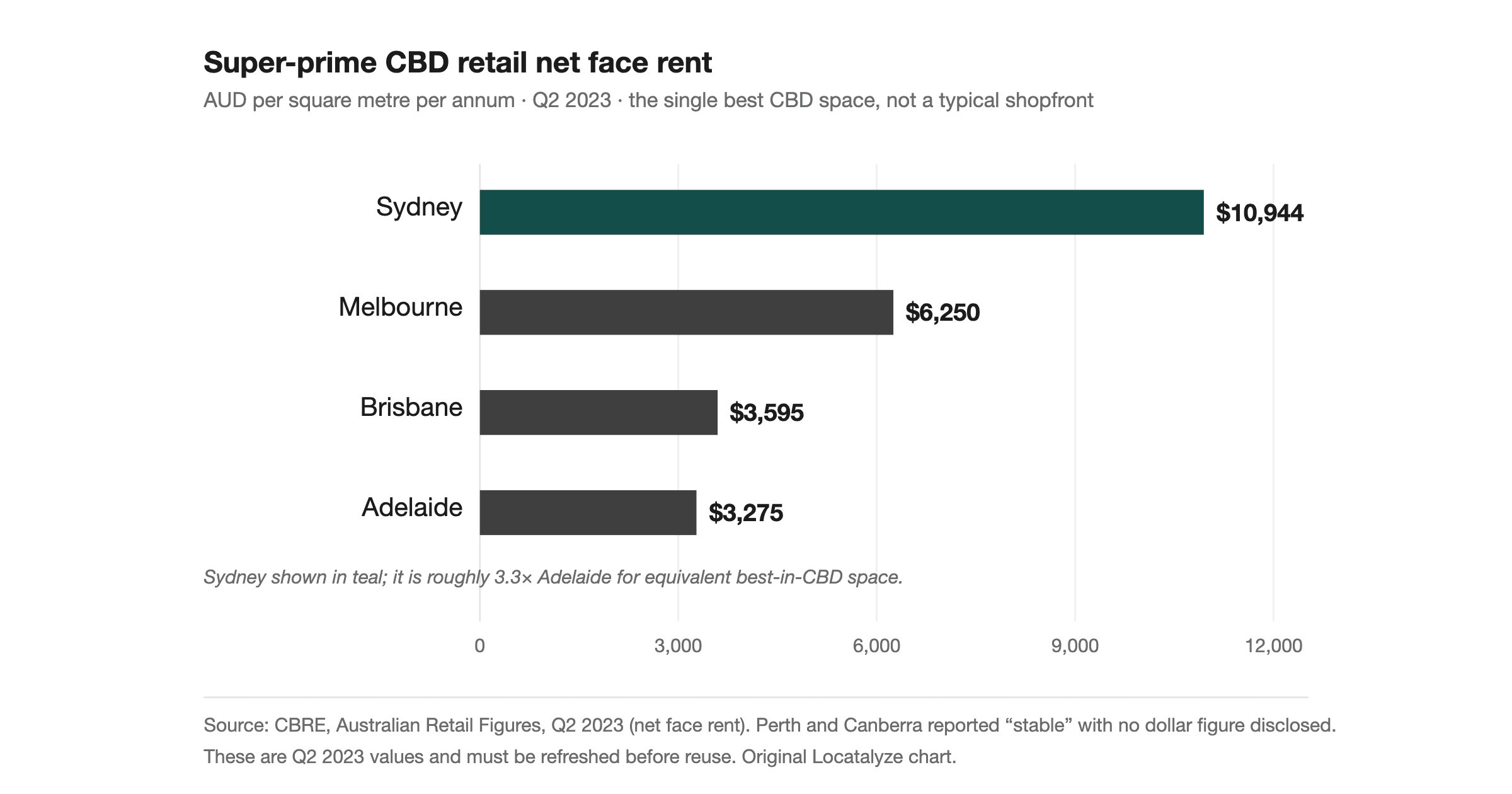
Sydney has a rent problem that Melbourne does not have to the same degree. The inner east — Darlinghurst, Potts Point, Paddington — commands rents that have historically required either very high average spend per head or very high turnover to justify. The inner west — Newtown, Marrickville, Glebe — offers more accessible rents but with trade-offs in foot traffic character. Western Sydney has the population and growth but has historically been underserved by the restaurant industry in ways that either represent opportunity or reflect genuine demand constraints, depending on the concept.
The core question a Sydney restaurant operator needs to answer before selecting a suburb is not "where do I want to be?" It is "what is my price point and how many covers at that price point does this location support?" A restaurant building its model on $85 average spend per head cannot work in a suburb where the median household income is $65,000 and the Friday night cultural behaviour is delivery-first. A restaurant built on $35 casual dining will be strangled by a Surry Hills or Paddington lease. The suburb and the financial model must be matched from the start.
Tier 1 — The established go-to precincts (and their real risks)
Surry Hills: where Sydney's food scene concentrates — and why it is harder than it looks
Crown Street between Cleveland Street and Oxford Street is Sydney's most celebrated independent restaurant corridor. The customer base is genuinely excellent — the Surry Hills suburb median weekly household income was $2,308 at Census 2021 (~$120k annualised; ABS QuickStats) — high relative to NSW, though 1 km catchments are not identical to the suburb boundary, the cultural appetite for dining out is among the strongest in the country, and the foot traffic on Friday and Saturday evenings is real. But the rents are among the highest of any restaurant strip in Australia outside of the CBD, and the competition is relentless. Operator mapping typically finds a very dense food cluster around Crown Street (often well over a hundred food businesses within roughly 800 metres — ESTIMATE from listing/maps counts, not an official ABS count). A new restaurant entering Surry Hills without a clear identity — a cuisine, an aesthetic, a story that stands apart — is entering a market that will not wait for it to find itself.
The specific streets within Surry Hills matter considerably. The Crown Street main strip between Oxford and Cleveland is the highest-competition, highest-foot-traffic zone — appropriate for well-capitalised operators with defined concepts. Riley Street and the blocks connecting toward Devonshire Street are quieter, offer rents 15–25% lower, and have seen new restaurant openings succeed in the last two years where the Crown Street main strip has continued to churn tenants. Bourke Street toward the Moore Park end is a lower-density residential zone where dinner trade is driven by local loyalty rather than passing traffic — completely viable but a different business model.
Surry Hills — Locatalyze read (2026)
LOCATALYZE ANALYSIS / ESTIMATE rent brackets (verify with current listings): Best streets: Crown St (Riley St to Devonshire zone), Devonshire St, Bourke St south end Locatalyze score range: 68–80 Rent: $5,500–$8,500/month for a 60–80sqm restaurant tenancy Median household income: $122,000 (ABS Census 2021, Surry Hills SA2) Competitors within 500m: 60–120 food businesses Avg spend per head required to sustain economics: $65–$90 Verdict: GO for well-capitalised operators with a clear concept. CAUTION on Crown St main strip for first-timers.
Newtown: the best combination of demographics, food culture, and accessible rent in Sydney's inner west
King Street, Newtown is Sydney's most diverse dining kilometre. The foot traffic on Thursday through Saturday evenings is among the highest of any dining strip in the country, the demographic — renters aged 25–40, above-average income, culturally engaged, experimental in their dining choices — is exactly what an independent restaurant needs, and the rents, while elevated, are not at the level of Surry Hills or the CBD.
The key distinction within Newtown is the section of King Street. The inner section (between St Peters Road and the Town Hall) has the highest foot traffic and the highest rents. The outer section toward Enmore Road has lower traffic but is the entry point for the Enmore dining corridor — a genuinely strong zone in its own right, anchored by the Enmore Theatre foot traffic on show nights. Enmore Road itself, running off King Street, has developed into a distinct dining strip with lower rents than King Street and growing independent character. Several well-regarded new Sydney restaurants have opened on Enmore Road in the last 18 months and outperformed adjacent King Street operators on rent-adjusted returns.
Newtown — Locatalyze read (2026)
LOCATALYZE ANALYSIS / ESTIMATE rent brackets (verify with current listings): Best streets: King St (mid-section), Enmore Road, Erskineville Road Locatalyze score range: 72–81 Rent: $4,200–$6,500/month for a standard restaurant tenancy Median household income: $95,000 (ABS Census 2021, Newtown SA2) Evening foot traffic: very high Thu–Sat; moderate Mon–Wed Avg spend per head supported: $40–$70 (wide range reflects diverse dining culture) Best concept fit: modern Asian, Mexican/Latin, natural wine bar-restaurant, vegan/plant-based Verdict: GO — one of Sydney's strongest independent restaurant locations
Analysing a Newtown or Enmore Road address? Get the full competitor map, rent benchmark, and scoring verdict before you negotiate.
Analyse Sydney restaurant address → →Tier 2 — The underrated opportunities
Marrickville: Sydney's most interesting restaurant suburb in 2026
Marrickville is doing what Newtown did fifteen years ago and what Surry Hills did twenty years before that. The demographics have shifted materially since 2016 — the ABS shows household income growth in the Marrickville SA2 of over 22% in real terms between 2016 and 2021, driven by an influx of 28–42 year old professionals who have been priced out of Newtown and Surry Hills. The food culture has followed: Marrickville's Illawarra Road and the Sydenham Road precinct now have a genuine independent hospitality scene with several nationally recognised restaurants operating from addresses that five years ago were unremarkable.
Rents in Marrickville are $3,200–$4,800 per month for a standard restaurant tenancy — roughly 25–35% below equivalent Newtown sites. Competition is growing but is not yet at a level that makes differentiation mandatory. The risk is the transition period: a Marrickville restaurant opening in 2026 will need to attract customers who still primarily think of Newtown as the destination and have not yet built the habit of travelling the extra kilometre. The operators who are succeeding are investing in their own visibility — social media, press, events — not waiting for the street to do the work for them.
Marrickville — Locatalyze read (2026)
LOCATALYZE ANALYSIS / ESTIMATE rent brackets (verify with current listings): Best streets: Illawarra Road, Sydenham Road, Marrickville Road precinct Locatalyze score range: 70–78 Rent: $3,200–$4,800/month Median household income: $94,000 and rising (ABS Census 2021, rapid change observed 2021–2026) Competition: growing but manageable (2–6 within 300m depending on exact site) Best concept fit: small casual, modern bistro, small-bar-restaurant hybrid, value-premium positioning Verdict: GO — the most compelling risk-adjusted opportunity in Sydney's inner west right now
Parramatta: the opportunity that Sydney restaurants keep ignoring
Greater Western Sydney had about 2.6 million usual residents at the 2021 Census (ABS; compiled in WESTIR / profile.id). Parramatta is a commercial and civic heart of that region. The dining scene, relative to the population, is dramatically underserved. Church Street Parramatta has strong weekday lunchtime trade from government workers, legal professionals, and the hospital sector — a stable, high-frequency customer base that is difficult to find in most other Sydney suburbs. Evening trade is growing, driven by a residential apartment boom that has added tens of thousands of new residents within walking distance of Church Street over the last six years.
The commercial rents in Parramatta are $3,000–$5,000 per month for a full restaurant tenancy — well below the inner east and inner west. The demographic that frequents Parramatta's growing restaurant scene is not the inner-west diner who is willing to travel for a small trendy restaurant. It is the local professional, the family on a special occasion, and the resident who wants something better than fast casual within walking distance of home. A restaurant concept calibrated to that customer — not one trying to transplant a Surry Hills identity to western Sydney — can build a very strong local business with rents that generate real margins.
Parramatta — Locatalyze read (2026)
LOCATALYZE ANALYSIS / ESTIMATE rent brackets (verify with current listings): Best streets: Church Street (both precincts), Darcy Street, the new residential precinct on the river Locatalyze score range: 68–76 Rent: $3,000–$5,000/month Daytime population: ~72,000 (ABS Working Population Profile — significantly above residential count) Best concept fit: mid-range modern Australian, reliable quality family dining, lunch-focused Key insight: concepts calibrated to the actual Parramatta customer outperform concepts transplanted from inner-city precincts Verdict: GO — particularly for operators willing to build for the actual market rather than the aspirational one
Glebe: loyal local base, low competition, manageable rent
Glebe Point Road has one of Sydney's most reliably loyal local dining bases. The demographic is a combination of long-term residents, academics and staff from the University of Sydney, and young professionals in the surrounding terrace houses. The street is not high-volume — it does not generate the foot traffic of Newtown — but the customer who does come is repeat, loyal, and values quality over novelty. For a restaurant building its model on regulars rather than destination dining, Glebe Point Road has genuine structural advantages. Rents are $3,200–$4,500 per month, competition is moderate (6–10 food businesses spread across a longer street), and the absence of a trendy reputation actually works in your favour because you are not competing against constant new openings.
Rozelle and Balmain: strong community, weekend-oriented, lower absolute volume
These inner-west villages have what most Sydney restaurant suburbs lack: genuine local loyalty built over years. The households around Darling Street in Rozelle and Balmain have median incomes well above $130,000, they eat out multiple times per week, and they are deeply tribal about their local restaurants. The trade-off is absolute foot traffic volume — these streets do not generate the pass-by numbers of Newtown or Surry Hills, which means you are almost entirely dependent on locals and word-of-mouth rather than walk-in trade. A restaurant that gets the first 80 regulars is set. One that fails to get past 40 will struggle to get to the numbers. The recipe is quality, consistency, and community engagement over the first 18 months.
Comparison table (12 precincts) — labelled analysis
Table provenance: scores and verdicts are LOCATALYZE ANALYSIS from the suburb model for restaurant-leaning formats (ranges reflect street/format sensitivity). Rent columns are ESTIMATE brackets from typical marketed restaurant tenancies — confirm face rent, outgoings and incentives in writing. They are not CBRE/Colliers published averages. Empty confidence is worse than a labelled range.
The Sydney dinner trade problem: why weekday performance determines survival
Sydney restaurants are overwhelmingly weekend-dependent compared to Melbourne. This is a structural feature of how Sydney lives and works. Monday through Wednesday dinner in most Sydney suburbs is thin. Thursday begins to recover. Friday and Saturday are strong. Sunday is inconsistent. For a restaurant with high fixed costs — a full lease, 5–8 staff, and a kitchen that needs to run — the Monday–Wednesday position determines whether the business is viable or perpetually struggling.
The suburbs that solve this problem are the ones with large daytime worker populations and the office lunch-to-dinner pipeline: Parramatta, North Sydney, Barangaroo, and select Surry Hills blocks. Suburbs that are purely residential — even wealthy residential — will deliver thin weekday trade that requires exceptional weekend performance to compensate. Before choosing a suburb, calculate how your revenue model performs if Saturday and Sunday are 35% below forecast. That scenario, for some concept and location combinations, means never reaching profitability.
Sydney dinner trade realities by suburb type
Office precinct (Parramatta, North Sydney, CBD fringe): strong Mon–Fri lunch, Thu–Sat dinner Inner west village (Glebe, Newtown, Marrickville): thin Mon–Wed, strong Thu–Sun Eastern suburbs premium (Surry Hills, Paddington): moderate Tue–Thu, strong Fri–Sun Inner west destination (Newtown main strip): strong 5 nights with right concept Purely residential suburb (most outer precincts): weekend-only; need community model to sustain
Sydney-specific mistakes that will cost you the business
The most common Sydney restaurant mistake is confusing a busy street with a viable restaurant location. Oxford Street in Darlinghurst generates enormous pedestrian traffic. It also has very high rents, a history of restaurant churn, and a foot-traffic character that is transient and not restaurant-conversion-oriented. The people walking Oxford Street at 8pm on a Friday are largely on their way to a bar, not looking for somewhere to sit down for dinner. The best restaurant locations in Sydney are not necessarily on the highest-traffic streets — they are on streets where the existing foot traffic is dinner-oriented and the rent reflects what the actual restaurant trade can support.
The second Sydney mistake is underestimating the conversion rate from residential density to restaurant covers. The apartment towers going up in suburbs like Green Square, Waterloo, and Zetland create the impression of enormous captive demand. But new-build apartment dwellers in Sydney — particularly younger professionals — have historically shown lower in-suburb restaurant spend than established suburbs, because delivery culture is strong, the street-level hospitality infrastructure has not yet developed, and residents have not formed the local dining habits that take years to build. Opening a 65-seat restaurant in a brand-new mixed-use development is a significantly different and harder proposition than opening on an established strip.
Practical checklist before signing a Sydney restaurant lease
Before committing to any Sydney restaurant location
- 1
Visit on a Thursday evening at 7pm: this is the truest test of whether a strip drives organic dinner trade
- 2
Count the occupied vs empty tables at the three nearest comparable restaurants — not just whether they are open
- 3
Calculate your required average spend per head to sustain the rent. Match it to the demonstrated spend pattern in the catchment
- 4
Ask neighbouring restaurant operators directly: what does Monday and Tuesday look like for them?
- 5
Check the planning approval for your intended use — "restaurant" in a commercial lease does not automatically permit late trading or alcohol service
- 6
Model the total 5-year lease cost: rent × 5 + fit-out + rent-free equivalent value. Compare this against your capital reserves
- 7
Get a quantity surveyor's estimate for fit-out before making your offer. In inner Sydney, fit-outs frequently cost $300,000–$600,000 for full-service restaurants
- 8
Understand what drove the previous tenant out. Speak to neighbouring businesses, not just the agent
- 9
Check the council DA tracker for road works, new developments, or approval of competing operators on the same street
- 10
Model with a 20% lower average spend than your target — a sustained cost-of-living environment means diners trade down before they stop dining out
How to use this guide before you shortlist
LOCATALYZE ANALYSIS: for a first-time independent with roughly $400k–$600k capital, precincts that more often clear a workable rent-to-cover match — when the concept fits — include Newtown (non-peak King Street sections), Marrickville, Glebe and Enmore. That is a shortlist pattern, not a ranking you can sign against without an address-level read.
For a well-funded operator with a strong concept and $700,000+ in capital, Surry Hills (the Devonshire Street to Riley Street zone, not the Crown Street main strip) still offers one of Sydney's strongest dining demographics. The competition is unforgiving but the demand is genuine and the spend per head is real. You will need a clear identity and a location that lets you build a regular before the early months of cash burn become critical.
Parramatta is the recommendation that will surprise most operators — but the data on daytime population, rent levels, and the structural underservice of a ~2.6 million-person Greater Western Sydney market (2021 Census geography) makes it the most compelling macro opportunity in Sydney for the right concept. Not a clone of an inner-city restaurant. A restaurant built for Parramatta's actual customers.
Run a Locatalyze analysis on any Sydney restaurant address — competitor map, rent benchmark, demand score, and recommendation. Typically 2–4 minutes.
Analyse Sydney restaurant address → →Next steps for Sydney operators
Sydney restaurant success is address-specific. Suburb guides are only the shortlist.
Free location score, map, data confidence and PROCEED / VERIFY / AVOID recommendation. Modelled financials stay optional.
Analyse a Sydney addressSources & verification
Related reading
Suburb deep-dive: Western Sydney Airport's 2026 opportunity map covers where the next decade's catchments are forming, and the Surry Hills suburb guide carries the engine's read on Sydney's densest dining precinct. Live scores for every Sydney suburb: the engine-ranked Sydney restaurant guide.
Frequently asked questions
About the author
Prashant GuleriaFounder, Locatalyze
Prashant Guleria founded Locatalyze to help Australian operators match format and rent to the precinct that can actually carry them.
Tools first — then a full report for your address
Free rent, viability, and break-even checks. Upgrade when you are ready for competitors, map, and numbers for a specific site.
No signup required for tools