How Much Do Café Owners Actually Make? Less Than the Listing Said, More Than the Horror Stories
Founder, Locatalyze
Every number you have read about café owner income is describing someone else's café. Broker listings quote 'adjusted' profits that add back the owner's own unpaid labour. Industry surveys average a Bondi flagship against a food-court kiosk and report a number that describes neither. And the horror stories — true as they often are — come from people who signed the wrong lease, which is a location story wearing an income costume. What you actually need is not a number. It is the machine that produces the number, so you can run it on the café you are actually considering.
This article explains structure, not promises. Costs and margins vary by site, format and operator, and nothing here is financial advice — model your own numbers with an accountant before committing capital. Where ranges appear they are indicative operating conventions used across our cost and profitability companions.
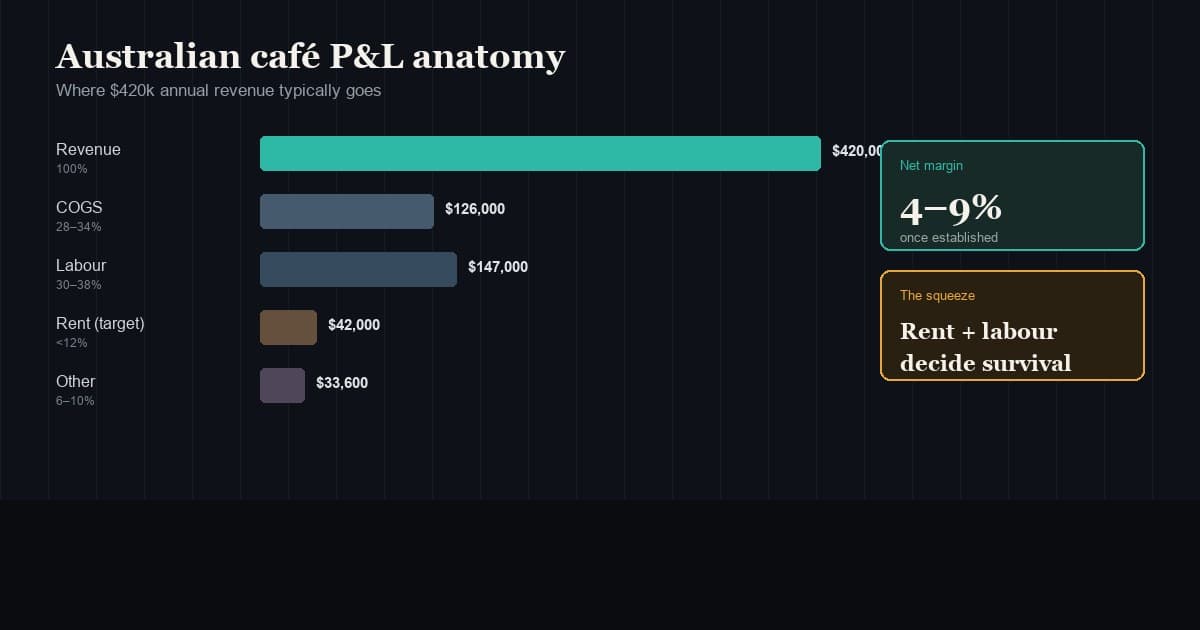
Start with the only honest framing: a café owner's income is what remains of revenue after five claims are paid, in order — suppliers, staff, the landlord, the tax office, and the equipment that is quietly wearing out. Each claim is a percentage band, and the bands are stubborn. The variation between a café that pays its owner well and one that pays nothing is rarely a clever menu. It is almost always revenue against rent — which is to say, the site.
Why every published number misleads
Three distortions run through almost every café income figure in circulation. First, survivor bias: surveys can only ask cafés that still exist, and roughly half of hospitality businesses don't survive four years — the incomes that went to zero are not in the average. Second, add-backs: a business listing's 'adjusted net profit' routinely adds the owner's own wages back into profit, which is accurate accounting for a sale and deeply misleading as an income expectation — you cannot spend the same dollar twice. Third, averaging across formats: a licensed 80-seat all-day café and a 20-square-metre espresso window are different businesses that happen to share a word.
The ATO publishes small business benchmarks for coffee shops — expense-to-turnover ranges drawn from actual tax returns, which makes them the least romantic numbers available. What they show structurally is exactly the stack below: most of every dollar of café revenue is spoken for before the owner sees any of it. Use them as a cross-check on any projection anyone shows you, including your own.
The margin stack: where each dollar goes
Notice what the stack implies. If cost of goods, labour and the miscellaneous lines are broadly similar across competently-run cafés — and they are, because they are set by awards, suppliers and physics — then the residual is decided almost entirely by two numbers: revenue, and rent. A café doing strong volume at 9% rent-to-revenue and an identical café doing modest volume at 16% are not slightly different businesses. One pays its owner properly; the other consumes them. This is why the rent-to-revenue test is the closest thing café finance has to a single controlling variable.
The owner is paid from the residual. Revenue and rent decide the residual. And the site decides both.
The owner-wage trap
Here is the question that separates honest income maths from wishful thinking: if you paid a manager award wages to do every hour you personally work in the café, what would be left? That leftover — not your takings, not your drawings — is the business's true profit. Many Australian café owners, run through this test, discover their café earns them less per hour than the baristas they employ, once their 60-hour weeks are priced at what those hours would cost to replace.
This is not an argument against owning a café. It is an argument for knowing which of three incomes you are actually buying: a job (you earn wages for hours worked, profit ≈ zero), a business (the café pays a manager and still leaves profit), or an asset (profit funds a second site or a sale). All three are legitimate. But they command very different purchase prices and justify very different rents — and most disappointment in this industry comes from paying business prices, or signing business rents, for what turns out to be a job.
The replacement test, in one line
True profit = reported profit − (award-rate cost of every hour the owner works unpaid). Run it on your projection, and on any café you are thinking of buying — the seller's 'adjusted net profit' almost never survives it intact.
What separates well-paid owners from unpaid ones
In rough order of leverage
Read that list again and count how many items are decided before opening day. The first, second and fourth are properties of the address. This is the quiet finding across our failure-rate analysis and the profitability breakdown: operators control the middle of the stack, but the site controls both ends — the revenue coming in and the rent going out.
Compute your own number
- 1
Estimate conservative daily transactions from a real foot-traffic count at the actual site — not the strip's best hour
- 2
Multiply by a realistic ticket for the catchment, then by 26 trading days for monthly revenue
- 3
Apply the stack: subtract ~32% goods, ~32% staff (excluding you), the actual quoted rent, and ~12% for everything else
- 4
Subtract award-rate wages for every hour you will personally work
- 5
What remains is the true annual profit. If it is negative at conservative volume, the site has answered your question
Steps 1–3, computed for a real address
A Locatalyze report models the demand a specific address supports, benchmarks the asking rent against its suburb and category, and returns a PROCEED / VERIFY / AVOID recommendation with the break-even workings — the site half of your income equation, before you commit to it.
Analyse an addressFAQ: café owner income in Australia
Is owning a café profitable in Australia?
It can be — but profitability is bimodal, not average. Cafés with strong site economics (healthy rent ratio, reliable morning volume) pay their owners properly; cafés without them consume owner labour for years. The determining decisions are mostly made before opening: the suburb, the site, and the lease.
Why do café income figures vary so wildly?
Because 'café' spans formats with completely different economics, because listings add owner wages back into profit, and because failed cafés exit the statistics. Treat any single published figure as marketing until you have seen the stack behind it.
What is a good profit margin for a café?
After paying the owner honestly for their hours, established well-sited cafés typically retain a single-digit-to-low-teens percentage of revenue as true profit — and the difference between the top and bottom of that range is usually rent. The full profitability breakdown works through the bands line by line.
From here: what it costs to open a café covers the capital side of the same equation, buy a café or build one? applies this income lens to the purchase decision, and the café failure-rate data shows what happens to the cafés that skip the maths.
Last reviewed 30 August 2026. Award rates, superannuation and tax settings change regularly — model current figures with your accountant, and check the ATO's small business benchmarks for the current expense ranges.
About the author
Prashant GuleriaFounder, Locatalyze
Prashant co-founded Locatalyze after encountering the difficulty of evaluating commercial locations for his own businesses. He leads the product around the practical questions independent operators need to answer before committing to a lease.
Tools first — then a full report for your address
Free rent, viability, and break-even checks. Upgrade when you are ready for competitors, map, and numbers for a specific site.
No signup required for tools