How Much Foot Traffic Does a Café Actually Need?
Founder, Locatalyze
“Find high foot traffic” is empty advice until you translate rent, ticket size and conversion into a number you can count on the footpath. This piece walks that arithmetic as a MODEL — so you can replace the assumptions with your own lease and menu — not as a claim that every Australian café needs the same daily count.
Evidence standard
All worked pedestrians-per-hour figures are MODEL / ILLUSTRATIVE arithmetic from stated rent, ticket and conversion assumptions. FACT context: ATO coffee-shop rent÷turnover bands (2023–24) for whether the rent in the model is in a plausible occupancy range. City sensor networks measure volume on instrumented streets only. Locatalyze address reads are LOCATALYZE ANALYSIS.
Why "High Foot Traffic" Without a Number Is Dangerous Advice
The advice to find a high foot traffic location sounds actionable. In practice, it sends operators to stand outside potential locations during the busiest possible time — Saturday afternoon, Friday lunch, a market day — and evaluate whether the street "feels busy enough." This evaluation process is systematically biased toward overestimating typical foot traffic, because the times operators naturally visit potential locations are precisely the times that maximise pedestrian activity.
More fundamentally: the question isn't whether the street is busy. The question is whether it's busy enough with the right kind of traffic, at the right time, to support the specific revenue requirement of your specific café, at your specific rent. A street that feels busy on Saturday afternoon might generate 40% less foot traffic on a Tuesday morning — which is, for most café formats, a more commercially important trading period. A street with 3,000 daily pedestrians might be dominated by commuters in transit who have eight minutes before their train and are not making a café stop decision. A street with 1,200 daily pedestrians might be dominated by office workers with a genuine 30-minute lunch window and a real appetite for exactly what you're selling.
The only way to evaluate foot traffic meaningfully is to calculate the specific count you need, count what's actually there, and compare the two numbers. Everything else is impression management.
The Foot Traffic Calculation: A Step-By-Step Framework
Step 1: Calculate Your Weekly Revenue Requirement
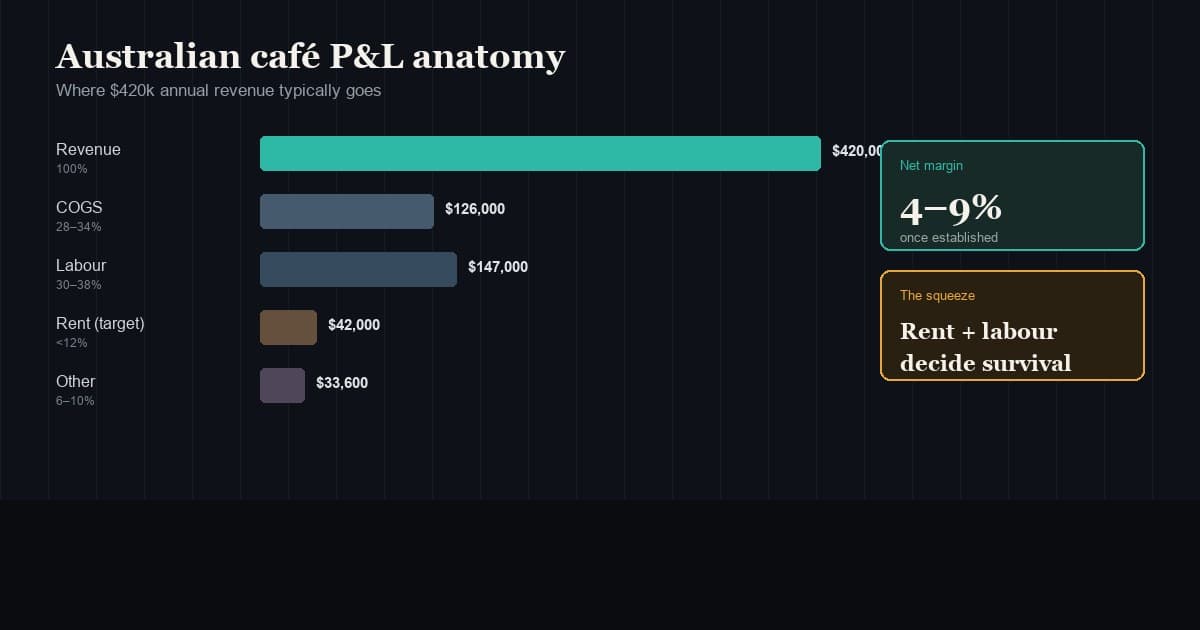
Start from your cost structure, not your aspiration. A standard owner-operated café in an Australian metro market has four primary cost lines: rent (target: 6–10% of revenue), food and beverage cost (typically 28–33%), labour (typically 32–38%), and other overheads — utilities, packaging, insurance, accounting, waste removal, cleaning (typically 12–15%). Together these represent 82–96% of revenue. Net profit, if it exists, is the difference between 100% and that total.
Work backward from rent. If your all-in weekly rent is $3,200, and you want rent to represent 10% of revenue (the outer limit of viability for most café formats), you need weekly revenue of $32,000. If you want rent at 8% (healthier), you need $40,000. These are your revenue targets. Now build a cost model: at $32,000 revenue per week with 30% food cost ($9,600), 35% labour ($11,200), and 13% other overheads ($4,160), you have $7,040 for rent — which is $3,840 per week. Your $3,200 rent fits within that structure at 10%. Marginally. On a good week.
Step 2: Calculate the Customers Required Per Day
Convert your weekly revenue requirement to a daily customer count. To do this, you need one more number: your average revenue per customer transaction.
For most café formats in Australian metro markets: coffee-only customers average $5–$6.50 per transaction (single espresso-based drink or small tea). Coffee plus food customers average $17–$24 depending on the food offer. The proportion of transactions that include food varies significantly by format — a destination brunch café might see 60–70% food attachment; a takeaway-focused commuter café might see 15–25% food attachment.
Blended average transaction calculation: (% coffee-only × coffee-only average) + (% coffee+food × coffee+food average). For a café with 70% coffee-only transactions at $5.80 and 30% coffee+food transactions at $19.50: (0.70 × $5.80) + (0.30 × $19.50) = $4.06 + $5.85 = $9.91 blended average. Round to $10 for simplicity.
Weekly revenue target ($32,000) ÷ blended average transaction ($10) = 3,200 transactions per week. Trading 6 days per week: 533 transactions per day. This is your daily customer target. Not your aspiration. The minimum required for the business model to work.
The four inputs you need
1. All-in weekly rent (base + outgoings) 2. Target rent-to-revenue ratio (8% is healthy, 10% is outer limit) 3. Blended average transaction value for your format 4. Trading days per week Formula: (Rent ÷ Ratio) ÷ Avg Transaction ÷ Trading Days = Required Daily Customers
Step 3: Convert Daily Customers to Required Foot Traffic
Here's where most operators dramatically underestimate their foot traffic requirement. The conversion rate — the percentage of pedestrians who walk past your café and actually enter — is much lower than intuition suggests. For most café locations in Australian markets, a realistic range is:
Using the mid-block main strip scenario (2.5% conversion) for a café needing 533 daily customer transactions: 533 ÷ 0.025 = 21,320 daily pedestrians required. That is a very busy street. For context, major Australian suburban shopping strips typically generate 5,000–12,000 daily pedestrians. The main commercial strips in CBDs of Sydney and Melbourne generate 15,000–40,000. Most mid-suburban main streets generate 2,000–6,000.
At a 2.5% conversion rate, your café needs to be on a street with more than 21,000 daily pedestrians to generate 533 daily transactions from walk-in traffic alone. At a 1.5% conversion rate (more typical for a café mid-block on a quieter main strip), the required daily pedestrian count is 35,533. These numbers are higher than the foot traffic on most Australian suburban commercial streets.
What These Numbers Actually Mean in Practice
There are two responses to these calculations. The first is alarm: "The foot traffic requirement is higher than I thought. This means the location I was considering might not work." The second — and more useful — response is: "Now I know what I'm solving for, and I can adjust one or more variables to make the equation work."
Variable 1: Increase your average transaction (the hardest lever)
If you can increase your blended average transaction from $10 to $15 through better food attachment, a higher-margin menu, or a larger average ticket on specialty coffee, your required daily foot traffic drops by 33% — from 21,320 to 14,213. That's a very significant change that moves many mid-tier suburban locations from "doesn't work" to "works if everything else is strong." The constraint: format changes to drive food attachment need to be real and sustainable, not aspirational. A café that depends on 65% food attachment to make its economics work needs to actually achieve 65% food attachment from day one, not in year two.
Variable 2: Improve your conversion rate (achievable through positioning)
A corner position rather than mid-block, open-plan frontage rather than recessed entry, strong visual cues (coffee roaster visible from street, sandwich board strategy, excellent exterior signage) can move your conversion rate from 2.5% to 4%. At 4% conversion, your required foot traffic for 533 daily transactions drops to 13,325 — a number that many active suburban main strips can sustain. The specific choices around location position and physical layout that maximise conversion are therefore direct revenue decisions, not aesthetic ones.
Variable 3: Reduce your rent requirement (the most impactful lever)
If your all-in weekly rent is $2,400 instead of $3,200, your required weekly revenue drops to $24,000 at 10% ratio. At $10 blended average, that's 400 daily transactions instead of 533. At 2.5% conversion, required daily pedestrians: 16,000. That's within reach of many active mid-suburban main strips. The same café concept on a street with 16,000 daily pedestrians is viable at $2,400 rent and unviable at $3,200 rent. The rent decision is simultaneously the most influential location decision and the one where operators have the most negotiating leverage if they know their numbers.
The Time-of-Day Distribution Problem
The total daily pedestrian count matters, but its time-of-day distribution matters more for most café formats. A street with 18,000 daily pedestrians where 60% of them move through in a 6am–9am commuter surge and 8,000 are present in a slow trickle across the remaining 15 hours is a very different commercial environment from a street with 18,000 daily pedestrians distributed evenly across 12 trading hours.
For a café whose economics depend heavily on commuter morning trade, the 7–9am window is everything. You need to count pedestrians specifically in that window, not total daily count. A busy commuter corridor that generates 2,800 pedestrians per hour in the 7–9am window and then drops to 180 per hour for the rest of the day has excellent morning economics and poor afternoon economics. Whether that's a good location for you depends entirely on whether your format is morning-anchored or whether you need consistent mid-morning and lunchtime trade as well.
7–9am
MODEL / LOCATALYZE ANALYSIS: The window that determines café viability for commuter-position locations
30–40%
MODEL / LOCATALYZE ANALYSIS: Of total daily café revenue generated in the 7–9am window for well-positioned commuter cafés
2.5%
MODEL / LOCATALYZE ANALYSIS: Realistic conversion rate for a mid-block main strip café — lower than most operators assume
How to Actually Count the Foot Traffic You Need
The calculation is only as good as your foot traffic count input. Manual counting — standing outside a location with a clicker for 2 hours at your primary trading period — is achievable for any operator, costs nothing, and produces useful data even if it's not as sophisticated as a mobile device location study. Do it three times: once on a Tuesday morning at 7:30–9:30am, once on a Thursday lunchtime at 12–2pm, and once on a Saturday morning at 9–11am. If you can do it across two separate weeks, including one school-holiday week, even better.
Compare the number you get to the number you need from your foot traffic calculation. If the count is materially below the required number — say, 8,000 daily pedestrians when you need 16,000 — the gap represents a structural problem that no execution improvement can bridge. If the count is at or above the required number, the location has the raw traffic volume to support your business model and the question becomes whether your format, conversion rate, and rent combine into a viable equation.
The Calculation That Should Happen Before Every Site Visit
Here is the practical conclusion from all of this. Before you visit any potential café location, before you walk through the door and start imagining how your fit-out would look in the space, do this calculation:
- 1
Get the all-in weekly rent estimate (ask the agent for an outgoings estimate, not just base rent).
- 2
Divide by 0.10 to get your required weekly revenue at 10% ratio.
- 3
Divide by your expected blended average transaction to get required weekly transactions.
- 4
Divide by your trading days to get required daily transactions.
- 5
Divide by your expected conversion rate (use 0.025 as a conservative starting point) to get required daily foot traffic.
- 6
Before visiting: check whether the location's pedestrian count is plausibly in that range. If the required count is 20,000 and the street looks like a quiet residential lane, you have your answer without a site visit.
This calculation takes four minutes with a phone calculator. It will save you from falling in love with spaces that can never support a viable business at the rent being quoted. It will focus your site visits on locations where the foot traffic math is at least plausible. And it will give you, for the first time, a specific number to look for when you're standing outside a potential location rather than a vague impression of whether the street "feels busy enough."
Counted your corner? Turn the number into a verdict
You stood there at 7:30am and counted 43 people — now what? The free break-even calculator turns your count, capture rate and rent into the daily revenue test, and a full report models the address's demand, competition and rent together with a PROCEED / VERIFY / AVOID recommendation.
Run your numbersKnow the foot-traffic math? Now check the address.
Required daily passers-by is only half the decision. Screen catchment, competition and rent fit for a specific café address before you visit — free score and recommendation, no card to begin.
Analyse a café address freeSources & verification
Related reading
Do the count properly first: how to analyse foot traffic covers method and timing, and the break-even foot traffic calculator does the arithmetic on whatever you count.
About the author
Prashant GuleriaFounder, Locatalyze
Prashant built Locatalyze because location intelligence should be data-driven, not anecdotal. He is obsessed with making the maths of location decisions accessible to every Australian operator.
Tools first — then a full report for your address
Free rent, viability, and break-even checks. Upgrade when you are ready for competitors, map, and numbers for a specific site.
No signup required for tools