Esperance Has World-Class Beaches and a Food Scene That's Wide Open. Here's What the Numbers Say Before You Commit.
Founder, Locatalyze
Esperance sits on one of the most spectacular coastlines in Australia — Lucky Bay, Cape Le Grand, the Pink Lake — and is gaining national recognition as a bucket-list destination that mainstream Australian tourism is only beginning to discover at scale. The population is approximately 14,000 permanent residents. The tourist visitation has been growing at 12–18% per year over the past five years, driven by social media coverage of the beaches and the development of Cape Le Grand National Park. And the food and beverage scene remains, for a destination of this quality, genuinely underserved. There are opportunities here that don't exist in the capital cities — not because they're easier, but because the market is thin enough, and growing fast enough, that the right format in the right position can establish a dominant market position within months rather than years. But Esperance is also one of the most commercially unusual markets in Australia, with mechanics that will surprise operators who don't understand them before they commit.
The Esperance Market: What Makes It Genuinely Different
Operating a food and beverage business in Esperance is categorically different from operating in any Australian capital city or major regional centre. The difference isn't just scale — it's the fundamental structure of the demand. In a capital city, your demand is primarily driven by a stable, growing resident population with predictable habits. In Esperance, demand is a three-way split between: permanent residents (14,000 people, your year-round baseline), agricultural and mining industry workers (transient, well-paid, volume-hungry), and tourists (rapidly growing, highly seasonal, concentrated in the October–April warm-weather period).
Each of these demand streams has completely different commercial characteristics, and a format that captures one well often serves the others less effectively. The café designed for the tourist market has the aesthetic, the Instagram appeal, and the price point for visitors spending freely on a once-in-a-lifetime trip. The same café may feel too precious and expensive for the agricultural workers who want a big breakfast and a flat white at 6:30am before heading out to the farm.
14,000
Permanent Esperance population — your year-round baseline
+15%
Annual tourist visitation growth rate 2021–2025
$800–$2,000
All-in weekly rent range — among the lowest commercially viable rents in Australia
The Seasonal Extreme: The Most Important Variable in Esperance
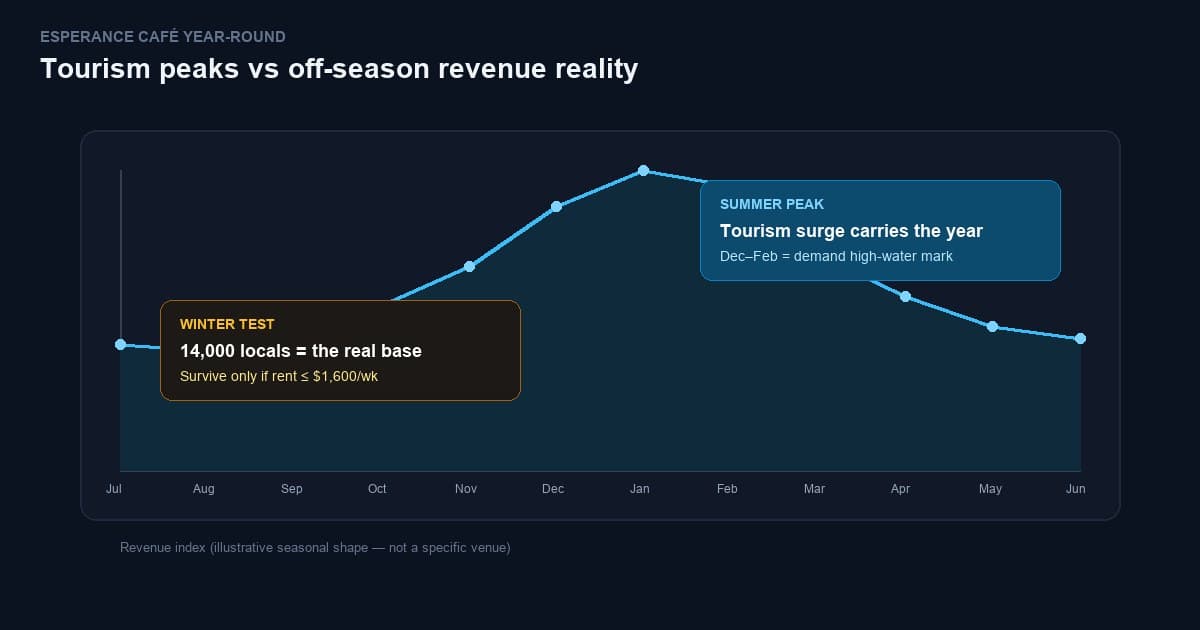
Esperance's trading seasonality is among the most extreme of any Australian market. The peak tourist season — October through April, aligning with the warm weather and school holiday periods — generates tourist visitor volumes that can temporarily multiply Esperance's effective population by 1.5–3 times. The major accommodation occupancy rates during this period regularly hit 85–95%. Certain long weekends see all accommodation booked months in advance.
The winter period — May through September — sees tourist volumes drop sharply. The permanent population of 14,000 remains, supplemented by the agricultural and mining worker population. But the sheer volume that the tourist season brings is absent, and a business model that requires tourist volume to cover its costs cannot survive the winter on local patronage alone.
The business model test for any Esperance food and beverage concept is this: can the business break even on permanent resident and agricultural worker patronage alone, during the off-season, without tourist revenue? If the answer is no — if the rent and cost structure requires tourist volume to cover fixed costs — then the business has a structural cash flow problem that six months of good tourist season cannot permanently solve.
The Supply Chain Reality
Esperance is 720km from Perth by road. This geographic reality has direct commercial consequences that operators who have never run a remote-location business consistently underestimate.
Food supply logistics are more complex and more expensive than in any capital city or major regional centre. Fresh produce deliveries are less frequent — typically two to three times per week rather than daily. Lead times for speciality orders are longer. Wastage is higher when deliveries are delayed or when demand is lower than forecast. And the cost of supply is structurally higher, partly because of freight but also because the smaller market means less supplier competition and less negotiating leverage for individual operators.
Equipment maintenance and repair is a specific operational risk. When a commercial refrigerator fails in Melbourne, a technician can be there within hours. When a commercial refrigerator fails in Esperance, the parts may need to come from Perth and the wait may be several days. A backup strategy for critical equipment failure is not a nice-to-have in Esperance — it is an operational necessity.
The supply chain cost buffer every Esperance operator needs
Budget 8–12% higher food and consumables costs than a comparable Perth business as a baseline assumption — this reflects freight, reduced supplier competition, higher wastage from less frequent deliveries, and the cost of maintaining buffer stock to manage supply disruptions. This directly affects your break-even revenue calculation. Run the numbers with this cost buffer before you model viability.
The Competitive Landscape: Thin But Not Empty
Esperance currently has a limited number of established food and beverage operators relative to its tourist visitation growth. This creates genuine opportunity — particularly in café formats that serve the tourist market's desire for quality experiences, and in mid-range dinner concepts that don't currently exist at the quality level the growing tourist demographic would support.
The competitive thinness is partly an opportunity and partly a signal. Esperance's permanent population of 14,000 has limited density to sustain multiple competing operations in the same category simultaneously. The market can support one excellent breakfast café. It is more doubtful that it can support three simultaneously. Any entrant needs to be either the first or the clearly best in their category — not because excellence is always rewarded, but because in a market this small, being second or third in a category means fighting for scraps from a population that already has its first choice established.
What Works in Esperance
Format profiles with genuine viability in the Esperance market:
Locatalyze covers Esperance with seasonality-adjusted modelling, supply chain cost benchmarking, and tourist demand projection analysis for your specific address.
Free location score, map, data confidence and PROCEED / VERIFY / AVOID recommendation. Modelled financials stay optional.
Analyse my Esperance locationRelated reading
About the author
Prashant GuleriaFounder, Locatalyze
Prashant built Locatalyze to give operators in every Australian market — not just capital cities — the commercial intelligence that makes location decisions sound.
Tools first — then a full report for your address
Free rent, viability, and break-even checks. Upgrade when you are ready for competitors, map, and numbers for a specific site.
No signup required for tools