Mandurah's Food Scene Is Growing Fast. Most New Operators Are Still Misreading the Market.
Founder, Locatalyze
Mandurah has been growing steadily for two decades. The canal system and estuary position has made it one of Western Australia's most appealing lifestyle destinations for retirees, weekenders, and coastal families priced out of Perth's inner suburbs. The population has crossed 100,000. New residential development continues to deliver density. And the hospitality market has been trying to catch up with a demographic that is, by the numbers, ready for better food and beverage options than the market has historically supplied. The opportunity is real. Operators who have done the analysis and entered at the right rent, right format, and right position in the market have built strong, profitable businesses. Operators who entered without adequately modelling Mandurah's specific commercial dynamics — its seasonal volatility, its retiree-vs-tourist demand structure, its weekend-heavy trading profile — have been consistently disappointed. This analysis tells you which category to be in.
The Mandurah Market in Numbers
105,000+
Mandurah metropolitan population — and growing
37%
Population aged 55+ — one of Australia's highest proportions for a city this size
$1,400–$3,200
All-in weekly rent for food and beverage tenancies on Mandurah Terrace and adjacent strips
Two numbers from that table define the entire commercial strategy for food and beverage in Mandurah. The population is over 100,000 — large enough to sustain multiple quality operators at viable rent levels. And 37% of that population is 55+ — the highest proportion of older residents for any Australian city of comparable size, and a demographic with fundamentally different hospitality behaviours from the younger, professional markets that most Sydney and Melbourne operators are used to targeting.
The Retiree Demographic: What It Means Commercially
The 55+ demographic in Mandurah is not monolithic. It spans from affluent canal-estate retirees who sold Cottesloe homes and are sitting on $1.5M+ in real assets, to more modest retirees on fixed incomes who regard dining out as an occasional rather than habitual pleasure. The commercially relevant segment is the middle-to-upper end of this group — the active, financially comfortable retirees who dine out regularly, care about quality, and have the time and inclination to become loyal regular customers of a concept they trust.
This segment has specific commercial characteristics that differ significantly from the younger-professional demographic most operators know. They dine earlier — peak dinner service for Mandurah's core retiree demographic is 5:30–7:30pm, not 7:30–9:30pm. They have lower alcohol consumption on average, which reduces per-head revenue from beverages but increases table turnover. They are extremely loyalty-driven — a retiree couple who likes your restaurant will come back every week or two for years, whereas a younger demographic might visit four times and move on to the next new opening. And they are highly word-of-mouth dependent — the social networks of an active retiree community are tight, and a positive reputation spreads fast and durably.
The Mandurah service time shift
In most Australian restaurant markets, dinner service peaks between 7:30pm and 9pm. In Mandurah, the peak for the core dining demographic is 5:30–7:30pm. An operator who staffs and kitchens for 7:30pm peak will miss the volume. An operator who starts dinner service at 11:30am-style energy and peaks at 6pm will capture the market. This is not a compromise — it's a format calibration. The operators who fight the Mandurah market's timing preferences lose covers. The operators who embrace them build the kind of loyal regular patronage that is extremely rare in more competitive markets.
The Seasonal Pattern: More Extreme Than Operators Expect
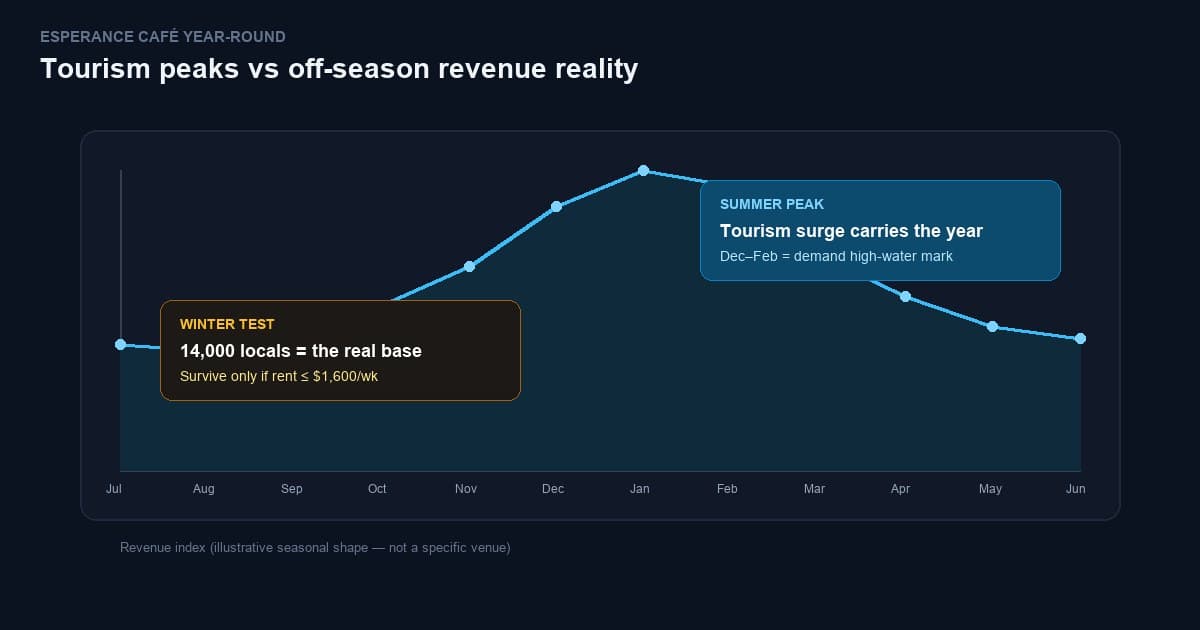
Mandurah's food and beverage economy has a seasonal trading profile that is more extreme than most operators from Perth or the eastern seaboard expect. The Western Australian summer holiday period — December through January — generates the highest foot traffic and revenue of the year, driven by Perth families using Mandurah as a summer coastal destination and the return of seasonal residents. School holidays in April, July, and September create secondary peaks. The Mandurah winter (June–August) is mild by most Australian standards but is still materially quieter than summer, particularly for tourist-facing and waterfront businesses.
The critical analytical discipline: model your annual average revenue, not your summer peak. An operator who visits Mandurah in January and sees packed restaurants and strong pedestrian activity on the Terrace is seeing the very best version of the market. The relevant question is what that same location looks like on a Tuesday in July — and whether the rent, modelled against the true annual average (not the January peak), produces a viable business.
The Mandurah Terrace Geography
Mandurah's primary hospitality strip runs along Mandurah Terrace and the waterfront adjacent to the Peel Inlet. This position — water-facing, with strong visual appeal and the tourist traffic that comes with it — commands the highest rents in the market and the most tourist-weighted foot traffic. It is the right position for concepts that benefit from tourist volume and destination appeal. It is a more challenging position for concepts whose economics depend on consistent year-round local patronage, because the tourist premium in the rent doesn't disappear in winter when the tourist volume does.
The inland side streets and the Mandurah Forum precinct have lower rents and a more consistent, local-patronage-dominant trading profile. Less glamorous. More predictable. For an operator whose format is built around repeat local visitation rather than tourist discovery, the lower-rent, more-local positions often produce better annual unit economics despite lower peak-period revenue.
Format Profiles That Work in Mandurah
What the Mandurah market demonstrates it will sustain:
Locatalyze provides seasonality-adjusted revenue modelling for any Mandurah address — see the annual average, not just the summer peak, before you commit.
Free location score, map, data confidence and PROCEED / VERIFY / AVOID recommendation. Modelled financials stay optional.
Analyse my Mandurah locationRelated reading
About the author
Prashant GuleriaFounder, Locatalyze
Prashant built Locatalyze to make rigorous location intelligence accessible to every Australian operator, in every market.
Tools first — then a full report for your address
Free rent, viability, and break-even checks. Upgrade when you are ready for competitors, map, and numbers for a specific site.
No signup required for tools