$150,000 or $400,000? Why Nobody Can Quote Your Café Until They've Seen the Site
Founder, Locatalyze
Search for what it costs to open a café in Australia and you will find a lot of confident numbers. Notice who is publishing them. Fit-out companies publish fit-out costs. Equipment suppliers publish equipment costs. Franchise groups publish the figure that makes their franchise look reasonable. Almost nobody publishes the total, because almost nobody sells the total, and the parts that have no vendor attached to them are the parts that sink people.
Some links on this page are affiliate links. If you sign up through one, Locatalyze may receive a commission at no additional cost to you. We only include products we believe are relevant, and none of the recommendations change if the links are removed. Cost ranges quoted here are drawn from published Australian trade sources and are indicative only. They are not a quote, and they are not financial advice. Get three written quotes for your own site.
There is a second problem underneath that one. Every published figure is a national average, and there is no such thing as a national café. The same 90 square metre shop costs wildly different amounts to open depending on whether the previous tenant was a café, a clothing shop, or nothing at all. That single fact moves the number more than your finishes, your coffee machine and your designer combined.
So this article does two things. It gives you the full set of buckets, with real Australian ranges and where they come from. Then it shows you which parts of your own site set your number, so you can work out yours rather than borrowing someone else's.
The number you were quoted
Australian fit-out contractors publishing 2026 guidance generally put café work somewhere between $1,500 and $4,500 per square metre, with the low end covering a basic espresso bar and the top end covering a full commercial kitchen behind premium front-of-house finishes. Translated into project totals on an 80 to 150 square metre tenancy, the same sources describe a basic espresso bar build at roughly $80,000 to $150,000, a mid-range café with custom joinery and a compact commercial kitchen at roughly $150,000 to $350,000, and a full-service café or small restaurant at $350,000 to $700,000 and up.
Those ranges are useful and I have no reason to think they are dishonest. But understand what they are: the price of the thing the publisher sells. A fit-out quote covers construction and joinery and, sometimes, kitchen equipment. It does not cover the six other buckets below, and those buckets are collectively about the same size again.
The single most common budgeting error
Treating the fit-out quote as the capital requirement, and treating everything else as small. The quote is typically somewhere near half of the cash you need to get from lease signature to a trading business that covers its own costs. If you have funded the quote and nothing else, you are not underfunded by a little.
Bucket 1: fit-out and kitchen
This is the bucket everyone models, so I will be brief. The kitchen specification is the dominant variable. Australian trade sources put a small café kitchen of 20 to 40 square metres at roughly $50,000 to $200,000 including equipment, and a restaurant kitchen of 60 to 100 square metres at $200,000 to $500,000 and above. The gap between the bottom and top of that range is not finishes. It is whether you are frying, whether you have gas, and how much mechanical ventilation the build needs.
One note on second-hand equipment, because it is where people reach first when the quote comes back high. Buying from a closing business is often good value, and it carries a specific risk: if the gear is subject to a security interest, the financier can repossess it from your premises even though you paid for it and have a receipt. Search the Personal Property Securities Register before you hand over money. It costs a couple of dollars.
Bucket 2: the services nobody quotes
This is the first bucket with no salesperson attached to it, which is exactly why it is missing from most published guides. These are the connections and approvals that make the building capable of being a food business.
The four that catch people
Do this before you sign anything
Get a fit-out contractor and, if you are cooking, a mechanical services contractor to walk the tenancy with you before you commit to the lease. Two hours of someone's time will tell you whether this bucket is $20,000 or $90,000, and that difference is usually larger than the rent negotiation you are about to spend three weeks on.
Bucket 3: money you hand over and don't get back
Some of this is recoverable in theory and none of it is available to you while you are opening, which for cash-flow purposes makes it the same as spent.
What sits here
The bank guarantee deserves a specific note. It is not cash you hand to the landlord; it is a commitment from your bank, and the bank will normally want that amount held as security. Either way it is capital that sits idle for the term of the lease. On $5,000 a month gross rent, a six-month guarantee is $30,000 you cannot spend on anything else for five years.
Bucket 4: professional fees and compliance
I am not going to publish fee ranges for solicitors, designers or certifiers, because the spread is enormous and a made-up midpoint would be worse than nothing. What I can tell you is which items exist, because the ones people forget are the compliance items, not the design ones.
Run your address and business type through ABLIS to get the actual federal, state and local list for your site, and check the Food Standards Australia New Zealand requirements for food safety management tools. Do it the week you get the lease offer, not the month before you open.
Bucket 5: stock, uniforms and opening
The smallest bucket and the one most likely to be paid for on a credit card at 2am in the week before opening. Opening stock across coffee, food, packaging and cleaning. Uniforms. Menus and signage. Point of sale hardware and the merchant facility. Small wares, which is the category that quietly doubles: tongs, tubs, trays, chopping boards, the third set of milk jugs you did not know you needed.
Tool worth looking at
Square
Best for. Counter-service cafés that want terminal, POS, reporting and accounting integration as one purchase rather than four decisions, with hardware they own outright and no monthly minimum.
Why it belongs here. Point of sale belongs in the capital budget as a real line, not an afterthought, and it has a lead time. A merchant facility needs approval and the hardware needs to arrive and be configured with your live product file before you trade. Starting six weeks out is comfortable. Starting the week before is how venues open on cash and a phone reader.
Check before you commit. The per-transaction rate against the volume you are actually forecasting, because flat-rate pricing is excellent at low volume and stops being cheapest as you grow. If you are running table service with course firing and split bills across many covers, a purpose-built hospitality POS earns its higher price.
Worth comparing against. Lightspeed or Impos for full table service and multiple revenue centres. For a counter-service café that capability is cost without benefit.
Explore Square →Bucket 6: working capital, the one that closes businesses
Every other bucket buys you an asset. This one buys you time, and it is the only bucket where running out ends the business rather than delaying it.
Working capital is what funds the gap between opening and the point where the business covers its own costs. In that period your wages are at full strength because a new team is slow, your rent is at full strength because the rent-free period ended when you started trading, and the supplier accounts that were on 30-day terms have started arriving weekly. Revenue, meanwhile, is real but thin.
There is no honest national number for this, because it depends entirely on how fast your specific site builds trade. What I can say is that the common planning assumption of three months is optimistic for a site with no existing customer base, and six months of fixed costs is a more defensible reserve. Work out your own figure rather than adopting either: total monthly fixed costs, including rent, outgoings, wages, insurance and utilities, multiplied by the number of months you can defend.
The cash-flow item people miss entirely
Since 1 July 2026, superannuation guarantee must be paid on each payday rather than quarterly, and the contribution has to reach the employee's fund within 7 business days of paying them. If you built your opening cash-flow model on super as a quarterly outflow you could time around, that assumption no longer holds, and it bites hardest in exactly the period where a new site is tightest.
The site multiplier: why your number is not the average
Here is the part the published guides cannot give you, because it is not a national figure. The single biggest determinant of your build cost is what the tenancy already is.
A 90 square metre shop that was a café last year and a 90 square metre former clothing store are the same line on a real estate listing and are not remotely the same project. The second one can carry $80,000 to $150,000 of services work that the first one does not, and none of it is visible to a tenant walking through with an agent.
Two shops, same size, same street, same rent. One is a $180,000 build and the other is a $320,000 build, and nothing on the listing tells you which is which.
This is also why the rent negotiation is not the whole negotiation. A cheaper shop that needs $100,000 more of services is not cheaper. Model the two together or you will pick the wrong site for a defensible-sounding reason.
A worked example
Numbers below are illustrative and chosen to show the method, not to predict your project. Assume a 95 square metre former retail shop on a suburban strip, no previous food use, $5,200 per month gross rent including outgoings, counter service with a small kitchen, no deep frying, 34 seats.
The point is not the total. It is the ratio. The quote is around half. If this operator raised $250,000 because that was the quote plus a bit of buffer, they are not slightly short. They will run out somewhere around week six of trading, which is the worst possible moment, because it is after all the money is spent and before the business has proven anything.
Before you commit this kind of capital, check the site can carry it
The rent, the catchment and the competition around your address set the revenue this build has to service. Locatalyze analyses the specific address against competitor density, demand signals and your actual rent, and returns a PROCEED, VERIFY or AVOID read with the numbers behind it.
Analyse the addressIf you want to check the rent assumption on its own first, the rent overpriced checker and the break-even foot traffic tool are free and take a couple of minutes.
Where budgets actually blow out
In rough order of how much damage they do, rather than how often they are mentioned.
The overrun list
- 1
Working capital was never a line. The most expensive omission in hospitality. It does not show up as an overrun; it shows up as a business closing while still busy.
- 2
Latent site conditions. Asbestos, rotten subfloor, drainage that is not where the drawings say. Nobody can quote what is behind a wall, which is precisely why you need a contingency rather than an optimistic quote.
- 3
Scope creep during the build. Every change after work starts is priced without competitive tension. A variation is the most expensive way to buy anything.
- 4
Programme slip against a rent-free period. Every week the build runs late is a week of rent with no revenue, and the number compounds quietly.
- 5
Approvals discovered late. A signage permit or a trade waste approval nobody lodged does not cost much in fees. It costs weeks, and weeks cost rent and wages.
- 6
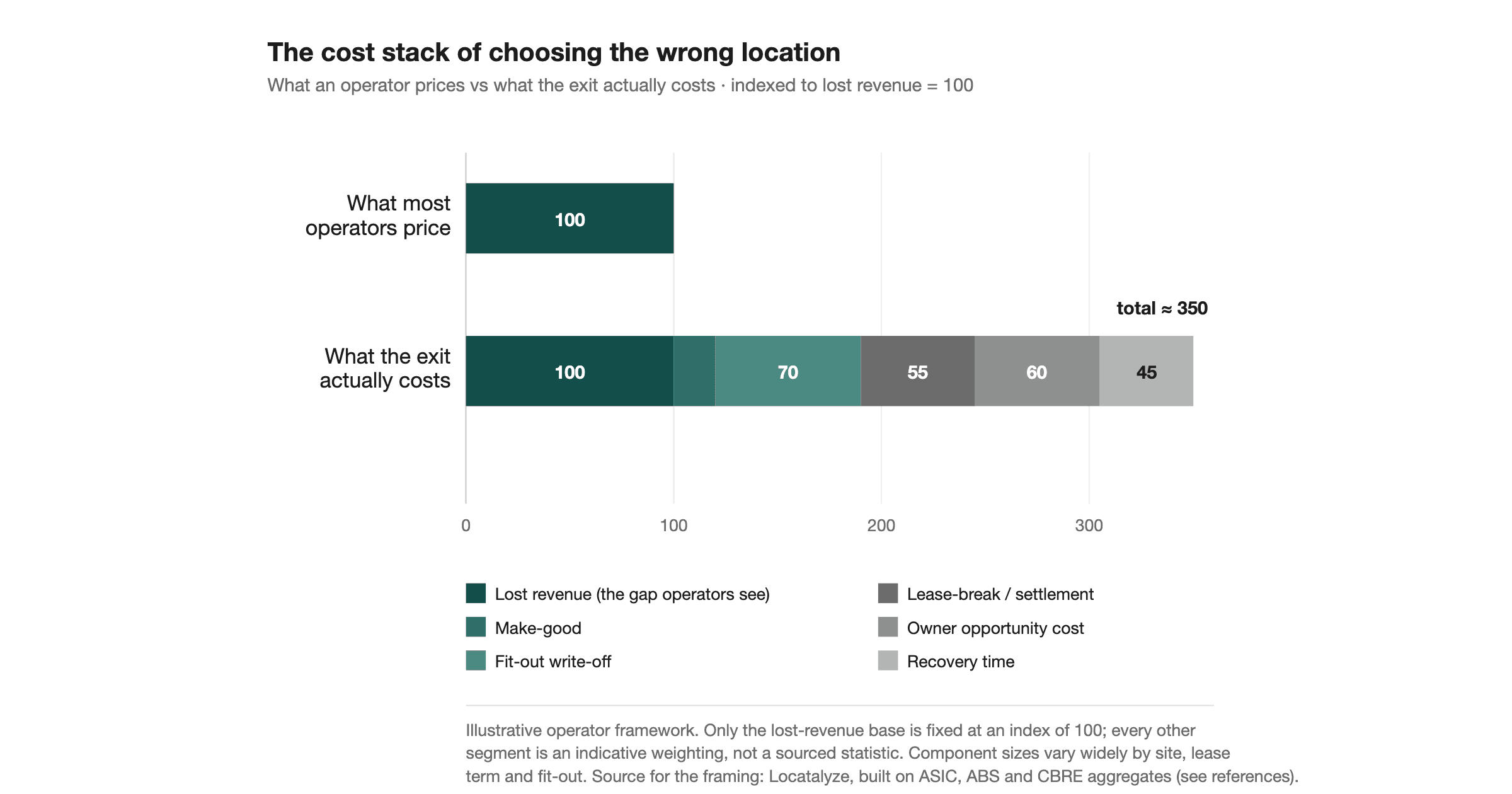
Make-good provisioned at zero. You will owe it at the end. Costing it at nothing on day one is how a profitable exit becomes a loss.
- 7
No contingency line at all. A fit-out budget without a contingency is a fit-out budget that will be funded out of working capital, which turns two problems into one much larger one.
How to pressure-test a quote before you accept it
You are not trying to negotiate the price down. You are trying to find out what is not in it.
Ask every builder these, in writing
Three quotes on an identical written scope is the only way to compare anything. Three quotes on three different understandings of the job tells you nothing, and it is the normal situation unless you insist otherwise.
Tool worth looking at
BizCover
Best for. Getting public liability and business pack cover in place quickly, which most commercial leases require before the landlord hands over keys and some fit-out contractors require before starting on site.
Why it belongs here. Insurance appears on most people's list as a pre-opening task. On a build it is actually a pre-handover task, and a certificate of currency that arrives late can hold up the start of the fit-out. Comparing a straightforward risk takes about twenty minutes and routinely surfaces meaningful differences in exclusions rather than just premium.
Check before you commit. That the cover matches the build. Ask specifically about contract works cover during the fit-out, who carries it, and what happens to your own contents and equipment while the site is a construction zone. Also confirm separately how you are arranging workers compensation, which runs through your state scheme and sits outside a business pack.
Worth comparing against. A local broker, who costs you nothing directly and will read your lease. On a commercial kitchen, a liquor licence or a heritage building, use one.
Explore BizCover →Your budget worksheet
Fill this in with your own quotes rather than the ranges above. If a line is genuinely zero for your site, write zero deliberately. The dangerous lines are the blank ones.
Capital required before you trade
Every line needs a number, even if that number is a rough allowance
Cash out that buys no asset
Recoverable in theory, unavailable in practice
Cash to survive opening
The bucket that decides whether the business gets to prove itself
If the number doesn't work
Most articles like this one stop at the worksheet, on the assumption that you will find the money. Sometimes the right answer is that you should not.
If the honest total is meaningfully above what you can fund, you have four options and only one of them is bad. You can reduce the scope, which usually means a simpler kitchen and a longer menu-development runway. You can find a site that starts closer to what you need, which changes the number more than anything else on this list and is the option people consider last. You can raise more, provided the revenue the site can plausibly produce services the additional cost. Or you can proceed underfunded and hope, which is the one that shows up in the failure statistics.
Walking away from a site you have spent six weeks on feels like losing. It costs you your time, some professional fees, and a period of frustration. Proceeding underfunded costs you the deposit, the fit-out, the guarantee, and often years of personal liability under a lease you signed in your own name. Those are not the same size, and the difference is entirely visible before you sign.
For what happens after the budget is settled, the Australian small-business setup checklist covers the full sequence from lease to opening. For the site decision itself, the cost of choosing the wrong business location and before you sign that lease are the two worth reading first.
Already chosen the site? Check the revenue can carry the build
Competitor density, catchment, demand signals and break-even against your actual rent, for the specific address.
Run the location analysisLast reviewed 16 August 2026. Cost ranges are drawn from published 2026 guidance by Australian fit-out and commercial kitchen contractors, from Sydney Water's trade waste fee schedule, and from Australian legal commentary on retail lease security deposits. They are indicative of market ranges, not quotes, and they date quickly. Regulatory requirements were current at the review date and change regularly: confirm the current position with business.gov.au, ABLIS, Food Standards Australia New Zealand, the ATO, your water authority and your local council. This article is general information only and is not legal, accounting, tax, insurance or financial advice.
Frequently asked questions
About the author
Prashant GuleriaFounder, Locatalyze
Prashant co-founded Locatalyze after encountering the difficulty of evaluating commercial locations for his own businesses. He leads the product around the practical questions independent operators need to answer before committing to a lease.
Tools first — then a full report for your address
Free rent, viability, and break-even checks. Upgrade when you are ready for competitors, map, and numbers for a specific site.
No signup required for tools