Coffee Shop Profitability in Australia: ATO Rent Bands and Modelled P&Ls (2026)
Founder, Locatalyze
How much does an Australian café actually make? The useful answer is not a single national average. It is a small set of cost ratios, a rent check you can defend, and an honest model of revenue the site can support — before you treat a hopeful P&L as a lease green light.
Evidence standard
FACT: ATO coffee-shop small-business benchmarks (2023–24 tax year) publish rent÷turnover ranges by size band — opened 29 Aug 2026. MODEL: revenue drivers, COGS/labour bands, and worked P&Ls below are illustrative arithmetic with stated assumptions — not a named café and not IBISWorld microdata (that series is gated; treat any “4–9% net” industry folklore as directional only unless you open the report). LOCATALYZE ANALYSIS: location sets the revenue ceiling and the timeline to viability more than coffee quality does.
8–14%
ATO rent÷turnover band for coffee shops with $250k–$600k turnover (2023–24) — tax rent expense, not always all-in occupancy
6–10%
ATO rent÷turnover band above $600k turnover (2023–24)
10–17%
ATO rent÷turnover band for $65k–$250k turnover (2023–24)
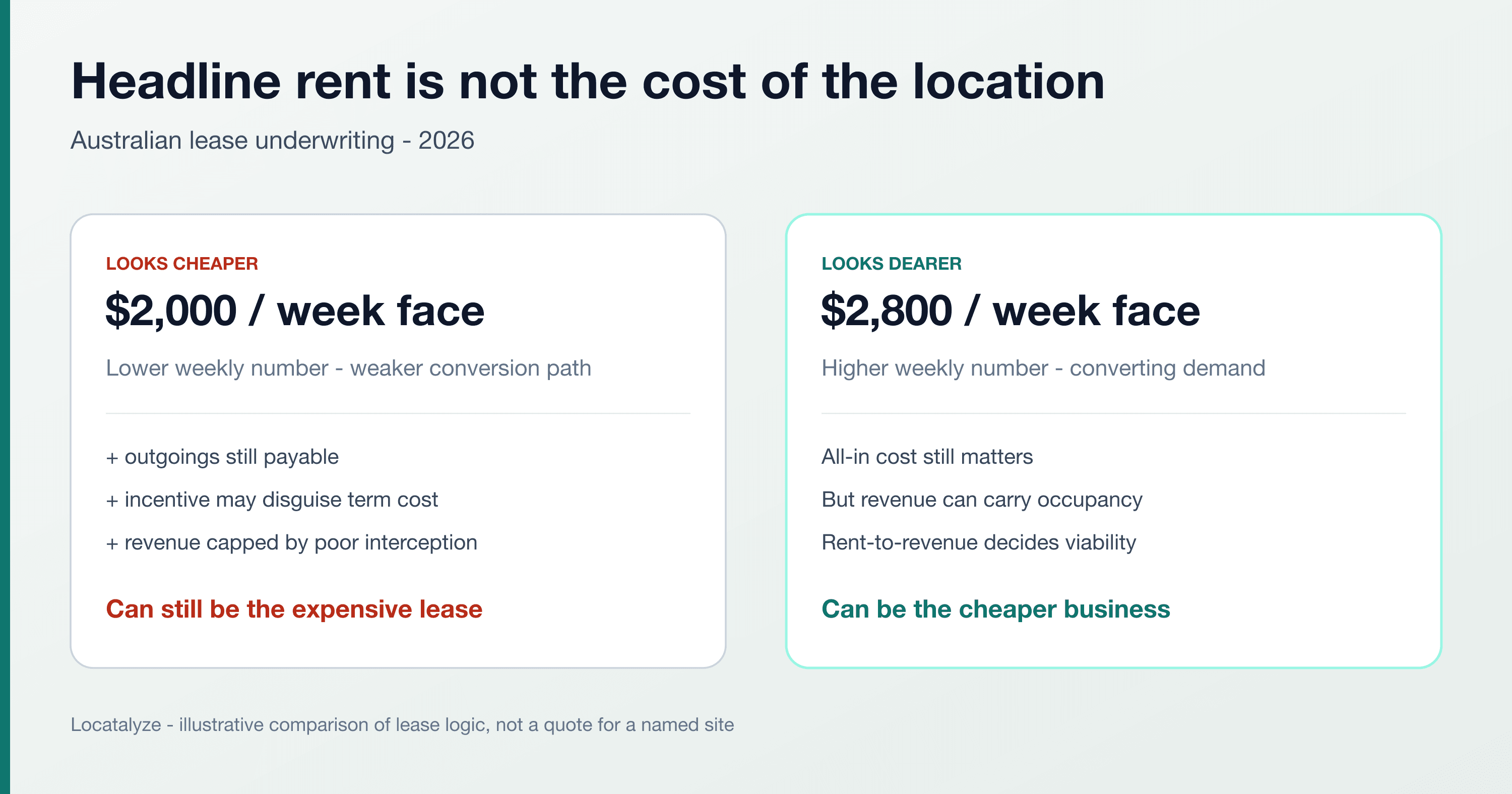
Those ATO ranges are observed tax-return ratios for coffee shops, not recommended targets and not a substitute for all-in occupancy after outgoings and incentives. Use them as a sanity check. Full underwriting of face rent vs effective cost sits in why a cheaper lease can be the more expensive location and the commercial rent per sqm reference.
Revenue is three variables — all site-dependent
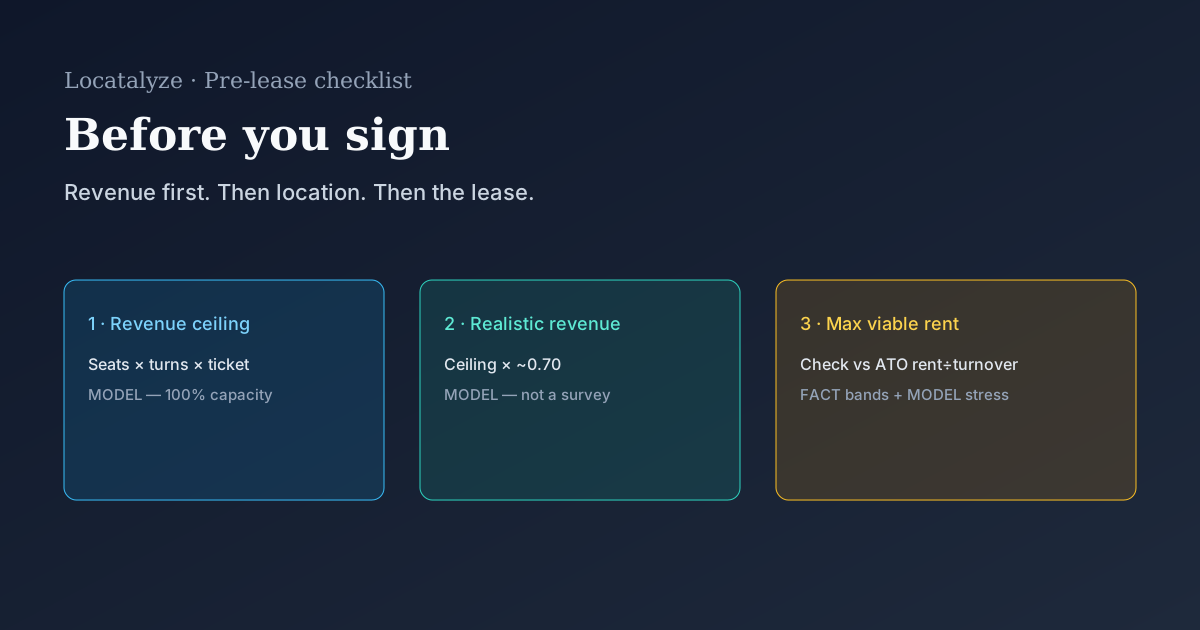
MODEL: café revenue ≈ average transaction value × daily transactions × trading days. Independent Australian cafés commonly sit somewhere around $8–$14 average ticket and anywhere from tens to a few hundred transactions a day depending on format and frontage. Those bands are industry-rule-of-thumb ranges, not a census. The only number that matters for your lease is the revenue your counted dayparts can support.
Cost structure — labelled model
MODEL (directional, not a survey microdata extract): many operator models place COGS roughly in the high-20s to mid-30s percent of revenue, labour in the low-to-mid 30s (higher if the owner is not on the floor), and aim for rent well below the point where occupancy alone consumes the ATO-observed bands above. Utilities, maintenance, marketing and insurance commonly add high-single-digit percentage points. What remains for net profit is often thin — commonly described in industry commentary as mid-single digits for established independents, and worse during ramp or January.
Illustrative annual stack (owner on tools)
Assumptions: $420,000 revenue; COGS 30%; labour 35% (owner included in labour); rent 10%; other overheads 8%. COGS $126,000 · Labour $147,000 · Rent $42,000 · Other $33,600 · Residual $71,400 (17%). That residual is an optimistic owner-operator outcome, not a typical take-home. Replace owner labour with a manager and the residual collapses. Raise rent toward the top of a weak site’s capacity and it disappears. Treat 4–9% net as a more common established-operator conversation starter — still a model, not a promise.
Illustrative monthly model — inner-suburban café
MODEL: 55-seat café, six trading days, 180 transactions/day at $11.50 average spend → about $2,070/day and ~$53,820 over 26 trading days. The table is arithmetic for teaching, not a named business.
That residual is unusually strong and depends on rent staying near $4,800 and the owner remaining one of the labour units. Hire a manager (~$5,500) and the residual falls toward ~9%. Lift rent to $7,500 and the model breaks. Those sensitivities are the point — see also café failure and lease maths.
The January test
January often cuts trading days (public holidays, leave). Fixed rent does not cut with them. MODEL: at the same daily rate, 22 days instead of 26 drops monthly revenue materially while costs stay sticky. Ask whether cash survives a soft January before you sign.
Undercapitalisation
Many closures are timing failures: the site might work eventually, but working capital does not cover the ramp. Model the deficit months explicitly. A $7,000 monthly shortfall over five ramp months is $35,000 that must exist before opening — illustration, not a universal constant.
PROCEED / VERIFY / AVOID
PROCEED (provisionally): counted dayparts support revenue that keeps all-in rent inside a defensible band (ATO mid-band sanity check for cafés), and ramp capital covers soft months. VERIFY: residual only looks healthy with owner-on-tools labour forever. AVOID: rent only clears if every day matches your best Saturday model.
Profitability only exists at a specific address. Model rent against the revenue that frontage can support.
Free location score, map, data confidence and PROCEED / VERIFY / AVOID recommendation. Modelled financials stay optional.
Analyse this addressWhat usually separates thin from workable
LOCATALYZE ANALYSIS: the gap between a café that clears a few points of net and one that barely covers wages is rarely roast quality. It is rent-to-revenue, off-peak labour, waste, and average ticket — and those are mostly location and operating discipline. Keep rent inside a band your counted revenue can carry; chase ticket and labour after the site is honest.
Timeline to viability
MODEL / INDUSTRY PATTERN: many new cafés take on the order of 6–18 months to reach consistent profitability, with early months cash-flow negative while regulars form. Lower footfall stretches the ramp. Location sets how long you must fund the gap — which is why undercapitalised operators often close as the curve was turning.
Location inside the financial model
A site that can support 150 qualifying people in your peak hour is not the same business as one that supports 50. Location sets the revenue ceiling and the months of capital you need. Count before you romanticise the fit-out. For conversion traps when the street looks busy, read high foot traffic, low sales.
Sources
Opened or labelled 29 August 2026
IBISWorld and magazine “typical revenue/margin” figures are widely repeated in hospitality commentary but were not opened as primary microdata for this revision. They are not used above as FACT. Worked P&Ls are illustrative models.
Related reading
The companion question — what these margins mean for the person holding the keys — is covered in how much café owners actually make, including the owner-wage test most projections quietly skip.
Frequently asked questions
About the author
Prashant GuleriaFounder, Locatalyze
Prashant writes location and lease economics for Australian operators — with labelled models where industry averages are thin or gated.
Tools first — then a full report for your address
Free rent, viability, and break-even checks. Upgrade when you are ready for competitors, map, and numbers for a specific site.
No signup required for tools