Why Your Landlord Wants You to Skip Due Diligence — Three of Their Five Tactics Are Already Void
Locatalyze Research Team
Location intelligence, Locatalyze
A landlord is a counterparty, not a partner, and the lease process is designed by their side. That much is widely said. What is almost never said is that Australian retail leasing legislation has already answered three of the five pressure tactics operators worry about — the ratchet clause is void by statute, the outgoings estimate must be disclosed in writing, and the compressed deadline runs into a seven-day legal floor. The two tactics with no statutory protection are the two carrying the money: on one worked five-year lease they are worth $100,500. This is a read of where the exposure actually sits, and it turns on a single question about your own lease.
How to read this article
**FACT** — supported by a named, linked source, or computed by us over a stated model with the inputs shown. **LOCATALYZE ANALYSIS** — our reading of that evidence. **INFERENCE** — a reasonable conclusion that is not proven. Every dollar figure below comes from one worked lease whose inputs are stated in full under [Method](#method), and every legal provision is cited to its section.
This is not legal advice
We are a location-analysis company, not a law firm. This article describes statutory provisions that exist in Australian retail leasing legislation and cites them so you can check them. **Whether any of them applies to your lease depends on your state and on whether your premises meet that state's definition of a retail shop** — a question only your solicitor can answer for your document. Nothing here is legal, financial or valuation advice, and the cost model is a labelled MODEL, not a quote.
Key takeaways
Whose side the paperwork is on
A commercial landlord is a counterparty in a financial negotiation, not a partner in your business. At the point of signing, their interests are maximum rent, minimum incentive, minimum flexibility for you to leave, and maximum obligation on you when you do. Yours are the exact opposite of all four. None of that makes a landlord dishonest. It makes them a party with different objectives, represented by an agent who negotiates leases for a living against a tenant who may be doing it for the first time.
That asymmetry is the whole story, and it is not mainly about the rent. It is about which questions get asked. The lease is drafted by the landlord's solicitor. The rent is quoted in the format that flatters it. The timeline is set by the person who benefits from you having less of it. LOCATALYZE ANALYSIS: due diligence is not a defence against dishonesty — it is a defence against a well-run process that was designed by someone else.
What makes this worth writing down is the part almost nobody tells operators. Three of the five tactics below stop working the moment you know one fact about your own lease. They are not negotiation problems. They are information problems, and Australian retail leasing legislation has already solved them — for the tenants it covers. The other two are unregulated, and those are the ones that carry the money.
First question: is your lease a retail lease?
Everything in the next section depends on this and nothing in the section after it does, so it is worth thirty seconds. Australian states each run a retail leasing statute that overrides what the lease document says. If your premises fall inside it, a set of protections applies automatically and cannot be contracted out of. If they fall outside it, you are in general commercial leasing, where the document governs and most of these protections simply do not exist.
FACT: in New South Wales the Retail Leases Act 1994 applies to premises under 1,000 m² used wholly or predominantly for a business prescribed by the regulations, or to any business inside a shopping centre, on a lease of six months to 25 years. FACT: cafés and restaurants are prescribed businesses, and the Retail Leases Regulation 2022 — which replaced the Act's Schedule 1 from 1 January 2023 — extended the list to include gyms and small bars.
LOCATALYZE ANALYSIS: on that test, the overwhelming majority of Australian cafés and restaurants are retail tenancies. A 55 m² shopfront café is comfortably inside it. The operators who fall outside tend to be the larger ones — a 1,200 m² venue, or a tenancy in an office tower that is not a shopping centre — and they are precisely the operators least likely to be reading a first-lease guide. INFERENCE: if you are opening your first café, the protections below probably do apply to you, and the single most valuable question you can put to your solicitor is the plain one: is this a retail lease under our state's Act?
Why this question is the whole article
A tenant who knows the answer treats three of the five tactics as settled and spends their negotiating capital on the other two. A tenant who does not know the answer spends it in the wrong place — arguing about a clause that is void, accepting a deadline that cannot lawfully be imposed, and signing without the outgoings number they were legally entitled to receive a week earlier.
The three tactics the law already blunts
These are real tactics. They are used, they work, and they work because of what the tenant does not know rather than what the landlord does. In a retail lease, all three are answered by statute.
The ratchet clause is void, not negotiable
The ratchet is the provision that says rent at a market review will be the greater of the current rent or the market rent. Its effect is that rent can rise at a review but never fall, so your rent floor is permanently set at its highest historical point even if the market around you has softened. Standard advice is to ask your solicitor to negotiate it out.
FACT: in a retail lease you do not have to. Queensland's Retail Shop Leases Act 1994 s.36A is headed "Ratchet rent provision void" and voids any provision that prevents the rent decreasing under a review, limits the amount by which it may decrease, or lets the lessor avoid the review to achieve either. FACT: New South Wales reaches the same result through s.18(4) of its Act, and Victoria through s.35(3) of the Retail Leases Act 2003.
LOCATALYZE ANALYSIS: a clause that is void by statute is not a negotiating chip, and treating it as one is how tenants pay for it twice — once by conceding something elsewhere to have it removed, and once by not knowing it was unenforceable in the first place. INFERENCE: the honest version of the standard advice is narrower and more useful. Ask whether the lease is a retail lease. If it is, the ratchet is already dead and your negotiating capital belongs somewhere else. If it is not, the clause is live, valid, and worth every bit of the fight.
One thing a ratchet is not
FACT: voiding a ratchet is not the same as voiding a **cap**. In Aldi Foods Pty Ltd v Northcote Shopping Centre Pty Ltd [2024] VSC 799 the Supreme Court of Victoria confirmed that caps limiting how far rent can rise at a review are permitted under the Victorian Act, overturning several VCAT decisions that had held otherwise. LOCATALYZE ANALYSIS: the statute stops the landlord from blocking a decrease. It does not stop the parties agreeing a ceiling — which is a provision that favours the tenant, and one worth asking for.
The outgoings you were not quoted are the ones you were entitled to be told
Rent is quoted net almost universally: the base figure, excluding outgoings. Outgoings are the landlord's costs of owning and running the building — council and water rates, land tax, building insurance, body-corporate levies, management fees, common-area cleaning and power — and the tenant pays them on top. They are not a trick in themselves. The tactic is that they are absent from the number you do your arithmetic on.
FACT: in a retail lease the landlord must give you a disclosure statement containing an estimate of outgoings, and must do so before the lease is entered into — in Queensland, s.21B requires the draft lease and disclosure statement at least seven days beforehand, and New South Wales imposes the same seven-day minimum. FACT: a late, incomplete or misleading disclosure statement can give the tenant a right to terminate and to claim compensation, with the remedy varying by state.
LOCATALYZE ANALYSIS: this reframes the question completely. The right response to a net quote is not to apply a rule of thumb and add twenty per cent — it is to ask for the document the landlord is already obliged to give you, which contains their own estimate, in writing, before you commit. A landlord who will not produce it has told you something, and a rule of thumb would have hidden it.
Urgency runs into a seven-day floor
"I have another party viewing Thursday." "The landlord needs an answer this week." The purpose of this language is to move you from evaluating to justifying, and it works on anyone who has already pictured themselves in the room. It is used whether or not the competing interest is real, because the agent's obligation runs to the landlord.
FACT: in a retail lease the compressed timeline is not lawfully available. The seven-day disclosure requirement sets a floor beneath which the lease cannot properly be entered into at all. LOCATALYZE ANALYSIS: that turns an emotional negotiation into an administrative one. You are not asking for a favour or revealing that you are nervous; you are pointing at a statutory minimum. And if the answer is that the timeline cannot move, the most likely explanation is not competing demand — it is that the paperwork you are entitled to has not been prepared.
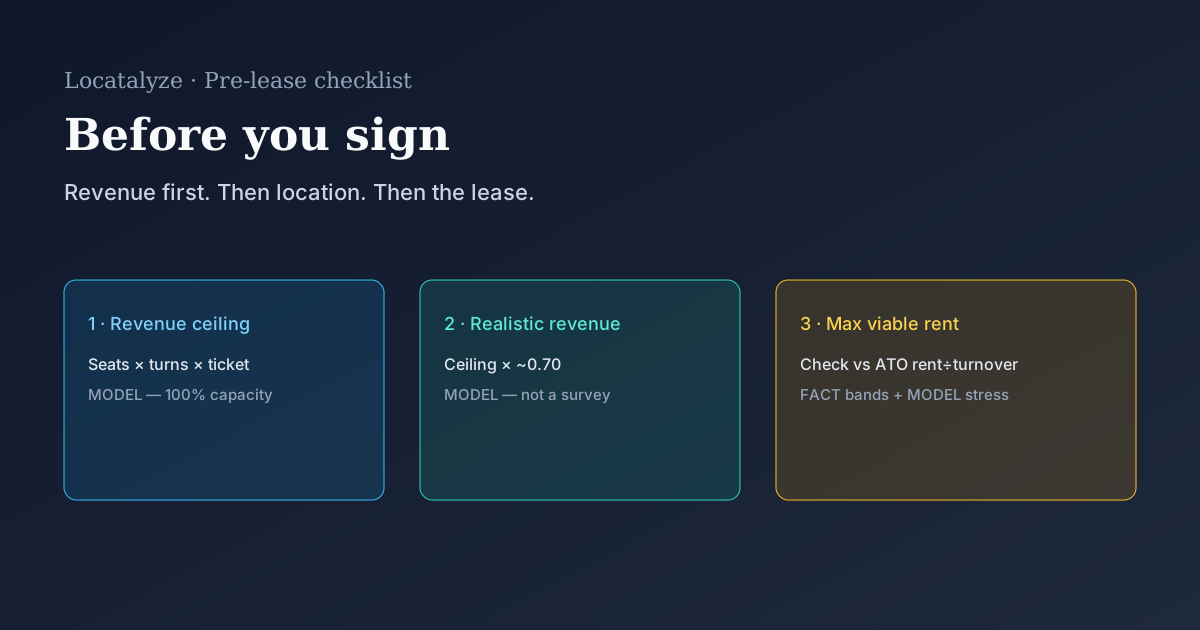
INFERENCE: the residual case is the genuinely non-retail tenancy, where no such floor exists. There the old advice stands and is worth restating: offer a holding deposit for a defined exclusivity period, non-refundable if you proceed. A landlord who accepts has told you what the competing demand is actually worth. Our pre-lease checklist covers the clause-by-clause version of this conversation.
The two the law does not touch
No Australian retail leasing statute tells you which of two offers is cheaper, and none caps what you will owe when you leave. These two tactics work on arithmetic and on timing, and there is no provision to fall back on. On the worked lease below they are worth $100,500 over five years.
The incentive is the distraction; the headline rent is the deal
Rent-free periods and fit-out contributions are genuine value. They are also the most effective misdirection available to a leasing agent, because they are paid once and visible, while the rent is paid weekly and abstract.
Here is the arithmetic on two offers for the same 55 m² tenancy over a five-year term. Offer A is $1,400 a week with four months rent-free. Offer B is $1,200 a week with one month. FACT: A's incentive is worth $23,800 and B's $4,800, so A's looks $19,000 better. FACT: across the 260-week term A costs $340,200 in base rent and B costs $307,200. LOCATALYZE ANALYSIS: the offer with the incentive that is $19,000 more generous costs $33,000 more to occupy. The gap widens with every year of term, and narrows to $12,200 over three years — which is the other half of the point, because term length changes which offer wins.
The correct comparison is total occupancy cost over the full term you intend to hold, not the incentive and not the weekly rate in isolation: (weeks paid × base rent) + (outgoings × years) + make-good − incentive value. INFERENCE: the reason this is not standard practice is not that operators cannot do the arithmetic. It is that the incentive arrives as a concession at the end of a negotiation, when the tenant is looking for a reason to say yes.
Make-good is a departure tax you agree to years before you can price it
The make-good obligation is not hidden. It sits in the lease under a heading like Reinstatement or Condition on Vacating, and it requires you to return the premises to their original condition. What is hidden is the number, because the number depends on the fit-out you have not installed yet.
FACT: on published Australian trade figures a hospitality fit-out involving a full commercial kitchen costs between $45,000 and $90,000 to reverse. LOCATALYZE ANALYSIS: at the mid-point of $67,500, on our worked lease, that is 21.6% of the entire five-year base rent, or fifty-six weeks of rent — and it falls due at the end of the term, which is the moment an exiting operator has the least cash and the weakest position.
There is a negotiating opportunity here that closes the day you sign. Many landlords will take a cash settlement rather than supervise the removal of a kitchen, and some will narrow the make-good scope in exchange for improvements you were going to make anyway. INFERENCE: those conversations are worth far more before signing than after, because afterwards the landlord holds every card. Our guide to why a cheaper lease can be the more expensive location works through what happens when this cost is discovered late.
The five tactics, priced
One tenancy, five years, every input stated. The point of the table is not the totals — your numbers will differ — but the distribution. The exposure is not spread evenly across the five tactics, and it is not concentrated where operators spend their attention.
FACT: the outgoings line is not an avoidable cost — you would pay it under any lease. It is a mispricing: $12,480 a year that was missing from the number you tested your business against, and $62,400 across the term. FACT: tactics 2 and 3 cost nothing at all in a retail lease, provided the tenant knows the provision exists. LOCATALYZE ANALYSIS: the two tactics with no statutory protection carry $100,500 of genuine exposure, and they are the two that operators discuss least.
The clauses operators fight hardest over are not the ones that cost them the most. One of them is already void.
When the rent passes the test and the lease fails it
There is one more consequence of the net quote, and it is the reason this matters beyond the money itself. The Australian Taxation Office publishes small-business benchmarks for coffee shops, including rent as a share of turnover. It is the closest thing Australian hospitality has to an official affordability test, and operators use it — correctly — to sanity-check an asking rent.
FACT: for the 2023–24 year the ATO reports rent at 10–17% of turnover for coffee shops turning over $65,000–$250,000, 8–14% from $250,001–$600,000, and 6–10% above $600,000 (Australian Taxation Office).
Now run our worked lease against it. At $450,000 of turnover, the quoted net rent of $1,200 a week is $62,400 a year — 13.9% of turnover, inside the ATO's 8–14% band. The all-in rent of $1,440 a week is $74,880 — 16.6%, outside it. FACT: both figures describe the same lease. LOCATALYZE ANALYSIS: the quote passes the industry's own affordability test and the lease does not, and nothing in the conversation would tell you that unless you asked for the outgoings estimate you were entitled to.
INFERENCE: this is the mechanism by which structurally unaffordable leases get signed by careful people. The operator did the check. They used the number they were given. Our commercial rent affordability guide sets out the full occupancy-cost test, and coffee shop profitability in Australia works through what the rest of the ATO benchmark implies for a P&L.
Before you test an asking rent against a benchmark, you need to know what the market rent for that corridor actually is. Locatalyze reads one specific Australian address for demand, competition, catchment and rent pressure.
Free location score, map, data confidence and PROCEED / VERIFY / AVOID recommendation. Modelled financials stay optional.
Analyse an addressWhat to do before you sign
Everything here is free, and the first item makes the next three either unnecessary or much shorter.
Nine things to settle before you sign
Most of this is one afternoon and one conversation with your solicitor
A tenant who arrives with the disclosure statement, an all-in rent figure, a make-good estimate and a written clause position is a different counterparty from one who has fallen in love with a room. The agent can tell which is which inside five minutes, and the difference shows up in the deal.
Know the corridor before you negotiate
A lease is negotiated against a market you either know or do not. Locatalyze reads one specific Australian address for demand, competition, catchment and rent pressure, and shows the evidence behind every number.
Analyse an address freeMethod, evidence and limits
The worked lease. One tenancy used throughout: 55 m², a quoted net base rent of $1,200 a week, a five-year term of 260 weeks, and outgoings at 20% of base rent. Outgoings are the single least standardised input in Australian leasing and published estimates vary widely by building and city, which is exactly why the article's advice is to read the disclosure statement rather than apply a percentage. Twenty per cent is a mid-range illustration, not a benchmark, and every figure derived from it moves if your estimate does.
The incentive comparison. Offer A is $1,400 a week with 17 rent-free weeks; Offer B is $1,200 with 4. Base rent paid is (260 − rent-free weeks) × weekly rent: A $340,200, B $307,200. Incentive value is rent-free weeks × weekly rent: A $23,800, B $4,800. The three-year figures use 156 weeks on the same rents.
Make-good. $45,000–$90,000 is the published range for reversing a hospitality fit-out with a full commercial kitchen; $67,500 is its mid-point. It is an illustration of scale, not a quote, and the article's recommendation is to obtain a real one for your actual works.
The ATO comparison. Rent-to-turnover bands are the ATO's published 2023–24 coffee shop benchmarks, reproduced exactly. Note the ATO states these benchmarks do not apply to coffee carts, vans or other mobile coffee retailers.
What this cannot tell you. Whether any statutory provision applies to your lease. Retail leasing legislation differs between states in its coverage tests, its exclusions and its remedies, and we have cited NSW, Victoria and Queensland because those are the three we verified to section level. Western Australia, South Australia, Tasmania, the ACT and the Northern Territory each run their own Act with its own tests, and this article does not set them out. We are not lawyers and this is not legal advice.
Locatalyze is decision-support for location choice. Nothing in this article is legal, financial, valuation or investment advice, and no firm, landlord or agent named or described here is a customer, partner or sponsor. Legislation cited was checked on 7 September 2026; provisions change, and only your own solicitor can tell you what applies to your document.
Sources
Legislation and primary sources
Related Locatalyze research
Frequently asked questions
About the author
Locatalyze Research Team
Location intelligence, Locatalyze
The Locatalyze research team builds the location-scoring models behind the platform and writes up what the evidence shows for Australian operators.
Tools first — then a full report for your address
Free rent, viability, and break-even checks. Upgrade when you are ready for competitors, map, and numbers for a specific site.
No signup required for tools