Why Businesses Fail in Darwin (And What Actually Works): A Data-Backed Breakdown
Founder, Locatalyze
Darwin has, depending on the measure used, the highest rate of hospitality business failure of any Australian capital city. Some estimates put the first-year closure rate for new food and beverage operators at 28–35% — significantly above the national average of 17–23%. The businesses that close are not, in the majority of cases, businesses run by incompetent operators. Many of them are run by talented people who made excellent food and delivered genuine hospitality. They failed for structural reasons that were predictable before they opened — and that the data makes visible to anyone who looks at them honestly before signing a lease. This analysis documents the specific failure patterns we see repeatedly in Darwin's hospitality market, identifies the common thread that runs through most of them, and then — because diagnosis without treatment is useless — documents in specific terms what the operators who succeed in Darwin actually do differently.
Failure Pattern 1: The Dry Season Benchmark Trap
The single most common cause of Darwin hospitality business failure is simple and completely avoidable: the operator benchmarked their business model against dry season performance and committed to a cost structure that the wet season cannot support.
Here is the specific mechanism. An operator visits Darwin in July — peak dry season. The outdoor seating areas on Mitchell Street are full. The Parap Markets are buzzing. Every restaurant with a decent outdoor area is turning tables. The tourism economy is at its peak and the city has genuine energy. The operator loves it, finds a space, and negotiates a lease based on an informal projection of what revenue looks like when the city is this alive.
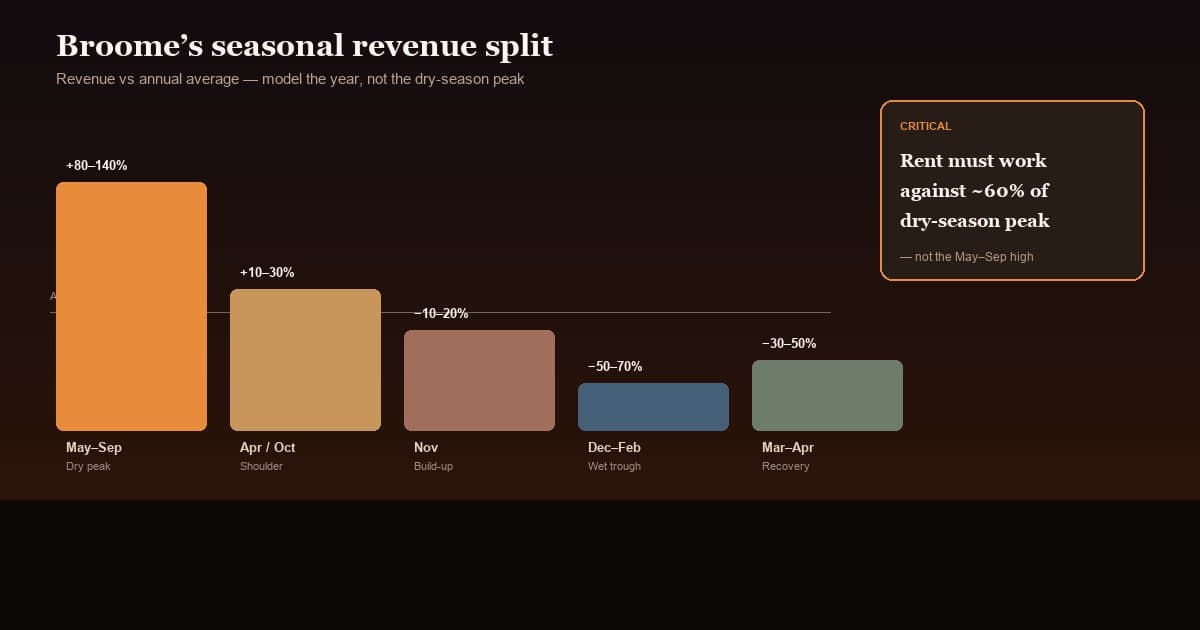
They open in September or October — still reasonable trading. By November, the build-up arrives. Humidity spikes, the evening storms start, and the outdoor dining that was generating 40% of their revenue becomes unusable for 2–3 hours each evening. Tourist arrivals drop sharply. By January and February, the monsoon is fully active. Weekly revenue is 35–55% of what it was during the dry season peak. The rent is the same. The staffing costs are largely the same. The food costs are the same. The business loses money every week of the wet season.
35–55%
Revenue decline from dry season peak to wet season trough for tourism-facing Darwin businesses
28–35%
Estimated first-year closure rate for Darwin food and beverage operators (vs 17–23% national average)
$42,000
Average additional annual cost for Darwin operators vs Perth equivalent (supply chain, cooling, pest control)
Failure Pattern 2: The Transient Loyalty Problem
Every business that depends on repeat customer loyalty has a basic model: the customer finds you, likes you, and returns. In most markets, once a customer becomes a regular, they stay a regular for years. The loyalty investment — the initial experience, the service quality, the personal connection — pays dividends for a long time.
In Darwin, this model is disrupted by the unusual transience of the population. The defence force personnel who become regulars at your restaurant in their first six months rotate out in 24–36 months. The mining FIFO workers who reliably visit every rotation cycle are replaced by different faces when their contract ends. The backpackers and working holiday visa holders who sustained your lunch trade for four months move on to the next city.
The mathematical consequence: Darwin businesses must invest in customer acquisition continuously rather than relying on a growing loyal base. This is expensive. Marketing, social media management, new customer incentives, and the staff time invested in building connections with new customers represents an ongoing cost that operators in stable-demographic markets do not carry at the same level. Darwin operators we have analysed spend 40–70% more on effective marketing and customer acquisition per dollar of revenue than comparable operators in Perth or Adelaide — not because they are bad at retention, but because the population turns over and retention is structurally harder regardless of execution quality.
Failure Pattern 3: The Supply Chain Cost Underestimate
Darwin is 3,400km from Sydney, 4,000km from Melbourne, and 2,700km from Perth by road. This geographic isolation has direct commercial consequences that operators moving from southern markets consistently underestimate. Food supply is more expensive: freight costs add a genuine premium to every product category. Fresh produce is less reliably available and more subject to price volatility from supply disruptions.
Equipment maintenance and repair is a specific operational risk that has ended several Darwin businesses. When a commercial refrigerator fails in Melbourne, a qualified technician can be there within hours. When a commercial refrigerator fails in Darwin, the parts may need to be freighted from Perth or Sydney, the qualified technician may be unavailable for days, and the business runs with compromised cold storage during the intervening period. In a tropical climate where the ambient temperature regularly exceeds 30°C, refrigeration failure is not a manageable inconvenience. It is a crisis.
We estimate the total structural cost premium for operating a comparable food and beverage business in Darwin versus Perth at $35,000–$55,000 per year for a standard 55-seat casual dining or café format. This premium includes: higher food costs (8–14% above Perth equivalent), higher cooling and air conditioning costs (12–18% above Perth), pest control and tropical building maintenance (significantly higher), and the equipment resilience buffer (backup equipment for critical systems). This $35,000–$55,000 is not optional. It is the cost of operating in Darwin's physical environment.
Failure Pattern 4: The Wrong Format for the Right Market
Darwin rewards specific formats and punishes others. The operators who enter Darwin with a format designed for a different market — a fine dining concept designed for Melbourne's food cognoscenti, a specialty coffee concept built for Sydney's specialty coffee culture, a wine-bar concept built for Adelaide's wine-literate demographic — find that Darwin's market has different composition and responds differently.
Darwin's food culture is real and genuine — it is one of Australia's most diverse culinary cities by cultural composition. But its dominant food preferences and spending patterns are different from the eastern seaboard markets that most operators have experience with. The Asian food culture is strong and sophisticated. The outdoor, casual, fun dining preference is dominant. The late-evening dining culture is active during the dry season. The format that thrives in Darwin is designed for Darwin's specific culture, not transplanted from another city with the assumption that quality alone crosses the cultural bridge.
What Actually Works: The Darwin Success Pattern
The operators who build profitable, enduring businesses in Darwin share a specific analytical discipline: they designed their business model explicitly for the worst case scenario — the wet season — and used the dry season as the profit and capital accumulation engine. Every decision about format, cost structure, rent level, and revenue mix flows from this inversion.
The Formats With the Strongest Darwin Track Record
Looking at the Darwin operators who have been trading profitably for 5+ years, the format patterns that consistently appear are: authentic Asian cuisine at accessible price points ($18–$38 per head), concepts with strong covered outdoor areas designed for year-round use, hybrid dine-in and delivery operations that shift their revenue mix toward delivery during the wet season, and bar-led operations with substantial food programmes that generate high per-head combined spend ($65–$110) from Darwin's well-paid professional and defence demographic.
The common thread is not a specific cuisine or style. It is a format architecture that is specifically calibrated to Darwin's operating conditions — the climate, the demographic transience, the tourism seasonality, and the supply chain premium — rather than a format transplanted from another market with an expectation that execution quality alone will overcome the structural differences.
The Darwin format checklist: 5 questions before you sign
1. Does my business model break even on wet season revenue alone (tourist revenue = zero)? 2. Does my format generate revenue when outdoor seating is unusable (monsoon rain/storms)? 3. Have I budgeted $40,000–$55,000 per year in Darwin-specific operating cost premiums? 4. Do I have 9–12 months of working capital to survive the first wet season? 5. Is my format designed for Darwin's actual demographic (diverse, outdoor, casual, Asian food literate) — or designed for a different city? If you can answer YES to all five, Darwin is a viable market with real opportunity. If any answer is NO, you are carrying a structural risk before you've served your first cover.
The GO/CAUTION Verdict for Darwin
DARWIN: GO — for operators who have done the homework
**GO if:** • Your format generates revenue in both wet and dry season • Your rent is benchmarked against annual average (not dry peak) • You have 9–12 months working capital • Your format is calibrated to Darwin's actual demographic and culture • You have a delivery or catering revenue stream for the wet season **AVOID if:** • Your format is transplanted from Melbourne or Sydney without Darwin-specific adaptation • Your rent viability depends on dry season tourist volume • You are capitalised for 3–6 months of operations • Your concept requires Melbourne-style dining culture to succeed
Darwin is not a market for operators who want an easy location. It is a market for operators who have specifically prepared for its conditions, adapted their format to its requirements, and who understand that the highest hospitality failure rate in Australia is a warning to take seriously — not a negative commentary on the market's potential, but a clear signal about the preparation required to access it successfully.
Locatalyze models Darwin's wet/dry seasonality, supply chain cost premiums, and demographic demand analysis for any Darwin address. Know your specific viability before committing.
Analyse my Darwin location → →Related reading
About the author
Prashant GuleriaFounder, Locatalyze
Prashant built Locatalyze to make the pre-commitment analysis that prevents preventable failures accessible to every Australian operator.
Tools first — then a full report for your address
Free rent, viability, and break-even checks. Upgrade when you are ready for competitors, map, and numbers for a specific site.
No signup required for tools