Retail Business Opportunities in Perth: A 2026 Suburb-by-Suburb Analysis
Locatalyze Research Team
Perth is the most underanalysed retail market in Australia. Business owners from Sydney and Melbourne dismiss it as too small, too isolated, or too dependent on mining cycles. That dismissal has created real opportunity. The suburbs covered here have above-average household incomes, manageable commercial rents, and — in several cases — customer demand that is not being met by the current supply of quality retail and hospitality businesses.
$112K
Median household income, Subiaco and Claremont catchments (ABS Census 2021 SA2)
$2,800–$4,500/mo
Typical strip retail rent across Perth walkable precincts (CBRE / JLL Perth retail 2025–26 — indicative)
2.1M
Greater Perth population & growth (ABS Regional Population — latest release; rounded)
Why Perth deserves a second look in 2026
The narrative about Perth retail is stuck in 2012. That was the peak of the resources construction boom — huge household incomes, strong retail spending, then a sharp correction as mining investment contracted. The Perth that emerged from that correction is different. The economy has diversified. The inner suburbs have gentrified more thoroughly than any comparable period in the city's history. And critically, commercial rents did not recover to pre-2012 levels the way residential property did. That divergence — rising incomes, relatively stable commercial rents — is the structural opportunity that makes Perth interesting for retail and food business operators right now.
A secondary factor is population composition. Perth has one of the youngest median ages of any Australian capital, a high rate of dual-income professional households, and a lifestyle orientation that rewards quality food and retail. The customer base in Subiaco or Leederville is not fundamentally different from the customer base in Paddington, Sydney — they just pay lower rents to reach them.
Subiaco: Perth's highest-scoring retail corridor
Rokeby Road is the benchmark for independent retail in Perth. This is the street where concepts get tested, where operators from other cities set up their first Perth location, and where the data consistently shows the strongest combination of foot traffic, income, and retail spend. Households within 1km of Rokeby Road have a median income exceeding $115,000. Weekend foot traffic between 9am and 2pm rivals inner Sydney strips. Café spend per head is higher than anywhere else in Perth.
Rent is the catch. Subiaco has seen commercial rent increases of 18–22% since 2022 as the suburb's desirability has pushed landlords to price accordingly. A well-positioned ground floor on Rokeby Road now costs $4,000–$5,500 per month for 60–80 sqm. Side streets off Rokeby (Hay Street, Barker Road) command $2,800–$3,800. These rents are still significantly below Crown Street, Surry Hills or Brunswick Street, Fitzroy, but they are no longer the bargain they were three years ago. The financial model for a Subiaco business needs to be built on strong daily customer volume — 100+ transactions daily to make the numbers work for most food concepts.
Subiaco location snapshot (Rokeby Road precinct)
Typical retail rent: $4,000–$5,500/month (60–80 sqm ground floor) Foot traffic: 8,000–12,000 daily (weekends higher) Median household income: $115,000+ Best fit: specialty coffee, premium casual dining, boutique health and beauty Risk: rent increases have outpaced revenue growth since 2022
Analysing a specific Subiaco address? Run a full GO/CAUTION/NO verdict with competitor map and rent benchmarks.
Analyse Subiaco → →Leederville: better economics, comparable customers
Oxford Street in Leederville is the honest answer to "where should I open in Perth if I can't afford Subiaco?" The demographics are comparable — young professionals, dual-income households, median income around $98,000 within 1km. Foot traffic is lower than Rokeby Road, but capture rates (the proportion of foot traffic that enters and purchases) are often higher because Leederville draws deliberate visitors rather than throughput foot traffic.
Rents are 20–30% lower than Subiaco for equivalent premises. A 70 sqm ground floor on Oxford Street costs $2,800–$3,600 monthly. The precinct has developed a genuine independent culture — there are no chain operators on the core strip, which means your neighbours are other quality independents rather than brand-name competition. For a new food or retail business, this matters. Being the third specialty café in a strip where the other two are excellent is a harder trade than being the first or second specialty café in a strip where the others are average.
The limitation in Leederville is that the strip is compact — roughly 600 metres of active retail. Once a concept is in, there is limited adjacent opportunity to expand to a second nearby site. This is a one-location suburb for most operators.
Looking at a specific Leederville address? See the full suburb intelligence with rent benchmarks and competitor mapping.
Analyse Leederville → →Mount Hawthorn: the suburb the data keeps flagging
Scarborough Beach Road through Mount Hawthorn is the Perth suburb that consistently scores above expectations in location analysis. The demographics are strong: median household income around $105,000, owner-occupier rate above 65%, high proportion of 30–45 age bracket. The hospitality infrastructure is less developed than Subiaco or Leederville — and that is the opportunity.
The existing food and retail offer on Scarborough Beach Road (between Buxton and Bourke Streets) has gaps. There is no high-quality specialty coffee roaster. There is no premium bakery. The wine and casual dining offer is thin relative to the income of the surrounding catchment. For operators in these categories, Mount Hawthorn is a suburb where the demand exists but the supply has not caught up.
Commercial rents reflect this — $2,200–$3,000 per month for a 60–80 sqm premises on the main strip. These are genuinely attractive economics for the quality of the catchment. The risk is that foot traffic relies on deliberate destination visits rather than throughput pedestrian numbers, which means you need a concept strong enough to pull customers to you rather than one that relies on passing trade.
Claremont: high income, underserved by quality independents
Claremont Quarter is a shopping centre that dominates the suburb, and that dominance has historically suppressed the independent strip retail on Bay View Terrace. But the strip has been recovering. Household income in Claremont and Cottesloe (immediately adjacent) is among the highest in Perth — median exceeding $130,000. The demographic is older on average than Subiaco: 35–55, established professionals and semi-retired households with genuine discretionary spending capacity.
The opportunity in Claremont is for concepts that the shopping centre cannot host: specialist, independent, experience-led. A high-quality wine merchant with a tasting room, a premium homeware and lifestyle retailer, a specialist food destination. The strip retail on Bay View Terrace is available at rents of $3,000–$4,500 monthly. For a concept positioned at the right end of the market, the catchment income makes these numbers viable.
Fremantle: the tourist premium and its limits
Fremantle is one of the most analysed locations in Perth retail, so the opportunity and risks are relatively well understood. The East Street and South Terrace precincts generate strong tourist and visitor foot traffic on weekends and throughout summer. This creates a natural market for food, lifestyle retail, and experience-led concepts. Premium pricing is accepted: a $7 coffee or a $35 brunch plate that would cause hesitation in a suburban strip is standard in central Fremantle.
The risk is structural. Fremantle's economy depends on visitor volume in a way that inner suburban strips do not. On a wet Tuesday in July, trading can be 30–40% below a comparable Saturday in summer. A Fremantle business that models on weekend summer figures will fail. The businesses that work in Fremantle have either built enough local repeat trade to sustain them through quiet periods, or have genuinely unique concepts that pull destination visitors regardless of season.
Commercial rents in central Fremantle have risen sharply since 2023 as the area's profile increased. Prime South Terrace premises now cost $3,500–$5,000 monthly. The economics only work for concepts with strong average transaction values — the foot traffic premium does not compensate for high rents if your average ticket is low.
Fremantle: when it works and when it doesn't
Works: premium dining, artisan food and beverage, destination retail with strong concept identity, weekend-first business models Does not work: high-volume, low-margin food, generic retail, businesses dependent on consistent weekday trade Rent range: $3,500–$5,000/month prime, $2,000–$3,000/month secondary streets
Considering Fremantle for a food or retail business? See how a specific address scores against rent benchmarks and competition.
Analyse Fremantle → →Mount Lawley: the established hospitality strip
Beaufort Street between Walcott Street and the Astor Theatre is one of the most reliable hospitality strips in Perth. It has developed over two decades into a destination for dining and nightlife that draws customers from across the northern inner suburbs. The customer mix is broader than Subiaco — age range 25–50, income range more varied — which means trade is more resilient and less dependent on a single demographic cohort.
For hospitality specifically, the economics on Beaufort Street are attractive. A mid-sized restaurant premises (100–140 sqm) commands $3,500–$4,800 monthly. The dining culture in Mount Lawley supports multiple cuisine types and price points. The risk is that the strip is maturing: the best sites are occupied by established operators with long leases, and incoming tenants are competing for secondary positions. New entrants need a concept strong enough to convert customers from existing loyalties.
Run a full address-level analysis for Mount Lawley — competitor mapping, rent benchmarks, and a GO/CAUTION/NO verdict.
Analyse Mount Lawley → →Northbridge: high upside, real risk
Northbridge is Perth's highest-risk, highest-potential-reward inner suburb for retail and hospitality. The suburb functions as an entertainment precinct — late-night dining, bars, event venues — rather than a daytime retail strip. This creates a specific pattern: strong Thursday–Saturday trade, weak Monday–Wednesday. Any business model that cannot survive weak weekday trading should not be in Northbridge.
The opportunity is that Northbridge rents remain among the lowest of any inner Perth suburb — $1,800–$2,800 per month for a 60–80 sqm premises. For a concept that is genuinely night-time first (a wine bar, a small cocktail bar with food, a late-night dining concept), the low rent baseline creates a viable model that would not work at Subiaco or Fremantle prices. The failure mode is opening a standard café or retail business at these prices and discovering that daytime foot traffic is insufficient to build a sustainable customer base.
Scarborough Beach and coastal suburban strips
The Scarborough Beach Road and West Coast Highway precincts have undergone significant development since the staged completion of the Scarborough foreshore redevelopment (2018–2020). Apartment density has increased dramatically. The coastal strip now supports a resident population within 1km that is substantially larger than five years ago, skewing toward 25–40 professionals in mid-range apartments. This demographic profile is exactly what drives café, casual dining, and lifestyle retail spend.
Commercial rents in Scarborough remain relatively low — $2,000–$3,200 monthly for strip retail premises. Given the demographic shift, some operators are finding that the customer quality has improved faster than the rents have risen, creating a temporary window of favourable economics. The risk is that this window closes as more operators recognise the opportunity and rents catch up to demographics.
Considering Scarborough or the coastal corridor? Analyse any address for rent viability, competition density, and revenue potential.
Analyse Scarborough → →Nedlands: the village retail model
Nedlands is a quiet suburb in Perth retail analysis, but the data is consistently favourable for specific concept types. The suburban strip around Stirling Highway in Nedlands serves a catchment that includes hospital workers from Sir Charles Gairdner, university-adjacent professionals, and established family households with median incomes above $120,000. Daytime population from the hospital and university adds a secondary customer pool that most suburban strips do not have.
The existing retail offer is thin relative to the income of the catchment. A high-quality café or health food concept in Nedlands is serving a customer who could easily afford Subiaco prices but does not want to drive there daily. This local loyalty dynamic — where proximity wins over destination branding — can create very resilient daily trade if the concept is good enough to earn repeat visits.
What Perth retail operators consistently get wrong
The most common mistake operators make entering the Perth market is using eastern capital benchmarks for expected customer volumes. Perth is a more car-dependent city than Sydney or Melbourne. Foot traffic counts on even the best Perth strips are lower than equivalent strips in Fitzroy or Paddington. This means the revenue model cannot rely on high foot traffic conversion — it must rely on high repeat visit rates from a loyal local base. A Perth business that targets 300 daily transactions is planning wrong. One that builds 120 daily transactions with 70% repeat customers is planning right.
The second common mistake is underestimating how quickly costs escalate once FIFO staffing patterns affect hiring. Perth's labour market is tighter than eastern capitals because a significant proportion of the skilled workforce rotates through fly-in fly-out mining work. Staff retention is harder and labour costs for the right staff are higher. Build this into your financial model before you sign the lease.
Perth financial model adjustments vs eastern capitals
Expected daily transactions: 20–30% lower than equivalent Sydney/Melbourne strip Repeat visit rate needed to hit break-even: 60%+ of daily customers Labour costs: add 8–12% premium over eastern capital benchmarks for roles requiring experience Seasonal variation: December–February is strong; June–August can drop 15–20% in outdoor-dependent locations
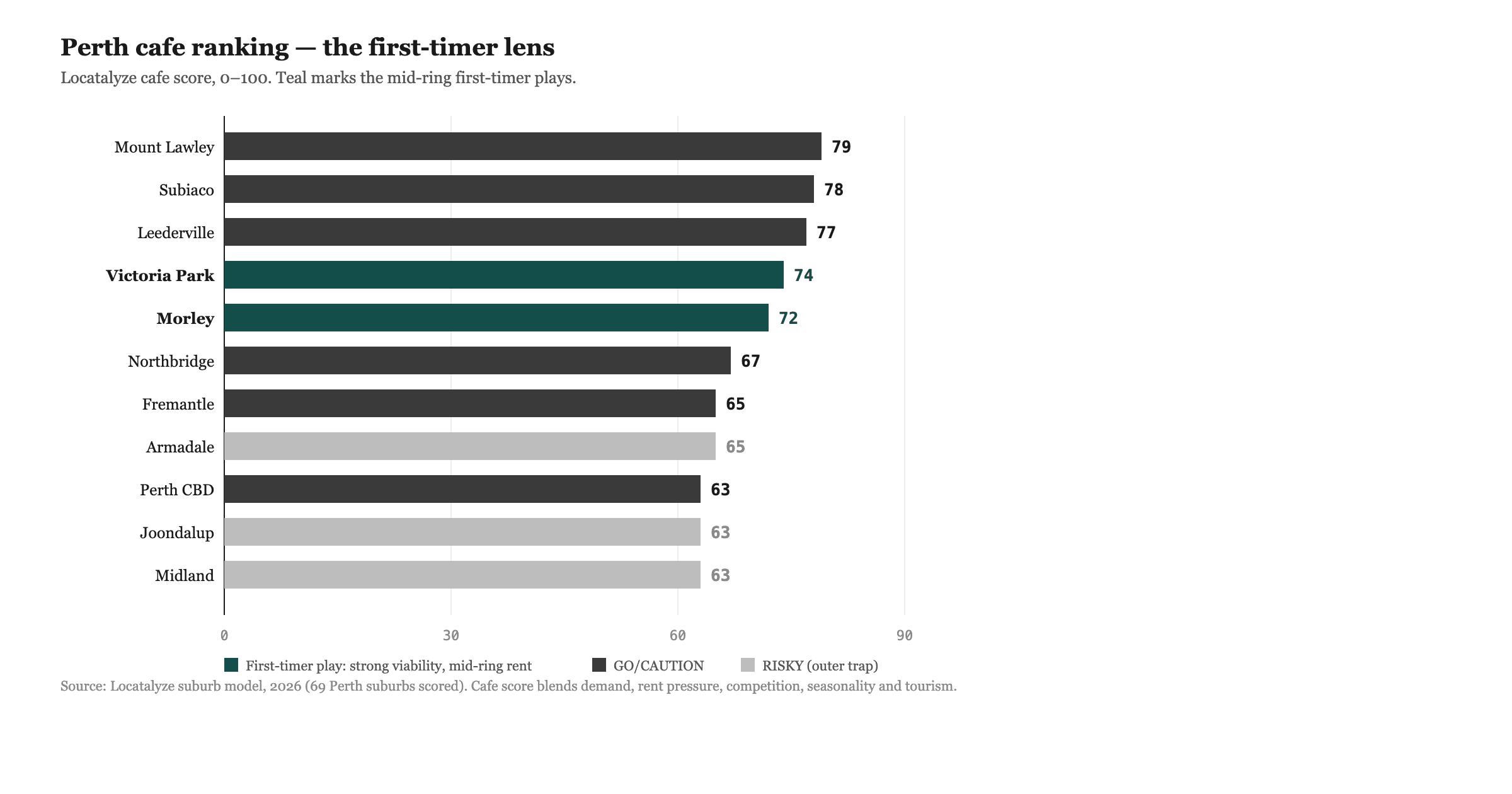
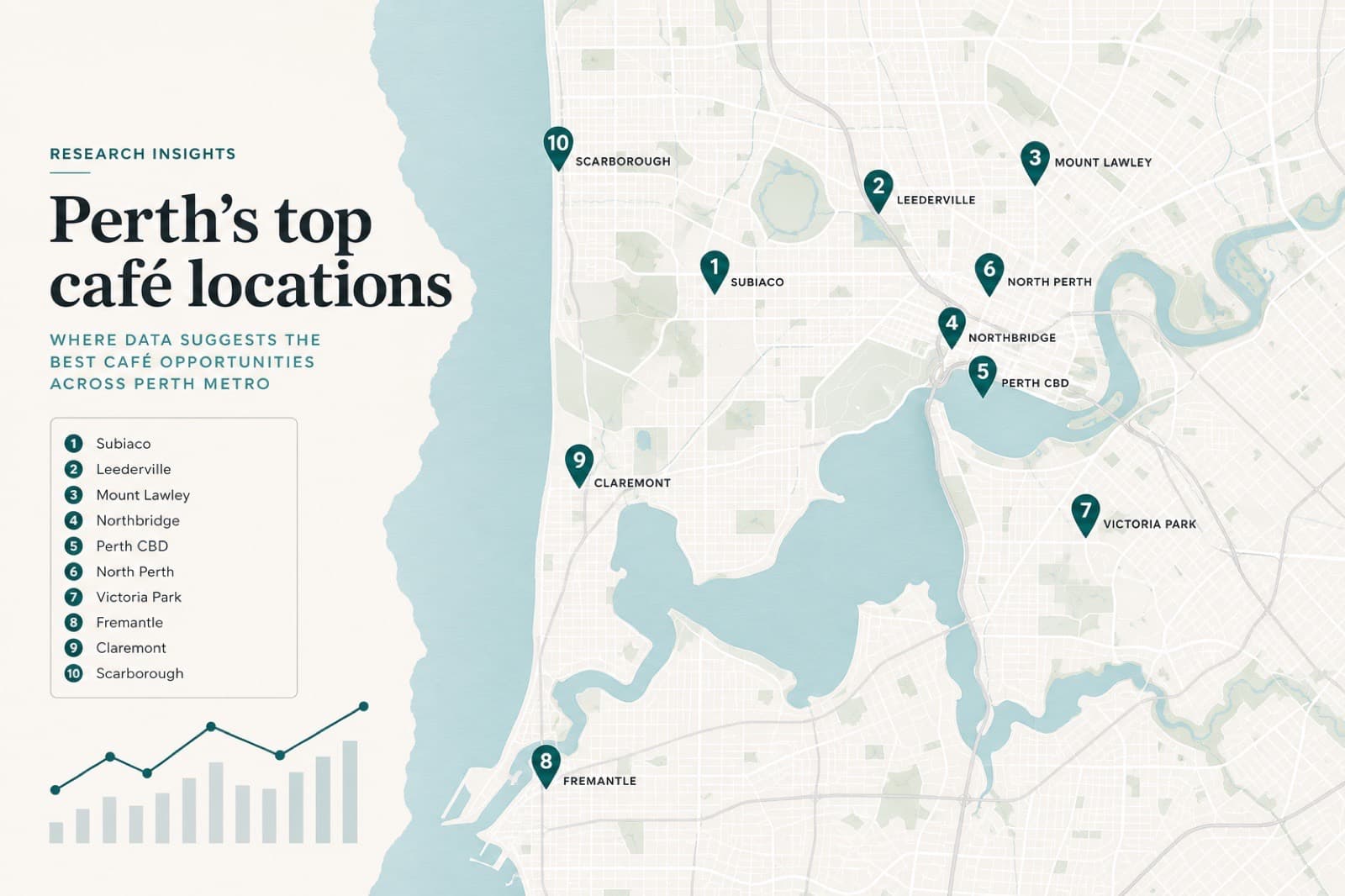
Perth suburb comparison: where the data points for each business type
The honest verdict on Perth in 2026
Perth is not a shortcut. The rents are lower than Sydney or Melbourne, but the lower foot traffic and tighter labour market partially offset that advantage. What Perth offers is a market where the income-to-rent ratio is genuinely favourable, where independent retail culture has room to grow, and where several specific suburbs have clear supply gaps in quality hospitality and retail concepts.
The operators who will do well in Perth in 2026 are those who build a business model around loyal repeat customers rather than high transaction volumes, who understand the labour market before they commit to a lease, and who pick a suburb where the demographic data shows unmet demand rather than trying to compete in established strips where the best sites are already taken. Mount Hawthorn, Leederville, and Nedlands all fit that description. Subiaco and Mount Lawley remain strong for the right concept. Fremantle and Northbridge reward patience and careful modelling.
Related reading
Tools first — then a full report for your address
Free rent, viability, and break-even checks. Upgrade when you are ready for competitors, map, and numbers for a specific site.
No signup required for tools