The Mistake That Kills Most New Australian Restaurants Is Not the Food
Founder, Locatalyze
Post-mortems in Australian hospitality often blame the menu, the roster or the marketing. Those factors matter — and they usually arrive after the lease is already wrong. The structural mistake is signing a rent (and a strip) that the format could never carry from that address. That is not the same as claiming a precise national percentage of restaurants die from location alone — we do not have a closure census that attributes cause that cleanly. What we do have is hospitality survival that is worse than the whole-economy base rate, and a set of failure modes you can spot before you sign.
Evidence standard
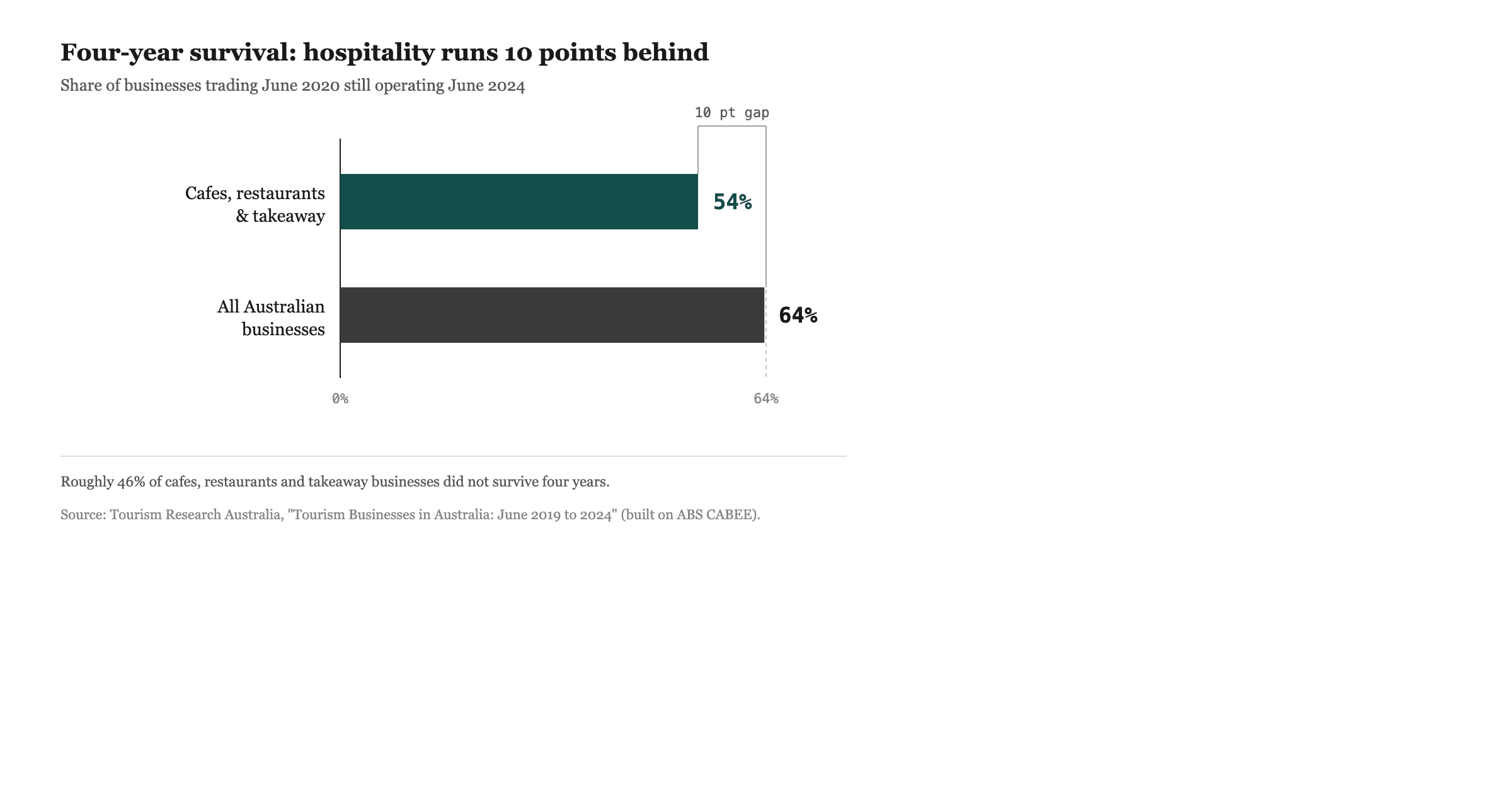
FACT: TRA/ABS — of cafés, restaurants and takeaway trading June 2020, 54% still trading June 2024 (worse than whole-economy ~64% over the same window). That is survival, not a cause-coded ‘% killed by location’. The previous title’s “a large share” claim was unsupported and has been removed. Failure modes below are LOCATALYZE ANALYSIS / operator pattern recognition. Worked rent ratios are MODELS. ASIC insolvency stats measure company insolvencies — not all closures.
Why Nobody Talks About This
The hospitality industry has a powerful incentive to not talk clearly about location economics as the primary cause of restaurant failure. Ingredient suppliers, equipment vendors, POS system companies, hospitality consultants, design firms, social media agencies — none of these businesses benefit from an honest conversation about how often restaurants fail before the first customer walks through the door because the rent-to-revenue structure was untenable from the day the lease was signed.
The conversation that's much more comfortable — and commercially convenient for everyone except the operator — is that the concept wasn't right, the service wasn't consistent enough, the marketing didn't land. These narratives imply that failure could have been avoided with better execution, which means there's a consulting product, a coaching program, or a software solution to sell. "You signed a lease with an economically unsurvivable rent structure" has no upsell.
There's also a psychology factor for the operators themselves. Acknowledging that the location was structurally wrong from day one means acknowledging that the years of effort, the capital, and the personal financial exposure were based on a flawed premise. It's an uncomfortable diagnosis. "If I had just marketed better" or "if I'd held on a bit longer" are more psychologically tolerable explanations than "I signed a lease that the business model could never justify." The former implies the failure was correctable. The latter says it was predetermined.
The most dangerous sentence in restaurant location selection is "I know the numbers are tight but we'll make it work once we build the customer base." Once is doing enormous work in that sentence. Once never reliably arrives when the rent-to-revenue ratio is structurally wrong.
Failure Mode 1: The Rent Compression Trap (The Most Common Killer)
The rent compression trap begins at the moment an operator starts thinking about rent in absolute dollar terms rather than as a percentage of potential revenue. "$5,500 a week sounds like a lot but it's manageable" is an absolute-dollar assessment. "$5,500 a week is 24% of our realistic weekly revenue ceiling, which means the business model can never generate a profit" is a percentage assessment. These two sentences are about the same lease. Only one of them tells you the truth.
Here is the mechanism in specific terms. A 50-seat casual dining restaurant. Average lunch spend: $28. Average dinner spend: $46. Table turn rate: 1.5 at lunch, 1.1 at dinner. The operator runs 14 services per week and realistically achieves 72% of theoretical maximum occupancy across those services. Weekly revenue: approximately $23,000. Rent: $5,500 per week. Rent-to-revenue ratio: 23.9%. The industry's outer limit for viability in this format is 10–11%. This business is paying more than twice a sustainable rent level. Before a single ingredient is costed, before a single staff member is paid, nearly a quarter of revenue is already committed to the landlord. At standard food cost (30%), standard labour (35%), and standard overheads (12%), this business is losing money at every single service. Not occasionally. Not in slow months. Every service, every day, every week.
What makes this trap particularly lethal is that it's invisible in the short run. The first weeks after opening almost always generate above-average revenue from novelty traffic and media attention. The opening rush can make a structurally broken business look viable for 3–6 months. By the time the true trading pattern establishes itself — the one where rent is 24% of weekly revenue — the operator has committed to the lease, invested the fit-out capital, hired and trained the team, and is psychologically all-in. Walking away at that point feels impossible. Continuing is also impossible. The trap has closed.
The table above illustrates the fundamental problem. A standard 60-seat casual dining restaurant in most Australian markets, trading well at 70% of theoretical capacity, generates somewhere between $22,000 and $28,000 per week in revenue. To make that work at a 10% rent ratio, the all-in weekly rent can't exceed $2,200–$2,800. The majority of visible, attractive retail and dining locations in Melbourne, Sydney, and Brisbane CBD and inner-suburban areas cost significantly more than that. The math fails before you've assessed a single other variable.
Failure Mode 2: The Phantom Traffic Problem
The phantom traffic problem is subtler than the rent compression trap but equally lethal. The location has foot traffic — real, visible, countable foot traffic. The site visit was on a busy weekday and people were clearly moving through the area. The problem is that the people who are walking past don't actually represent the operator's customer.
This plays out in a specific pattern that we see repeatedly in failed location analyses. An operator scouts a location near a large hospital campus in outer suburban Sydney or Melbourne. High pedestrian movement. Healthcare workers on shift rotations. Visiting patients and families. Administrative staff. On the site visit, the street feels alive and purposeful. The operator commits.
What they didn't analyse: healthcare workers on shift rotations have 20–30 minutes for lunch and require fast, cheap, and reliably consistent. They have already established habitual loyalty to two or three local options and will not be redirected by a new opening unless it delivers on all three dimensions immediately and consistently. Visiting families are emotionally preoccupied and eating is functional — they want the fastest, least-stressful option available. Administrative staff often bring their own lunch or coordinate group orders. The foot traffic is real. The customer base for a sit-down, $30-average-spend, 45-minute-service restaurant does not exist in that pedestrian flow in meaningful numbers.
Phantom traffic locations are everywhere in Australian commercial districts. Commuter transit hubs generate enormous pedestrian counts, but most of that traffic is people with a train to catch and an 8-minute window between decision and departure. Tourism corridors look excellent on Saturday afternoons but often produce minimal weekday repeat trade. Shopping centre mid-mall positions generate genuine foot exposure but primarily from people who've already committed to a retail destination and aren't in a dining decision moment. The question that cuts through all of this isn't "how many people walk past?" It's "how many people in my target customer profile, with time and appetite and spend capacity matching my format, walk past during my operating hours?" These are very different questions with very different answers.
How to diagnose phantom traffic before you sign
Stand outside your candidate location for 2 hours at the time and day of your primary meal service (e.g., 12–2pm on a Wednesday for a lunch-focused casual dining concept). Count the pedestrians. Then estimate: what proportion of these people, based on their visible demographic profile and apparent purpose, would realistically be potential customers for your specific format? If the answer is less than 2%, your conversion math becomes very difficult. If the answer is less than 1%, the location is a phantom traffic trap.
Failure Mode 3: The Competitor Blindspot
Most operators assess competition at the level of what's visible from the shopfront. "There's a burger place and a Japanese restaurant, but there's no Thai concept, so there's a gap for us." This assessment framework is inadequate in two specific ways that consistently contribute to location failures.
First: competition for a specific location isn't defined by cuisine type. It's defined by meal occasion. A ramen restaurant, an Italian trattoria, and a Korean BBQ concept are not competing with each other on cuisine. They are competing for the Friday-night-out dinner occasion within their shared catchment. Any business that captures that occasion — regardless of cuisine — is a direct competitive threat to all three of them. Operators who assess competition at the cuisine level systematically underestimate how many established players they are actually competing against for their core occasions.
Second: the strength of established competitive operators matters as much as their number. A precinct with one long-established, highly loyal, consistently busy restaurant is a harder competitive environment for a new entrant than a precinct with six mediocre, inconsistently popular restaurants. The long-established operator has built occasion loyalty — Friday night dinner, the anniversary restaurant, the team celebration venue — that is extremely difficult to dislodge regardless of how good the new entrant's product is. Starting-from-zero within visual range of a beloved, operationally excellent competitor is one of the most challenging commercial positions a new restaurant can occupy.
The operators in our data who navigated competitive environments successfully did one of two things. They chose competitive clusters deliberately and with a clear differentiation thesis — a specific cuisine category, price point, or experience format that the cluster genuinely lacked. Or they identified under-served corridors where the absence of competition was an opportunity rather than a signal that the market wasn't there. Both strategies can work. What doesn't work is ignoring competition because your cuisine is different, or misreading the absence of competition as unclaimed opportunity without investigating why it's absent.
Failure Mode 4: The Lease Structure Time Bomb
This failure mode doesn't kill businesses on day one. It kills them in year two or year three, which is in many ways more cruel — by that point the operator has poured years of their life, every dollar they had, and often a significant chunk of their family's financial security into the business. The lease structure time bomb comes in three primary variants.
The uncapped CPI review clause. Standard in many Australian commercial leases, this provision increases rent annually in line with the Consumer Price Index with no upper limit on the increase. In normal conditions — CPI of 2–3% — this is modestly annoying but manageable. In an elevated inflation environment, which Australia experienced sharply through 2022–2024, an uncapped CPI clause meant automatic annual rent increases of 5–8% with no ability to negotiate or resist. An operator whose rent was already at the outer edge of viability found it pushed well into unviability within 18–24 months of signing, through a mechanism that was in the lease from day one. They just didn't notice it until it started firing.
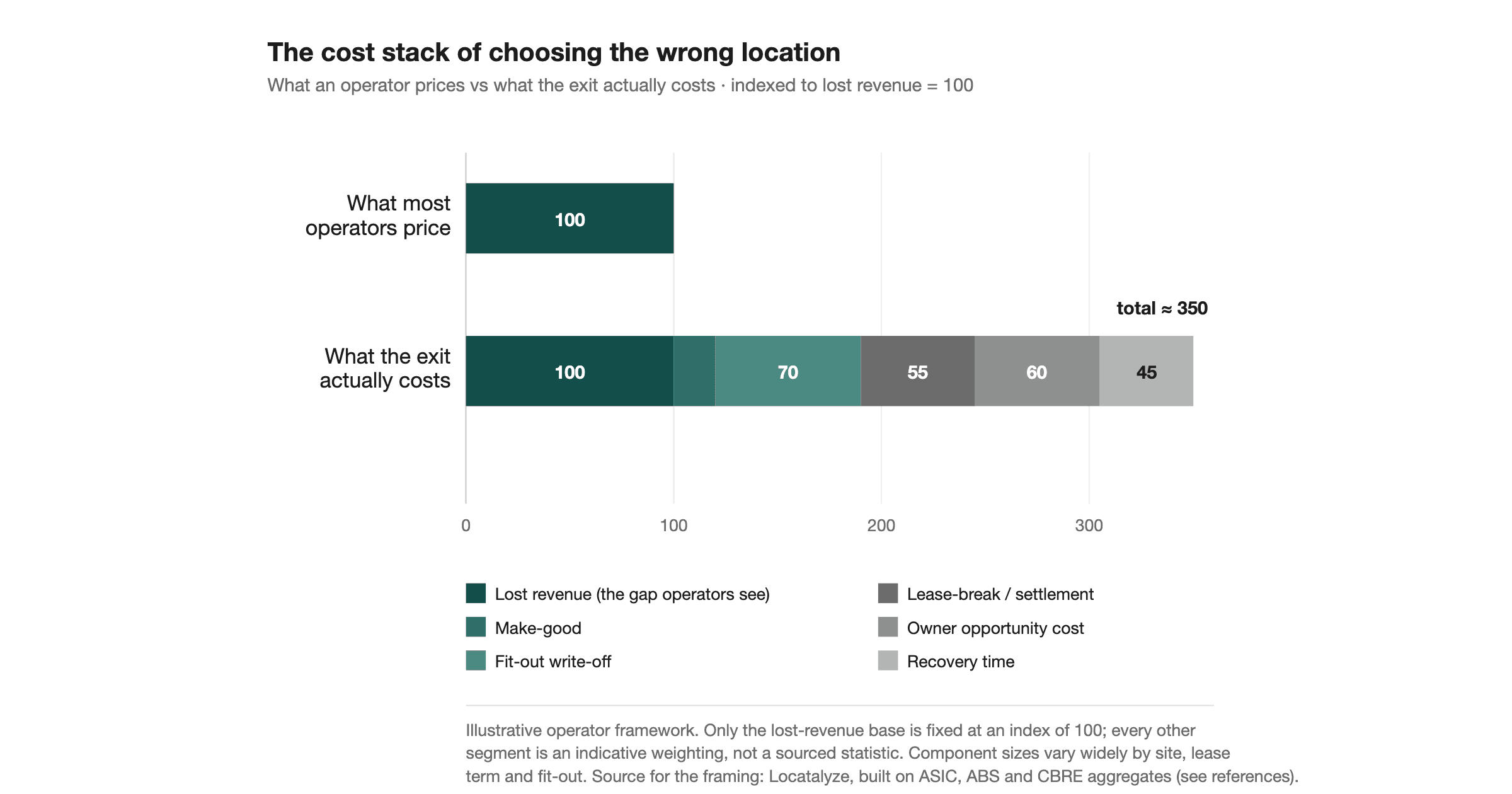
The make-good obligation. Every commercial lease contains a clause requiring the tenant to return the premises to original condition at the end of the lease term. For a food and beverage operator who has installed a $180,000 kitchen, a commercial exhaust system, custom joinery, and specialised flooring, "return to original condition" means removing all of that work. The cost: typically $45,000–$90,000, depending on the scope of the fit-out. This liability exists from day one of the lease. It should be modelled into the total cost of the tenancy from the first day of planning. It almost never is. Operators discover it when the lease ends, often at the worst possible time financially.
The personal guarantee. Standard in Australian commercial leasing for small business operators, the personal guarantee provision means that you personally — not just your company — are responsible for the full lease obligation if the business fails. If the business closes with two years remaining on a $5,800-per-week lease, you personally owe $604,160. Not your company. You. This is the clause that turns a business failure into a personal financial catastrophe. Most operators know the personal guarantee is there. Very few model what their actual worst-case exposure is in dollar terms before they sign.
54%
FACT: TRA/ABS — cafés/restaurants/takeaway still trading June 2024 of those trading June 2020 (not cause-coded to location)
MODEL
Worked rent-compression examples below are illustrative arithmetic — not a national loss survey
Lease
Use before-you-sign checklist for make-good, guarantees and term risk
The Psychology That Makes This Mistake So Common
Understanding why this mistake persists requires acknowledging the specific psychological context in which lease decisions are made. The founder is, by definition, emotionally invested in their concept. They've been carrying this vision for months or years. The food is excellent in their mind. The fit-out is planned. The name is chosen. The Instagram handle is secured. When they walk into a space that physically matches the vision — the right light, the right proportions, the vibe that matches the dream — something significant happens in the brain.
The cognitive mode shifts from evaluation to justification. The question is no longer "does this location make economic sense?" The question becomes "how do I make the numbers work so I can have this location?" These are opposite cognitive processes. Justification analysis finds reasons to proceed. Evaluation analysis finds reasons to reconsider. Justification analysis consistently produces worse commercial decisions because it starts from a desired conclusion and works backward to a rationale, rather than starting from data and arriving at a conclusion.
Add to this the artificial urgency that landlords and property managers apply deliberately and skillfully — "there's another party viewing this on Thursday," "the landlord needs a decision by Friday," "I can't hold this for you past the weekend" — and you have a perfect environment for bypassing the rational analysis that a $300,000 investment and a 5-year personal liability obviously deserves. The urgency is often manufactured or exaggerated. The signing deadline is almost always more flexible than presented. But the emotional cocktail of vision + attachment + urgency produces decisions that the person who signs them would not make if they had a week to run the numbers properly.
The single sentence that indicates you're in justification mode
"I know the rent is high but we'll build the customer base." This sentence acknowledges that the math doesn't currently work and proposes that execution will fix a structural problem. Execution can't fix a structural problem. A rent-to-revenue ratio of 22% doesn't become viable because your food is excellent. It becomes viable when the rent comes down or the revenue ceiling goes up — and for a fixed-seat restaurant, the revenue ceiling is determined by the location, not the execution.
What Would Have Changed the Outcome
For the vast majority of Australian restaurant failures that trace back to location economics, the information required to make a different decision was available before the lease was signed. It wasn't hidden. It wasn't proprietary. It required analysis that most operators either didn't know to do or didn't have time to do before the landlord's deadline arrived.
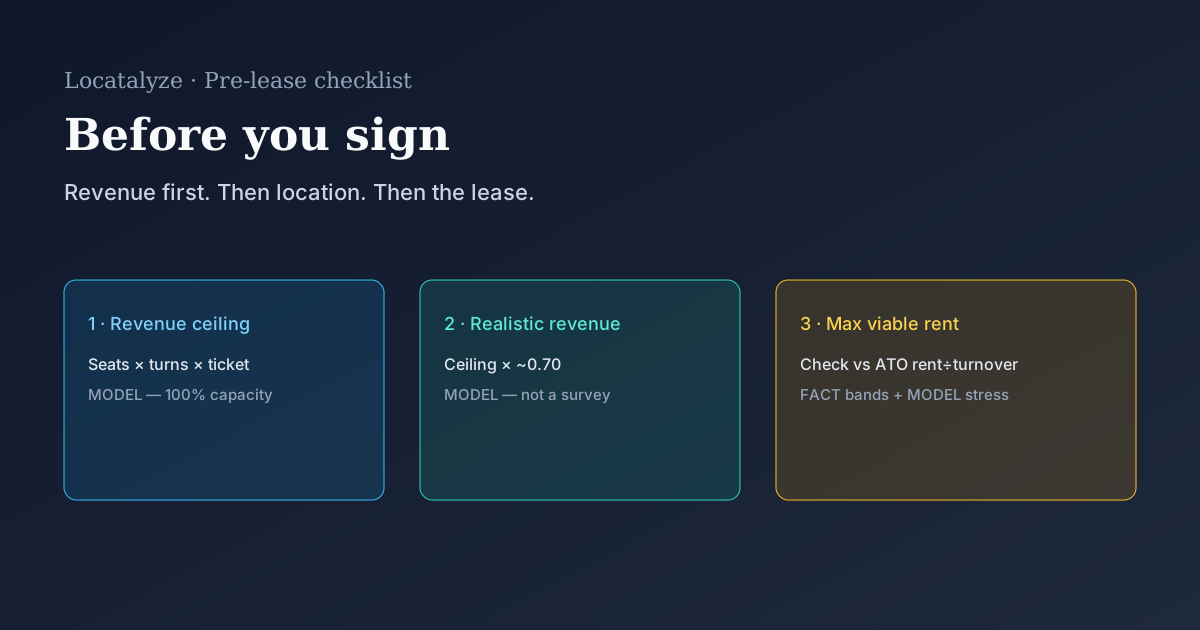
A revenue ceiling calculation done before visiting the space: how much can this format, at this seat count and price point, realistically generate per week at 70% of theoretical maximum? A maximum viable rent derived from that figure: revenue × 0.10. A market review of comparable properties in the corridor to confirm whether the quoted rent is at, above, or below market. A foot traffic count conducted at the actual time of the primary trading occasion, not during a weekend visit when the area looks its best. A competition mapping exercise at a 2km radius, by meal occasion type. A development application register check for the street and surrounding blocks. A lease clause review with a hospitality-specialist solicitor who has seen make-good obligations and CPI review clauses cause real damage to real operators.
None of this is exotic analysis. None of it requires resources that a first-time operator doesn't have. What it requires is time — specifically, the time to do this work before the landlord's pressure timeline makes it feel impossible — and an analytical discipline that sits uneasily alongside the excitement and certainty that most restaurant founders bring to their concept.
Locatalyze automates the pre-commitment analysis that separates operators who build profitable businesses from those who learn the hard way. Two minutes, any Australian address.
Free location score, map, data confidence and PROCEED / VERIFY / AVOID recommendation. Modelled financials stay optional.
Run your location analysisSources & verification
Related reading
Frequently asked questions
About the author
Prashant GuleriaFounder, Locatalyze
Prashant built Locatalyze after spending years watching talented operators fail for preventable reasons at the lease stage of their businesses.
Tools first — then a full report for your address
Free rent, viability, and break-even checks. Upgrade when you are ready for competitors, map, and numbers for a specific site.
No signup required for tools