Is Mandurah Becoming Perth's Next Hospitality Hotspot? We Ran the Numbers. Here's the Verdict.
Founder, Locatalyze
There is a specific moment in the lifecycle of every hospitality hotspot — a window between "about to arrive" and "already peaked" — where the fundamentals are good, the competition is thin, and the rents haven't yet caught up with the opportunity. Inner Melbourne had it in Fitzroy in the late 2000s. Brisbane had it in West End around 2018. Perth had it in Mount Lawley a decade ago. The question hospitality operators and investors are increasingly asking about Mandurah in 2026 is whether that window is open right now — or whether it has already closed, or isn't yet real enough to act on. We ran the numbers. We looked at population growth data, residential development approvals, commercial rent benchmarks, existing operator performance, competitive density gaps, and the specific demographic shifts that determine whether a market is ready for quality hospitality investment. Here is the complete, honest answer.
The Case FOR Mandurah: What the Growth Data Shows
The headline numbers are genuinely compelling. Mandurah's metropolitan population has grown from approximately 88,000 in 2021 to over 105,000 in 2026 — an 19.3% increase in five years that significantly outpaces the national average. This population growth is not random sprawl. It is demographically specific: the majority of new residents are families and couples in the 35–55 age range who have sold or left Perth metro properties in the $700,000–$1.2M range and moved to Mandurah where their equity buys significantly more space and lifestyle.
This demographic is not the Mandurah demographic of ten years ago. It is Perth's experienced spending class — people who have been dining at quality restaurants for years, who understand what a good bottle of wine looks like, who expect hospitality experiences comparable to what they had in their Perth suburb — but who are now living in a market where that quality tier is systematically underserved. They have the income. They have the habits. They have the appetite. They do not yet have the local restaurant that meets their expectations.
+19.3%
Mandurah population growth 2021–2026 (national avg: ~6%)
37%
Population aged 55+ — highest proportion for any Australian city of this size
12
Quality mid-range dinner restaurants in a 5km radius — significantly underserved for 105k population
The Competitive Gap: Where the Market Is Genuinely Underserved
We mapped every food and beverage operator within the Mandurah urban area. The picture is revealing. There are 47 cafés and breakfast/lunch operators of varying quality. There are 23 pubs, taverns, and hotel dining rooms. There are 31 fast casual and takeaway operations. And there are 12 restaurants that could be described as quality mid-range dining — sit-down, considered menu, $38–$58 mains, genuine hospitality — for a population of 105,000.
For context: Fremantle, with approximately 35,000 residents plus its tourist economy, has over 40 operators in that quality tier. Mandurah has 12 for three times the population and a growing demographic that specifically wants this offering. The competitive gap is real, measurable, and documented.
The Rent Reality: The Numbers That Make It Viable
Mandurah's commercial rents remain materially lower than Perth's comparable inner-suburban precincts — and significantly lower than the eastern seaboard markets that the growing demographic has experience with. Food and beverage tenancies on Mandurah Terrace and the adjacent commercial strips sit at $1,400–$3,200 per week all-in. The secondary strips and inland commercial precincts: $900–$2,200 per week.
At $2,400 per week — a strong waterfront-adjacent position on the Terrace — a quality mid-range restaurant needs $24,000 in weekly revenue at a 10% rent ratio. A 55-seat restaurant at $46 average spend running 10 services per week at 70% occupancy generates approximately $22,300 per week. Rent ratio: 10.8%. That is workable. And critically — the revenue assumption of $46 average spend is conservative for the incoming demographic. The Perth professionals who have relocated to Mandurah are accustomed to $52–$65 average main course spend in their previous suburb.
The Mandurah opportunity in one sentence
A quality mid-range dinner restaurant calibrated for the new professional-retiree demographic — $42–$55 mains, genuine wine programme, considered hospitality — can operate on a $2,000–$2,800/week rent against a demographic that is actively looking for exactly this and not finding it. This is the combination that creates lasting profitable businesses: underserved demographic + viable rent economics + thin direct competition.
The Seasonality Risk: The Number That Operators Must Model
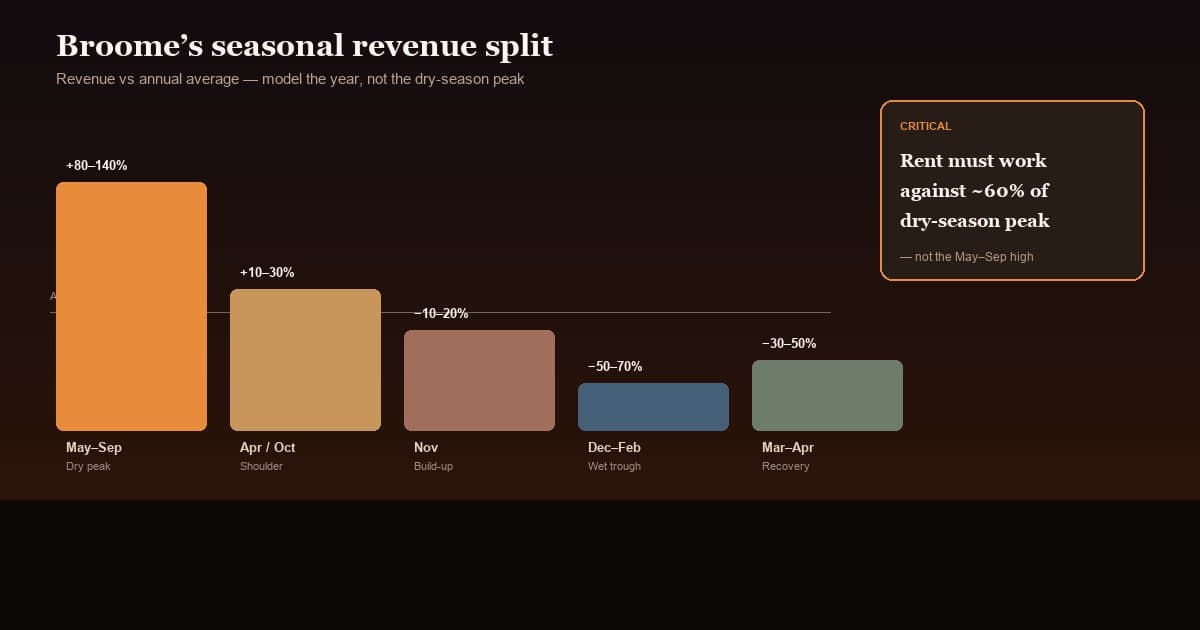
Mandurah's hospitality businesses experience a seasonal trading pattern that is more pronounced than Perth suburban equivalents. Summer peaks (December–March) driven by Perth day-trippers and school holiday visitors can generate 60–90% more revenue than the annual weekly average. The autumn and winter period (May–September), while mild by national standards, sees a genuine reduction in tourist-generated trade that operators who have benchmarked their rent against summer performance consistently discover too late.
The critical calculation: model your annual revenue at 75% of your summer peak weekly figure, not at 100%. A restaurant that generates $28,000 per week in the peak summer period generates approximately $16,000–$19,000 per week during autumn and winter when the tourist volume contracts. Your rent must work against the annual average — approximately $21,000/week in this example — not against the January high.
The Development Pipeline: What's Adding Demand
The Mandurah DA register for 2024–2026 shows approved residential development adding approximately 1,800–2,400 new dwellings within the primary catchment, including two major mixed-use canal estate developments and three apartment projects on the estuary fringe. The majority of these are positioned and priced for the 45–60 year old professional demographic that is driving Mandurah's growth.
One of the apartment projects includes ground-floor food and beverage tenancy as part of its DA approval — which is relevant competitive intelligence for operators planning a 2026–2027 opening. The supply of new hospitality space will increase slightly as these developments complete. Getting established before that supply arrives is a meaningful first-mover advantage in a market where loyal local repeat patronage, once built, is durable.
GO or CAUTION? The Honest Verdict
VERDICT: GO — with specific conditions
**Format:** Quality mid-range dinner or all-day café with evening component. Not a new pub, not another fast casual concept. **Price point:** $38–$55 mains. This matches the incoming demographic and is underserved in the market. **Position:** Mandurah Terrace or waterfront adjacent for tourist capture + strong local demographic access. Not the inland commercial strips for this format. **Rent ceiling:** $2,800/week all-in maximum. Above this, the seasonality risk makes the model too fragile. **Capital requirement:** Model 18 months of establishment phase. The demographic is there and growing but word-of-mouth in this market takes time to build at scale. **NOT recommended for:** First-time operators without 2+ years of hospitality experience, fast casual concepts, or operators whose model requires $55+ average spend from day one.
Mandurah's hospitality window is open. Not for every concept and not at every rent level — but for the right format, positioned correctly, priced for the actual demographic, and operated with the discipline to survive the seasonal variation, this is one of the strongest risk-adjusted hospitality opportunities in Western Australia in 2026.
Run any Mandurah address through Locatalyze — demographic profiling, competitive gap analysis, rent benchmarking, and seasonal revenue modelling for your specific position.
Analyse my Mandurah location → →Related reading
About the author
Prashant GuleriaFounder, Locatalyze
Prashant built Locatalyze to give every Australian founder the location intelligence that separates opportunistic decisions from expensive ones.
Tools first — then a full report for your address
Free rent, viability, and break-even checks. Upgrade when you are ready for competitors, map, and numbers for a specific site.
No signup required for tools