Busy Streets Don't Mean Profits: The Real Business Case for Darwin
Founder, Locatalyze
Darwin has the highest foot traffic per capita of any Australian capital city during the dry season. It also has the highest hospitality business failure rate of any Australian capital city at any time of year. These two facts exist simultaneously, and they are not contradictions. They are the same story told from two different angles. The Mitchell Street foot traffic at 9pm on a Saturday in July is real. The revenue it generates for hospitality operators during those five months is real. What is also real is that the same street at 9pm on a Tuesday in February — wet season, 32°C, humidity at 85%, a monsoonal deluge arriving at 6:30pm that cleared the outdoor areas and sent the last stragglers home before dessert — is a different commercial environment entirely. The business case for Darwin is not "busy streets = profits." The business case for Darwin is: build something that captures the dry season goldmine without building a cost structure that the wet season destroys. Most operators fail to do this. The ones who do it correctly build some of the most profitable businesses per-square-metre of any regional Australian market.
The Trap: How Darwin's Foot Traffic Tricks You
I want to describe something specific, because the mechanism of how Darwin traps operators is worth understanding in detail. An operator visits Darwin for the first time in June or July — peak dry season, the month where Darwin is genuinely one of the most extraordinary hospitality environments in Australia. The weather is perfect: 28°C evenings, zero humidity, a breeze off the harbour. The outdoor dining areas are full. Mitchell Street is alive at 10pm. The mindil Beach Sunset Market is drawing thousands of people. The bars are turning away customers. The energy is undeniable.
The operator feels it immediately. This market is underserved. There is demand here that isn't being met. The rents are lower than Perth or Melbourne. The competition isn't as sophisticated as Sydney. There is a genuine opportunity. They start making calls. They look at a couple of spaces. They run some rough numbers against the trading they can see happening around them. The numbers look excellent.
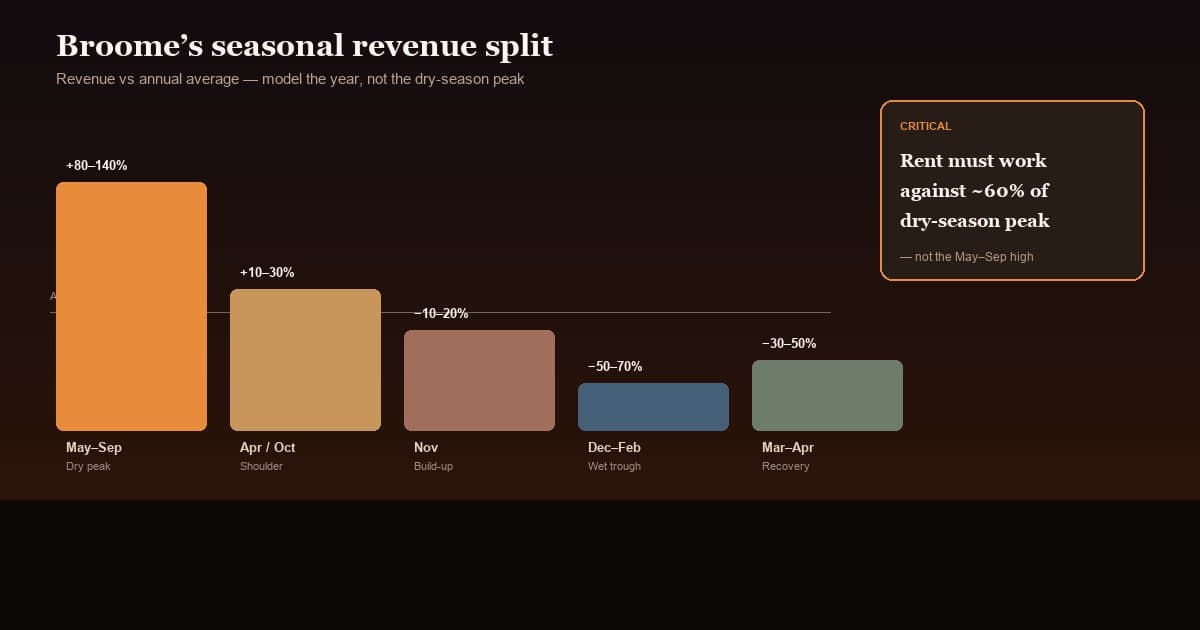
What they have done, without realising it, is benchmark their entire business case against approximately five months of the year and mentally averaged it across twelve. The July Darwin trading is not a sample of Darwin's annual average trading. It is the extreme upper end of Darwin's trading distribution. The February trading — which they have not witnessed and have not researched specifically — sits at the extreme lower end. The average of these extremes is what the business must be built on. And nobody booking site visits in July ever books one for February.
28–35%
Darwin hospitality first-year failure rate — highest of any Australian capital city
-50–70%
Revenue decline from dry season peak to wet season trough for tourist-facing formats
5 months
The dry season window that generates the majority of Darwin hospitality's annual revenue
The Real Numbers: What Darwin Actually Generates Across 12 Months
Let me model a specific Darwin restaurant. 55 seats. Quality casual dining with a strong outdoor component — essential for Darwin's dry season. Broadly Asian-influenced menu (appropriate for Darwin's demographic). $44 average spend. Open 7 days, lunch and dinner.
Total annual revenue range: approximately $759,000–$1,089,000. Annual average weekly revenue: approximately $14,600–$20,900 — call it $17,750 in the middle of the range. Now: what does this restaurant need to generate in weekly revenue to make its rent viable at 10%? At a Mitchell Street mid-range position of $3,800/week all-in, the revenue requirement is $38,000 per week. The annual average of $17,750 per week means this restaurant is running at 46% of its rent-viability threshold on average. It is viable only during the 5-month dry season, generates losses for 7 months of the year, and is structurally dependent on the dry season surplus to cover the annual deficit.
Now change the rent. At $1,600/week all-in — a secondary position, a street off Mitchell, a smaller tenancy — the rent-viability threshold is $16,000 per week. The annual average of $17,750 is above this threshold. The business is viable on an annual basis. The dry season surplus doesn't paper over annual losses — it generates profit that can fund growth or reserves. The entire business calculus changed because of a $2,200/week rent difference.
Why The Good Businesses in Darwin Are Not on Mitchell Street
This is the most counterintuitive piece of Darwin business intelligence, and it takes most operators too long to absorb: the most commercially resilient, profitable hospitality businesses in Darwin are disproportionately not on Mitchell Street.
Mitchell Street has the highest foot traffic in Darwin. It also has the highest rents, the most extreme tourist-to-local ratio, and the most dramatic seasonal swing. It is perfectly calibrated for a short-term trading mentality — maximise the dry season take and accept the wet season pain — which is why it attracts operators who think in terms of peak season rather than annual average. The operators who have built 5+ year profitable businesses in Darwin cluster in the streets immediately adjacent to the CBD, in the Parap and Fannie Bay precincts, and in Smith Street Mall — locations with lower rents, more consistent local patronage ratios, and less extreme seasonal swings.
One more thing about Mitchell Street that the foot traffic figures don't capture: the dominant customer demographic during dry season peak is tourists and backpackers. These customers spend differently from working professionals. Average transaction is lower. Alcohol margin is higher but the food margin is compressed by value expectations. The loyalty is zero — they leave Darwin and never return. Building a business whose customer acquisition investment entirely resets with each tourist turnover cycle is structurally more expensive than building a business with genuine local repeat patronage.
The Formats That Actually Work in Darwin: Evidence, Not Theory
I am done with generalisations. Here is what the operators who have been trading profitably in Darwin for 3+ years are actually doing.
Verified Darwin success patterns:
The Specific Things That Cause Darwin Business Failures
Pattern 1: The operator commits to a Mitchell Street rent based on dry season trading observations, discovers the wet season in their first November, and has insufficient reserves to survive 4 months of 50–60% revenue reduction against a fixed rent designed for dry season performance.
Pattern 2: The operator opens a fine dining or mid-premium concept calibrated for a Melbourne demographic, discovers that Darwin's local professional base has different dining preferences and frequency, and runs at 55–65% of projected covers without understanding why.
Pattern 3: The operator understands the seasonality but hasn't modelled the supply chain cost premium — Darwin operations run $38,000–$55,000 per year more expensive than comparable Perth operations in food costs, cooling, equipment maintenance, and pest control. This premium exists every week of the year, including the 17 wet season weeks when revenue is at its lowest.
The Darwin business model test: can you pass all three?
1. Does your business break even on wet season revenue alone — with zero tourist trade, $5,000–$10,000 weekly revenue? 2. Have you budgeted the $40,000–$55,000 Darwin operating cost premium into your annual P&L? 3. Is your rent below 10% of your annual AVERAGE revenue — not your dry season peak, but the weighted average across all 52 weeks? If you answer yes to all three: Darwin is one of the most exciting business environments in Australia and you are positioned to access it. If any answer is no: you are carrying a structural risk that the dry season excitement will mask until it cannot.
Locatalyze models Darwin's wet and dry season separately, calculates your specific annual average against rent scenarios, and flags the operating cost premiums that most Darwin business plans miss.
Model my Darwin location → →Related reading
About the author
Prashant GuleriaFounder, Locatalyze
Prashant built Locatalyze to help operators make decisions based on annual commercial reality rather than peak-season excitement.
Tools first — then a full report for your address
Free rent, viability, and break-even checks. Upgrade when you are ready for competitors, map, and numbers for a specific site.
No signup required for tools