Demand 7/10: the wealthiest-feeling and oldest-skewing of the upper north shore (10,620 residents; median age 42; household income $2,802/week; Chinese the leading ancestry at 31.1%) — large heritage homes, high owner-occupancy and the prized Killara High School public catchment — but quiet and residential with only a small local strip, leaning on Lindfield and Gordon for larger village amenity.
VERIFYBest fit: Café (64/100)
Location score
60
out of 100
Recommendation
VERIFY
Potentially viable — important checks remain
BEST FIT
64
Café
6.4/10 category
59
Restaurant
54
Retail
Businesses analysed16
Cache updated27 June 2026
Enginev7.3.0
Medium confidence
16 businesses sampled near Killara centre (updated within the last 4 months); suburb scores use Locatalyze engine v7.3.0. Suburb-centre snapshots for Killara — validate at your lease address before signing.
Demand, rent, competition, seasonality, and tourism — scored and weighted for Australian commercial operators.
7/10
Demand
7/10
Rent cost
4/10
Competition
2/10
Seasonality
2/10
Tourism dep
Business-Type Scores
How each format performs
Café / Specialty Coffee64
Full-Service Restaurant59
Independent Retail54
Scores use engine-derived weights: cafés weight demand and rent most heavily; restaurants factor tourism; retail factors tourism and demand equally.
Analyst Notes — Killara
What the data says about this location
1
Demand 7/10: the wealthiest-feeling and oldest-skewing of the upper north shore (10,620 residents; median age 42; household income $2,802/week; Chinese the leading ancestry at 31.1%) — large heritage homes, high owner-occupancy and the prized Killara High School public catchment — but quiet and residential with only a small local strip, leaning on Lindfield and Gordon for larger village amenity.
2
Competition 4/10: almost no commercial fabric of its own — most café/retail spend leaks to Lindfield and Gordon, so a small quality neighbourhood or school-catchment-adjacent format is the realistic play, not a destination strip.
3
Rent 7/10: high prestige upper-north-shore rents (median residential rent $620/week).
4
Seasonality 2/10: a prestige, heritage, school-catchment family base trades steadily year-round; T1 North Shore line.
Local insight — Killara
On-the-ground read for operators
Editorial notes layered on top of the scored model — same scores and benchmarks above; this section translates strip mechanics into decisions.
Local reality check
Demand 7/10: the wealthiest-feeling and oldest-skewing of the upper north shore (10,620 residents; median age 42; household income $2,802/week; Chinese the leading ancestry at 31.1%) — large heritage homes, high owner-occupancy and the prized Killara High School public catchment — but quiet and residential with only a small local strip, leaning on Lindfield and Gordon for larger village amenity.
Competition 4/10: almost no commercial fabric of its own — most café/retail spend leaks to Lindfield and Gordon, so a small quality neighbourhood or school-catchment-adjacent format is the realistic play, not a destination strip.
Rent 7/10: high prestige upper-north-shore rents (median residential rent $620/week).
Competition is lighter than inner strips — validate why (gap vs weak demand) before assuming easy trade.
Micro-location breakdown
Killara main strip / highest visibility
What tends to work: Service-led and neighbourhood concepts with repeat local trade.
What struggles: Formats needing highway visibility or large-format parking ratios.
Rent vs foot traffic: Prime band often near $5,281–$6,597/mo — Rent pressure 7/10 in sydney — landlords have pricing power; negotiate on effective rent over the full term.
Secondary street / side pocket
What tends to work: Operators who accept lower passer-by counts but fund discovery through product, hours, or events.
What struggles: Walk-in-only models with no marketing budget or brand recognition.
Rent vs foot traffic: Secondary band often near $4,294–$5,281/mo — savings must fund signage and fit-out amortisation, not disappear into rent alone.
Budget / upstairs / off-strip
What tends to work: Studios, appointment services, niche retail with owned traffic.
What struggles: Full-service dining depending on spontaneous footfall without a booking channel.
Rent vs foot traffic: Lower band near $2,791–$4,294/mo — viable only when customers arrive by intent, not accident.
Real business scenarios
If prime rent clears near $5,281–$6,597/mo, model daily covers at your real average ticket — the engine verdict is VERIFY at 60/100, not a guarantee at your address.
Tourism dependency 2/10: when elevated, January and shoulder weeks need explicit planning, not December extrapolation.
Run competitors within 500m before offer — Competition is lighter than inner strips — validate why (gap vs weak demand) before assuming easy trade.
Competitive reality
Killara (VERIFY, 60/100) is a modelled read across demand, rent, competition, and seasonality — validate on-site at quiet and peak dayparts, then reconcile with your accountant before lease execution.
Sharp verdict
Killara pays off when rent sits inside $5,281–$6,597/mo at conservative revenue — do not sign on suburb hype; sign on covers you can defend on a Tuesday.
Operator's briefing
Killara is among the wealthiest-feeling and oldest-skewing suburbs of Sydney's upper north shore — a Ku-ring-gai enclave of large heritage homes, high owner-occupancy (71.7%) and affluent, education-focused families. Its great draw is the prized Killara High School public catchment, one of the strongest family pulls on the North Shore line. But Killara is quiet and residential: it has only a small local strip and leans on Lindfield and Gordon for larger village amenity, so most café and retail spend leaks away. Demand reads wealthy and durable, but the thin commercial fabric keeps the composite at 63/100 — a VERIFY verdict, restaurant the best fit at 69/100. This briefing sets out the catchment and the format that fits.
Killara is a residence first and a commercial precinct barely at all. The 2021 Census records 10,620 residents with a median age of 42 — older than most of Sydney — in large, established, family homes: 78.9% are family households, the average household runs to 2.8 people, and 71.7% are owner-occupiers (39.4% owned outright, 32.3% with a mortgage). The median weekly household income is $2,802, well above the Greater Sydney $2,077. This is settled, affluent, long-tenure family money.
The catchment is therefore wealthy, education-driven and internationally diverse, with a near-even Australian/overseas birthplace split (49.4% born overseas) and Chinese the leading ancestry at 31.1%. The food and service demand is the quiet, quality, family-and-school trade of a prestige residential suburb, not the volume of a village high street. The constraint is the commercial fabric: Killara has almost none of its own, and most discretionary spend flows to Lindfield and Gordon. Read this briefing, then position a small, quality, school-catchment-adjacent format rather than a destination strip Killara cannot fill.
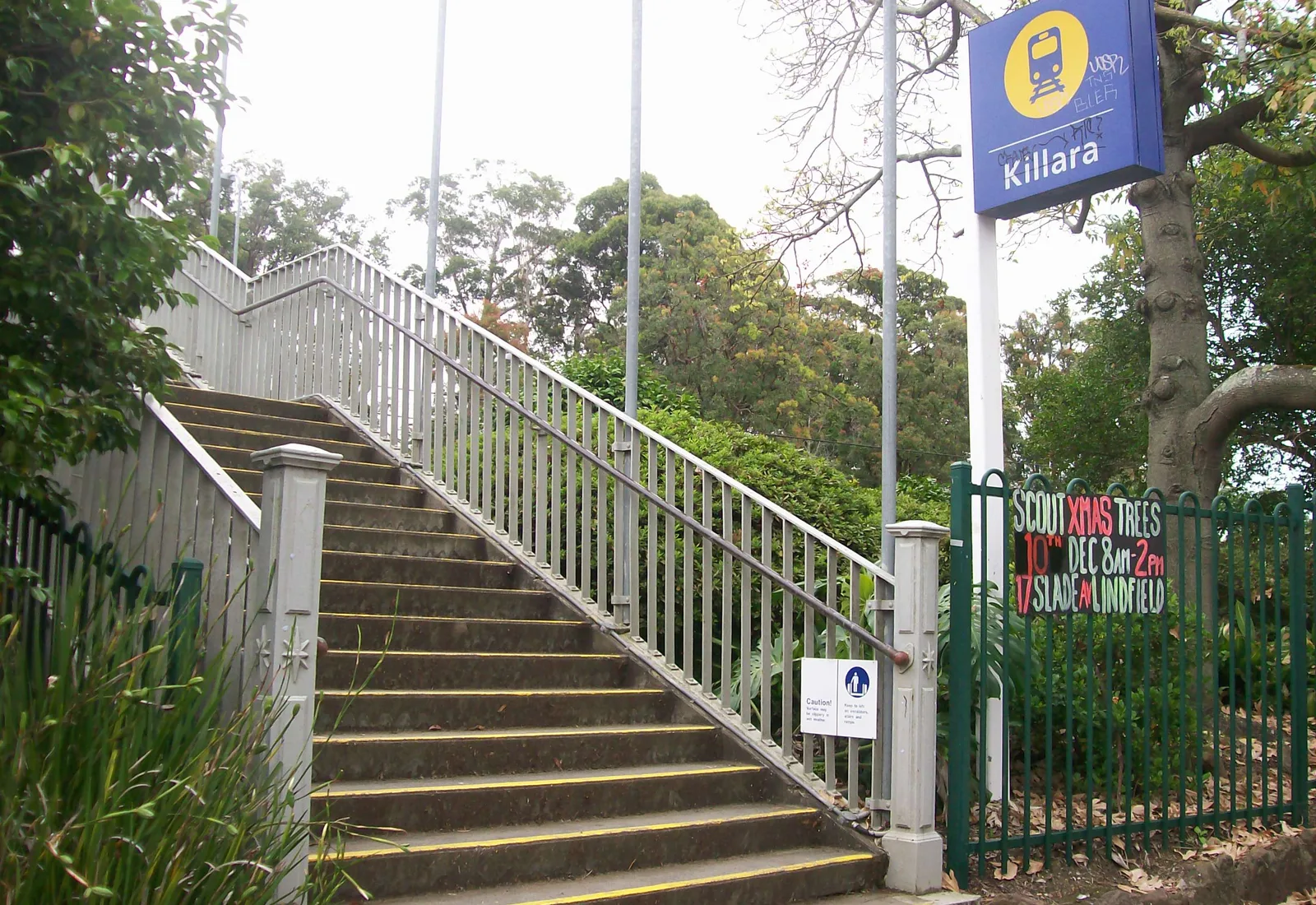
Killara railway station (east entrance) on the T1 North Shore line — anchor of the suburb's small local strip, with larger amenity one stop away at Lindfield and Gordon. Photo: Abesty via Wikimedia Commons, CC BY-SA 3.0
Demographic & economic snapshot
Who lives and works in Killara
ABS Census 2021 (suburb / SAL), with Greater Sydney benchmarks. Superscripts link to the numbered sources below.
Demographic and economic indicators for Killara, with Greater Sydney benchmarks.
Killara's resident numbers describe a wealthy, settled, family-and-school suburb rather than a commercial market — a median age of 42, 78.9% family households, an average household of 2.8, and 71.7% owner-occupancy (39.4% outright). The household income of $2,802/week sits well above the Greater Sydney median, and the base is internationally diverse, with 49.4% born overseas and Chinese the leading ancestry at 31.1%. This is durable, high-equity family money.
The decisive constraint is the commercial fabric, not the wealth. Killara has only a small local strip and leans on Lindfield and Gordon for larger amenity, so most discretionary spend leaks away. The operator implication is a small, quality, school-catchment-adjacent format sized to a modest local catchment that recaptures the leaking trade — priced for spend, positioned on the family-and-school desire-lines, and kept tight enough to carry a prestige-suburb rent against thin footfall.
Figure 1
Killara's affluent family catchment
Killara — household income$2,802
vs $2,077 Greater Sydney.
Greater Sydney — household income$2,077
Benchmark.
Killara — Chinese ancestry31.1%
Leading ancestry.
Killara — resident base10,620
Affluent family population.
Source: ABS Census 2021 — Killara (NSW) SAL12137 [1] and Greater Sydney [2]. Median weekly household income versus benchmark, leading-ancestry share and resident base.
A prestige, heritage, owner-occupied family suburb
Killara is one of the upper north shore's most established and affluent addresses — a Ku-ring-gai suburb of large heritage homes on leafy blocks, settled by long-tenure families. The 2021 Census numbers describe exactly that: a median age of 42, an average household of 2.8 people, 78.9% family households, and 71.7% owner-occupancy, of which a remarkable 39.4% own their home outright. A household income of $2,802 a week sits comfortably above the metropolitan median. This is generational, settled wealth, not transient renters.
For an operator, that profile is a double-edged signal. The spending power is genuine and durable — affluent families with stable incomes and high home equity. But the population is older, settled and home-centred, not a churning, footfall-heavy market, and the suburb's character is residential and quiet by design. The demand is high-value but low-volume, which rewards a quality offer pitched at the family-and-school catchment and punishes any format that needs the foot traffic of a busy strip Killara does not have.
Killara High School is the family draw
The single strongest pull on Killara is its public school catchment. Killara is the prized Killara High School zone — one of the most sought-after comprehensive public catchments on the North Shore line — and that draws education-focused families into the suburb and holds them there. Layered on the heritage homes and the affluent base, the school catchment is the engine that keeps Killara a family suburb rather than a passing-through one, and it concentrates a particular customer: parents, students and the daily school-run rhythm.
For an operator, the school catchment is the catchment. The productive trade sits around the family-and-school routines — the morning drop-off, the after-school window, weekend family activity — rather than a commuter or office pulse. A small café or food offer positioned near the school-run desire-lines and the family-housing pockets banks that rhythm; one that ignores it, betting on a strip footfall Killara lacks, is positioned against the suburb's only real flow. The school draw is durable and specific — build to it, not to a generic high-street assumption.
The commercial fabric is thin — spend leaks to Lindfield and Gordon
Killara's defining commercial fact is how little commercial fabric it has. The suburb has only a small local strip near the station on the T1 North Shore line, with limited café and retail offer, and no village centre of any scale. For larger amenity — a proper shopping strip, a deeper café and dining set, supermarkets and services — Killara residents drive or take the train one stop to Lindfield or Gordon, the established village centres either side. The result is that most discretionary café and retail spend physically leaves the suburb.
For an operator, that leakage is the central risk and the central opportunity at once. The risk is obvious: a destination format in Killara competes against well-established strips in Lindfield and Gordon that residents already use by habit, and Killara's own footfall is too thin to carry a large concept. The opportunity is the gap it leaves — a small, genuinely good neighbourhood offer that captures the local family trade that would otherwise drive away. The play is convenience and quality close to home, not scale; recapturing a slice of the leaking spend, not building a strip Killara cannot sustain.
High rent against thin footfall is the binding constraint
Killara carries the cost base of a prestige upper north shore suburb — high residential rents (median $620/week, well above the Greater Sydney $470) and a premium property market generally. That high cost sits against a thin commercial footfall, and that mismatch is the single biggest reason the composite reads 63 (VERIFY): the suburb has the wealth but not the volume, so an operator pays a premium-suburb cost base while drawing on a low-traffic local market.
The discipline is to size the format to the real, modest local catchment and keep the cost base tight. A small, efficient neighbourhood café or quality food offer with low fixed costs can be carried by Killara's affluent-but-thin trade; a large, high-rent destination concept reliant on strip footfall cannot. Model the rent on the small local strip, not on Lindfield or Gordon's busier centres, and the break-even on a modest, high-value family catchment rather than high volume — the spending power is real, but the footfall is unforgiving of an oversized format.
Format, competition and the leakage question
Direct competition inside Killara is light — there is little commercial fabric to compete with — but the real competition sits one stop away in Lindfield and Gordon, where established strips already capture the bulk of resident spend. The contest, then, is not against a crowded local market but against the habit of driving out for amenity. An operator wins by being the genuinely good, convenient local option that makes a Killara family choose close-to-home over the short drive — quality, neighbourhood familiarity and a fit to the family-and-school rhythm are the levers.
The leakage is the strategic question. Killara's residents are wealthy and will spend, but they are accustomed to spending in Lindfield and Gordon, and a new Killara operator has to actively recapture that trade rather than assume it. A small quality format with a clear local point of difference — the best coffee, a reliable family-friendly offer, a service the strip lacks — can claw back a meaningful slice. A me-too offer with nothing to pull residents from their established habits simply watches the spend keep leaking.
The format that fits, in plain terms
The strongest fit is a small, quality neighbourhood restaurant or food offer pitched at the affluent family-and-school catchment (restaurant 69/100) — sized modestly, positioned near the school-run and family-housing desire-lines, and built to recapture spend that would otherwise leak to Lindfield and Gordon. A quality neighbourhood café on the same lines fits the same market (café 64/100), trading the morning, after-school and weekend family rhythm. Services that suit an affluent, older, education-focused family base — allied health, tutoring-adjacent and family convenience — benefit from the settled, high-income catchment.
What does not fit: a large destination strip format Killara's thin footfall cannot fill; a value or high-volume concept out of place in a prestige, low-traffic suburb (retail reads weakest at 54/100); or a me-too offer with nothing to pull residents back from their established Lindfield and Gordon habits. Killara is a genuinely wealthy, durable family-and-school catchment for a small, quality operator who sizes the format to a modest local market and recaptures the leaking spend — but it is not, and cannot be made into, a high-traffic destination strip.
Zone-by-zone breakdown
Killara station / small local strip
The limited commercial strip near the station on the T1 North Shore line — the suburb's only real commercial pocket. Works for: a small, quality café or food offer banking the local family and commuter trickle. Fails for: large destination formats relying on a strip footfall Killara does not have.
Killara High School catchment / family housing
The family-housing pockets and the school-run desire-lines around Killara High. Works for: a neighbourhood offer trading the drop-off, after-school and weekend family rhythm. Fails for: formats ignoring the school catchment, betting on a flow Killara lacks.
Lindfield / Gordon edge
The approaches toward the established village centres either side, where Killara spend already leaks. Works for: a convenient close-to-home option that recaptures trade before it drives out. Fails for: concepts competing head-on with the deeper Lindfield and Gordon strips on their own ground.
Operator Intelligence
10 dimensions — what matters most here
Scored 1–10 from an operator perspective: higher always means better. Each dimension includes the reasoning behind the score.
The prized Killara High public catchment concentrates an education-focused family rhythm — the suburb's strongest and most specific pull.
8/10
Commercial fabric / footfallCritical
Almost no commercial fabric of its own — only a small local strip; footfall is thin and low-volume by design.
3/10
Spend retention (leakage)Important
Most discretionary café and retail spend leaks to the established Lindfield and Gordon centres either side.
3/10
Cost base (rent)Important
Prestige upper north shore rents (residential median $620/week) sit against thin footfall — the binding constraint.
4/10
When Killara trades
Peak and off-peak trading periods
Moderate
Weekday morning & school run (07:00–09:30)
The school drop-off and the station commuter trickle on the T1 North Shore line — the suburb's main weekday pulse.
Weak
Weekday midday (11:00–14:00)
A quiet residential daytime — the working population is largely out of the suburb.
Moderate
After-school (15:00–17:30)
The Killara High and family-housing rhythm — students, parents and the family-run trade.
Strong
Weekends
The affluent family base is home and active — the suburb's best window for a neighbourhood food offer.
Operator fit warning
Who should not open in Killara
✕
Large destination strip formats Killara's thin footfall cannot fill.
✕
Value or high-volume concepts out of place in a prestige, low-traffic suburb.
✕
Me-too offers with nothing to pull residents back from their Lindfield and Gordon habits.
Best business formats for Killara
A small quality offer that recaptures leaking spend
The best-fit play (restaurant 69/100). Killara's affluent families already drive to Lindfield and Gordon for amenity. A genuinely good, convenient local restaurant or food offer claws back a slice of that leaking spend without needing a strip footfall the suburb lacks.
School-catchment-adjacent café trade
The Killara High catchment concentrates a family-and-school rhythm. A quality neighbourhood café (64/100) on the school-run desire-lines banks the morning, after-school and weekend family trade — a durable, specific catchment to build to.
Services for an affluent, older family base
A settled, high-income, education-focused population (household income $2,802/week, 71.7% owner-occupied) supports allied health, tutoring-adjacent and family-convenience services that suit a wealthy residential suburb more than a high-volume food concept.
Risks specific to Killara
Spend leaks to Lindfield and Gordon
Killara's thin commercial fabric means residents habitually spend in the established strips either side. A new operator must actively recapture that trade, not assume it — a me-too offer with no point of difference simply watches the spend keep leaking.
High rent against thin footfall
A prestige upper north shore cost base (residential rent median $620/week) sits against a low-traffic local market. That mismatch is why the composite reads CAUTION — an oversized, high-rent format cannot be carried by Killara's modest footfall.
Quiet, residential, low-volume by design
Killara is an older, settled, home-centred suburb, not a footfall-heavy market. The spending power is real but the volume is low — a format that needs busy-strip traffic is positioned against the suburb's character.
Common mistakes
How operators get Killara wrong
Treating Killara as a high-street market
Killara has almost no commercial fabric — only a small strip. Sizing a format to a busy high-street footfall the suburb does not have is the most common and most expensive misread of the catchment.
Assuming the wealth converts to volume
The spending power is real but the population is older, settled and home-centred. Banking on the footfall to match the income overestimates a quiet, low-traffic residential suburb.
Ignoring the Lindfield and Gordon habit
Residents already spend in the established centres either side. An operator who does not actively differentiate to recapture that trade simply watches the spend keep leaking out of the suburb.
Underrated signals
Hidden advantages in Killara
A durable, recession-resilient family base
39.4% own outright and 71.7% are owner-occupiers — settled, long-tenure, high-equity families whose spending is far steadier than a transient renter market through downturns.
The school catchment locks in demand
The prized Killara High catchment keeps education-focused families in the suburb and turning over the school-run rhythm — a specific, durable flow a quality local offer can build to.
A genuine convenience gap to fill
Because so much spend leaks out, a genuinely good, convenient local offer faces little direct competition inside Killara — the gap is the opportunity for a small, sharp operator.
Rent viability bands for Killara
Indicative monthly rent envelopes for typical commercial tenancies — what each band buys, where it works, where it does not.
Rent freshness: 2026 indicative benchmarksValidate against the exact lease before signing
Band
Range
What it buys
Works for
Fails for
Killara strip / station-adjacent
Indicative — prestige upper north shore tier
A frontage on the small local strip near the station, Killara's only real commercial pocket.
A small, quality café or food offer sized to the modest local family and commuter trade.
Large destination formats relying on a strip footfall Killara does not have.
School-catchment / family-housing edge
Indicative — high tier
Proximity to the Killara High catchment and the family-housing pockets.
A neighbourhood offer trading the school-run and weekend family rhythm.
Formats ignoring the family-and-school flow, betting on a generic high-street footfall.
Lindfield / Gordon approach
Indicative — mid-to-high tier
A position toward the established village centres where Killara spend already leaks.
A convenient close-to-home option that recaptures trade before it drives out.
Concepts competing head-on with the deeper Lindfield and Gordon strips on their ground.
Lindfield, one stop south, is where much of Killara's spend already goes — it has the deeper village strip, café set and amenity Killara lacks. Killara is the wealthier, more heritage-residential, school-catchment suburb; Lindfield is the working village centre. For a destination strip format Lindfield offers the footfall; for a small school-catchment-adjacent neighbourhood offer that recaptures Killara's leaking trade, Killara itself is the play.
Gordon, one stop north, is the other established centre Killara spend leaks to — a larger village hub with broader retail and services. Killara is quieter, more prestige-residential and family-and-school led; Gordon carries the centre amenity and footfall. A high-volume or retail concept belongs in Gordon's deeper market; a small quality neighbourhood offer for Killara's affluent family base belongs in Killara.
Decision framework
Is your format small and efficient enough to be carried by Killara's affluent-but-thin local footfall?
Are you positioned on the school-run and family-housing desire-lines around Killara High, the suburb's real flow?
Does your offer have a genuine point of difference that pulls residents back from their Lindfield and Gordon habits?
Can your cost base survive a prestige-suburb rent against a low-traffic local market — modelled on the small strip, not the busier centres?
Are you building to a wealthy, settled family-and-school catchment rather than a destination-strip footfall Killara cannot supply?
Killara offers a genuinely wealthy, durable family-and-school catchment — but only for a small, quality format that recaptures leaking spend against a thin commercial fabric and a premium cost base. Locatalyze runs an address-level analysis on the exact tenancy: the real local foot traffic on the small strip and the school-run lines, how much spend leaks to Lindfield and Gordon, indicative upper north shore rent against your format, and a break-even built on a modest, high-value family catchment rather than busy-strip volume. Before you sign in Killara, get the catchment-size and leakage read right.
Is Killara a good place to open a café or restaurant?
For a small, quality offer aimed at the affluent family-and-school catchment, yes — restaurant is the best-fitting format at 69/100 and café at 64/100. Killara is a wealthy, settled suburb (household income $2,802/week, 71.7% owner-occupied) with the prized Killara High catchment drawing families. The composite is 63/100 (VERIFY) because the commercial fabric is thin and most spend leaks to Lindfield and Gordon — it rewards a small, sharp neighbourhood operator and punishes an oversized destination concept.
Why is the verdict VERIFY when the suburb is so wealthy?
Because the wealth does not translate into footfall. Killara has genuine spending power but almost no commercial fabric of its own — only a small local strip — and residents habitually spend in Lindfield and Gordon. The composite of 63 reflects a high-value but low-volume catchment held below PROCEED by thin footfall, spend leakage and a premium cost base.
What rent should I expect in Killara?
Prestige upper north shore levels — residential rents alone median $620/week, well above the Greater Sydney $470 (rent is the binding constraint against thin footfall). The small station strip is the only real commercial pocket. The bands here are indicative envelopes — verify commercial comps for the specific tenancy. The rent against low traffic is what makes a tight, modestly sized format essential.
Who is the Killara customer?
Primarily an affluent, settled family: 10,620 residents, median age 42, 78.9% family households, average household 2.8 people, and 71.7% owner-occupiers (39.4% outright). The base is internationally diverse — 49.4% born overseas, a near-even Australian/overseas split, with Chinese the leading ancestry at 31.1%. High-spend, education-focused and home-centred rather than footfall-driven.
How much does the Killara High School catchment matter?
It is the major family draw. Killara sits in the prized Killara High public catchment, one of the strongest family pulls on the North Shore line, which keeps the suburb a family market and concentrates a school-run rhythm — morning drop-off, after-school and weekend family activity. For an operator, the school catchment is the catchment: position to the family desire-lines, not a generic high-street footfall.
Why does so much spend leak to Lindfield and Gordon?
Because Killara has only a small local strip and no village centre of scale, residents drive or take the train one stop to the established Lindfield and Gordon centres for larger amenity. Most discretionary café and retail spend therefore leaves the suburb. The opportunity is to recapture a slice with a genuinely good, convenient local offer — but it must be actively won back, not assumed.
Who should not open in Killara?
Operators planning a large destination strip format Killara's thin footfall cannot fill; value or high-volume concepts out of place in a prestige, low-traffic suburb (retail reads weakest at 54/100); or me-too offers with nothing to pull residents back from their established Lindfield and Gordon habits.
Data provenance & limitations. Demographic figures are from the ABS 2021 Census for the Killara (NSW) suburb (SAL12137), with Greater Sydney (1GSYD) as benchmark; the 2021 Census is the most recent available. Owner-occupied is reported as the sum of owned outright (39.4%) and owned with a mortgage (32.3%). The Killara High School catchment and the Killara station description on the T1 North Shore line are from Wikipedia, a secondary link to primary reporting. Rent bands are indicative envelopes, not achieved rents — informed by Killara's premium upper north shore positioning; verify commercial comps for the specific tenancy. Factor scores are relative estimates calibrated across all Locatalyze suburbs, not guarantees of outcome.
Methodology: Scores are engine-derived from five observable inputs (demand strength, rent pressure, competition density, seasonality risk, tourism dependency — each 1–10). These feed into business-type-specific weighted composites via a single scoring engine used across all markets. Scores are relative estimates calibrated across all Sydney suburbs — a score of 80 indicates materially better conditions than 65; it is not a success probability or guarantee.
Frequently Asked Decision Questions
Have a specific address in Killara?
Run a full competitor map, rent benchmark, and location score, data confidence, and proceed / verify / avoid screening recommendation for any Killara address. Free.
Ranked from cached Google Places data near the suburb centre. Validate at your lease address before signing.
Cache refreshed 27 June 2026Suburb-centre scan, not lease-address validation
Who wins in Killara — Cafés
Ranked by success score (rating, review depth, centrality) within ~800m of the suburb centre.
What winners have in common
·2 of 3 top venues sit at 4.3★+ — customers reward consistent execution, not novelty alone.
·No single venue dominates on both rating and review depth — the category may still be contestable.
·Most winners sit within 400m of the suburb centre — frontage on the walkable strip matters.
1. DON DON Coffee
★★★★½ 4.9 (68 reviews) · 214m from centre
83 · Dominant
·4.9★ rating beats the typical café baseline in this catchment.
·0.5★ above the 4.4★ average among top local peers.
·Central location (214m from suburb centre) captures pass-by and destination traffic.
If you are opening nearby: DON DON Coffee (Dominant) shows what execution looks like at this score tier — 214m from centre — frontage on the walkable strip matters — For new entrants: Win on speed, workspace-friendly seating, or a neighbourhood loyalty hook before operators like DON DON Coffee raise their game.
2. Marian St. Cafe
★★★★☆ 4.1 (106 reviews) · 109m from centre
60 · Growing
·4.1★ rating beats the typical café baseline in this catchment.
·Rating sits below the 4.8★ peer average — volume or convenience may be doing the work.
·Review volume 179% above peer average (38).
If you are opening nearby: 109m from centre — frontage on the walkable strip matters — For new entrants: Win on speed, workspace-friendly seating, or a neighbourhood loyalty hook before operators like Marian St. Cafe raise their game.
3. Hidden Garden Community Cafe
★★★★½ 4.8 (8 reviews) · 747m from centre
56 · Growing
·4.8★ rating beats the typical café baseline in this catchment.
·0.3★ above the 4.5★ average among top local peers.
If you are opening nearby: For new entrants: Win on speed, workspace-friendly seating, or a neighbourhood loyalty hook before operators like Hidden Garden Community Cafe raise their game.
Possible market opportunities
Derived from venue counts and formats in our Google Places snapshot — not a guarantee of demand at your exact address.
High confidenceNeighbourhood specialty coffee + pastry counter
Reason: Only 3 cafés surfaced near the centre with strong demand signals — room for a quality daily ritual spot.
High confidenceAll-day workspace café
Reason: No dominant high-rated café in the top results — first mover with reliable Wi‑Fi and power can capture remote workers.
Who wins in Killara — Restaurants
Ranked by success score (rating, review depth, centrality) within ~1000m of the suburb centre.
What winners have in common
·Review depth averages 334 — operators with under 150 reviews read as unproven next to incumbents.
·No single venue dominates on both rating and review depth — the category may still be contestable.
·Most winners sit within 400m of the suburb centre — frontage on the walkable strip matters.
·4.2★ and 1,163 reviews — customers actively recommend this restaurant.
·Review volume 1928% above peer average (57).
·Mid-range positioning with strong review depth — balanced offer, not discount-led.
If you are opening nearby: Divan Persian Restaurant is the benchmark restaurant here — 4.2★ with 1,163 reviews signals repeat custom, not novelty traffic — $$ positioning is validated by review depth in this catchment — 380m from centre — frontage on the walkable strip matters.
2. Marian St. Cafe
★★★★☆ 4.1 (106 reviews) · 109m from centre
60 · Growing
·4.1★ rating beats the typical restaurant baseline in this catchment.
·Central location (109m from suburb centre) captures pass-by and destination traffic.
If you are opening nearby: 109m from centre — frontage on the walkable strip matters — For new entrants: Before venues like Marian St. Cafe thicken the cluster, a quality-led casual format with clear dietary options could set a new benchmark.
3. Jacaranda Restaurant & Bar
★★★★½ 4.6 (57 reviews) · 653m from centre
67 · Established
·4.6★ rating beats the typical restaurant baseline in this catchment.
·0.5★ above the 4.1★ average among top local peers.
If you are opening nearby: For new entrants: Jacaranda Restaurant & Bar already pulls the wine-and-snacks crowd — pick a different occasion (family early dining, counter lunch, or late casual) instead of another small-plates room.
4. Greengate Terrace
★★★½☆ 3.9 (9 reviews) · 552m from centre
33 · Emerging
·Rating sits below the 4.3★ peer average — volume or convenience may be doing the work.
If you are opening nearby: For new entrants: Before venues like Greengate Terrace thicken the cluster, a quality-led casual format with clear dietary options could set a new benchmark.
Possible market opportunities
Derived from venue counts and formats in our Google Places snapshot — not a guarantee of demand at your exact address.
High confidenceCounter-service Asian or Mediterranean bowls
Reason: Thin restaurant supply (4 venues) with solid demand — fast casual can fill the lunch gap without full-service overheads.
High confidenceWine bar with small plates
Reason: No clear 4.5★+ destination restaurant in local results — evening trade may be underserved.
Who wins in Killara — Retail
Ranked by success score (rating, review depth, centrality) within ~1500m of the suburb centre.
What winners have in common
·3 of 9 top venues sit at 4.3★+ — customers reward consistent execution, not novelty alone.
·No single venue dominates on both rating and review depth — the category may still be contestable.
1. Aqua Shop Sydney
★★★★½ 4.7 (44 reviews) · 1254m from centre
62 · Established
·4.7★ rating beats the typical retail baseline in this catchment.
·0.4★ above the 4.3★ average among top local peers.
·Review volume 564% above peer average (7).
If you are opening nearby: their 4.7★ and 44 reviews beat the 7-review peer average — For new entrants: A service-heavy or experiential retail concept can win where product-only formats like Aqua Shop Sydney look interchangeable.
2. Dutch Hideout
★★★★½ 4.7 (24 reviews) · 1349m from centre
60 · Growing
·4.7★ rating beats the typical retail baseline in this catchment.
·0.4★ above the 4.3★ average among top local peers.
·Review volume 163% above peer average (9).
If you are opening nearby: their 4.7★ and 24 reviews beat the 9-review peer average — For new entrants: A service-heavy or experiential retail concept can win where product-only formats like Dutch Hideout look interchangeable.
3. Vinnies Gordon
★★★½☆ 3.7 (25 reviews) · 1273m from centre
35 · Emerging
·Rating sits below the 4.5★ peer average — volume or convenience may be doing the work.
·Review volume 178% above peer average (9).
If you are opening nearby: For new entrants: A service-heavy or experiential retail concept can win where product-only formats like Vinnies Gordon look interchangeable.
4. Rodney Clark - Gordon
★★★½☆ 3.7 (3 reviews) · 1429m from centre
26 · Emerging
·Rating sits below the 4.5★ peer average — volume or convenience may be doing the work.
If you are opening nearby: For new entrants: A service-heavy or experiential retail concept can win where product-only formats like Rodney Clark look interchangeable.
5. arena Swimming Gordon
★★★★★ 5.0 (1 review) · 1252m from centre
58 · Growing
·5.0★ rating beats the typical retail baseline in this catchment.
·0.8★ above the 4.2★ average among top local peers.
If you are opening nearby: For new entrants: A service-heavy or experiential retail concept can win where product-only formats like arena Swimming Gordon look interchangeable.
Possible market opportunities
Derived from venue counts and formats in our Google Places snapshot — not a guarantee of demand at your exact address.
Medium confidenceService-led retail (phone repair, alterations, or plant studio)
Reason: Product-only retail is crowded online — hands-on services tied to a high-street address defend against e-commerce.