Demand 7/10: a north-east medical precinct anchored by Austin Hospital — a 671-bed public teaching hospital, Victoria's largest tertiary referral centre — plus Warringal Private and the Mercy, generating a large year-round daytime catchment around the Burgundy Street strip and a comfortable resident base of 7,360 (median personal income $1,086, above the Greater Melbourne $841).
VERIFYBest fit: Café (70/100)
Location score
65
out of 100
Recommendation
VERIFY
Potentially viable — important checks remain
BEST FIT
70
Café
7.0/10 category
64
Restaurant
59
Retail
Businesses analysed30
Cache updated27 June 2026
Enginev7.3.0
Medium confidence
30 businesses sampled near Heidelberg centre (updated within the last 4 months); suburb scores use Locatalyze engine v7.3.0. Suburb-centre snapshots for Heidelberg — validate at your lease address before signing.
Elevated — model lease and dayparts before signing
3. Commercial demand analysis
Why people move through this precinct, how spending behaves, and how dayparts shape revenue.
Customer intent scales with the precinct’s demand factor — higher scores imply stronger pedestrian and spending throughput for aligned categories.
Dayparts and category fit still decide outcomes: match menu, roster, and logistics to the strip’s dominant movement patterns rather than suburb stereotypes.
4. Business-type performance
Engine scores plus operator rationale — commercial viability only.
Café / specialty coffee70/100
Engine café line 70/100 weights demand 7/10 and commercial rent pressure 5/10 — stronger where commuter throughput is predictable and competition isn’t purely generic.
Full-service restaurant64/100
Restaurant line 64/100 lifts when tourism 2/10 supports dinner trade and seasonality 2/10 stays manageable for roster planning.
Independent retail59/100
Retail line 59/100 responds to demand × tourism blend — wins where window visibility and category gaps align with walk-by intent.
Services / fitness (proxy)64/100
Services / fitness proxy 64/100 blends retail + hospitality signals — use for gym, salon, and appointment formats where repeat locals matter.
5. Competition & saturation analysis
Where categories crowd out entrants and where disciplined positioning still clears margin.
Moderate — room for distinct offers — saturated lanes punish undifferentiated entrants; look for cuisine, experience, or SKU whitespace backed by counts.
Substitution risk rises where neighbouring precincts offer comparable trips at lower friction — differentiation must be operational, not cosmetic.
6. Street-level intelligence
Micro-zones inside the suburb — not uniform throughput.
Structured for search and AI citation — operator viability only (no residential rental advice).
Is Heidelberg good for a café?
Screen using the café line (70/100) plus weekday throughput proof — the composite verdict is VERIFY.
Is retail saturated in Melbourne?
Competition intensity is 4/10 — high saturation demands differentiation and SKU velocity.
What business works best?
Compare café (70), restaurant (64), and retail (59) lines — highest score indicates lowest-friction alignment with model weights.
Is foot traffic strong enough?
Demand strength is 7/10 — confirm hourly intent at your intended frontage.
Should I open solely based on this page?
No — this is precinct screening intelligence. Run a Locatalyze address analysis for lease benchmarking and competitor mapping.
Locatalyze scores are engine-derived from demand strength, commercial rent pressure, competition density, seasonality risk, and tourism dependency — each 1–10 — rolled into business-type lines and composite verdicts. This report is commercial location intelligence for operators, not residential market commentary.
How to read these scores
Composite 65/100; Café 70/100. Use this as a screening verdict before lease diligence.
Source
Locatalyze engine v7.3.0 plus cached local competitor evidence
Freshness
Competitor cache refreshed 27 June 2026
Confidence
Medium - 30 businesses sampled
Limitation
Heidelberg scores screen the suburb, not the lease. The paid report tests frontage, rent, nearest competitors, and break-even at your exact address.
Evidence freshness
Scores
Engine v7.3.0; suburb-level model
Competition
Google Places cache refreshed 27 June 2026
Rent
No sourced asking-rent series — obtain current listings
Demographics
ABS Census 2021 baseline with operator interpretation
Mini location report — Heidelberg
Café opportunity snapshot
PROCEED band for café operators in Heidelberg.
Also scored: Restaurant 64 · Retail 59
Café opportunity score
70/100
Demand strength
7/10
Rent pressure
Moderate (5/10)
Competition density
4/10
Financial model — unlock at your address
Suburb-level estimates only. Your full report models P&L from your lease address, rent, and format.
🔒Est. monthly revenue range
Modelled at your address from rent, ticket and demand — not a suburb average
🔒Break-even customers per day
Calculated from your rent, staffing, and average ticket at your exact address
🔒Payback period on fit-out
Months to recover setup costs at base-case revenue
🔒Rent-to-revenue ratio
Whether the lease is sustainable at modelled trade levels
See if the numbers work at your rent
Run a free analysis at your Heidelberg address. Unlock modelled P&L, break-even, and scenarios from $29.
Demand, rent, competition, seasonality, and tourism — scored and weighted for Australian commercial operators.
7/10
Demand
5/10
Rent cost
4/10
Competition
2/10
Seasonality
2/10
Tourism dep
Business-Type Scores
How each format performs
Café / Specialty Coffee70
Full-Service Restaurant64
Independent Retail59
Scores use engine-derived weights: cafés weight demand and rent most heavily; restaurants factor tourism; retail factors tourism and demand equally.
Analyst Notes — Heidelberg
What the data says about this location
1
Demand 7/10: a north-east medical precinct anchored by Austin Hospital — a 671-bed public teaching hospital, Victoria's largest tertiary referral centre — plus Warringal Private and the Mercy, generating a large year-round daytime catchment around the Burgundy Street strip and a comfortable resident base of 7,360 (median personal income $1,086, above the Greater Melbourne $841).
2
Competition 4/10: Burgundy Street is a genuine but uncrowded café and retail strip with a medical-services lean, leaving room for a quality operator serving the hospital workforce and the affluent residents.
3
Seasonality 2/10: a 24/7 hospital precinct plus an established residential base gives steady year-round trade with no university or tourism swing.
4
Rent 5/10: moderate north-east village rents, supported by the constant hospital catchment and the comfortable resident incomes.
Local insight — Heidelberg
On-the-ground read for operators
Editorial notes layered on top of the scored model — same scores and benchmarks above; this section translates strip mechanics into decisions.
Local reality check
Demand 7/10: a north-east medical precinct anchored by Austin Hospital — a 671-bed public teaching hospital, Victoria's largest tertiary referral centre — plus Warringal Private and the Mercy, generating a large year-round daytime catchment around the Burgundy Street strip and a comfortable resident base of 7,360 (median personal income $1,086, above the Greater Melbourne $841).
Competition 4/10: Burgundy Street is a genuine but uncrowded café and retail strip with a medical-services lean, leaving room for a quality operator serving the hospital workforce and the affluent residents.
Seasonality 2/10: a 24/7 hospital precinct plus an established residential base gives steady year-round trade with no university or tourism swing.
Competition is lighter than inner strips — validate why (gap vs weak demand) before assuming easy trade.
Micro-location breakdown
Heidelberg main strip / highest visibility
What tends to work: Service-led and neighbourhood concepts with repeat local trade.
What struggles: Formats needing highway visibility or large-format parking ratios.
Rent vs foot traffic: Prime band often near $4,503–$5,483/mo — Rent pressure 5/10 — treat agent ranges as opening positions; model $/sqm and outgoings before emotional commitment.
Secondary street / side pocket
What tends to work: Operators who accept lower passer-by counts but fund discovery through product, hours, or events.
What struggles: Walk-in-only models with no marketing budget or brand recognition.
Rent vs foot traffic: Secondary band often near $3,768–$4,503/mo — savings must fund signage and fit-out amortisation, not disappear into rent alone.
Budget / upstairs / off-strip
What tends to work: Studios, appointment services, niche retail with owned traffic.
What struggles: Full-service dining depending on spontaneous footfall without a booking channel.
Rent vs foot traffic: Lower band near $2,449–$3,768/mo — viable only when customers arrive by intent, not accident.
Real business scenarios
If prime rent clears near $4,503–$5,483/mo, model daily covers at your real average ticket — the engine verdict is VERIFY at 65/100, not a guarantee at your address.
Tourism dependency 2/10: when elevated, January and shoulder weeks need explicit planning, not December extrapolation.
Run competitors within 500m before offer — Competition is lighter than inner strips — validate why (gap vs weak demand) before assuming easy trade.
Competitive reality
Heidelberg (VERIFY, 65/100) is a modelled read across demand, rent, competition, and seasonality — validate on-site at quiet and peak dayparts, then reconcile with your accountant before lease execution.
Sharp verdict
Heidelberg pays off when rent sits inside $4,503–$5,483/mo at conservative revenue — do not sign on suburb hype; sign on covers you can defend on a Tuesday.
Operator's briefing
Heidelberg is a hospital town. Austin Hospital — a 671-bed public teaching hospital and Victoria's largest tertiary referral centre — sits at its heart, alongside Warringal Private and the Mercy, generating a large, constant, year-round daytime catchment around the Burgundy Street strip. The 7,360 residents are comfortable (median personal income $1,086 a week, above the Greater Melbourne $841), and competition is low. Demand reads 7/10, seasonality just 2/10, and the composite lands at 65/100 with a VERIFY verdict — a steady, under-competed medical-precinct village whose ceiling is its resident scale. This briefing sets out the catchment and the format that fits.
Heidelberg's defining asset is its hospitals. A major teaching hospital plus the private and women's hospitals put a large, shift-based, year-round workforce — and a constant flow of patients, outpatients and visitors — at the centre of the suburb, demand that does not take a season off. Layered on top is a comfortable, settled residential base. Café scores 70/100 here because that steady hospital-and-resident demand meets low competition on the Burgundy Street strip.
The commercial heart is Burgundy Street, the Heidelberg village and medical-services strip beside the Austin precinct, with Heidelberg station on the Hurstbridge line nearby. The strip leans medical and professional — pharmacies, allied health, services — alongside the cafés and eateries that serve the hospital workforce and the residents. Read this briefing, then position a format for either the hospital catchment or the comfortable resident village.
Heidelberg's resident numbers describe a comfortable, professional, settled north-east suburb — household and personal incomes above the Greater Melbourne medians, a high professional share, and a median age of 39, with an apartment-driven rental share around the precinct. It is a comfortable base that supports a quality offer, but at only 7,360 residents it is small in scale.
The figure that transforms the suburb is the hospital. Austin Hospital — 671 beds, Victoria's largest tertiary referral centre — plus the co-located private and women's hospitals overlay a constant, 24/7, year-round daytime catchment many times the resident count. The operator implication is a fast, reliable, quality format built around the hospital clock and the comfortable residents, with Austin as the season-proof floor under the trade.
Figure 1
Heidelberg's income premium over Greater Melbourne
Heidelberg — personal income$1,086
Above the Greater Melbourne $841.
Greater Melbourne — personal income$841
Benchmark.
Heidelberg — household income$2,012
Above the Greater Melbourne $1,901.
Source: ABS Census 2021 — Heidelberg (Vic.) [1] and Greater Melbourne [2]. Median weekly figures. Comfortable, professional resident base; Austin Hospital (see references) adds the large year-round daytime catchment.
The hospitals are the engine — year-round and shift-based
Austin Hospital is the single most important fact about trading in Heidelberg. A 671-bed public teaching hospital — affiliated with the University of Melbourne and others, and Victoria's largest tertiary referral centre, with specialist services in transplantation, spinal injury and cancer — it generates an enormous, constant daytime-and-night-time catchment: clinical and administrative staff across multiple shifts, outpatients and day-surgery attendees, and the families and visitors of inpatients. Add the co-located Warringal Private Hospital and the Mercy Hospital for Women, and Heidelberg carries a hospital workforce and visitor flow many times its resident count.
For an operator, that is the most valuable demand characteristic a catchment can have: frequency and stability. A café or food format positioned for the hospital workforce trades on shift changes, breaks and the constant visitor flow across a seven-day, year-round clock — which is precisely why Heidelberg's seasonality reads a very low 2/10 and its café sub-score reaches 70/100. The customer is time-poor and value-conscious by the nature of hospital work, so the format has to be fast and reliable; win the habit of the hospital staff and you have a revenue base most suburbs cannot offer.
The resident base — comfortable and settled
Heidelberg's residents are the second pillar, and they are comfortable rather than budget. The 2021 Census records 7,360 residents with a median personal income of $1,086 a week — above the Greater Melbourne $841 — and a household income ($2,012) above the metropolitan median, a high professional share (41.8%), and a median age of 39. The 41.1% rental share reflects the apartment development around the precinct and the hospital-adjacent rental market. This is a comfortable, professional base that supports a quality offer alongside the hospital trade.
The operator implication is two complementary customers. The hospital catchment is constant, time-poor and value-conscious — fast, reliable, year-round. The resident base is comfortable, professional and discerning — supporting a quality café or a considered local offer. A format can serve both: the speed and reliability the hospital workforce needs, at a quality the comfortable residents reward. The two together, on a steady year-round clock, are the foundation of a durable Heidelberg business.
Burgundy Street — a medical-services village strip
The Burgundy Street strip is Heidelberg's commercial heart, and it has a distinctive character: a village high street with a strong medical-services lean, reflecting its position beside the Austin precinct. Pharmacies, allied health, medical and professional services sit alongside the cafés and eateries that serve the hospital workforce and the residents. Competition reads just 4/10 — the strip is genuine but uncrowded, leaving room for a quality hospitality operator in a market where much of the frontage is medical rather than food-and-beverage.
That medical lean is the opportunity for a hospitality operator: the café and food offer is thinner relative to the demand than on a pure hospitality strip, because so much of Burgundy Street serves the medical function. A quality café for the large hospital-and-resident catchment, a considered restaurant the strip lacks, or a fast healthy format for the time-poor workforce all find room. The losing move is a generic offer with no point of difference, or a format that ignores the hospital clock the strip's demand runs on.
The format that fits, in plain terms
The strongest fit is a quality café (café 70/100) — fast and reliable for the year-round hospital workforce, and good enough for the comfortable, professional residents, positioned on Burgundy Street or near the Austin precinct. A considered restaurant the medical-leaning strip lacks, or a fast healthy format for the time-poor hospital staff, fits the same logic (restaurant 64/100). Pharmacy, allied health and professional services trade on the constant hospital-and-resident footfall — though much of that demand is already served, so a hospitality or specialty gap is the clearer opening.
What does not fit: a high-fixed-cost, high-volume format needing crowds the modest resident base cannot supply on its own; a generic offer with no point of difference on an uncrowded strip; or a format that misreads the hospital clock the demand runs on. Retail (59/100) works for the comfortable demographic and struggles for general categories against the bigger centres. Match the format to a constant, year-round hospital catchment plus a comfortable resident base, positioned for the medical-precinct rhythm — and Heidelberg is one of the steadier, under-competed markets in north-east Melbourne.
The trade-off — steady demand, modest resident scale
Heidelberg's honest constraint is resident scale. At 7,360 residents it is a small suburb, and while the hospital catchment is large and constant, the resident base alone is modest. The café sub-score of 70 reflects the excellent, season-proof hospital-driven demand against low competition; the composite of 65 reflects that the resident volume is village-scale and the hospital, while a constant driver, is not a regional shopping magnet. A high-fixed-cost format needing large covers from residents alone will feel the ceiling.
The format that resolves it leans on the hospital as the floor and the residents as the margin. A quality café or food business sized to the constant hospital-and-staff trade, with the comfortable residents widening the base, is the durable model — insulated from seasonality by the 24/7 hospital and supported by a professional, comfortable local catchment. Right-size to the combined demand, position for the medical-precinct rhythm, and Heidelberg rewards a steady, quality operator; over-build for a resident volume the small suburb cannot supply, and the hospital floor will not fully cover it.
The station and the precinct geography
Heidelberg station, on the Hurstbridge line, anchors the precinct alongside a bus interchange, adding a commuter pulse to the hospital and resident trade. The morning and evening commuter flow past the Burgundy Street strip supplies a grab-and-go and coffee market on top of the constant hospital catchment, and the walk between the station, the strip and the Austin precinct is the spine the trade follows. A format on that line captures the commuter pulse alongside the hospital-and-resident base.
The productive positions track the desire-lines between three nodes — the station, the Burgundy Street strip, and the Austin hospital precinct — where staff, commuters and residents all pass. A site off those lines relies on destination visits the time-poor hospital customer rarely makes. Map the position against the actual flow between station, strip and hospital before committing; in a precinct this defined by its hospital, being on or off that line is the difference between catching the constant trade and waiting for it.
Zone-by-zone breakdown
Austin hospital precinct
The streets around Austin, Warringal Private and the Mercy — the constant, year-round, shift-based workforce and visitor flow. Works for: fast, reliable cafés and food, pharmacy and allied health on the hospital clock. Fails for: leisurely formats needing dwell time the shift worker or visitor lacks.
Burgundy Street village strip
The medical-leaning village high street — uncrowded hospitality amid medical services. Works for: a quality café, a considered restaurant the strip lacks, or a fast healthy format the workforce wants. Fails for: generic offers with no point of difference.
Heidelberg station precinct
The Hurstbridge-line station and bus interchange — the commuter pulse. Works for: grab-and-go and coffee on the station-to-strip line. Fails for: sit-down formats needing dwell time the commuter does not have.
Operator Intelligence
10 dimensions — what matters most here
Scored 1–10 from an operator perspective: higher always means better. Each dimension includes the reasoning behind the score.
Year-round hospital demandCritical
Austin Hospital (671 beds, Victoria's largest tertiary referral centre) plus the private and women's hospitals generate a constant, 24/7, season-proof catchment.
8/10
Resident spending powerImportant
A comfortable, professional resident base (personal income $1,086/week, above the metro median) supports a quality offer.
7/10
Competitive headroomCritical
A medical-leaning Burgundy Street leaves the hospitality offer thin relative to demand — room for a quality operator.
7/10
Resident scaleImportant
Only 7,360 residents — the resident base alone is village-scale; the hospital is the floor.
4/10
Trading stabilitySupporting
A 24/7 hospital plus station and residential trade give one of the lowest seasonality reads of the cohort (2/10).
Hospital shift start plus the Hurstbridge-line commuter pulse and resident coffee.
Strong
Weekday lunch (11:30–14:00)
Hospital staff, Burgundy Street workers and residents — the daily peak.
Moderate
Weekends
Hospital visitor flow and resident village trade hold a base the office precincts lack.
Operator fit warning
Who should not open in Heidelberg
✕
High-fixed-cost, high-volume formats needing resident crowds a small suburb cannot supply.
✕
Generic offers with no point of difference on an uncrowded, medical-leaning strip.
✕
Formats that ignore the shift-based hospital clock the demand runs on.
Best business formats for Heidelberg
A quality café for the hospital-and-resident base
The best-fit format (café 70/100). A 671-bed hospital plus the private and women's hospitals give a constant, season-proof workforce-and-visitor catchment; the comfortable residents widen the base. Be fast and reliable for the staff, and good enough for the professionals.
The hospitality the medical-leaning strip lacks
Burgundy Street leans medical, so the café-and-food offer is thinner relative to the demand than on a pure hospitality strip. A considered restaurant or a fast healthy format fills a genuine gap for the workforce and residents.
Hospital-and-resident services
Pharmacy, allied health and professional services trade on the constant hospital-and-resident footfall on a year-round clock — though much is already served, so a clear specialty gap is the opening.
Risks specific to Heidelberg
Modest resident scale
At 7,360 residents the suburb is small; the resident base alone is village-scale. Lean on the hospital as the floor and the residents as the margin — a format needing large resident covers will feel the ceiling.
Serve the hospital clock
The demand runs on a shift-based, time-poor hospital rhythm. A format that ignores it — slow, leisurely, mistimed — misreads the catchment that drives the suburb.
Geography is decisive
Trade sits on the lines between station, Burgundy Street and the Austin precinct. A site off those desire-lines relies on destination visits a time-poor hospital customer rarely makes.
Rent viability bands for Heidelberg
Indicative monthly rent envelopes for typical commercial tenancies — what each band buys, where it works, where it does not.
Rent freshness: 2026 indicative benchmarksValidate against the exact lease before signing
Band
Range
What it buys
Works for
Fails for
Austin precinct-adjacent
Indicative — medical-precinct tier
Proximity to the constant hospital workforce and visitor flow.
Fast, reliable cafés and food, pharmacy and allied health on the hospital clock.
Leisurely sit-down formats needing dwell time the shift worker or visitor lacks.
Burgundy Street village frontage
Indicative — mid tier
A walk-up frontage on the village high street among the medical-and-resident trade.
A quality café, a considered restaurant, or a fast healthy format with a point of difference.
Generic offers competing on nothing but presence on an uncrowded strip.
Station-adjacent / residential edge
Indicative — mid tier
A position on the commuter flow or near the comfortable residents at lower cost.
Grab-and-go, and resident and professional services.
Formats relying on a passing footfall off the station-strip-hospital line.
Decision framework
Can your format trade fast and reliably on a shift-based, time-poor hospital clock, capturing the constant Austin-precinct flow?
Are you leaning on the hospital catchment as the year-round floor and the comfortable residents as the margin, rather than betting on resident volume alone?
Are you filling the hospitality or specialty gap on a medical-leaning Burgundy Street, rather than a generic offer?
Are you positioned on the station-to-strip-to-hospital desire-line where staff, commuters and residents all pass?
Have you right-sized to a small resident base (7,360) supplemented by the large hospital catchment, rather than over-building for resident covers?
Heidelberg offers a rare combination — a large, constant, year-round hospital catchment plus a comfortable resident base, with low competition — but only for a format that serves the hospital clock and is sized to the combined demand. Locatalyze runs an address-level analysis on the exact tenancy: the real foot traffic on the station-to-Burgundy-Street-to-Austin line, the competing set, indicative rent against your format, and a break-even built on the constant hospital floor plus the comfortable resident margin. Before you sign in Heidelberg, get the hospital-and-position read right.
For a fast, quality café serving the hospital workforce and the comfortable residents, yes — café is the best-fitting format (70/100). Austin Hospital (671 beds) plus the private and women's hospitals give a constant, year-round catchment, and competition on the medical-leaning Burgundy Street is low. The composite is 65/100 (VERIFY) because the resident base is small — lean on the hospital as the floor and size accordingly.
Why is the verdict VERIFY when the hospital demand is so steady?
Because the resident scale is modest. Heidelberg has excellent, season-proof hospital-driven demand and low competition (demand 7, seasonality 2, competition 4), but only 7,360 residents — the hospital is a constant driver, not a regional shopping magnet. The composite of 65 reflects a steady, under-competed market whose ceiling is its resident volume, rewarding a hospital-clock format sized to the combined demand.
What rent should I expect in Heidelberg?
Moderate north-east village rents. Austin precinct-adjacent positions are medical-precinct tier; Burgundy Street village frontages and station-adjacent positions are mid. The bands here are indicative envelopes — verify comps for the specific tenancy. The constant hospital catchment supports the rent for a well-positioned format.
How much does Austin Hospital matter?
It is the engine. Austin Hospital — 671 beds, a public teaching hospital and Victoria's largest tertiary referral centre — plus the co-located Warringal Private and Mercy Hospital for Women generate a constant, 24/7, year-round catchment of staff, patients and visitors. For a format on the precinct it is the season-proof floor under the trade, and unlike a residential village it does not soften seasonally.
Who is the Heidelberg customer?
Two complementary groups: the large, year-round hospital workforce-and-visitor catchment (time-poor, value-conscious), and a comfortable, professional resident base of 7,360 (median personal income $1,086, above the Greater Melbourne $841, with a 41.8% professional share). The opportunity is serving both — fast and reliable for the staff, quality for the residents.
How does Heidelberg compare to other hospital suburbs?
Like Kogarah or Wahroonga in Sydney, Heidelberg is anchored by a major hospital that supplies constant, season-proof demand. It is more comfortable than a value market like Kogarah and less premium than Wahroonga, with a distinctive medical-services lean on Burgundy Street that leaves the hospitality offer thinner relative to the demand — the opportunity for a quality operator.
Who should not open in Heidelberg?
Operators with a high-fixed-cost, high-volume format needing resident crowds the small suburb cannot supply; a generic offer with no point of difference on an uncrowded strip; or a format that ignores the shift-based hospital clock the demand runs on.
Austin Hospital / Wikipedia, Austin Hospital — 671-bed public teaching hospital, Victoria's largest tertiary referral centre, Heidelberg (Austin Health), accessed June 2026. https://en.wikipedia.org/wiki/Austin_Hospital
Public Transport Victoria, Heidelberg station — Hurstbridge line, accessed June 2026. https://www.ptv.vic.gov.au/
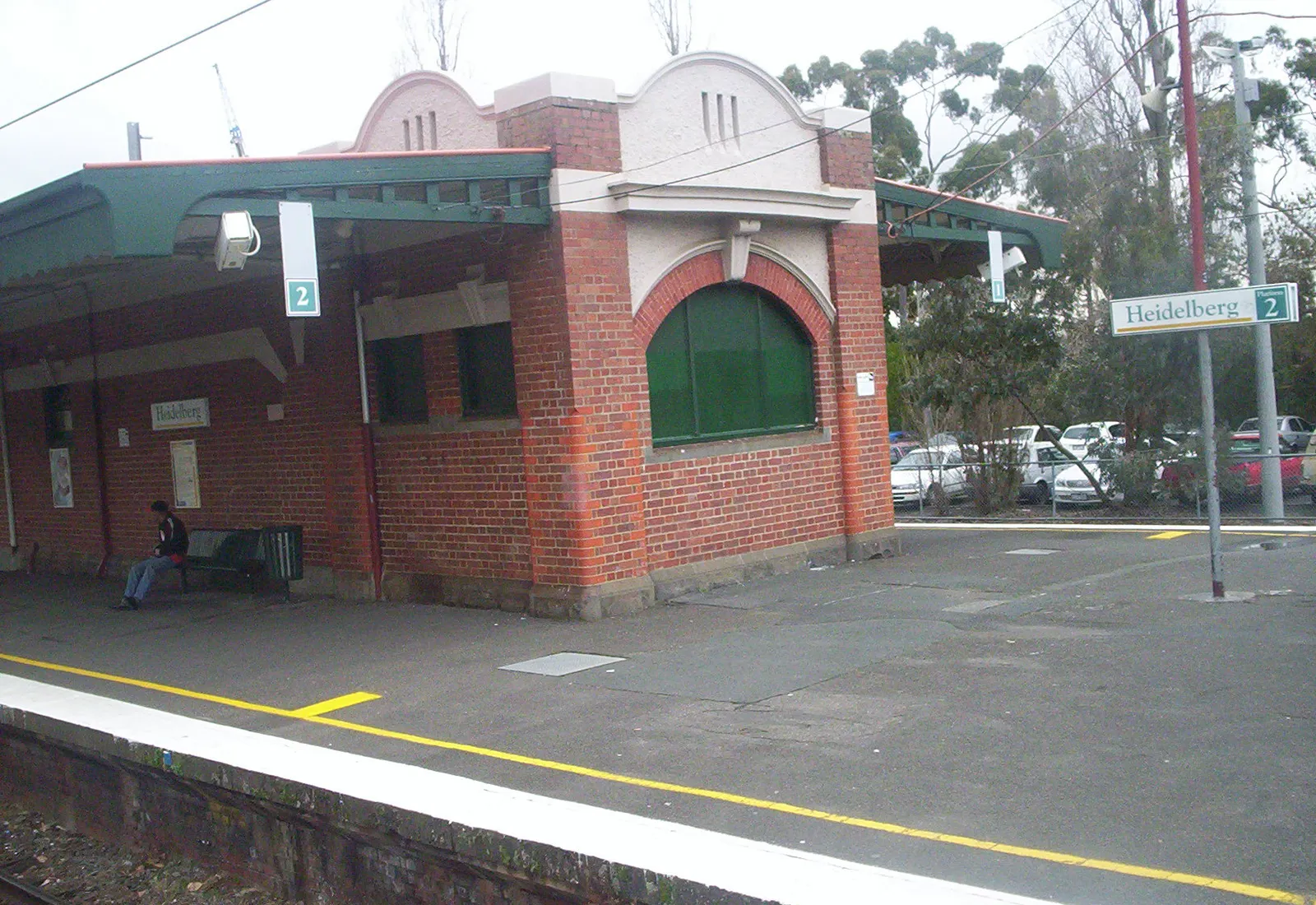
Data provenance & limitations. Demographic figures are from the ABS 2021 Census for the Heidelberg (Vic.) suburb (SAL21167), with Greater Melbourne (2GMEL) as benchmark; the 2021 Census is the most recent available. Austin Hospital's 671-bed figure and tertiary-referral status are from the hospital's published profile via Wikipedia, a secondary link to primary reporting; Warringal Private and the Mercy Hospital for Women are described qualitatively. Rent bands are indicative envelopes, not achieved rents — informed by the medical-precinct and comfortable-village positioning; verify comps for the specific tenancy. The photograph of Heidelberg station dates from 2005; confirm current streetscape before use. Factor scores are relative estimates calibrated across all Locatalyze suburbs, not guarantees of outcome.
Methodology: Scores are engine-derived from five observable inputs (demand strength, rent pressure, competition density, seasonality risk, tourism dependency — each 1–10). These feed into business-type-specific weighted composites via a single scoring engine used across all markets. Scores are relative estimates calibrated across all Melbourne suburbs — a score of 80 indicates materially better conditions than 65; it is not a success probability or guarantee.
Frequently Asked Decision Questions
Have a specific address in Heidelberg?
Run a full competitor map, rent benchmark, and location score, data confidence, and proceed / verify / avoid screening recommendation for any Heidelberg address. Free.
·4.5★ with 759 reviews — repeat local demand, not one-off visits.
·Review volume 151% above peer average (302).
·Mid-range positioning with strong review depth — balanced offer, not discount-led.
If you are opening nearby: Cafe Matto is the benchmark café here — their 4.5★ and 759 reviews beat the 302-review peer average — $$ positioning is validated by review depth in this catchment.
·4.3★ and 921 reviews — customers actively recommend this café.
·Review volume 224% above peer average (284).
·Mid-range positioning with strong review depth — balanced offer, not discount-led.
If you are opening nearby: their 4.3★ and 921 reviews beat the 284-review peer average — $$ positioning is validated by review depth in this catchment — For new entrants: The Train Yard cafe & Events space's volume comes from breadth — narrow to one daypart (early breakfast or late specialty coffee) rather than their full menu.
·4.5★ with 615 reviews — repeat local demand, not one-off visits.
·Review volume 93% above peer average (318).
·Mid-range positioning with strong review depth — balanced offer, not discount-led.
If you are opening nearby: The Alleyway (Dominant) shows what execution looks like at this score tier — their 4.5★ and 615 reviews beat the 318-review peer average — $$ positioning is validated by review depth in this catchment.
4. Superdays Coffee
★★★★½ 4.7 (276 reviews) · 355m from centre
78 · Dominant
·4.7★ with 276 reviews — repeat local demand, not one-off visits.
·0.3★ above the 4.4★ average among top local peers.
If you are opening nearby: Superdays Coffee (Dominant) shows what execution looks like at this score tier — 4.7★ with 276 reviews signals repeat custom, not novelty traffic — 355m from centre — frontage on the walkable strip matters.
5. Scintilla Cafe
★★★★☆ 4.2 (359 reviews) · $$ · 576m from centre
62 · Established
·4.2★ and 359 reviews — customers actively recommend this café.
·Rating sits below the 4.5★ peer average — volume or convenience may be doing the work.
·Mid-range positioning with strong review depth — balanced offer, not discount-led.
If you are opening nearby: 4.2★ with 359 reviews signals repeat custom, not novelty traffic — $$ positioning is validated by review depth in this catchment — For new entrants: Scintilla Cafe is beatable on pastry-forward with a limited hot menu — avoid matching incumbents' full menu breadth.
Possible market opportunities
Derived from venue counts and formats in our Google Places snapshot — not a guarantee of demand at your exact address.
Medium confidenceEarly-morning grab-and-go coffee kiosk
Reason: Engine shows high demand with manageable rent and competition — a lean format can test the trade before a full fit-out.
Who wins in Heidelberg — Restaurants
Ranked by success score (rating, review depth, centrality) within ~1000m of the suburb centre.
What winners have in common
·7 of 10 top venues sit at 4.3★+ — customers reward consistent execution, not novelty alone.
·Review depth averages 622 — operators with under 150 reviews read as unproven next to incumbents.
·Typical positioning is $$ (10 venues report Google price tiers).
·6 benchmark operators combine 4.4★+ ratings with 150+ reviews — new entrants need a clear niche, not a me-too menu.
·4.8★ with 923 reviews — repeat local demand, not one-off visits.
·0.5★ above the 4.3★ average among top local peers.
·Review volume 57% above peer average (588).
If you are opening nearby: Little Black Pig & Sons is the benchmark restaurant here — their 4.8★ and 923 reviews beat the 588-review peer average — $$ positioning is validated by review depth in this catchment.
·4.5★ with 759 reviews — repeat local demand, not one-off visits.
·Mid-range positioning with strong review depth — balanced offer, not discount-led.
If you are opening nearby: Cafe Matto (Dominant) shows what execution looks like at this score tier — their 4.5★ and 759 reviews beat the 607-review peer average — $$ positioning is validated by review depth in this catchment.
·4.3★ and 921 reviews — customers actively recommend this restaurant.
·Review volume 56% above peer average (589).
·Mid-range positioning with strong review depth — balanced offer, not discount-led.
If you are opening nearby: their 4.3★ and 921 reviews beat the 589-review peer average — $$ positioning is validated by review depth in this catchment — For new entrants: Focus on a specific occasion (date night, quick lunch, or group dining) that The Train Yard cafe & Events space does not dominate.
·4.5★ with 615 reviews — repeat local demand, not one-off visits.
·Mid-range positioning with strong review depth — balanced offer, not discount-led.
If you are opening nearby: 4.5★ with 615 reviews signals repeat custom, not novelty traffic — $$ positioning is validated by review depth in this catchment — For new entrants: Avoid cuisine overlap with The Alleyway — target an occasion they do not own (quick lunch, date night, or group dining).
5. Elia Greek Tavern
★★★★☆ 4.4 (473 reviews) · $$ · 481m from centre
70 · Established
·4.4★ and 473 reviews — customers actively recommend this restaurant.
·Mid-range positioning with strong review depth — balanced offer, not discount-led.
If you are opening nearby: 4.4★ with 473 reviews signals repeat custom, not novelty traffic — $$ positioning is validated by review depth in this catchment — For new entrants: Focus on a specific occasion (date night, quick lunch, or group dining) that Elia Greek Tavern does not dominate.
Possible market opportunities
Derived from venue counts and formats in our Google Places snapshot — not a guarantee of demand at your exact address.
Medium confidenceQuality-led restaurant with a single hero offer
Reason: Engine signals demand outpacing restaurant competition — structural room for a focused new entrant.
Who wins in Heidelberg — Retail
Ranked by success score (rating, review depth, centrality) within ~1500m of the suburb centre.
What winners have in common
·7 of 10 top venues sit at 4.3★+ — customers reward consistent execution, not novelty alone.
·No single venue dominates on both rating and review depth — the category may still be contestable.
·4.8★ and 130 reviews — customers actively recommend this retail.
·0.3★ above the 4.5★ average among top local peers.
·Review volume 641% above peer average (18).
If you are opening nearby: their 4.8★ and 130 reviews beat the 18-review peer average — 367m from centre — frontage on the walkable strip matters — For new entrants: A service-heavy or experiential retail concept can win where product-only formats like AD Stitch look interchangeable.
2. Ritz of Rosanna
★★★★½ 4.8 (61 reviews) · 1172m from centre
70 · Established
·4.8★ rating beats the typical retail baseline in this catchment.
·0.3★ above the 4.5★ average among top local peers.
·Review volume 142% above peer average (25).
If you are opening nearby: their 4.8★ and 61 reviews beat the 25-review peer average — For new entrants: A service-heavy or experiential retail concept can win where product-only formats like Ritz of Rosanna look interchangeable.
3. Deeva
★★★★☆ 4.3 (53 reviews) · 447m from centre
62 · Established
·4.3★ rating beats the typical retail baseline in this catchment.
·Rating sits below the 4.6★ peer average — volume or convenience may be doing the work.
·Review volume 103% above peer average (26).
If you are opening nearby: their 4.3★ and 53 reviews beat the 26-review peer average — For new entrants: A service-heavy or experiential retail concept can win where product-only formats like Deeva look interchangeable.
4. Rosanna Op Shop by Kids First
★★★½☆ 3.8 (20 reviews) · 1025m from centre
34 · Emerging
·Rating sits below the 4.6★ peer average — volume or convenience may be doing the work.
If you are opening nearby: For new entrants: A service-heavy or experiential retail concept can win where product-only formats like Rosanna Op Shop by Kids First look interchangeable.
5. Mamo Fine Tailors & Mens Clothing
★★★★½ 4.9 (9 reviews) · 544m from centre
58 · Growing
·4.9★ rating beats the typical retail baseline in this catchment.
·0.4★ above the 4.5★ average among top local peers.
If you are opening nearby: For new entrants: A service-heavy or experiential retail concept can win where product-only formats like Mamo Fine Tailors & Mens Clothing look interchangeable.
Possible market opportunities
Derived from venue counts and formats in our Google Places snapshot — not a guarantee of demand at your exact address.
Medium confidenceService-led retail (phone repair, alterations, or plant studio)
Reason: Product-only retail is crowded online — hands-on services tied to a high-street address defend against e-commerce.