The strangest retail story in Australia right now is not that shops are closing. It is that shops are closing while good retail space is getting harder to find. That contradiction is exactly where operators get hurt. A vacancy can be a rare opening, a landlord's problem, or a trap wearing a discount. In 2026, the skill is not spotting an empty shopfront. It is knowing why it is empty, who else wants it, and whether your cost base can survive the lease once wages, energy, suppliers and rent all land in the same month.
Editorial note
This article is a location-strategy guide, not legal, financial or leasing advice. Vacancy rates describe market conditions, not the quality of an individual tenancy. Before signing, test the exact address, lease terms, customer flow and operating model.
Key takeaways
Interactive retail contradiction filter
Find out whether a vacancy is an opening or a warning
Compare retail formats, rank them for your concept, stress-test rent against the new cost base, and take a sharper checklist into the inspection.
CBD retail strips
Vacancy signal: 10.4%
medium
demand
firm
rent heat
watch
closure risk
Best fit: high-throughput food, convenience, beauty, tourism-adjacent retail
Why it can work: CBD vacancy is improving, but individual streets still depend on the right mix of workers, visitors, students and events.
Main risk: Visible footfall can hide weak stopping behaviour and thin Mondays or Fridays.
Shortlisting aid only. Vacancy figures are format-level signals from cited market sources, not a verdict for any specific lease.
4.4%
Shopping-centre vacancy in July 2026, reported by CommBank citing JLL Research
160
Potential store closures from recent administrations, reported by CommBank
10.4%
Weighted Australian CBD retail vacancy in H2 2025, reported by CBRE
$26.44
National minimum wage per hour from 1 July 2026, Fair Work Ombudsman
Why the headlines feel contradictory
The public story is full of closures. ABC reported that Barbeques Galore would wind up 62 company-owned stores after a failed rescue deal. Cafes and restaurants have been talking openly about rising food, wage, energy and insurance costs. ABC's June 2026 hospitality report described operators closing venues or cutting back because the cost of running the business had moved faster than customers' willingness to pay. In early July, ABC also reported that wage increases and higher expenses were adding pressure to small businesses.
Then the property data says something that sounds like the opposite. CommBank's July 2026 commercial property note, citing JLL Research, said shopping-centre vacancy had dropped to 4.4%, the lowest since 2018. It also said up to 160 stores could close nationally from recent retailer administrations, mostly in clothing and footwear. Both can be true. A weak operator can fail in a tight market. A category can shrink while another category takes the same space quickly. A bad lease can kill a business even when the shopping centre remains highly occupied.
For a new operator, the contradiction is not academic. It changes how you negotiate. If you assume closures mean landlords are desperate, you may be surprised when a good tenancy attracts three applicants. If you assume low vacancy means every site is strong, you may inherit a position that has already burned two operators. The useful question is not whether retail is healthy or unhealthy. It is whether this vacancy is being recycled into a better use, or whether the site itself has a structural problem.
Closures do not create the same kind of vacancy
A store closure in a large-format bulky-goods precinct is not the same thing as a failed boutique in a quiet CBD arcade. Large-format space can be scarce because the boxes are hard to replace: loading, parking, exposure, ceiling heights and zoning all matter. When a national chain collapses and releases big boxes, competitors may move quickly because there are few equivalent options. That is why a closure can trigger a rush rather than a slump. A landlord may lose one tenant and still gain negotiating power if the format is tight.
A neighbourhood strip vacancy behaves differently. The shop might be empty because the rent got too high, because the operator aged out, because parking became awkward, because the street lost an anchor, or because the category no longer fits the local customer. Some of those are fixable. Some are not. If a tired gift shop closes on a strip that now wants allied health, coffee and convenience, the vacancy may be useful. If three food operators have failed in the same tenancy because extraction is poor, bins are impossible and the lunch market is thin, a lower rent does not fix the site.
CBD vacancies are stranger again. CBRE reported national CBD retail vacancy tightening to 10.4% in H2 2025, helped by return-to-office momentum, tourism, events, infrastructure and international student inflows. But the city spread was wide: Sydney was reported at 4.3%, Melbourne at 6.5%, Brisbane at 17.5% and Perth at 18.6%. That means a CBD vacancy can be anything from a rare Sydney opening to a Perth or Brisbane negotiation case where the right micro-location matters more than the city label.
The new cost base changes the rent test
Retail operators have always had to watch rent. In 2026, rent has to be read with wages and utilities in the same frame. Fair Work Ombudsman says the National Minimum Wage is now $1,004.90 per week or $26.44 per hour from 1 July 2026, and award minimum wages increased by 4.75% where eligible. For small food, service and retail businesses, that increase does not arrive as a spreadsheet note. It arrives every roster. A site that looked viable at the old wage floor can become marginal if rent was already near the upper edge.
That is why the old rule of thumb - find a busy street and negotiate hard - is not enough. The first test is whether the site can support revenue with a realistic roster. A cafe that needs an owner, two casuals and a kitchen hand at peak has a different rent capacity from a service retailer with appointments and lower staffing intensity. A boutique that opens because the centre requires trading hours may carry labour costs during slow windows. A food tenancy with a low headline rent but difficult loading, poor storage and expensive waste handling can lose the saving before the first month is over.
The sharper test is effective occupancy cost. That includes base rent, outgoings, marketing levy, percentage rent if applicable, storage, utilities, waste, required trading hours, security, fit-out amortisation and the labour needed to operate the hours the lease or centre expects. If the vacancy exists because the previous tenant could not carry that full load, a rent discount has to be large enough to change the equation. Five percent off the asking rent does not fix a site that needs 20 percent more sales than the catchment can plausibly deliver.
Why low vacancy can be dangerous
Low vacancy creates urgency, and urgency is expensive. When good space is scarce, operators start treating availability as evidence of quality. That is backward. Scarcity tells you other tenants want space in the format. It does not prove the specific tenancy suits your concept. In a regional centre, a food operator may face strong foot traffic, but also strict trading hours, high fit-out standards, intense nearby competition and a customer who compares offers quickly. In a large-format centre, a service or fitness operator may love the parking but underestimate how hard it is to build repeat visits in a destination retail environment.
Low vacancy also reduces landlord flexibility. If three tenants want the same shop, the landlord has less reason to fund the fit-out or soften the rent review. That may be fine for a proven operator with strong sales data. It is dangerous for a first-time operator using optimism as collateral. The tighter the market, the more disciplined the tenant has to be. Scarcity should make you faster at due diligence, not looser with assumptions.
Why high vacancy can also be dangerous
High vacancy feels like leverage, and sometimes it is. In a CBD street with visible empty shops, a good operator can ask for rent-free months, fit-out support, flexible assignment rights, signage contribution and a more honest rent review. The landlord may prefer a credible tenant at a lower effective rent to another six months of darkness. That is the good version.
The bad version is when high vacancy lets the operator talk themselves into a weak street. Empty shops can break a customer path. They reduce browsing, make a precinct feel unloved and remove the neighbouring uses that help everyone. A cafe beside a dark tenancy and a discount store may technically be in the CBD, but the customer psychology is different from a cafe beside a busy pharmacy, office lobby and newsagency. High vacancy gives you negotiating leverage only if the remaining customer flow is strong enough to monetise. Otherwise you are negotiating a lower price for a weaker asset.
Category failure is not the same as site failure
When a retailer fails, everyone nearby becomes an amateur forensic accountant. Was it rent? Online competition? Debt? Category decline? Bad stock? Weak management? The answer matters because a new tenant needs to know whether the site is contaminated or just the previous use. Clothing and footwear administrations do not necessarily mean food, allied health or personal services should avoid the same centre. A failed discretionary retailer may create an opening for a higher-frequency use. A failed food tenant, however, should make another food tenant ask harder questions.
Barbeques Galore is a useful example precisely because it is not a cafe or boutique. The company-owned store closures are a retail story, but the released boxes may be valuable to other large-format users because large-format vacancy is tight. The category had problems. The real estate may still be attractive. That distinction is everything. A closure tells you something changed. It does not tell you whether the land, building, customer path or lease is bad.
The operator's inspection should feel uncomfortable
A proper inspection is not a tour. It is an argument with the lease before the lease can hurt you. Start by walking the customer route without the agent. If the tenancy relies on parking, park where customers park and walk in. If it relies on public transport, arrive from the station. If it relies on workers, approach from the office tower exits at lunch. If it relies on parents, visit during school pickup. Watch what people are already trying to do. The best retail sites make a customer mission easier. The worst ones ask customers to change behaviour just because the operator needs them to.
Then inspect the tenancy as a worker, not a founder. Where does stock arrive? Where do bins go? Where does staff park? Where is the grease trap? Where are the bathrooms? Can signage be seen before the decision point? Does the shopfront have glare at the wrong hour? Does the air-conditioning reach the customer area? Is the floor shape useful or just large? Many bad retail leases are not obviously bad from the front door. They are bad from the back corridor, the roster, the loading bay and the weekly utility bill.
What to ask the landlord before you ask for a discount
Do not begin with "what rent-free period can you do?" Begin with why the vacancy exists. How long has it been empty? What did the previous tenant pay? Did the previous tenant assign, expire, close or default? Were there arrears? Were there complaints about access, services, noise, waste, water, air-conditioning or signage? What incentives were offered in the last deal? Which works does the landlord consider base-building and which are tenant works? Is there a demolition, redevelopment or relocation clause? Are there exclusivity conflicts with existing tenants?
Once those answers are clear, negotiate the economics. Ask for incentives in effective-rent terms across the full lease, not as a headline month count. Ask how outgoings are reconciled. Ask whether turnover rent applies. Ask whether the landlord will fund works that improve the asset after you leave. Ask for a realistic handover condition. The point is not to win every clause. The point is to avoid being charmed by a vacancy that still carries all the risk of the previous tenant's failure.
Where the opportunity is real
The opportunity is real where three things line up. First, the format has demand. That might be low vacancy in a regional centre, tight large-format supply, or a CBD street where vacancy is falling and foot traffic has multiple engines. Second, the category fits the current customer. In 2026 that often means value-aware food, repair, health, beauty, fitness, medical, pet, convenience, services and specialist retail with a reason to exist beyond browsing. Third, the lease shares risk. A landlord who wants a tenant to activate a vacancy should help create the runway for that tenant to survive.
The best opportunities may look less glamorous than the headlines. A small service use beside a supermarket can be better than a beautiful discretionary shop in a weak arcade. A repair or health tenant in a regional centre can be stronger than a fashion boutique with prettier branding. A compact takeaway near workers can be better than a large restaurant with a river view. In a cost-heavy year, boring repeat demand is underrated. The customer who comes every week is worth more than the customer who might wander in once because the shop looked good in a leasing deck.
Cheap rent is not the same as a cheap opening
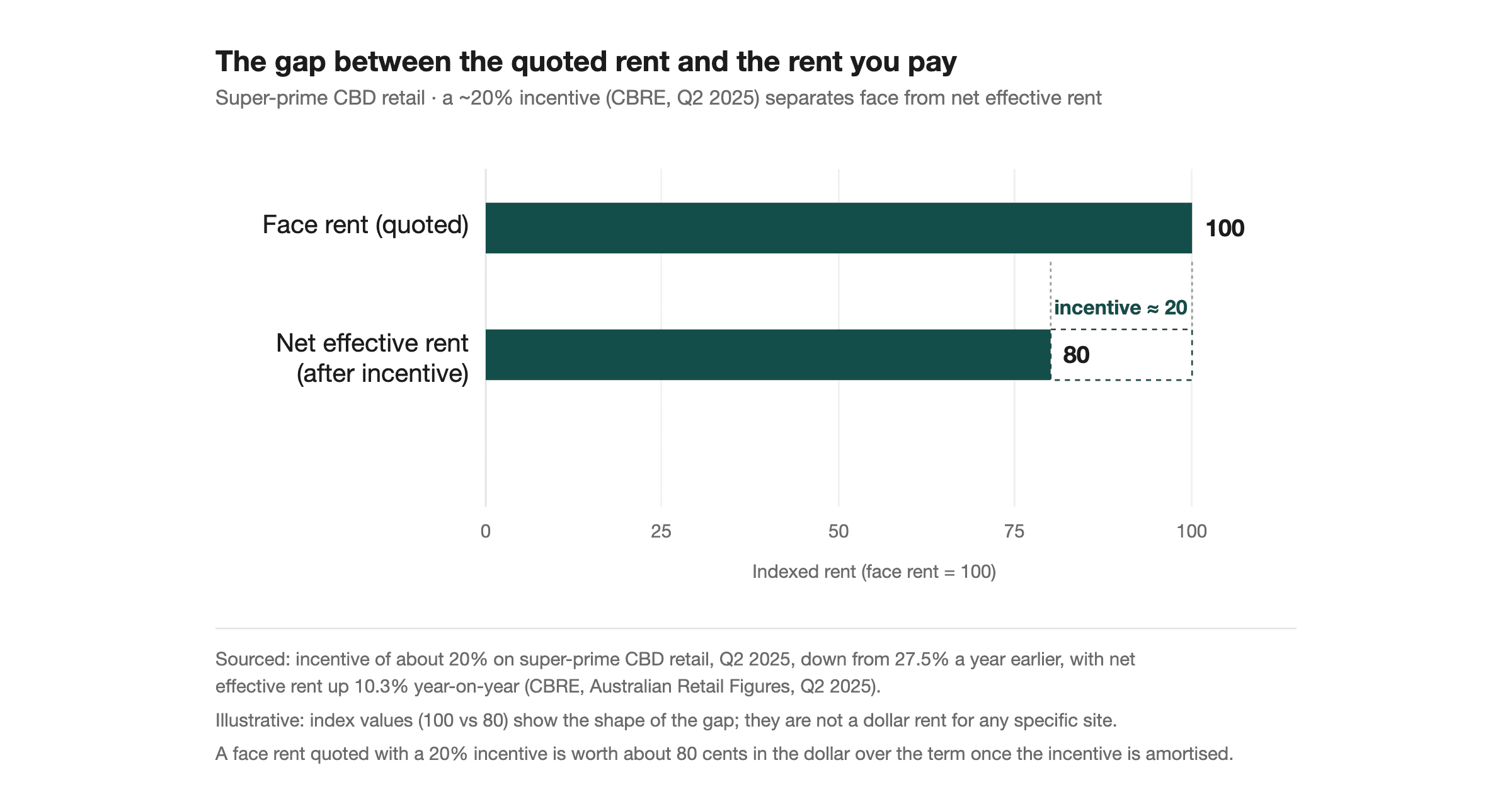
A discounted vacancy can still be expensive once the first year is modelled honestly. Operators tend to focus on the rent-free period because it feels tangible: three months rent free, a contribution to works, a lower starting rent, a stepped increase. Those items matter, but they are only useful if they buy time for the business to reach stable trading. If the site needs a heavy fit-out, slow awareness building, extra signage, longer staff training, more delivery management or a larger opening stock position, the incentive can disappear before the store has proved demand.
The cleaner way to judge the deal is to convert everything into a first-year and full-term effective rent. Add the base rent, outgoings, marketing levy, likely utilities, required insurance, maintenance, storage, waste and any works the tenant must fund. Then subtract the landlord contribution and rent-free value. The number that remains is the cost of occupying the address before wages, suppliers, finance costs, card fees, shrinkage, professional fees and owner drawings. If that number still requires heroic sales, the lease is not cheap. It is just delayed pain with better presentation.
The first 90 days deserve their own forecast. A new retail business rarely opens at mature revenue. Staff are learning, local customers are testing the offer, suppliers are being adjusted, menu or stock mistakes show up, and the operator is still discovering which hours are profitable. A site with strong weekly repeat demand can climb through that messy period. A site that depends on occasional discovery may burn cash before the customer habit forms. That is why location intelligence should be used before lease negotiation, not only after a shortlist is built. The data tells you whether the trade area contains enough of the customer missions the business needs to survive the learning curve.
Landlords also read tenant quality. In a tight format, a landlord may prefer a proven operator with clear numbers over a higher bidder with no evidence. That gives disciplined tenants an opening. Bring sales benchmarks, staffing assumptions, local competitor analysis and a clear fit-out plan. Show how the business will activate the vacancy without asking the landlord to take blind faith. The negotiation becomes stronger when the tenant can explain not only what they want to pay, but why the address can support that rent if both sides structure the opening sensibly.
When to walk away
Walk away when the rent only works if every optimistic assumption happens at once. Walk away when the landlord cannot explain why the previous tenant left. Walk away when the centre requires trading hours your labour model cannot support. Walk away when a vacancy sits in a dead stretch and the only answer is that the area will improve later. Walk away when incentives are verbal, when outgoings are vague, or when fit-out obligations are bigger than the landlord admits. A vacancy should make your due diligence sharper, not your standards lower.
There is no shame in missing one tenancy. Good operators pass on sites constantly. The mistake is treating the empty shop as a scarce chance before you know whether it is scarce for good reasons. In 2026, the best retail operators will not be the ones who move fastest. They will be the ones who can tell the difference between a closure that creates an opening and a closure that leaves a warning sign on the door.
How to underwrite a retail vacancy in 2026
- 1
Identify the format first: regional centre, large-format, CBD, neighbourhood strip or discretionary boutique.
- 2
Ask why the vacancy exists before discussing rent.
- 3
Model the new wage floor, award increase, utilities and supplier costs before setting rent capacity.
- 4
Count repeat-use customer missions within the real trade area.
- 5
Separate category failure from site failure.
- 6
Negotiate incentives as effective rent over the full lease term.
- 7
Walk the site at the weakest hour your business has to survive.
Before you sign an empty retail tenancy, run the address through Locatalyze and see whether the catchment, competitors, rent pressure and customer flow support the lease.
Analyse the tenancy →Sources
Frequently asked questions
About the author
Locatalyze Research Team
Location intelligence, Locatalyze
The Locatalyze research team builds the location-scoring models behind the platform and writes up what the data shows for Australian operators.
Tools first — then a full report for your address
Free rent, viability, and break-even checks. Upgrade when you are ready for competitors, map, and numbers for a specific site.
No signup required for tools