Café Location Checklist for Australia: What to Verify Before You Sign
Founder, Locatalyze
A café can have good coffee and still fail the lease. The checks that matter most happen before you sign: counted morning traffic for your daypart, rent against a revenue model you can defend, competition that validates rather than cannibalises, and a room you can actually operate. This is a checklist — not a memoir. Use it with [before you sign that lease](/blog/before-you-sign-that-lease-checklist-restaurant) when the solicitor draft arrives.
Evidence standard
FACT: ATO coffee-shop rent÷turnover bands (2023–24). FACT: TRA/ABS hospitality survival June 2020→2024 (54%). Checklist steps and ‘7am test’ are LOCATALYZE ANALYSIS / operator practice. Peak-hour customer counts in examples are MODELS. No invented café owner story.
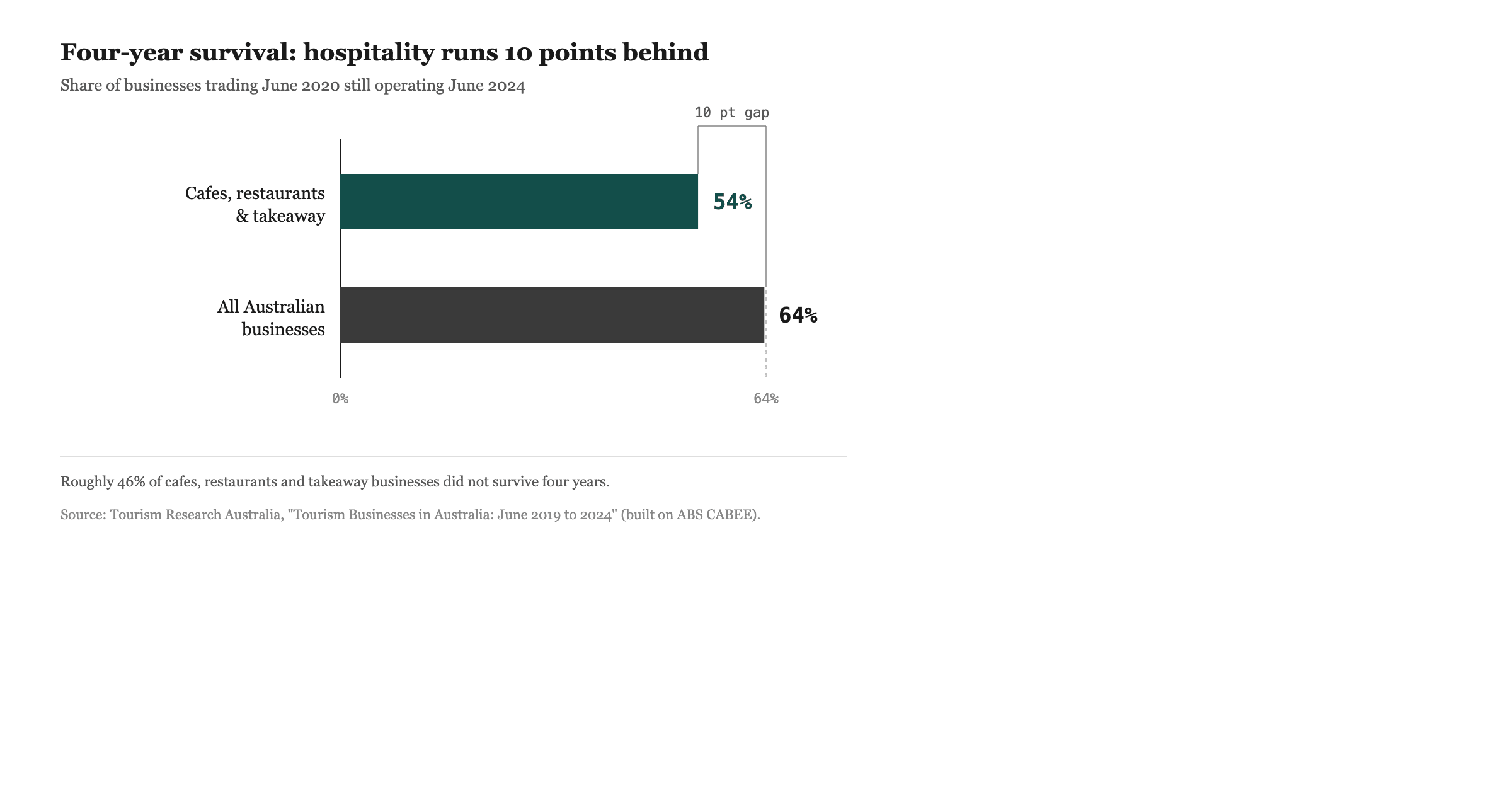
54%
FACT: TRA/ABS hospitality four-year survival June 2020→2024 (café failure pillar)
8–14%
FACT: ATO coffee-shop rent÷turnover mid band $250k–$600k (2023–24)
7–9am
LOCATALYZE ANALYSIS: critical count window for many commuter cafés — verify on site
Why location usually beats coffee quality
LOCATALYZE ANALYSIS: walk-past traffic for your daypart, rent against a revenue model you can defend, and competition that validates habit rather than cannibalising it are the variables operators can change least after signing. Coffee quality matters — but it does not rewrite a rent that needs 200 transactions a day from a quiet corner.
Location is the decision you cannot undo. Menu, prices and branding can change. A frontage that cannot produce the daily transactions your rent requires cannot be fixed with better beans.
The 7am test: the single most important thing you can do
Before any spreadsheet, before any data analysis, do this: visit the location at 7am on a Tuesday and count how many people walk past in exactly 10 minutes. Multiply by 6 to get an hourly rate. This is your most important data point.
7am count → MODEL bands (not a census)
Count people walking past for 10 minutes at 7am on a Tuesday; ×6 ≈ hourly rate. Interpret against YOUR rent maths, not a universal law: • Low teens–30/hour: only viable if rent is exceptionally low or format is destination. • ~30–60/hour: possible with strong capture and disciplined labour. • ~60–120/hour: often workable if competition is honest. • 120+/hour: strong ceiling — still underwrite conversion and rent. These bands are LOCATALYZE ANALYSIS / operator practice, not ABS pedestrian statistics.
This test gives you something no dataset can replicate: the character of foot traffic at the moment that matters most. Are these people rushing to a train? Walking a dog? In office attire? Each answer changes your revenue model fundamentally.
The rent affordability test
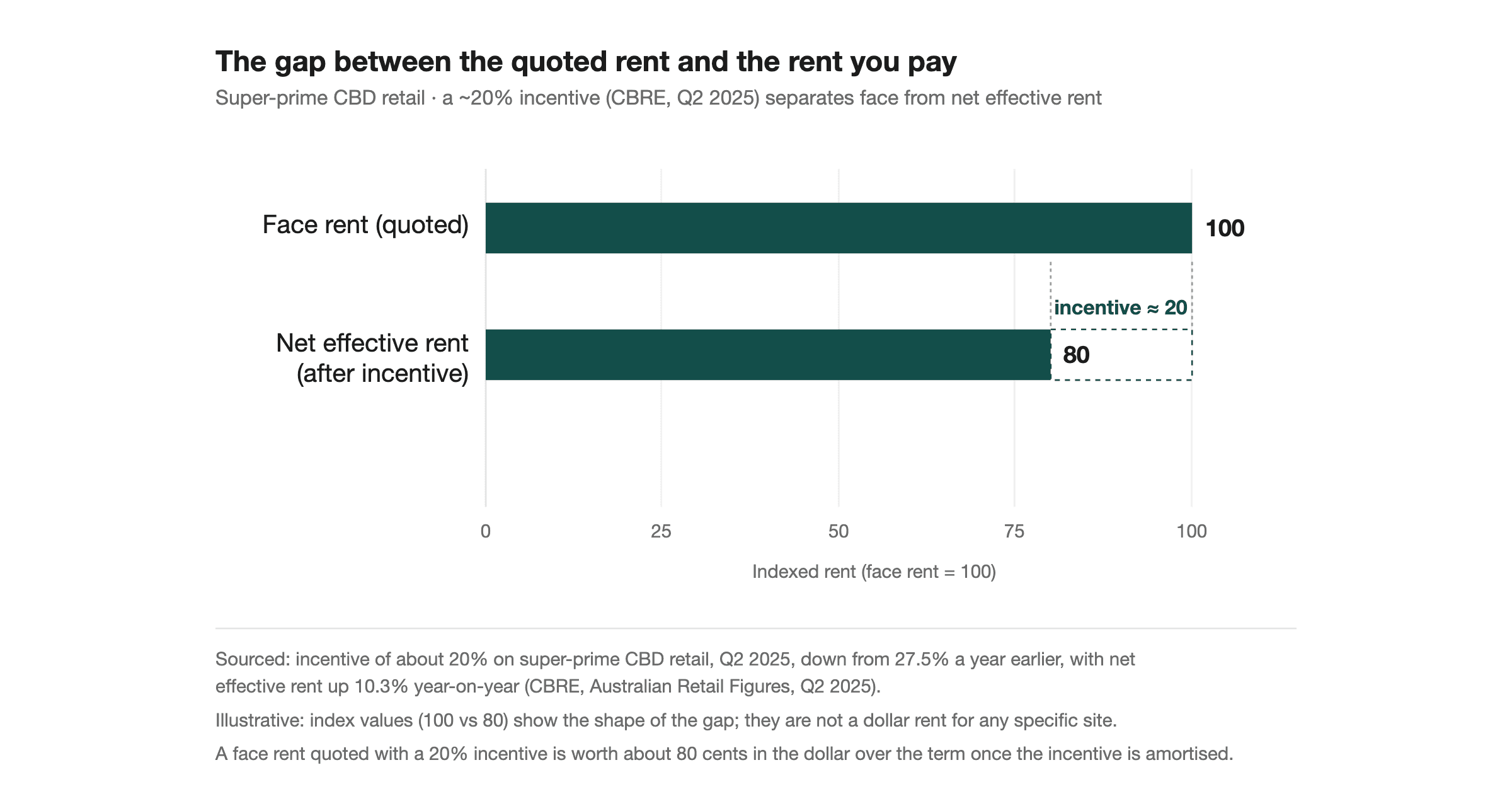
Rent is the fixed cost that breaks cafés fastest. FACT: ATO coffee-shop benchmarks (2023–24) show observed rent÷turnover bands of 10–17% / 8–14% / 6–10% by size. Use those as sanity checks, not targets. MODEL: monthly all-in rent ÷ 0.10 ≈ revenue needed to keep rent near 10% of turnover — then convert to daily transactions at your average ticket. Above the top of the matching ATO band without a clear demand story is VERIFY or AVOID.
Here is the test: take the monthly rent, divide by 0.10. That is the revenue you need to keep rent at a healthy 10%. Divide that by your average transaction value. Divide by 26 trading days. That is your required daily transaction count. Is it achievable at this location?
Before running the formula yourself — check whether the rent you have been quoted is above or below market for your city and business type. Takes 10 seconds.
Is this rent overpriced? →A $4,500/month rent at $9 average spend means you need 50 transactions per day just to keep rent at 10% of revenue. Before you sign — count the feet.
A worked example: $5,200/month rent in an inner-city suburb
Take a site asking $5,200/month. Divided by 0.10, your required monthly revenue is $52,000. With a realistic combined coffee and food average of $9.50 per transaction, you need 5,474 transactions per month. Divided by 26 trading days, that is 211 transactions per day.
For a 55-seat café with 3 seat turns per day and an 8-hour service window, 211 transactions represents a utilisation rate of roughly 72%. Achievable at a strong location with consistent morning commuter traffic. Very difficult at a location where the 7am count comes in below 40 people per hour.
Before you visit: run the numbers
Monthly rent ÷ 0.10 = required monthly revenue Required monthly revenue ÷ avg transaction value = required monthly transactions Required monthly transactions ÷ 26 days = required daily transactions Required daily transactions ÷ seats ÷ turns = required utilisation rate If required utilisation is above 80%, this site has almost no margin for error. Walk away or negotiate the rent down.
Where leases go wrong
INFERENCE from survival and insolvency patterns (see café failure pillar): many independent café exits follow occupancy that never matched counted demand — not a single bad roast. Run required daily transactions before you fall in love with the fit-out. By the time the shortfall is obvious, capital is sunk and the lease still runs.
The calculation above takes a minute or two by hand — or you can run it against your actual rent and AOV in our free Break-even Foot Traffic tool. No signup.
Open the break-even tool →Reading competition the right way
Two or three cafés nearby is often a good sign — it means people in the area already have the habit of buying coffee. A street with zero cafés might mean untapped opportunity, or it might mean there is no demand. You need to know which.
Competition within ~200 m (LOCATALYZE ANALYSIS screens)
Demographics: not all foot traffic is equal
Retirees do not buy $6 flat whites at the same rate as office workers. The demographic profile of a suburb tells you whether the people walking past are likely to be your customers. ABS Census data by suburb shows median household income, age breakdown and employment type — all of which predict café spend.
Demographics to pull (FACT method)
Use ABS Census QuickStats for the suburb/SA2: median household income, age structure, employment, dwelling density. LOCATALYZE ANALYSIS: café formats usually need daytime workers, students or dense residents who walk — not a single national income cut-off. Compare your suburb to Greater Capital City medians rather than inventing a $90k rule.
Physical site checklist
What to look for in the actual premises
- 1
Corner or end-of-terrace: visibility from two directions
- 2
Existing commercial kitchen infrastructure (ESTIMATE: can save a large share of kitchen fit-out vs building from shell — verify quotes; do not treat any single dollar band as FACT)
- 3
Outdoor seating potential — north or east facing for morning light
- 4
On-street parking or public transport within 200m
- 5
Wide footpath for queue formation during peak periods
- 6
Rear lane for deliveries without disrupting service
Using data to shortlist before you visit
Visiting every potential location is time-consuming and expensive. Use data tools to screen addresses before spending a day travelling. The free Business Viability Checker will tell you in a few minutes which sites deserve a site visit and which to skip — and the Break-even Foot Traffic tool turns the rent calculation above into a single-click test.
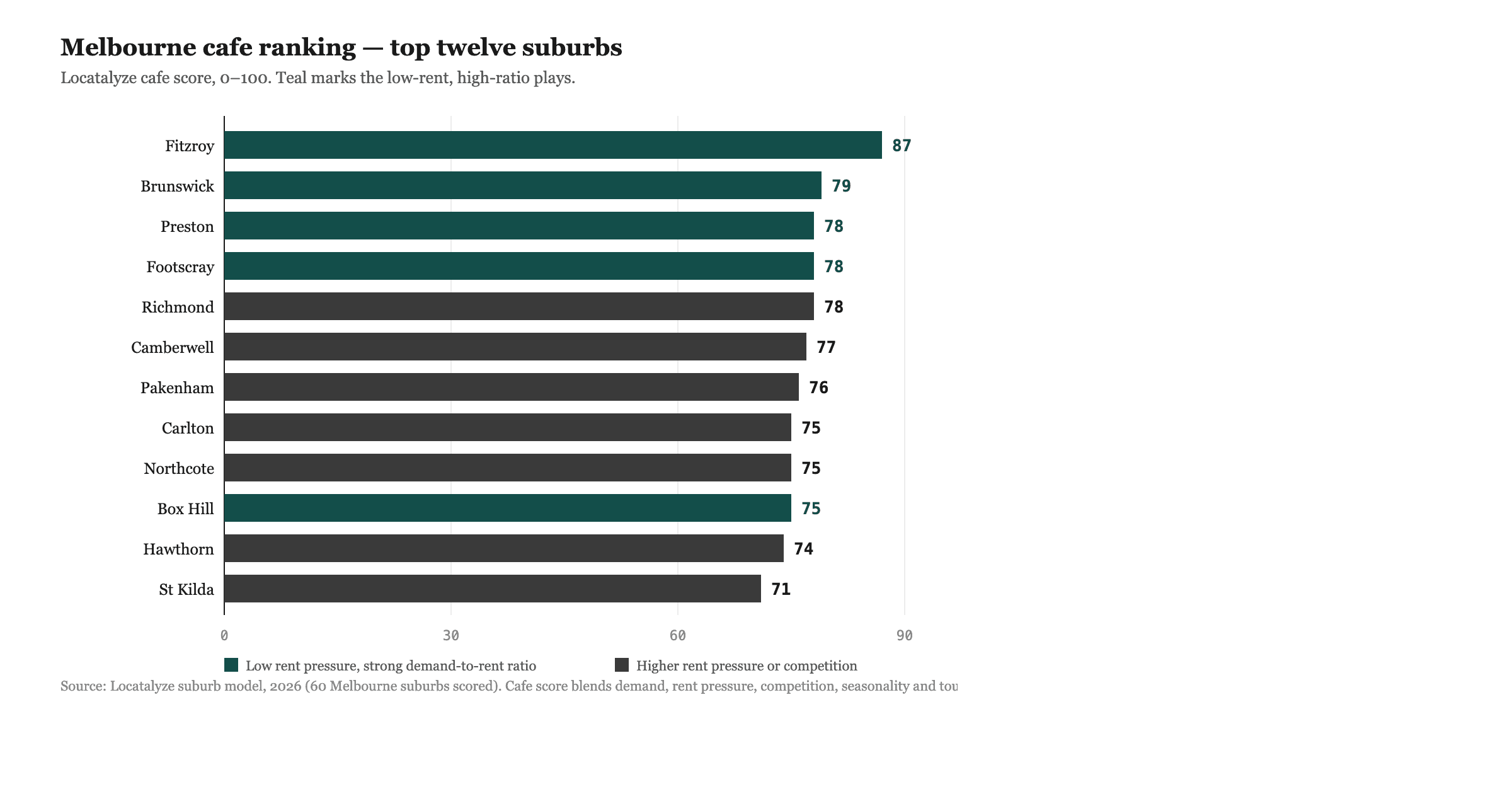
That is the whole method in one table: five comparable suburbs, engine café scores (live on the Melbourne guide), and a reason attached to every keep-or-drop call. Your Saturday site visits now cover three suburbs that earned them instead of five that didn't.
PROCEED / VERIFY / AVOID after the checklist
Run the same address through Locatalyze when you are ready for a scored read — the checklist above is the fieldwork; the report is the reconciliation.
Sources & verification
Related reading
Related: the café failure-rate data sets the base rates behind every threshold in it, and if you are still deciding whether to build at all, buy a café or build one? weighs the two paths.
Frequently asked questions
About the author
Prashant GuleriaFounder, Locatalyze
Prashant founded Locatalyze to replace vibe-based café site picks with checks operators can defend.
Tools first — then a full report for your address
Free rent, viability, and break-even checks. Upgrade when you are ready for competitors, map, and numbers for a specific site.
No signup required for tools