
Sydney Suburb Intelligence
Why Locatalyze says VERIFY for Parramatta
VERIFY first — Café category score 6.8/10. Location composite 67/100.
Location score
Recommendation
VERIFY
Potentially viable — important checks remain
Parramatta in 30 seconds
Parramatta is VERIFY at 67/100 (café 68, restaurant 67, retail 65). That is a shortlist, not a yes. Prove the named street and daypart before you sign.
Café 68/100 · Restaurant 67/100 · Retail 65/100 — pick the branch that matches your concept before you sign rent.
Station convenience and fast food — Works when the site is obvious, quick to enter and suited to repeat commuter decisions.
Parramatta demand is real, but the wrong side of a street or centre entrance can change the economics.
The lease only works on suburb-average foot traffic, weekend trade is unproven at the door, or your concept cannot name a clear reason customers switch from incumbents.
Best proof window for station, office and civic-worker formats
Parramatta pays off when your trading calendar survives ordinary Thursdays — event nights and tower lunch are upside, not the thesis.
Recommendation
VERIFY first
Café category score
6.8/10
Structural risk
Medium
Competition
Very high (9/10) — chains on Church Street; Circa-scale incumbents
Differentiation required
Required
Location composite 67/100 measures overall suburb fit across all factors. Café category score is the format this page recommends. Scores screen the suburb, not the individual lease; the address report checks nearest competitors, rent-to-revenue, and break-even for the exact tenancy.
Should I open a café or restaurant in Parramatta?
Maybe — if you model Tue–Thu corporate lunch honestly and avoid Church Street chain wars. Cafés score 68/100 here with a VERIFY composite — demand is real at secondary-CBD scale (~80,000–95,000 weekday workers), but Parramatta is four precincts, not one. Church Street carries chain saturation and multicultural weekend trade; Phillip and Macquarie carry corporate lunch peaking Tuesday–Thursday while Monday and Friday run 25–35% softer. Circa and Volcanos Steakhouse already own recommendation paths. Operators fail importing Sydney CBD margins — not because foot traffic is weak.
What surprised me
Church Street reads chain-dominated — Coffee Club, Starbucks, Gloria Jean's — yet Phillip corporate cafés still clear at $6,000–$12,000/month. The gap I see is station convenience and fast food, not another generic espresso bar fighting the mall halo.
How to read these scores
Composite 67/100; Café 68/100. Use this as a screening verdict before lease diligence.
Source
Locatalyze engine v7.4.0 plus cached local competitor evidence
Freshness
Competitor cache refreshed 27 June 2026
Confidence
Medium - 30 businesses sampled
Limitation
Parramatta scores screen the suburb, not the lease. The paid report tests frontage, rent, nearest competitors, and break-even at your exact address.
Evidence freshness
Scores
Engine v7.4.0; suburb-level model
Competition
Google Places cache refreshed 27 June 2026
Rent
No sourced asking-rent series — obtain current listings
Demographics
ABS Census 2021 baseline with operator interpretation
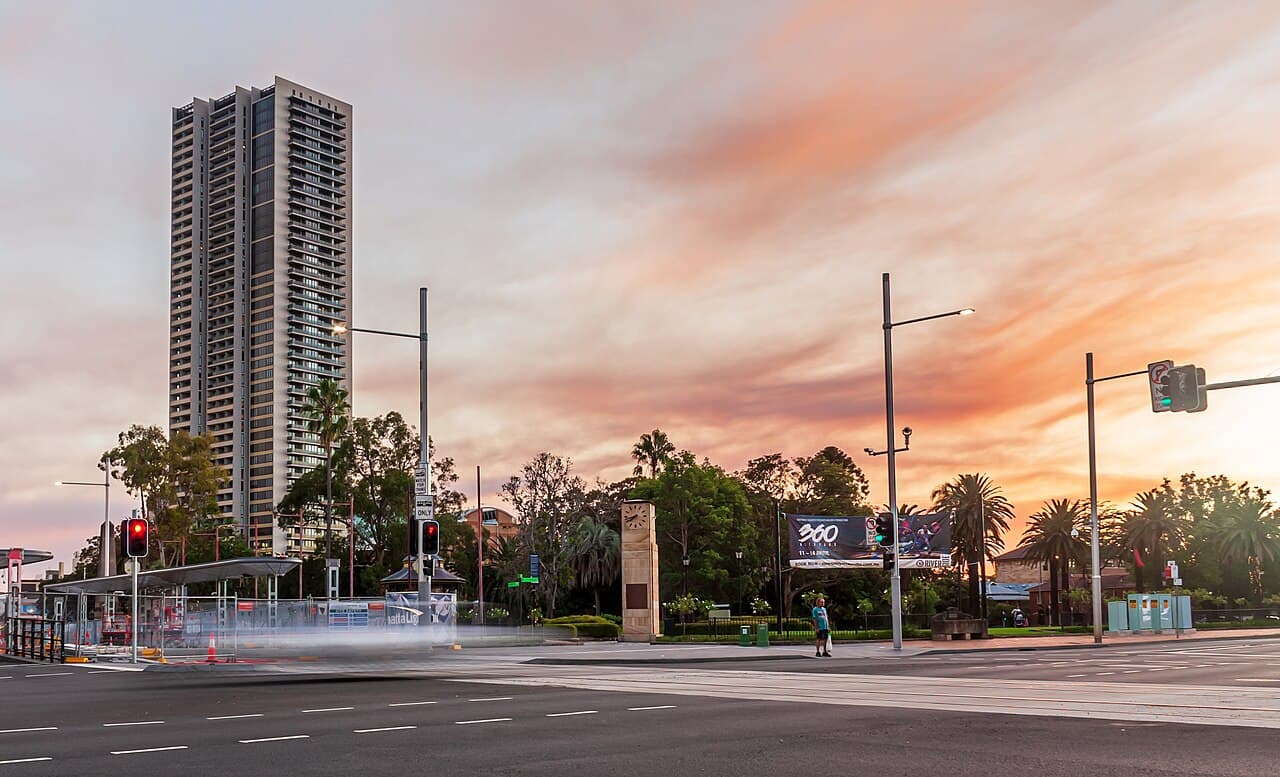
Precinct map
Western Sydney's CBD is four precincts — not one postcode
Church & Eat Street
$9k–$15k/mo
Multicultural weekend · corporate lunch
Best for: Full-service dining, cultural-community restaurants, weekend family trade
Phillip & Macquarie
$6k–$12k/mo
Tue–Thu office lunch · Mon/Fri softer
Best for: Corporate café, lunch-led dining, allied health, grooming
Parramatta Square
$5.5k–$11k/mo
Resident evenings · growing tower base
Best for: Neighbourhood café, evening dining, resident-aligned retail
Westfield in-line
$12k–$28k/mo
Regional mall peaks · chain throughput
Best for: National F&B, high-volume QSR, anchor-aligned retail
Church weekend trade, Phillip corporate lunch, Square resident evenings, and Westfield mall throughput need different P&Ls — hybrid work hollows Mon/Fri on the office spine.
Operator fit warning
Who should not open in Parramatta
Operators who assume all Parramatta CBD positions trade the same way.
Retailers without a clear answer to centre competition.
Food operators who have not tested quiet-day and late-trade economics.
Decision path
What are you opening?
Pick your format — the guide shows only the branch that applies to your concept.
No dedicated section for this format in the suburb guide — run an address-level analysis for restaurant, retail, or bar economics.
Why do successful venues survive here?
Tuesday–Thursday lunch on the corporate spine is the revenue engine; Saturday multicultural family trade on Church Street is the second pillar — survivors match block to one rhythm or bridge both deliberately. Casual dining clusters tightly — differentiation is cuisine clarity and operational discipline, not another “modern Australian” line-up. Weekday lunch Tue–Thu concentrates 12:00–14:00 from 80,000+ office workers. Weekday 07:00–09:30 on Phillip carries strong commuter coffee. Weekend daytime on Church captures regional multicultural family flow. Where I still see room: station convenience and fast food.
Local competition
Who wins in Parramatta — and where to differentiate
Ranked from cached Google Places data near the suburb centre. Validate at your lease address before signing.
Who wins in Parramatta — Cafés
Ranked by success score (rating, review depth, centrality) within ~800m of the suburb centre.
What winners have in common
- ·2 of 10 top venues sit at 4.3★+ — customers reward consistent execution, not novelty alone.
- ·Review depth averages 1,181 — operators with under 150 reviews read as unproven next to incumbents.
- ·Typical positioning is $$ (10 venues report Google price tiers).
- 87 · Dominant
1. Circa
★★★★½ 4.6 (2,303 reviews) · $$ · 415m from centre
- ·4.6★ with 2,303 reviews — repeat local demand, not one-off visits.
- ·0.7★ above the 3.9★ average among top local peers.
- ·Review volume 118% above peer average (1,057).
If you are opening nearby: Circa is the benchmark café here — their 4.6★ and 2,303 reviews beat the 1,057-review peer average — $$ positioning is validated by review depth in this catchment.
- 78 · Dominant
2. Lil Miss Collins Parramatta
★★★★☆ 4.3 (1,568 reviews) · $$ · 446m from centre
- ·4.3★ and 1,568 reviews — customers actively recommend this café.
- ·0.4★ above the 3.9★ average among top local peers.
- ·Review volume 38% above peer average (1,138).
If you are opening nearby: Lil Miss Collins Parramatta (Dominant) shows what execution looks like at this score tier — their 4.3★ and 1,568 reviews beat the 1,138-review peer average — $$ positioning is validated by review depth in this catchment.
- 68 · Established
★★★½☆ 3.9 (1,596 reviews) · $$ · 304m from centre
- ·1,596 reviews place it on the local shortlist even where ratings are mixed.
- ·Review volume 41% above peer average (1,135).
- ·Mid-range positioning with strong review depth — balanced offer, not discount-led.
If you are opening nearby: $$ positioning is validated by review depth in this catchment — 304m from centre — frontage on the walkable strip matters — For new entrants: Cuban Corner Parramatta's volume comes from breadth — narrow to one daypart (early breakfast or late specialty coffee) rather than their full menu.
- 60 · Growing
4. Max Brenner - Parramatta
★★★½☆ 3.7 (1,445 reviews) · $$ · 310m from centre
- ·1,445 reviews place it on the local shortlist even where ratings are mixed.
- ·Rating sits below the 4.0★ peer average — volume or convenience may be doing the work.
- ·Mid-range positioning with strong review depth — balanced offer, not discount-led.
If you are opening nearby: $$ positioning is validated by review depth in this catchment — 310m from centre — frontage on the walkable strip matters — For new entrants: Max Brenner is beatable on single-origin filter led — avoid matching incumbents' full menu breadth.
- 55 · Growing
5. Social Hideout Parramatta
★★★½☆ 3.7 (1,301 reviews) · $$ · 735m from centre
- ·1,301 reviews place it on the local shortlist even where ratings are mixed.
- ·Rating sits below the 4.0★ peer average — volume or convenience may be doing the work.
- ·Mid-range positioning with strong review depth — balanced offer, not discount-led.
If you are opening nearby: $$ positioning is validated by review depth in this catchment — For new entrants: Social Hideout Parramatta is beatable on pastry-forward with a limited hot menu — avoid matching incumbents' full menu breadth.
Possible market opportunities
Derived from venue counts and formats in our Google Places snapshot — not a guarantee of demand at your exact address.
- Medium confidenceHealth-forward fast café (smoothies, bowls, cold brew)
Reason: Local cafés show moderate review scores — operators who nail consistency and speed can lift the bar quickly.
Who wins in Parramatta — Restaurants
Ranked by success score (rating, review depth, centrality) within ~1000m of the suburb centre.
What winners have in common
- ·4 of 10 top venues sit at 4.3★+ — customers reward consistent execution, not novelty alone.
- ·Review depth averages 3,199 — operators with under 150 reviews read as unproven next to incumbents.
- ·Typical positioning is $$ (10 venues report Google price tiers).
- ·4 benchmark operators combine 4.4★+ ratings with 150+ reviews — new entrants need a clear niche, not a me-too menu.
- 87 · Dominant
1. Volcanos Steakhouse Parramatta
★★★★½ 4.6 (8,609 reviews) · $$ · 393m from centre
- ·4.6★ with 8,609 reviews — repeat local demand, not one-off visits.
- ·0.4★ above the 4.2★ average among top local peers.
- ·Review volume 231% above peer average (2,598).
If you are opening nearby: Volcanos Steakhouse Parramatta is the benchmark restaurant here — their 4.6★ and 8,609 reviews beat the 2,598-review peer average — $$ positioning is validated by review depth in this catchment — 393m from centre — frontage on the walkable strip matters.
- 80 · Dominant
2. Restaurant 317 — Italian Restaurant Parramatta
★★★★☆ 4.4 (3,596 reviews) · $$ · 401m from centre
- ·4.4★ and 3,596 reviews — customers actively recommend this restaurant.
- ·0.2★ above the 4.2★ average among top local peers.
- ·Mid-range positioning with strong review depth — balanced offer, not discount-led.
If you are opening nearby: Restaurant 317 — Italian Restaurant Parramatta (Dominant) shows what execution looks like at this score tier — 4.4★ with 3,596 reviews signals repeat custom, not novelty traffic — $$ positioning is validated by review depth in this catchment.
- 85 · Dominant
3. Circa
★★★★½ 4.6 (2,303 reviews) · $$ · 415m from centre
- ·4.6★ with 2,303 reviews — repeat local demand, not one-off visits.
- ·0.4★ above the 4.2★ average among top local peers.
- ·Mid-range positioning with strong review depth — balanced offer, not discount-led.
If you are opening nearby: Circa (Dominant) shows what execution looks like at this score tier — 4.6★ with 2,303 reviews signals repeat custom, not novelty traffic — $$ positioning is validated by review depth in this catchment.
- 70 · Established
4. Criniti's Parramatta
★★★★☆ 4.1 (3,366 reviews) · $$$ · 364m from centre
- ·4.1★ rating beats the typical restaurant baseline in this catchment.
- ·Premium tier ($$$) with deep reviews — customers accept higher spend here.
If you are opening nearby: $$$ positioning is validated by review depth in this catchment — 364m from centre — frontage on the walkable strip matters — For new entrants: Focus on a specific occasion (date night, quick lunch, or group dining) that Criniti's Parramatta does not dominate.
- 60 · Growing
5. Billu's Indian Restaurant
★★★½☆ 3.9 (5,074 reviews) · $$ · 844m from centre
- ·5,074 reviews place it on the local shortlist even where ratings are mixed.
- ·Rating sits below the 4.2★ peer average — volume or convenience may be doing the work.
- ·Review volume 70% above peer average (2,991).
If you are opening nearby: $$ positioning is validated by review depth in this catchment — For new entrants: Billu's Indian Restaurant sets expectations for this cuisine — win on speed, dietary clarity, or a narrower menu rather than a broad copy.
Possible market opportunities
Derived from venue counts and formats in our Google Places snapshot — not a guarantee of demand at your exact address.
- Medium confidenceTourist-friendly lunch spot with local produce story
Reason: Tourism dependency is elevated — visitors want authentic local food without fine-dining price tags.
Who wins in Parramatta — Retail
Ranked by success score (rating, review depth, centrality) within ~1500m of the suburb centre.
What winners have in common
- ·4 of 10 top venues sit at 4.3★+ — customers reward consistent execution, not novelty alone.
- ·Review depth averages 457 — operators with under 150 reviews read as unproven next to incumbents.
- 69 · Established
★★★★☆ 4.0 (1,575 reviews) · $$ · 534m from centre
- ·4.0★ rating beats the typical retail baseline in this catchment.
- ·Rating sits below the 4.3★ peer average — volume or convenience may be doing the work.
- ·Review volume 373% above peer average (333).
If you are opening nearby: Target Parramatta is the benchmark retail here — $$ positioning is validated by review depth in this catchment — For new entrants: Niche or service-led retail beats another generalist shelf near Target Parramatta.
- 65 · Established
★★★½☆ 3.8 (1,581 reviews) · 398m from centre
- ·1,581 reviews place it on the local shortlist even where ratings are mixed.
- ·Rating sits below the 4.3★ peer average — volume or convenience may be doing the work.
- ·Review volume 375% above peer average (333).
If you are opening nearby: 398m from centre — frontage on the walkable strip matters — For new entrants: Niche or service-led retail beats another generalist shelf near David Jones.
- 78 · Dominant
★★★★☆ 4.2 (584 reviews) · 216m from centre
- ·4.2★ and 584 reviews — customers actively recommend this retail.
- ·Review volume 32% above peer average (443).
- ·Central location (216m from suburb centre) captures pass-by and destination traffic.
If you are opening nearby: Peter Wynn’s Score (Dominant) shows what execution looks like at this score tier — 4.2★ with 584 reviews signals repeat custom, not novelty traffic — 216m from centre — frontage on the walkable strip matters.
- 78 · Dominant
4. Surplus City
★★★★½ 4.6 (171 reviews) · 208m from centre
- ·4.6★ and 171 reviews — customers actively recommend this retail.
- ·0.4★ above the 4.2★ average among top local peers.
- ·Central location (208m from suburb centre) captures pass-by and destination traffic.
If you are opening nearby: Surplus City (Dominant) shows what execution looks like at this score tier — 4.6★ with 171 reviews signals repeat custom, not novelty traffic — 208m from centre — frontage on the walkable strip matters.
- 80 · Dominant
5. House of Albert
★★★★★ 5.0 (101 reviews) · 221m from centre
- ·5.0★ and 101 reviews — customers actively recommend this retail.
- ·0.8★ above the 4.2★ average among top local peers.
- ·Central location (221m from suburb centre) captures pass-by and destination traffic.
If you are opening nearby: House of Albert (Dominant) shows what execution looks like at this score tier — 5.0★ with 101 reviews signals repeat custom, not novelty traffic — 221m from centre — frontage on the walkable strip matters.
What mistakes do new operators make?
A Parramatta address is not enough if customers naturally walk on the other side of the block.
Here's what would stop me signing a lease
Operators who assume all Parramatta CBD positions trade the same way.
Would I personally invest here?
I would only recommend this with moderate confidence — clear corporate or multicultural lane, Tue–Thu revenue engine, and Parramatta-tier pricing (not Sydney CBD margins).
I would back station convenience and fast food — or walk away. I would not price like Sydney CBD on a $24–$42 main ceiling, and I would not sign Church rent expecting Phillip weekday density without weekend trade to carry Monday and Friday. Parramatta pays off when your trading calendar survives ordinary Thursdays — event nights and tower lunch are upside, not the thesis. Only if your model clears 68/100 with explicit Tue–Thu versus Mon/Fri splits and precinct matched to format.
Sense-check suburb-level margin before you sign — café score 68/100 supports shortlisting the precinct, but Phillip versus Church rent, hybrid-work splits, and chain competition at your door determine whether the P&L works.
Parramatta can work at suburb level for the right concept at secondary-CBD economics. Leases fail on precinct mismatch — Church weekend trade, Phillip corporate lunch, Westfield mall throughput, and Square resident evenings are four environments. The next decision is not "Should I open in Parramatta?" It is "Should I open at this address?"
Format-by-format depth, comparisons, and FAQsExpand for zones, rent bands, trading windows, format depth, comparisons, and due-diligence FAQs.
Check an address in Parramatta
Parramatta looks workable at suburb level for some formats. Your lease still needs demand, competition and rent fit at a specific frontage — not the suburb average.
Analyse a Parramatta address free