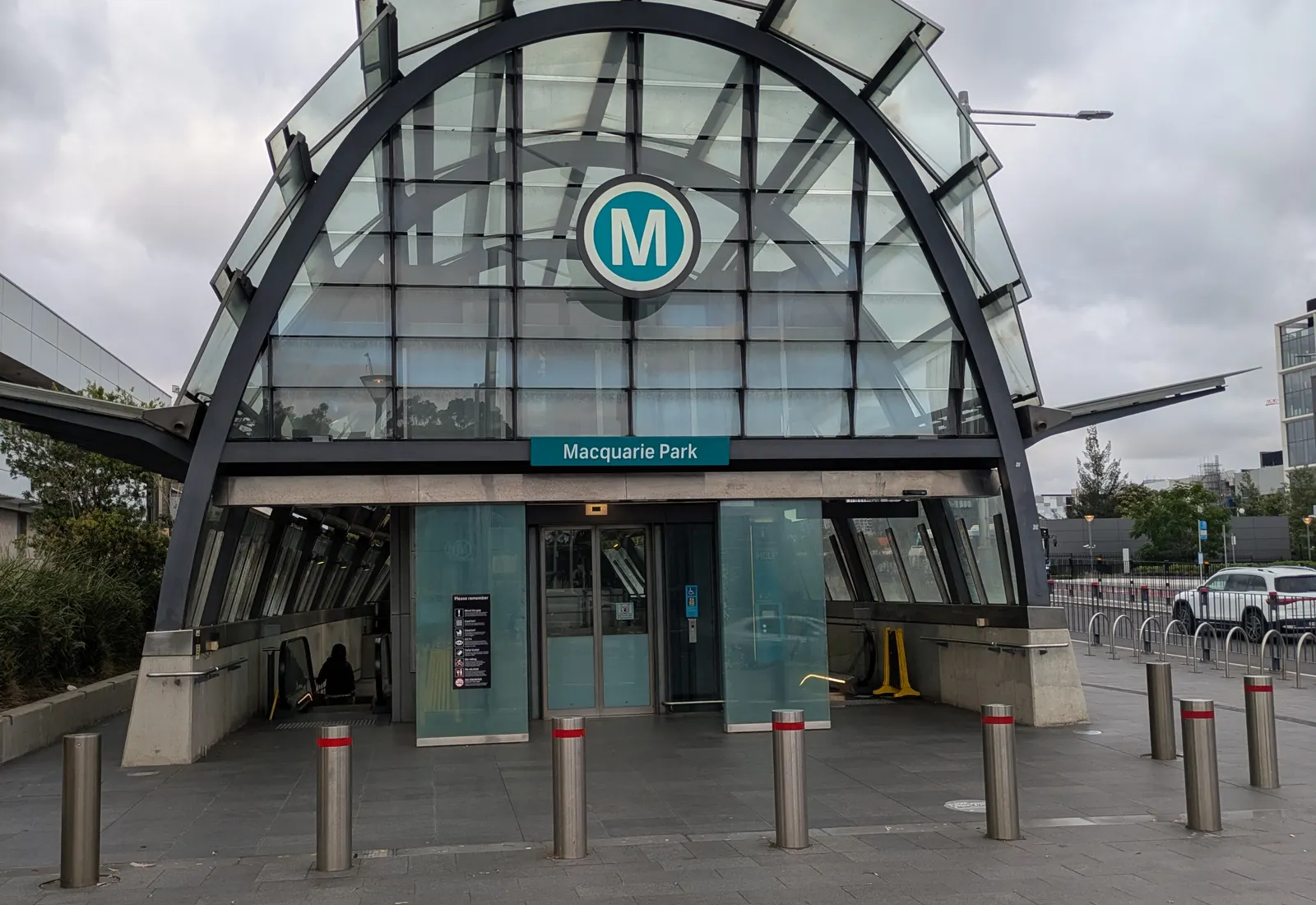
Demand 9/10: one of Sydney's largest daytime catchments — roughly 45,000 jobs across the innovation district (Optus, Cochlear, AstraZeneca, Sanofi) plus 44,015 Macquarie University students (2023) — but the demand is weekday- and term-skewed, not a seven-day resident base of just 11,071.
VERIFYBest fit: Café (67/100)
Location score
62
out of 100
Recommendation
VERIFY
Potentially viable — important checks remain
BEST FIT
67
Café
6.7/10 category
60
Restaurant
56
Retail
Businesses analysed30
Cache updated27 June 2026
Enginev7.3.0
Medium confidence
30 businesses sampled near Macquarie Park centre (updated within the last 4 months); suburb scores use Locatalyze engine v7.3.0. Suburb-centre snapshots for Macquarie Park — validate at your lease address before signing.
Composite 62/100; Café 67/100. Use this as a screening verdict before lease diligence.
Source
Locatalyze engine v7.3.0 plus cached local competitor evidence
Freshness
Competitor cache refreshed 27 June 2026
Confidence
Medium - 30 businesses sampled
Limitation
Macquarie Park scores screen the suburb, not the lease. The paid report tests frontage, rent, nearest competitors, and break-even at your exact address.
Evidence freshness
Scores
Engine v7.3.0; suburb-level model
Competition
Google Places cache refreshed 27 June 2026
Rent
No sourced asking-rent series — obtain current listings
Demographics
ABS Census 2021 baseline with operator interpretation
Mini location report — Macquarie Park
Café opportunity snapshot
VERIFY band for café operators in Macquarie Park.
Also scored: Restaurant 60 · Retail 56
Café opportunity score
67/100
Demand strength
9/10
Rent pressure
Moderate (6/10)
Competition density
6/10
Financial model — unlock at your address
Suburb-level estimates only. Your full report models P&L from your lease address, rent, and format.
🔒Est. monthly revenue range
Modelled at your address from rent, ticket and demand — not a suburb average
🔒Break-even customers per day
Calculated from your rent, staffing, and average ticket at your exact address
🔒Payback period on fit-out
Months to recover setup costs at base-case revenue
🔒Rent-to-revenue ratio
Whether the lease is sustainable at modelled trade levels
See if the numbers work at your rent
Run a free analysis at your Macquarie Park address. Unlock modelled P&L, break-even, and scenarios from $29.
Demand, rent, competition, seasonality, and tourism — scored and weighted for Australian commercial operators.
9/10
Demand
6/10
Rent cost
6/10
Competition
5/10
Seasonality
2/10
Tourism dep
Business-Type Scores
How each format performs
Café / Specialty Coffee67
Full-Service Restaurant60
Independent Retail56
Scores use engine-derived weights: cafés weight demand and rent most heavily; restaurants factor tourism; retail factors tourism and demand equally.
Analyst Notes — Macquarie Park
What the data says about this location
1
Demand 9/10: one of Sydney's largest daytime catchments — roughly 45,000 jobs across the innovation district (Optus, Cochlear, AstraZeneca, Sanofi) plus 44,015 Macquarie University students (2023) — but the demand is weekday- and term-skewed, not a seven-day resident base of just 11,071.
2
Competition 6/10: Macquarie Centre concentrates around 350 stores and a large food court that captures the bulk of food and retail spend, so strip and tower-frontage operators compete against the mall as much as each other.
3
Seasonality 5/10: the signature Macquarie Park risk — university term breaks overlapping the corporate Christmas shutdown create a pronounced December–January trough, and the office rhythm leaves evenings and weekends thin.
4
Tourism 2/10: a worker and student precinct rather than a visitor destination, so trade has to be earned from the daytime catchment, not walk-up tourism.
Local insight — Macquarie Park
On-the-ground read for operators
Editorial notes layered on top of the scored model — same scores and benchmarks above; this section translates strip mechanics into decisions.
Local reality check
Demand 9/10: one of Sydney's largest daytime catchments — roughly 45,000 jobs across the innovation district (Optus, Cochlear, AstraZeneca, Sanofi) plus 44,015 Macquarie University students (2023) — but the demand is weekday- and term-skewed, not a seven-day resident base of just 11,071.
Competition 6/10: Macquarie Centre concentrates around 350 stores and a large food court that captures the bulk of food and retail spend, so strip and tower-frontage operators compete against the mall as much as each other.
Seasonality 5/10: the signature Macquarie Park risk — university term breaks overlapping the corporate Christmas shutdown create a pronounced December–January trough, and the office rhythm leaves evenings and weekends thin.
Competition is moderate — you are buying into share-of-wallet, not automatic overflow.
Micro-location breakdown
Macquarie Park main strip / highest visibility
What tends to work: High-throughput food, proven hospitality formats, and retail with clear window narrative.
What struggles: Formats needing highway visibility or large-format parking ratios.
Rent vs foot traffic: Prime band often near $5,092–$6,240/mo — Rent pressure 6/10 — treat agent ranges as opening positions; model $/sqm and outgoings before emotional commitment.
Secondary street / side pocket
What tends to work: Operators who accept lower passer-by counts but fund discovery through product, hours, or events.
What struggles: Walk-in-only models with no marketing budget or brand recognition.
Rent vs foot traffic: Secondary band often near $4,231–$5,092/mo — savings must fund signage and fit-out amortisation, not disappear into rent alone.
Budget / upstairs / off-strip
What tends to work: Studios, appointment services, niche retail with owned traffic.
What struggles: Full-service dining depending on spontaneous footfall without a booking channel.
Rent vs foot traffic: Lower band near $2,750–$4,231/mo — viable only when customers arrive by intent, not accident.
Real business scenarios
If prime rent clears near $5,092–$6,240/mo, model daily covers at your real average ticket — the engine verdict is VERIFY at 62/100, not a guarantee at your address.
Tourism dependency 2/10: when elevated, January and shoulder weeks need explicit planning, not December extrapolation.
Run competitors within 500m before offer — Competition is moderate — you are buying into share-of-wallet, not automatic overflow.
Competitive reality
Macquarie Park (VERIFY, 62/100) is a modelled read across demand, rent, competition, and seasonality — validate on-site at quiet and peak dayparts, then reconcile with your accountant before lease execution.
Sharp verdict
Macquarie Park pays off when rent sits inside $5,092–$6,240/mo at conservative revenue — do not sign on suburb hype; sign on covers you can defend on a Tuesday.
Risk-first walkthrough
Macquarie Park is the most deceptive catchment in northern Sydney. The headline numbers are enormous — roughly 45,000 jobs across the innovation district and 44,015 Macquarie University students in 2023 — but the resident base is just 11,071, the trade is weekday- and term-time-skewed, and Macquarie Centre's 350-odd stores and food court capture most of the food and retail spend. Demand reads 9/10 on raw catchment size; the composite lands at 62/100 with a VERIFY verdict because competition (6/10) and seasonality (5/10) quietly tax everything. This page is a risk-first walkthrough: it tells you exactly which version of Macquarie Park works for an operator and which version bankrupts one.
Read this before you fall for the daytime headcount. Macquarie Park is not a seven-day high street; it is a worker-and-student precinct wrapped around a regional shopping centre and three Metro stations. The opportunity is real but narrow — a fast, daytime-format business in the right micro-location can do very well on the 06:30–15:00 weekday window. A full-service, evening-and-weekend thesis priced for a residential village will struggle, because at 18:00 on a Saturday the office towers are empty and the students have gone home.
The precinct's commercial geography sits across four distinct micro-locations: Macquarie Centre (the dominant retail anchor on Herring Road), the Metro station forecourts (Macquarie University, Macquarie Park and North Ryde), the Waterloo Road / Lachlan's Line business and residential corridor, and the university campus edge. Each trades to a different clock. Choosing the wrong one is the single most common way operators lose money here.
The table is the whole argument for treating Macquarie Park as a daytime market. A resident base of 11,071 with a median age of 31 and 65.8% renting is too small and too transient to anchor seven-day hospitality on its own. The spending power that matters arrives by Metro: a professional workforce (43.6% professionals, median personal income $970 a week, above the Greater Sydney $881) and 44,015 university students. Price for the worker's lunch and the student's coffee, not for a wealthy resident dinner crowd.
The household-income figure sitting below Greater Sydney while personal income sits above it is the tell: this is a suburb of well-paid individuals in shared and rented dwellings, not high-income family households. That shapes daypart and format — strong on weekday coffee, lunch and quick-service; weak on the family-weekend and evening-destination trade that residential suburbs supply.
Figure 1
Who is actually in Macquarie Park on a teaching weekday
Residents11,071
Median age 31; 65.8% renting.
University students44,015
Enrolled 2023; term-time, not year-round.
Precinct jobs~45,000
Innovation-district workforce; weekday-skewed.
Sources: resident population, ABS Census 2021 [1]; university students, Macquarie University 2023 [3]; precinct jobs, Connect Macquarie Park Innovation District [4]. Worker and student figures are daytime catchment, not residents.
The catchment is huge, but it is daytime money
Start with the real numbers. The 2021 Census counted 11,071 residents in Macquarie Park, with a median age of 31 and 65.8% of occupied dwellings rented — a young, mobile, renter-dominated base, not a settled family catchment. On its own that residential population could not sustain the precinct's hospitality. What sustains it is the daytime layer: approximately 45,000 jobs across the Macquarie Park innovation district — Optus's national headquarters, Cochlear, AstraZeneca, Sanofi and a deep medtech and technology cluster — plus 44,015 students enrolled at Macquarie University in 2023. Add the two and roughly 89,000 people are in the precinct on an ordinary teaching Wednesday.
That is the opportunity and the trap in one sentence. The catchment is one of the largest in Sydney outside the CBD, but almost none of it lives here. The money arrives by Metro and car between 07:30 and 09:30 and largely leaves by 18:00. The lunch peak — roughly 11:45 to 13:45 — is intense and bankable; the dinner service many operators budget for barely exists outside the mall. Treat Macquarie Park as a weekday daytime market with a strong lunch engine and a thin evening, and the economics make sense. Treat it as a balanced seven-day suburb and the model breaks.
Resident incomes reinforce the read. Median weekly household income was $1,886 in 2021 — below the Greater Sydney figure of $2,077 — because the resident base is student-heavy and renter-heavy. But median personal income, at $970 a week, sits above Greater Sydney's $881, reflecting the professional workers who commute in. The spending power you are pricing for is the worker's lunch wallet and the student's coffee budget, not a wealthy resident dinner crowd.
Macquarie Centre is the competitor you cannot out-spend
Any food or retail plan for Macquarie Park has to start with Macquarie Centre, because it sets the gravity. The centre runs around 350 specialty stores across roughly 134,900 m² of gross lettable area, anchored by David Jones, Myer, Big W, Kmart, Aldi, Coles and Woolworths, with one of the largest enclosed food courts in northern Sydney. For a worker or student deciding where to spend a lunch break, the centre offers air-conditioning, hundreds of options, and a two-minute walk from the Metro and the campus footbridge. A standalone café three hundred metres up Waterloo Road is competing against all of that.
This does not mean independents cannot win — it means they have to win on something the centre is structurally bad at: speed for regulars, genuine quality coffee, a specific cuisine done properly, or a location the mall cannot replicate (a tower lobby, a campus-edge corner, a Metro forecourt). What fails reliably is the generic mid-market café or casual-dining format that offers the centre's proposition without the centre's foot traffic, rent leverage, or marketing budget. Competition here reads 6/10 not because the strip is crowded — it is not — but because the mall absorbs the demand before it reaches the strip.
Seasonality is the risk operators discover too late
Macquarie Park has a seasonality problem that most northern-Sydney suburbs do not, and it is the reason the verdict is CAUTION rather than GO. The university calendar and the corporate calendar trough at the same time. Macquarie University's long summer break runs from late November into late February; the corporate Christmas shutdown across the innovation district overlaps it almost exactly. For roughly six weeks from mid-December the precinct's daytime population — both pillars of it — collapses together. A café that banks $4,500 a week in October can find itself doing a third of that in January, with the same rent and the same minimum roster.
There is a second, weekly version of the same problem: the precinct empties on weekends. Office workers are gone, much of the student cohort lives elsewhere and travels in only for classes, and the residential base of 11,071 is too small to fill the gap. Saturday and Sunday trade outside Macquarie Centre is thin. Operators who model seven even days, or who sign a lease in October when the place is heaving, routinely under-provision for the December–February trough and the every-weekend softness. Build the cash-flow model around the teaching weeks and the weekday lunch, treat the breaks as the base case rather than the exception, and negotiate a rent structure that can survive January.
Transport and growth are genuine tailwinds
The structural case for Macquarie Park is not weak — it is just specific. Three Sydney Metro stations opened on the North West Line in 2019 serve the precinct directly: Macquarie University, Macquarie Park and North Ryde. Frequent, turn-up-and-go services have materially improved access from a wide northern catchment and feed the station forecourts with a reliable commuter pulse morning and evening. For a grab-and-go format positioned within sight of a Metro entrance, that pulse is the whole business.
Growth is real and documented. The innovation district carries roughly 854,000 m² of commercial floorspace today and is master-planned to expand towards 2.5 million m² over the coming decades, a trajectory that would place it among Australia's largest commercial centres by floorspace. The Lachlan's Line residential precinct on the western edge is adding the kind of resident density the suburb has historically lacked, which over time should soften both the weekend and the summer troughs. An operator taking a five-to-ten-year view is buying into a catchment that is being built up around them — but the page's job is to be honest that the seven-day, year-round demand is a future state, not today's.
The format that fits, in plain terms
The business that works in Macquarie Park is fast, daytime, and positioned where the catchment physically moves. Specialty coffee with a tight, quick food offer aimed at the 06:30–10:00 commuter wave and the 11:45–13:45 lunch peak is the strongest fit — café scores 67/100 here, the best of the three formats, precisely because the model matches the demand shape. A focused, single-cuisine quick-service restaurant that the food court does not already do well can capture worker lunch and student dinner-before-the-train trade. Health, allied-health and professional services that serve the 45,000-strong workforce trade on the same weekday clock and are insulated from the weekend problem entirely.
What does not fit: a full-service à-la-carte restaurant relying on evening covers; a weekend-destination café built for a residential village that is not here; any retail format competing head-on with Macquarie Centre's categories. Restaurant scores 60/100 and retail 56/100 for exactly these reasons — the tourism and resident-evening demand those formats need is the weakest part of Macquarie Park's profile. Match the format to the daytime clock and the right micro-location and the precinct is productive; fight the clock and it is one of the more expensive lessons in northern Sydney.
Zone-by-zone breakdown
Macquarie Centre (Herring Road)
The retail and food gravity of the whole precinct. In-centre tenancies and the food court capture the bulk of worker and student spend, but rents are regional-mall tier and competition inside is severe — you are one of hundreds of options. Works for: operators with a brand draw or a category the centre lacks. Fails for: undifferentiated mid-market food expecting the centre's foot traffic to carry a weak proposition.
Metro station forecourts (Macquarie University / Macquarie Park / North Ryde)
The single best position for grab-and-go. The commuter pulse morning and evening is reliable and the trade is fast, habitual and price-tolerant for quality coffee. Works for: tight specialty-coffee and quick-food formats within sight of an entrance. Fails for: anything that needs a lingering, sit-down dwell time the commuter does not have.
Waterloo Road / business-park corridor
Tower lobbies and ground-floor tenancies among the office buildings. Strong, captive weekday lunch from the immediate workforce, but dead at 18:00 and on weekends, and exposed to the corporate-shutdown trough. Works for: weekday lunch specialists and worker-services formats. Fails for: any model that needs evening or weekend trade to clear its rent.
Lachlan's Line / residential edge
The newest and most resident-anchored micro-location, adding the seven-day base the suburb has lacked. Smaller catchment today but the most balanced trading clock, and the part of Macquarie Park most likely to support an evening and weekend offer as density fills in. Works for: neighbourhood formats taking a longer view. Fails for: operators needing volume from day one.
Operator Intelligence
10 dimensions — what matters most here
Scored 1–10 from an operator perspective: higher always means better. Each dimension includes the reasoning behind the score.
Weekday daytime demandCritical
Roughly 45,000 jobs plus 44,015 university students create one of Sydney’s largest non-CBD daytime catchments. The lunch and commuter peaks are intense and bankable.
9/10
Seven-day / evening demandCritical
Only 11,071 residents; workers and most students leave by evening and on weekends. Outside Macquarie Centre, nights and weekends are thin.
3/10
Seasonal stabilityImportant
University summer break and the corporate Christmas shutdown overlap, producing a pronounced six-week mid-December to late-February trough.
4/10
Transport accessImportant
Three Sydney Metro stations (opened 2019) provide frequent, turn-up-and-go access and a reliable commuter pulse at the forecourts.
9/10
Competitive headroom for independentsCritical
Macquarie Centre’s ~350 stores and food court capture most spend two minutes from the Metro and campus; independents must win on speed, quality or an irreplaceable location.
4/10
Growth trajectorySupporting
Floorspace is master-planned to expand towards 2.5 million m²; Lachlan’s Line is adding the resident density the suburb has lacked.
8/10
When Macquarie Park trades
Peak and off-peak trading periods
Strong
Weekday breakfast & commute (06:30–10:00)
Metro-forecourt grab-and-go peaks; the most reliable, habitual trade in the precinct.
Strong
Weekday lunch (11:45–13:45), teaching weeks
Intense worker-and-student lunch rush; the core revenue engine for daytime formats.
Weak
Weekday evening (after 18:00)
Office towers empty out; only the residential edge and the mall hold any trade.
Weak
Weekends
Thin outside Macquarie Centre; the 11,071-resident base cannot fill the gap left by workers and students.
Weak
Mid-December to late February
University summer break overlaps the corporate shutdown — the precinct’s leanest six weeks. Model as the floor.
Operator fit warning
Who should not open in Macquarie Park
✕
Full-service restaurants relying on evening à-la-carte covers — the dinner trade outside the mall barely exists.
✕
Weekend-destination cafés built for a residential village — Macquarie Park does not have one yet.
✕
Retail formats competing head-on with Macquarie Centre’s categories — the centre captures the spend first.
✕
Operators who cannot fund a six-week summer trough on full rent and a minimum roster.
Best business formats for Macquarie Park
Specialty coffee at a Metro forecourt
The best-fit format (café scores 67/100). Position within sight of a Metro entrance, build for the 06:30–10:00 commuter wave and the 11:45–13:45 lunch peak, keep the food offer tight and fast, and bank the weekday rhythm. Do not over-build seating you cannot fill on a Saturday.
Single-cuisine quick-service the food court does not do well
A focused QSR with a genuine point of difference can pull worker lunch and pre-train student dinner trade that Macquarie Centre's generic food court leaks. Cuisine clarity and speed beat breadth here.
Worker-services formats on the weekday clock
Allied health, grooming, professional and personal services that serve the 45,000-strong workforce trade weekday-daytime by nature and sidestep the weekend and summer troughs entirely. The catchment's professional skew (43.6% of workers are professionals) supports premium positioning.
Risks specific to Macquarie Park
The December–February trough is the base case, not the exception
University summer break and the corporate Christmas shutdown overlap, and the daytime catchment collapses for roughly six weeks. Model January as your floor, not your outlier, and negotiate rent terms that survive it.
Weekends are thin outside the mall
With only 11,071 residents and the workers and most students gone, Saturday and Sunday trade away from Macquarie Centre is weak. A seven-even-day model will over-provision labour and stock for demand that is not there.
Macquarie Centre captures the spend before it reaches the strip
Around 350 stores and a major food court two minutes from the Metro and campus set the gravity. A strip operator offering the centre's proposition without its foot traffic loses. Win on speed, quality or a location the centre cannot replicate, or do not open.
Rent viability bands for Macquarie Park
Indicative monthly rent envelopes for typical commercial tenancies — what each band buys, where it works, where it does not.
Rent freshness: 2026 indicative benchmarksValidate against the exact lease before signing
Band
Range
What it buys
Works for
Fails for
Metro forecourt / high-visibility kiosk
Indicative — premium tier
A small footprint within sight of a Metro entrance with the strongest commuter foot traffic in the precinct.
Tight specialty-coffee and grab-and-go formats with high transaction velocity.
Any model needing large seating or evening dwell time to justify the per-square-metre cost.
Macquarie Centre in-line / food court
Indicative — regional-mall tier (highest)
Direct access to the centre's captured worker and student spend and its marketing draw.
Brands with a category the centre lacks or a draw strong enough to carry mall-tier occupancy costs and turnover rent.
Undifferentiated mid-market food that cannot clear mall-tier rent on contested volume.
Tower ground-floor / Waterloo Road frontage
Indicative — mid tier
A captive weekday-lunch position among the office towers and their immediate workforce.
Weekday lunch specialists and worker-services formats built around the 11:45–13:45 peak.
Evening- or weekend-dependent formats — the corridor is dead after 18:00 and on weekends.
Lachlan's Line / residential-edge tenancy
Indicative — lower-to-mid tier
A neighbourhood position with the most balanced seven-day clock in the suburb, in a growing resident catchment.
Neighbourhood cafés and convenience formats taking a longer view as density fills in.
Operators needing high volume from day one before the resident base matures.
Decision framework
Is your model fast and daytime? If your revenue depends on evening covers or weekend destination trade, Macquarie Park is the wrong suburb — choose a residential high street instead.
Can your cash flow survive a six-week summer trough on the same rent and a minimum roster? If not, do not sign, or negotiate abatement and turnover-linked terms first.
Are you positioned where the catchment physically moves — a Metro forecourt, a tower lobby, a campus edge — rather than on a quiet stretch the mall has already drained?
Do you offer something Macquarie Centre is structurally bad at: speed for regulars, genuine specialty quality, or a single cuisine done properly? If you are offering the mall’s proposition without the mall’s traffic, expect to lose.
Have you verified the actual tenancy comps and the specific weekday-versus-weekend foot traffic at the exact address, not the precinct average? The micro-location difference here is larger than in almost any other Sydney suburb.
Macquarie Park rewards operators who model the daytime clock honestly and punishes those who read the headline catchment as seven-day demand. Locatalyze runs an address-level analysis on the exact tenancy you are considering — weekday-versus-weekend foot traffic, the real competitive set within walking distance, indicative rent against the format you intend to run, and a break-even built on teaching-week and summer-trough scenarios rather than a flat annual average. Before you sign in Macquarie Park, get the micro-location read right.
For a fast, daytime specialty-coffee format in the right micro-location, yes — café is the best-fitting format here, scoring 67/100. For a weekend-destination or evening café relying on resident trade, no. The resident base is only 11,071 and the precinct empties on weekends and over the university summer break, so the model has to match the weekday daytime clock.
Why is the verdict VERIFY when the catchment is so large?
Because the catchment is daytime money, not seven-day demand. Around 45,000 workers and 44,015 students pass through on a teaching weekday, but Macquarie Centre captures most of the food and retail spend, the precinct troughs hard from mid-December to late February, and weekends are thin. The composite is 62/100 — competition (6/10) and seasonality (5/10) tax an otherwise very strong demand score (9/10).
What rent should I expect in Macquarie Park?
It depends heavily on the micro-location. Macquarie Centre in-line and food-court tenancies are regional-mall tier (the highest), Metro-forecourt kiosks are premium for their visibility, tower-frontage on Waterloo Road is mid-tier, and the Lachlan's Line residential edge is lower. The bands on this page are indicative envelopes — there are roughly 26 retail and 81 office lease listings for Macquarie Park (postcode 2113) on the major commercial portals as of mid-2026 — and you should verify comps for the specific tenancy before signing.
When does Macquarie Park trade best and worst?
Best: weekday mornings (06:30–10:00 commuter wave) and lunch (11:45–13:45), during university teaching weeks. Worst: the mid-December to late-February window, when the university summer break and the corporate Christmas shutdown overlap, and weekends year-round outside Macquarie Centre. Model January as your floor.
How does Macquarie Park compare to Chatswood or Eastwood for hospitality?
Chatswood (composite around 66) is a more balanced seven-day centre with stronger weekend and visitor trade and lower seasonality. Eastwood (around 70) offers far better rent-to-demand economics and a genuine seven-day food destination. Macquarie Park has a bigger raw daytime catchment than either but worse weekend, evening and summer balance, which is why it scores below both.
Is the new Metro good for retail and hospitality here?
Yes, for the right format. The three Metro stations (Macquarie University, Macquarie Park and North Ryde) opened in 2019 and feed reliable morning and evening commuter pulses into the station forecourts. A grab-and-go or specialty-coffee format within sight of an entrance benefits directly; a sit-down format that needs dwell time benefits less.
Who should not open in Macquarie Park?
Anyone whose model needs evening covers, weekend destination trade, or a settled residential dinner crowd. Full-service restaurants, weekend-village cafés, and retail competing head-on with Macquarie Centre’s categories all run into the same wall: the demand that supports them is the weakest part of this precinct’s profile.
Data provenance & limitations. Demographic figures are from the ABS 2021 Census for the Macquarie Park suburb (SAL12446), with Greater Sydney (1GSYD) as benchmark; the 2021 Census is the most recent available. Student numbers are Macquarie University's 2023 figures; precinct jobs (~45,000) and floorspace are from Connect Macquarie Park Innovation District and are precinct estimates. Rent bands are indicative envelopes, not achieved rents — informed by current commercial-lease listings for Macquarie Park (postcode 2113) on commercialrealestate.com.au (approximately 26 retail and 81 office listings, accessed June 2026) and the precinct's office-tier positioning; verify comps for the specific tenancy. Competitor context refers to Macquarie Centre's published tenancy count rather than a fixed-radius count. Factor scores are relative estimates calibrated across all Locatalyze suburbs, not guarantees of outcome.
Methodology: Scores are engine-derived from five observable inputs (demand strength, rent pressure, competition density, seasonality risk, tourism dependency — each 1–10). These feed into business-type-specific weighted composites via a single scoring engine used across all markets. Scores are relative estimates calibrated across all Sydney suburbs — a score of 80 indicates materially better conditions than 65; it is not a success probability or guarantee.
Frequently Asked Decision Questions
Have a specific address in Macquarie Park?
Run a full competitor map, rent benchmark, and location score, data confidence, and proceed / verify / avoid screening recommendation for any Macquarie Park address. Free.
·2,510 reviews place it on the local shortlist even where ratings are mixed.
·Rating sits below the 4.0★ peer average — volume or convenience may be doing the work.
·Review volume 1023% above peer average (224).
If you are opening nearby: McDonald's North Ryde is the benchmark café here — $ positioning is validated by review depth in this catchment — For new entrants: McDonald's North Ryde is the benchmark café here — compete on speed, workspace utility, or an earlier breakfast daypart, not a bigger fit-out.
·4.9★ with 348 reviews — repeat local demand, not one-off visits.
·1.0★ above the 3.9★ average among top local peers.
·Central location (174m from suburb centre) captures pass-by and destination traffic.
If you are opening nearby: The Naked Duck M-Park (Dominant) shows what execution looks like at this score tier — 4.9★ with 348 reviews signals repeat custom, not novelty traffic — 174m from centre — frontage on the walkable strip matters.
·4.4★ and 391 reviews — customers actively recommend this café.
·0.4★ above the 4.0★ average among top local peers.
If you are opening nearby: 4.4★ with 391 reviews signals repeat custom, not novelty traffic — For new entrants: Near Inlakesh Living Foods, differentiate through health-forward bowls with fast service — generic third-wave coffee will not stand out.
4. Chambers Coffee @ Macquarie Centre Food Court
★★★★☆ 4.0 (266 reviews) · $$ · 716m from centre
55 · Growing
·4.0★ rating beats the typical café baseline in this catchment.
·Mid-range positioning with strong review depth — balanced offer, not discount-led.
If you are opening nearby: $$ positioning is validated by review depth in this catchment — For new entrants: Chambers Coffee @ Macquarie Centre Food Court is beatable on single-origin filter led — avoid matching incumbents' full menu breadth.
5. Ellatte Coffee Bar Macquarie
★★★★☆ 4.3 (165 reviews) · $ · 378m from centre
68 · Established
·4.3★ and 165 reviews — customers actively recommend this café.
·0.3★ above the 4.0★ average among top local peers.
·Value-tier pricing with high volume — wins on convenience and price, not premium experience.
If you are opening nearby: 4.3★ with 165 reviews signals repeat custom, not novelty traffic — $ positioning is validated by review depth in this catchment — 378m from centre — frontage on the walkable strip matters.
Possible market opportunities
Derived from venue counts and formats in our Google Places snapshot — not a guarantee of demand at your exact address.
Medium confidenceHealth-forward fast café (smoothies, bowls, cold brew)
Reason: Local cafés show moderate review scores — operators who nail consistency and speed can lift the bar quickly.
Who wins in Macquarie Park — Restaurants
Ranked by success score (rating, review depth, centrality) within ~1000m of the suburb centre.
What winners have in common
·3 of 10 top venues sit at 4.3★+ — customers reward consistent execution, not novelty alone.
·Review depth averages 880 — operators with under 150 reviews read as unproven next to incumbents.
·Typical positioning is $$ (8 venues report Google price tiers).
·3 benchmark operators combine 4.4★+ ratings with 150+ reviews — new entrants need a clear niche, not a me-too menu.
·4.7★ with 1,327 reviews — repeat local demand, not one-off visits.
·0.9★ above the 3.8★ average among top local peers.
·Review volume 60% above peer average (830).
If you are opening nearby: Ozeki Bowl Macquarie is the benchmark restaurant here — their 4.7★ and 1,327 reviews beat the 830-review peer average — For new entrants: Avoid cuisine overlap with Ozeki Bowl Macquarie — target an occasion they do not own (quick lunch, date night, or group dining).
·4.2★ and 2,021 reviews — customers actively recommend this restaurant.
·0.3★ above the 3.9★ average among top local peers.
·Review volume 168% above peer average (753).
If you are opening nearby: Verace Pizzeria (Dominant) shows what execution looks like at this score tier — 4.2★ with 2,021 reviews signals repeat custom, not novelty traffic — $$ positioning is validated by review depth in this catchment — 202m from centre — frontage on the walkable strip matters.
·4.1★ rating beats the typical restaurant baseline in this catchment.
·0.2★ above the 3.9★ average among top local peers.
·Review volume 133% above peer average (777).
If you are opening nearby: $$ positioning is validated by review depth in this catchment — For new entrants: Focus on a specific occasion (date night, quick lunch, or group dining) that PappaRich Macquarie does not dominate.
·4.4★ and 391 reviews — customers actively recommend this restaurant.
·0.5★ above the 3.9★ average among top local peers.
If you are opening nearby: 4.4★ with 391 reviews signals repeat custom, not novelty traffic — For new entrants: Focus on a specific occasion (date night, quick lunch, or group dining) that Inlakesh Living Foods does not dominate.
5. KFC North Ryde
★★★½☆ 3.6 (947 reviews) · $ · 494m from centre
57 · Growing
·947 reviews place it on the local shortlist even where ratings are mixed.
·Rating sits below the 3.9★ peer average — volume or convenience may be doing the work.
·Value-tier pricing with high volume — wins on convenience and price, not premium experience.
If you are opening nearby: $ positioning is validated by review depth in this catchment — For new entrants: Focus on a specific occasion (date night, quick lunch, or group dining) that KFC North Ryde does not dominate.
Who wins in Macquarie Park — Retail
Ranked by success score (rating, review depth, centrality) within ~1500m of the suburb centre.
What winners have in common
·2 of 10 top venues sit at 4.3★+ — customers reward consistent execution, not novelty alone.
·Review depth averages 215 — operators with under 150 reviews read as unproven next to incumbents.
·No single venue dominates on both rating and review depth — the category may still be contestable.
·1,199 reviews place it on the local shortlist even where ratings are mixed.
·Review volume 1034% above peer average (106).
·Benchmark incumbent — new entrants in this category are measured against this operator.
If you are opening nearby: David Jones - Macquarie Centre is the benchmark retail here — For new entrants: Niche or service-led retail beats another generalist shelf near David Jones.
2. ZARA
★★★½☆ 3.7 (453 reviews) · $$ · 608m from centre
53 · Growing
·453 reviews place it on the local shortlist even where ratings are mixed.
·Review volume 140% above peer average (189).
·Mid-range positioning with strong review depth — balanced offer, not discount-led.
If you are opening nearby: $$ positioning is validated by review depth in this catchment — For new entrants: Niche or service-led retail beats another generalist shelf near ZARA.
3. Kathmandu Macquarie
★★★★☆ 4.3 (132 reviews) · 716m from centre
57 · Growing
·4.3★ and 132 reviews — customers actively recommend this retail.
·0.5★ above the 3.8★ average among top local peers.
If you are opening nearby: 4.3★ with 132 reviews signals repeat custom, not novelty traffic — For new entrants: Niche or service-led retail beats another generalist shelf near Kathmandu Macquarie.
4. Nike Macquarie Centre
★★★★☆ 4.4 (95 reviews) · 459m from centre
62 · Established
·4.4★ and 95 reviews — customers actively recommend this retail.
·0.6★ above the 3.8★ average among top local peers.
If you are opening nearby: 4.4★ with 95 reviews signals repeat custom, not novelty traffic — For new entrants: Niche or service-led retail beats another generalist shelf near Nike Macquarie Centre.
5. M.J. Bale Macquarie Centre
★★★★☆ 4.1 (63 reviews) · 533m from centre
51 · Growing
·4.1★ rating beats the typical retail baseline in this catchment.
·0.3★ above the 3.8★ average among top local peers.
If you are opening nearby: For new entrants: Niche or service-led retail beats another generalist shelf near M.J. Bale Macquarie Centre.
Who wins in Macquarie Park — Pizza
Ranked by success score (rating, review depth, centrality) within ~1000m of the suburb centre.
What winners have in common
·Review depth averages 1,129 — operators with under 150 reviews read as unproven next to incumbents.
·Most winners sit within 400m of the suburb centre — frontage on the walkable strip matters.
·4.2★ and 2,021 reviews — customers actively recommend this restaurant.
·Rating sits below the 4.4★ peer average — volume or convenience may be doing the work.
·Review volume 753% above peer average (237).
If you are opening nearby: Verace Pizzeria is the benchmark restaurant here — 4.2★ with 2,021 reviews signals repeat custom, not novelty traffic — $$ positioning is validated by review depth in this catchment — 202m from centre — frontage on the walkable strip matters.
2. Kismet Kebab&Pizza
★★★★☆ 4.4 (237 reviews) · $ · 488m from centre
70 · Established
·4.4★ and 237 reviews — customers actively recommend this restaurant.
·0.2★ above the 4.2★ average among top local peers.
·Value-tier pricing with high volume — wins on convenience and price, not premium experience.
If you are opening nearby: 4.4★ with 237 reviews signals repeat custom, not novelty traffic — $ positioning is validated by review depth in this catchment — For new entrants: Kismet Kebab&Pizza owns pizza in this catchment — avoid head-on overlap; counter-service, by-the-slice, or a distinct cuisine format has more room.