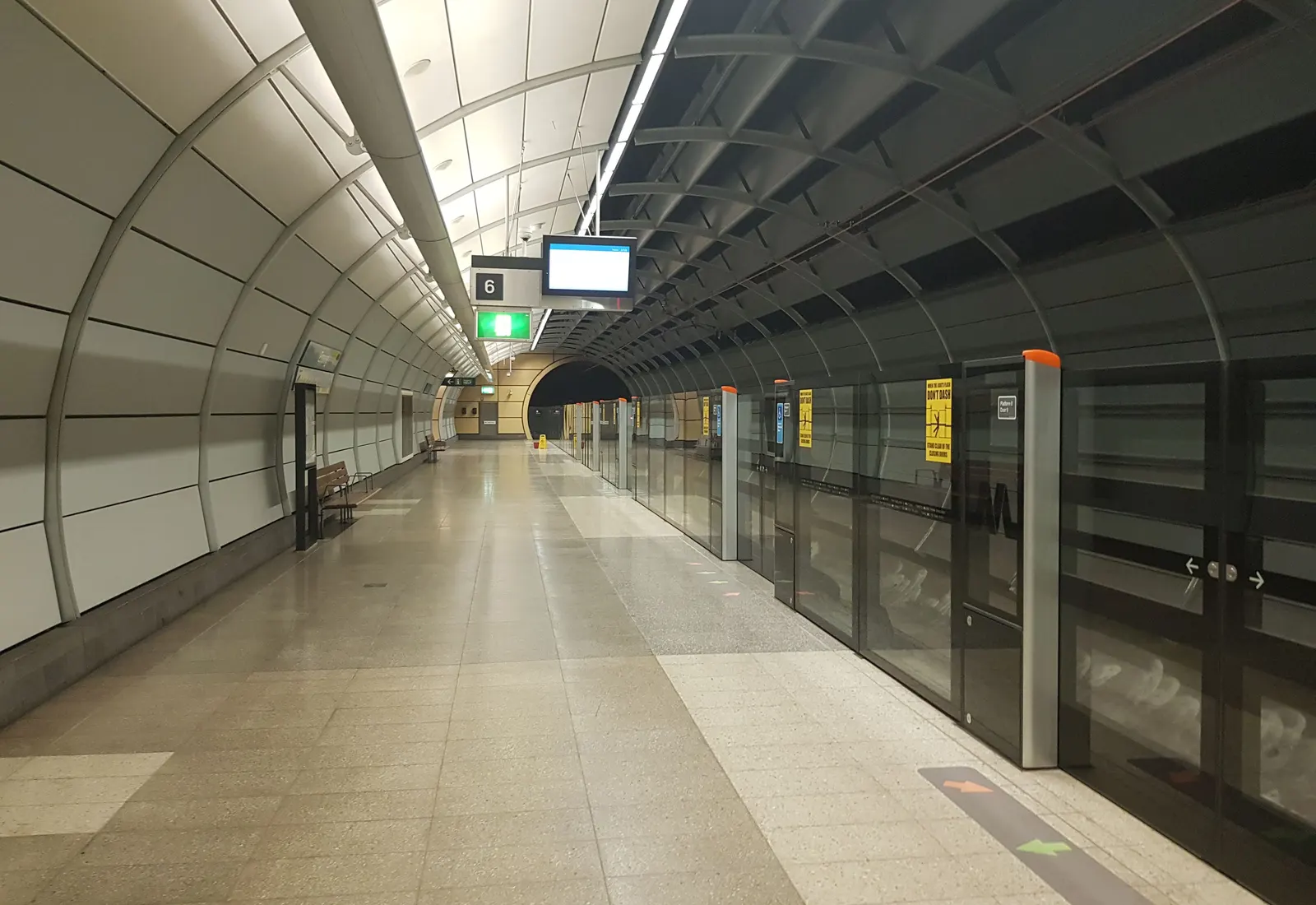
Demand 9/10: a major double interchange (Sydney Metro plus the T9 heavy-rail line) feeding a dense, fast-growing catchment of 29,551 residents, anchored by one of northern Sydney's strongest Chinese consumer markets (40.4% Chinese ancestry, 23.1% speak Mandarin at home).
VERIFYBest fit: Café (73/100)
Location score
68
out of 100
Recommendation
VERIFY
Potentially viable — important checks remain
BEST FIT
73
Café
7.3/10 category
66
Restaurant
62
Retail
Businesses analysed30
Cache updated27 June 2026
Enginev7.3.0
Medium confidence
30 businesses sampled near Epping centre (updated within the last 4 months); suburb scores use Locatalyze engine v7.3.0. Suburb-centre snapshots for Epping — validate at your lease address before signing.
Demand, rent, competition, seasonality, and tourism — scored and weighted for Australian commercial operators.
9/10
Demand
5/10
Rent cost
6/10
Competition
3/10
Seasonality
3/10
Tourism dep
Business-Type Scores
How each format performs
Café / Specialty Coffee73
Full-Service Restaurant66
Independent Retail62
Scores use engine-derived weights: cafés weight demand and rent most heavily; restaurants factor tourism; retail factors tourism and demand equally.
Analyst Notes — Epping
What the data says about this location
1
Demand 9/10: a major double interchange (Sydney Metro plus the T9 heavy-rail line) feeding a dense, fast-growing catchment of 29,551 residents, anchored by one of northern Sydney's strongest Chinese consumer markets (40.4% Chinese ancestry, 23.1% speak Mandarin at home).
2
Rent 5/10: high-rise redevelopment around the station has lifted retail rents from their pre-Metro base, but they remain well below Chatswood for comparable foot traffic on Rawson Street and Langston Place.
3
Competition 6/10: the Rawson Street and Langston Place dining cluster is dense and cuisine-specific, so format alignment to the Asian-Australian customer base matters more than generic positioning.
4
Tourism 3/10: locally and commuter-driven trade rather than a visitor destination — a reliable seven-day rhythm built on residents and interchange flow.
Local insight — Epping
On-the-ground read for operators
Editorial notes layered on top of the scored model — same scores and benchmarks above; this section translates strip mechanics into decisions.
Local reality check
Demand 9/10: a major double interchange (Sydney Metro plus the T9 heavy-rail line) feeding a dense, fast-growing catchment of 29,551 residents, anchored by one of northern Sydney's strongest Chinese consumer markets (40.4% Chinese ancestry, 23.1% speak Mandarin at home).
Rent 5/10: high-rise redevelopment around the station has lifted retail rents from their pre-Metro base, but they remain well below Chatswood for comparable foot traffic on Rawson Street and Langston Place.
Competition 6/10: the Rawson Street and Langston Place dining cluster is dense and cuisine-specific, so format alignment to the Asian-Australian customer base matters more than generic positioning.
Competition is moderate — you are buying into share-of-wallet, not automatic overflow.
Micro-location breakdown
Epping main strip / highest visibility
What tends to work: High-throughput food, proven hospitality formats, and retail with clear window narrative.
What struggles: Formats needing highway visibility or large-format parking ratios.
Rent vs foot traffic: Prime band often near $4,903–$5,883/mo — Rent pressure 5/10 — treat agent ranges as opening positions; model $/sqm and outgoings before emotional commitment.
Secondary street / side pocket
What tends to work: Operators who accept lower passer-by counts but fund discovery through product, hours, or events.
What struggles: Walk-in-only models with no marketing budget or brand recognition.
Rent vs foot traffic: Secondary band often near $4,168–$4,903/mo — savings must fund signage and fit-out amortisation, not disappear into rent alone.
Budget / upstairs / off-strip
What tends to work: Studios, appointment services, niche retail with owned traffic.
What struggles: Full-service dining depending on spontaneous footfall without a booking channel.
Rent vs foot traffic: Lower band near $2,709–$4,168/mo — viable only when customers arrive by intent, not accident.
Real business scenarios
If prime rent clears near $4,903–$5,883/mo, model daily covers at your real average ticket — the engine verdict is VERIFY at 68/100, not a guarantee at your address.
Tourism dependency 3/10: when elevated, January and shoulder weeks need explicit planning, not December extrapolation.
Run competitors within 500m before offer — Competition is moderate — you are buying into share-of-wallet, not automatic overflow.
Competitive reality
Epping (VERIFY, 68/100) is a modelled read across demand, rent, competition, and seasonality — validate on-site at quiet and peak dayparts, then reconcile with your accountant before lease execution.
Sharp verdict
Epping pays off when rent sits inside $4,903–$5,883/mo at conservative revenue — do not sign on suburb hype; sign on covers you can defend on a Tuesday.
Sectional field guide
Epping is a transport-led centre that trades far above its size. A double interchange — Sydney Metro plus the T9 heavy-rail line — pours commuters through a town centre of 29,551 residents, and the demand is anchored by one of the strongest Chinese consumer markets in northern Sydney (40.4% Chinese ancestry, 23.1% speaking Mandarin at home). Demand reads 9/10; the composite lands at 68/100 with a VERIFY verdict, held just below PROCEED by a dense, cuisine-specific dining strip (competition 6/10) and the rent lift that high-rise redevelopment has brought. This field guide walks the centre section by section so you can match a format to the right block.
Epping is two things at once: a commuter interchange and a destination Asian-food precinct. The interchange supplies a reliable weekday pulse; the food economy supplies the weekend and evening trade that pure office suburbs lack. That combination is why café scores 73/100 here — the best-fitting format — and why the centre sustains genuine seven-day hospitality in a way Macquarie Park, two stops away, does not.
The commercial geography is compact and walkable: Rawson Street and the Langston Place laneway form the dining and café core directly above the station; Beecroft Road and Epping Road carry the through-traffic and the larger-format retail; and the high-rise residential towers around the station have added density and a young-professional resident base on top of the established owner-occupier catchment. Read the section below that matches your format before you shortlist an address.
Epping's numbers describe a dense, affluent, multicultural centre with a genuine seven-day base — the opposite of a pure commuter dormitory. A household income above the Greater Sydney median, a high professional share, and 29,551 residents give the town centre real resident spending power, while the 40.4% Chinese ancestry and 23.1% Mandarin-speaking share define the dominant food and retail demand. Align the offer to that customer and the centre rewards it; ignore it and the laneway will not.
The 41.9% rental share — up with the high-rise delivery around the station — signals a younger cohort layering onto the established owner-occupier base. That mix is why evening and weekend trade is deepening, and why the strongest formats serve both the commuter pulse and the resident density rather than betting on either alone.
Figure 1
The depth of Epping's Chinese consumer market
Residents (total)29,551
Median household income above Greater Sydney.
Chinese ancestry~11,940
40.4% of residents.
Mandarin spoken at home~6,830
23.1% of residents.
Source: ABS Census 2021, Epping (NSW) [1]. Counts derived by applying the published ancestry and language shares to the 29,551 resident population; figures are approximate.
The interchange is the engine — read the commuter pulse
Epping's defining asset is its station. The Metro (North West Line) and the T9 Northern Line meet here, making Epping one of the few northern-Sydney centres with two rail systems feeding a single town centre. The practical effect for an operator is a dense, predictable commuter flow morning and evening, concentrated on the Rawson Street and Langston Place exits. A grab-and-go or specialty-coffee format positioned on that flow trades on habit and frequency, not discretionary destination visits — the most defensible revenue base a small footprint can have.
Unlike a pure office precinct, the interchange pulse is bidirectional and sustained: Epping is both an origin (residents commuting out) and a destination (workers and students arriving, including the spillover from neighbouring Macquarie Park). That two-way flow softens the dead-zone problem — the morning outbound wave and the evening inbound wave both land in the same few hundred metres of town centre, and the resident base of 29,551 keeps the centre alive on weekends.
The Rawson Street / Langston Place core — dense, cuisine-specific, competitive
The dining heart of Epping is tight and busy. Rawson Street and the Langston Place laneway carry a high density of Asian-Australian restaurants, bakeries, dessert venues and bubble-tea operators serving a customer base that is 40.4% Chinese by ancestry, with significant Korean and Indian communities alongside. Competition here reads 6/10 — not because the strip is oversupplied in every category, but because it is cuisine-specific and discerning. A generic 'modern Australian' café dropped into this block competes against operators who know the customer intimately.
What works in the core is category alignment plus execution. Specialty coffee done genuinely well, a bakery or dessert format with a clear cultural read, or a single-cuisine restaurant that the strip does not already do at quality — these capture the resident and commuter trade. What struggles is an undifferentiated offer relying on foot traffic alone; the foot traffic is real, but the customer has strong, specific options within a fifty-metre walk.
Beecroft Road and Epping Road — through-traffic and larger formats
Step out of the laneway core and the character changes. Beecroft Road and Epping Road carry vehicle through-traffic and suit larger-format and destination-led tenancies — grocers, allied health, services, and dining with parking access rather than the walk-up laneway trade. Rent per square metre is generally lower than the prime Rawson Street frontages, and the trade is more deliberate (driven-to, not passed-by). For a format that needs floor area or off-peak parking — a sit-down restaurant, a medical or services tenancy, a larger grocer — this is the more economic position.
The trade-off is visibility and impulse: you give up the laneway's pedestrian density for affordability and access. Operators consistently misjudge this by paying laneway-tier rent for a Beecroft Road footprint, or by putting a high-impulse coffee format on a road position where nobody walks. Match the format's demand mechanic — impulse-and-walk versus destination-and-drive — to the street.
The redevelopment premium — rent has moved, plan around it
Epping has been one of northern Sydney's more aggressive high-rise redevelopment precincts since the Metro opened, and that has two consequences for an operator. The first is upside: thousands of new apartments around the station have added resident density and a younger, renter-heavier cohort (41.9% of dwellings are now rented) on top of the established family base, deepening the evening and weekend trade. The second is cost: retail rents on the prime Rawson Street frontages have lifted well above their pre-Metro level, even if they remain below Chatswood for comparable foot traffic.
The discipline this demands is simple but often skipped: do not model Epping on its old, cheaper reputation. The catchment is stronger than it was five years ago and so is the rent. Build the break-even on current comps, weight the model toward the high-frequency daytime and commuter trade the interchange guarantees, and treat the deepening residential base as the margin that makes a marginal site work — not the base case that rescues an overpriced one.
Reading the competition before you commit
Epping punishes operators who skip the competitive read, because the strip is small enough that the existing set is knowable and good enough that being new is no advantage. Before shortlisting an address, walk the Rawson Street and Langston Place block at three different times — the weekday morning peak, a weekday lunch, and a Saturday midday — and count what is already there in your category. The customer who is 40.4% Chinese by ancestry already has a trusted bakery, a regular bubble-tea stop, a default dumpling lunch. Your concept has to beat one of those defaults on something specific, not merely add another option.
The most reliable gaps in a centre like Epping are categories the incumbents under-serve rather than head-on duplication. A genuine specialty-coffee operator can lift a strip where the coffee is functional rather than excellent; a single cuisine the block lacks can pull trade from across the catchment; a contemporary format aimed at the younger tower cohort can serve a customer the established operators were not built for. The losing move is the fourth competent café on a block that already has three — the foot traffic is real, but it is already spoken for.
Pair the competitive read with the rent read, because the two interact. The blocks with the best foot traffic carry the highest rent and the most capable incumbents simultaneously — so the prime frontage is also the hardest place to win. Sometimes the better economics sit one position off the absolute prime, where rent eases and a differentiated concept can still capture the flow. Map the competing set, the rent tiers, and the pedestrian counts together; in a centre this compact, that combined map is the whole decision.
The format that fits, in plain terms
The strongest fit is specialty coffee and quick food on the commuter flow (café 73/100) — fast, habitual, positioned at a Rawson Street or Langston Place station exit. Close behind is a category-aligned food destination: a bakery, dessert or single-cuisine restaurant that reads the Chinese-Australian customer base correctly and executes better than the incumbent (restaurant 66/100). Services that trade on the resident and commuter base — allied health, grooming, professional services — are well supported by the high professional share (44.4% of workers).
What does not fit: a generic café or casual-dining format with no cultural read, dropped into the laneway core expecting density to carry it; or an impulse format mispriced onto a Beecroft Road through-road position. Retail (59–62/100) works where it aligns to the cultural community or serves the larger-format road frontages, and struggles where it tries to compete head-on with the regional centres at Macquarie Park or Carlingford Court.
Zone-by-zone breakdown
Rawson Street / Langston Place (station core)
The dining and café heart, directly on the commuter flow. Highest pedestrian density and the strongest seven-day trade, but the most competitive and cuisine-specific. Works for: specialty coffee, category-aligned bakeries/desserts, single-cuisine restaurants done at quality. Fails for: generic offers with no cultural read.
Beecroft Road / Epping Road (through-roads)
Vehicle through-traffic and larger-format tenancies at lower per-square-metre rent. Destination-and-drive trade rather than walk-up. Works for: sit-down restaurants, grocers, allied health and services needing floor area or parking. Fails for: high-impulse coffee formats that need pedestrian density.
Station-precinct towers (new residential)
The high-rise cohort around the station — younger, renter-heavier, and the source of the deepening evening and weekend trade. Works for: convenience, evening dining and neighbourhood formats serving the new density. Fails for: formats relying solely on the daytime commuter and ignoring the resident base.
Operator Intelligence
10 dimensions — what matters most here
Scored 1–10 from an operator perspective: higher always means better. Each dimension includes the reasoning behind the score.
Transport interchange demandCritical
A rare double interchange (Sydney Metro + T9 heavy rail) feeds a sustained bidirectional commuter pulse through a compact town centre.
9/10
Seven-day resident tradeCritical
29,551 residents plus a deepening high-rise cohort keep the centre alive on weekends and evenings — unlike pure worker precincts.
7/10
Cultural-market depthImportant
One of northern Sydney's strongest Chinese consumer markets (40.4% ancestry, 23.1% Mandarin) rewards category-aligned food and retail.
8/10
Competitive intensity (core)Critical
The Rawson Street / Langston Place dining cluster is dense and discerning; generic offers struggle against cuisine-specific incumbents.
5/10
Rent affordabilityImportant
Redevelopment has lifted prime frontages above Epping's pre-Metro base, though still below Chatswood for comparable traffic.
5/10
Growth trajectorySupporting
Continued high-rise delivery around the station is adding resident density and deepening off-peak trade.
7/10
When Epping trades
Peak and off-peak trading periods
Strong
Weekday morning commute (06:30–09:30)
Outbound commuter wave on the station exits — prime grab-and-go window.
Strong
Weekday evening (16:30–19:00)
Inbound commuter return plus resident dining; the bidirectional pulse keeps both peaks live.
Strong
Weekend daytime
Resident and destination Asian-food trade across Rawson Street and Langston Place — a genuine seven-day economy.
Moderate
Weekday mid-afternoon (14:00–16:00)
Quieter between peaks; resident and services trade holds a base.
Operator fit warning
Who should not open in Epping
✕
Generic café or casual-dining concepts with no cultural read on the Chinese-Australian customer base.
✕
Impulse formats placed on the Beecroft Road / Epping Road through-roads where pedestrian density is thin.
✕
Operators budgeting on Epping's cheaper pre-Metro reputation rather than current redevelopment-era rents.
Best business formats for Epping
Specialty coffee on the station exits
The best-fit format (café 73/100). Position on the Rawson Street or Langston Place commuter flow, build for the bidirectional morning and evening pulses, and bank the frequency. The interchange guarantees the traffic; you compete on speed and quality.
Category-aligned food destination
A bakery, dessert venue or single-cuisine restaurant that reads the Chinese-Australian customer base (40.4% ancestry, 23.1% Mandarin) and executes better than the incumbent. Cultural fluency plus execution beats a generic offer in this core.
Resident-and-commuter services
Allied health, grooming and professional services trade on Epping's high professional share (44.4% of workers) and the deepening residential base, and sidestep the laneway's hospitality competition entirely.
Risks specific to Epping
The laneway core is competitive and discerning
A generic café or casual-dining offer with no cultural read will lose to operators who know the customer. Win on category alignment and execution, or take a cheaper road position with a different mechanic.
Rent has moved with redevelopment
Prime Rawson Street frontages cost well above Epping's pre-Metro reputation. Model on current comps, not the old, cheaper Epping — overpaying on a laneway frontage is the most common error here.
Street choice is decisive
An impulse format on a Beecroft Road through-road, or a destination format buried off the commuter flow, both underperform. Match the demand mechanic — impulse-and-walk versus destination-and-drive — to the street before you sign.
Rent viability bands for Epping
Indicative monthly rent envelopes for typical commercial tenancies — what each band buys, where it works, where it does not.
Rent freshness: 2026 indicative benchmarksValidate against the exact lease before signing
Band
Range
What it buys
Works for
Fails for
Rawson Street / Langston Place prime
Indicative — highest tier
A walk-up frontage on the densest commuter and dining flow in the centre.
Specialty coffee, category-aligned bakeries/desserts and single-cuisine restaurants with high transaction velocity.
Generic offers that cannot out-execute the cuisine-specific incumbents at this rent.
Secondary laneway / off-core
Indicative — mid-to-high tier
Proximity to the core with slightly lower visibility and cost.
Established formats with their own draw that do not need the absolute prime frontage.
New concepts depending on passing density to build a customer base.
Beecroft Road / Epping Road frontage
Indicative — mid tier
Larger floor area and parking access on a through-road, with destination-and-drive trade.
Sit-down restaurants, grocers, allied health and services needing space or parking.
High-impulse coffee formats that need pedestrian density rather than vehicle traffic.
Decision framework
Is your demand mechanic impulse-and-walk or destination-and-drive? The first belongs on the Rawson Street / Langston Place commuter flow; the second on a Beecroft or Epping Road frontage. Mismatching the two is the classic Epping error.
Do you have a genuine cultural read on the Chinese-Australian customer base, or a category the core does not already do well? If not, the laneway is the wrong block — compete on a different mechanic or a different street.
Have you modelled rent on current redevelopment-era comps rather than Epping's cheaper pre-Metro reputation?
Can your format bank the interchange pulse (frequency, habit) rather than relying on discretionary destination visits? The commuter flow is the most defensible revenue base here.
Have you verified the specific block's pedestrian count and the competing set within fifty metres? In a centre this compact, the difference between two adjacent frontages is large.
Epping rewards operators who read the street correctly — the laneway core and the through-roads are different businesses at different rents. Locatalyze runs an address-level analysis on the exact tenancy: the real pedestrian flow on that block, the competing set within walking distance, indicative rent against your format, and a break-even built on the interchange's commuter frequency rather than a flat assumption. Before you sign on Rawson Street, get the block-level read right.
Yes — café is the best-fitting format here, scoring 73/100. A fast specialty-coffee format on the Rawson Street or Langston Place commuter flow trades on the interchange's bidirectional morning and evening pulses. The composite is 68/100 (VERIFY) because the dining core is competitive and redevelopment has lifted prime rents, but the demand base is genuinely strong.
Why is the verdict VERIFY when demand is 9/10?
Because two factors tax an excellent demand base. The Rawson Street and Langston Place dining cluster is dense and cuisine-specific (competition 6/10), and high-rise redevelopment has pushed prime retail rents above Epping's pre-Metro level. The composite of 68 sits just one point below the GO threshold — a strong centre for the right format, not a forgiving one for the wrong one.
What rent should I expect in Epping?
It depends on the block. Prime Rawson Street and Langston Place frontages are the highest tier (walk-up commuter density); secondary laneway positions are mid-to-high; Beecroft Road and Epping Road through-road frontages are mid-tier but offer floor area and parking. The bands on this page are indicative envelopes — verify comps for the specific tenancy, and budget on current redevelopment-era pricing, not Epping's older reputation.
Who is the Epping customer?
A dense, multicultural and relatively affluent base: 29,551 residents with a median weekly household income of $2,243 (above the Greater Sydney $2,077), 40.4% Chinese ancestry, 23.1% speaking Mandarin at home, and a high professional share (44.4% of workers). Plus the commuter flow through one of northern Sydney's few double rail interchanges.
How does Epping compare to Macquarie Park or Chatswood?
Epping has a genuine seven-day resident-and-food economy that Macquarie Park (a weekday worker precinct) lacks, which is why it scores higher (68 vs 62). Against Chatswood (around 66), Epping offers a comparable Asian-food demand base at lower rent, but with a smaller overall centre and less weekend visitor pull.
Will the residential towers help my business?
Yes, over time. The high-rise redevelopment around the station has added a younger, renter-heavier cohort (dwellings are now 41.9% rented) on top of the established family base, deepening evening and weekend trade. Treat that density as the margin that makes a good site better — not a rescue for an overpriced one.
Who should not open in Epping?
Operators with a generic café or casual-dining concept and no cultural read on the customer base, dropped into the competitive laneway core; and operators who put an impulse format on a Beecroft Road through-road where nobody walks. Street choice and category fit are decisive here.
Data provenance & limitations. Demographic figures are from the ABS 2021 Census for the Epping (NSW) suburb (SAL11431), with Greater Sydney (1GSYD) as benchmark; the 2021 Census is the most recent available. Ancestry and language counts in the figure are derived by applying the published percentages to the resident population and are approximate. Rent bands are indicative envelopes, not achieved rents — informed by current commercial-lease listings for the Epping town centre and the precinct's post-redevelopment positioning; verify comps for the specific tenancy. Factor scores are relative estimates calibrated across all Locatalyze suburbs, not guarantees of outcome.
Methodology: Scores are engine-derived from five observable inputs (demand strength, rent pressure, competition density, seasonality risk, tourism dependency — each 1–10). These feed into business-type-specific weighted composites via a single scoring engine used across all markets. Scores are relative estimates calibrated across all Sydney suburbs — a score of 80 indicates materially better conditions than 65; it is not a success probability or guarantee.
Frequently Asked Decision Questions
Have a specific address in Epping?
Run a full competitor map, rent benchmark, and location score, data confidence, and proceed / verify / avoid screening recommendation for any Epping address. Free.
·4.7★ with 337 reviews — repeat local demand, not one-off visits.
·Review volume 90% above peer average (178).
·Benchmark incumbent — new entrants in this category are measured against this operator.
If you are opening nearby: Java House Cafe Epping is the benchmark café here — their 4.7★ and 337 reviews beat the 178-review peer average — For new entrants: Java House Cafe Epping is the benchmark café here — compete on speed, workspace utility, or an earlier breakfast daypart, not a bigger fit-out.
·4.8★ with 269 reviews — repeat local demand, not one-off visits.
·0.3★ above the 4.5★ average among top local peers.
·Review volume 45% above peer average (185).
If you are opening nearby: Common Coffee (Dominant) shows what execution looks like at this score tier — their 4.8★ and 269 reviews beat the 185-review peer average — $$ positioning is validated by review depth in this catchment.
·4.7★ with 232 reviews — repeat local demand, not one-off visits.
·Mid-range positioning with strong review depth — balanced offer, not discount-led.
If you are opening nearby: Yoonin Table (Dominant) shows what execution looks like at this score tier — their 4.7★ and 232 reviews beat the 189-review peer average — $$ positioning is validated by review depth in this catchment.
4. Cafe 3927
★★★★☆ 4.3 (318 reviews) · 557m from centre
65 · Established
·4.3★ and 318 reviews — customers actively recommend this café.
·Rating sits below the 4.6★ peer average — volume or convenience may be doing the work.
·Review volume 77% above peer average (180).
If you are opening nearby: their 4.3★ and 318 reviews beat the 180-review peer average — For new entrants: Cafe 3927 is beatable on single-origin filter led — avoid matching incumbents' full menu breadth.
5. 111 espresso
★★★★½ 4.8 (159 reviews) · 514m from centre
77 · Established
·4.8★ and 159 reviews — customers actively recommend this café.
·0.3★ above the 4.5★ average among top local peers.
If you are opening nearby: 4.8★ with 159 reviews signals repeat custom, not novelty traffic — For new entrants: 111 espresso is beatable on pastry-forward with a limited hot menu — avoid matching incumbents' full menu breadth.
Who wins in Epping — Restaurants
Ranked by success score (rating, review depth, centrality) within ~1000m of the suburb centre.
What winners have in common
·5 of 10 top venues sit at 4.3★+ — customers reward consistent execution, not novelty alone.
·Review depth averages 638 — operators with under 150 reviews read as unproven next to incumbents.
·Typical positioning is $$ (9 venues report Google price tiers).
·3 benchmark operators combine 4.4★+ ratings with 150+ reviews — new entrants need a clear niche, not a me-too menu.
·4.5★ with 863 reviews — repeat local demand, not one-off visits.
·0.3★ above the 4.2★ average among top local peers.
·Review volume 41% above peer average (613).
If you are opening nearby: Broaster Chicken Epping is the benchmark restaurant here — their 4.5★ and 863 reviews beat the 613-review peer average — For new entrants: Avoid cuisine overlap with Broaster Chicken Epping — target an occasion they do not own (quick lunch, date night, or group dining).
·4.3★ and 1,008 reviews — customers actively recommend this restaurant.
·Review volume 69% above peer average (597).
·Mid-range positioning with strong review depth — balanced offer, not discount-led.
If you are opening nearby: their 4.3★ and 1,008 reviews beat the 597-review peer average — $$ positioning is validated by review depth in this catchment — For new entrants: Focus on a specific occasion (date night, quick lunch, or group dining) that Mughal Palace Epping does not dominate.
·4.5★ with 548 reviews — repeat local demand, not one-off visits.
·0.3★ above the 4.2★ average among top local peers.
·Mid-range positioning with strong review depth — balanced offer, not discount-led.
If you are opening nearby: Zappi's Pizzeria Cafe Epping (Dominant) shows what execution looks like at this score tier — 4.5★ with 548 reviews signals repeat custom, not novelty traffic — $$ positioning is validated by review depth in this catchment.
4. Curry Lovers Epping
★★★★☆ 4.1 (793 reviews) · $$ · 586m from centre
67 · Established
·4.1★ rating beats the typical restaurant baseline in this catchment.
·Mid-range positioning with strong review depth — balanced offer, not discount-led.
If you are opening nearby: $$ positioning is validated by review depth in this catchment — For new entrants: Focus on a specific occasion (date night, quick lunch, or group dining) that Curry Lovers Epping does not dominate.
5. Galbi House (Korean BBQ), Epping 갈비하우스
★★★★☆ 4.4 (437 reviews) · $$ · 740m from centre
65 · Established
·4.4★ and 437 reviews — customers actively recommend this restaurant.
·Mid-range positioning with strong review depth — balanced offer, not discount-led.
If you are opening nearby: 4.4★ with 437 reviews signals repeat custom, not novelty traffic — $$ positioning is validated by review depth in this catchment — For new entrants: Galbi House (Korean BBQ), Epping 갈비하우스 sets expectations for this cuisine — win on speed, dietary clarity, or a narrower menu rather than a broad copy.
Who wins in Epping — Retail
Ranked by success score (rating, review depth, centrality) within ~1500m of the suburb centre.
What winners have in common
·3 of 10 top venues sit at 4.3★+ — customers reward consistent execution, not novelty alone.
·4.8★ with 545 reviews — repeat local demand, not one-off visits.
·0.5★ above the 4.3★ average among top local peers.
·Review volume 5474% above peer average (10).
If you are opening nearby: Brides of Beecroft is the benchmark retail here — their 4.8★ and 545 reviews beat the 10-review peer average — For new entrants: A service-heavy or experiential retail concept can win where product-only formats like Brides of Beecroft look interchangeable.
2. Vinnies Epping
★★★½☆ 3.7 (54 reviews) · 765m from centre
43 · Emerging
·Rating sits below the 4.5★ peer average — volume or convenience may be doing the work.
If you are opening nearby: For new entrants: A service-heavy or experiential retail concept can win where product-only formats like Vinnies Epping look interchangeable.
3. Good As New
★★★★☆ 4.2 (27 reviews) · 791m from centre
47 · Growing
·4.2★ rating beats the typical retail baseline in this catchment.
·Rating sits below the 4.4★ peer average — volume or convenience may be doing the work.
If you are opening nearby: For new entrants: A service-heavy or experiential retail concept can win where product-only formats like Good As New look interchangeable.
4. PARTY CLOTHES - Online Women’s Party Dresses & Clothes
★★★★★ 5.0 (2 reviews) · 730m from centre
58 · Growing
·5.0★ rating beats the typical retail baseline in this catchment.
·0.7★ above the 4.3★ average among top local peers.
If you are opening nearby: For new entrants: A service-heavy or experiential retail concept can win where product-only formats like PARTY CLOTHES look interchangeable.
5. Holiday Lunch
★★★★☆ 4.0 (2 reviews) · 748m from centre
33 · Emerging
·4.0★ rating beats the typical retail baseline in this catchment.
·Rating sits below the 4.5★ peer average — volume or convenience may be doing the work.
If you are opening nearby: For new entrants: A service-heavy or experiential retail concept can win where product-only formats like Holiday Lunch look interchangeable.