Evidence on this page: Locatalyze engine score (five factors, same thresholds as every city) and editorial analysis. No competitor snapshot is cached for Brisbane yet, so venue names, counts and market gaps are not shown — we do not invent them. A free address check samples nearby competition for your exact site.
Operator's briefing
Use this Sunnybank guide to shortlist a tenancy, then verify the address with current listings, inspections and lease evidence.
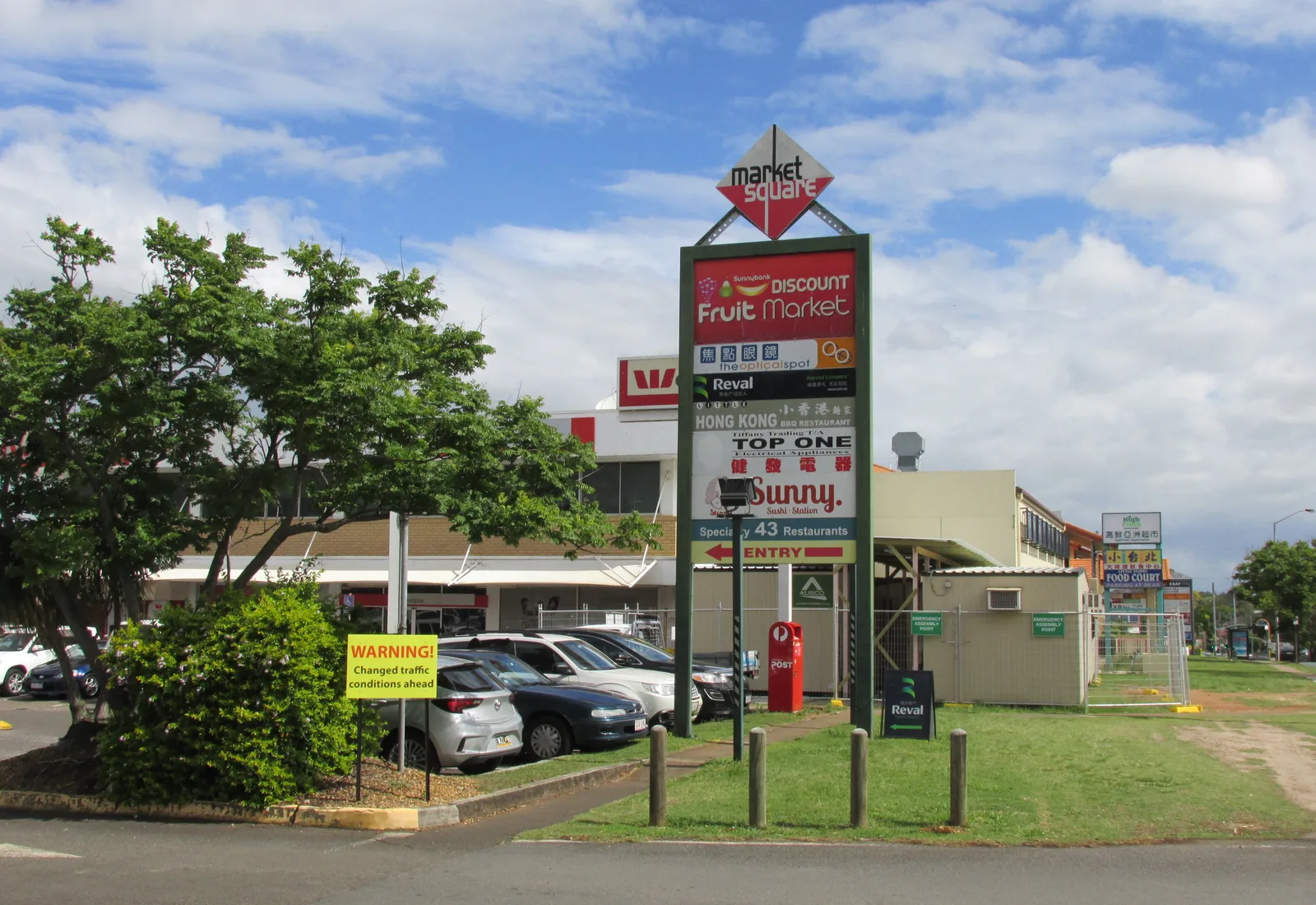
Sunnybank is a specialist food and retail market, especially around Mains Road, Sunnybank Plaza and Market Square. Operators should treat the area as a destination dining and grocery catchment with informed customers, not as a generic southside suburb. The lease test is category depth. Check whether your cuisine, signage, menu, delivery channel and service style are credible against existing Asian dining clusters. Parking, visibility from Mains Road, evening safety, tenancy size and kitchen extraction can matter as much as the headline address.
In Sunnybank, judge the frontage, rent, neighbours, access and customer path before the suburb reputation.
Sunnybank's numbers describe a dense, intensely East-Asian, value-conscious food precinct. With 35% Chinese ancestry, large mainland-China and Taiwanese-born communities, and Mandarin, Cantonese and Korean widely spoken, the food and retail demand is cuisine-specific and culturally deep. Incomes sit below the Greater Brisbane medians and large households point to families and shared student-and-worker households — a value-and-volume market built on frequency.
What the resident line understates is the destination pull. The Mains Road centres draw diners and shoppers from across Brisbane and the wider south-east, widening the addressable market well beyond the suburb, while a Beenleigh-line station adds a commuter pulse. The operator implication is an authentic, cuisine-specific, value-priced format in or near the precinct — built to bank both the local frequency and the city-wide destination trade.
Figure 1
The depth of Sunnybank's East-Asian market
Residents (total)8,892
Median age 35; large East-Asian community.
Chinese ancestry~3,113
35.0% of residents.
Mandarin spoken at home~2,370
26.7% — among Australia's highest concentrations.
Source: ABS Census 2021, Sunnybank (Qld) [1]. Counts derived by applying the published shares to the 8,892 resident population; figures are approximate. The Mains Road centres' city-wide destination trade adds further demand on top.
Sunnybank rewards authenticity and punishes shallow positioning
Sunnybank is a specialist food and retail market, especially around Mains Road, Sunnybank Plaza and Market Square. Operators should treat the area as a destination dining and grocery catchment with informed customers, not as a generic southside suburb.
The lease test is category depth. Check whether your cuisine, signage, menu, delivery channel and service style are credible against existing Asian dining clusters. Parking, visibility from Mains Road, evening safety, tenancy size and kitchen extraction can matter as much as the headline address.
The Asian food-and-grocery destination cluster — local plus city-wide visitor trade. Works for: authentic East/South-East-Asian eateries, dessert and bubble tea, grocery and bakery. Fails for: premium Western concepts or generic offers with no cultural read.
Station & residential edge
Sunnybank station and the dense, diverse residential streets. Works for: grab-and-go, bakery and cuisine-specific local eateries and grocers. Fails for: formats needing the destination footfall the Mains Road centres concentrate.
When Sunnybank trades
Peak and off-peak trading periods
Moderate
Weekday mornings
Check whether workers, residents, students or commuters pass the exact frontage.
Moderate
Lunch and school-pickup periods
Inspect queue patterns, parking pressure, crossings and competing food or service offers.
Moderate
Evenings and weekends
Confirm whether the area stays active or thins out once offices, schools or events finish.
Operator fit warning
Who should not open in Sunnybank
✕
Operators who need the suburb name to do most of the marketing work.
✕
Operators who have not inspected the tenancy during their actual trading windows.
✕
Operators signing before checking nearby vacancies, direct competitors, access constraints and lease obligations.
Best business formats for Sunnybank
Operators with a clear local use case
In Sunnybank, prove the nearby worker, resident, visitor, transport or appointment demand at the door.
Tenancies with proof at the door
Check anchors, customer paths, signage, access, loading, outgoings, incentives and make-good before negotiating.
Risks specific to Sunnybank
Suburb reputation replacing site evidence
A known Sunnybank address can still fail if the tenancy is hidden, costly, hard to access or poorly differentiated.
Lease terms that remove flexibility
Before signing, check permitted use, signage, fit-out approvals, trading limits, relocation clauses and nearby works.
Common mistakes
How operators get Sunnybank wrong
Inspecting at the wrong time
A site can look strong at lunch and weak when you need it most. Visit across the trading week before negotiating.
Ignoring the total occupancy cost
Base rent is only part of the decision. Outgoings, fit-out, approvals, signage and make-good can change the lease.
Underrated signals
Hidden advantages in Sunnybank
Practical fit can beat prestige
A less obvious tenancy with easier access, loading and repeat demand can beat a more prestigious address.
Rent viability bands for Sunnybank
Indicative monthly rent envelopes for typical commercial tenancies — what each band buys, where it works, where it does not.
Rent freshness: 2026 indicative benchmarksValidate against the exact lease before signing
Band
Range
What it buys
Works for
Fails for
Primary frontage
Verify against current lease evidence
Visibility, easier discovery and proximity to proven anchors.
Businesses with strong margins, proven demand and a reason to pay for exposure.
Operators relying on suburb name alone.
Secondary street
Benchmark against live listings
Lower fixed cost with more need for deliberate customer acquisition.
Destination, service, appointment, wellness, specialist retail and neighbourhood food uses.
Impulse-led models that need constant passing trade.
Destination or tucked-away site
Use only with a conservative buffer
Operational flexibility and potentially lower rent.
Businesses with repeat customers, bookings or an existing audience.
New concepts without a clear acquisition plan.
Decision framework
Sunnybank deserves deeper analysis when the exact tenancy has a customer source you can see and verify.
Compare current lease evidence, inspect real trading windows and model a cautious first year without invented numbers.
Data provenance & limitations. Sunnybank notes are based on public precinct context reviewed in July 2026 and qualitative local-commercial analysis. No new customer-volume, rent or revenue numbers were added.
How to read these scores
Composite 66/100; Café 70/100. Use this as a screening verdict before lease diligence.
Source
Locatalyze engine plus suburb-level evidence
Freshness
Engine scores current; no competitor cache for this suburb
Confidence
Medium - suburb-level scoring only
Limitation
Sunnybank scores screen the suburb, not the lease. The paid report tests frontage, rent, nearest competitors, and break-even at your exact address.
Evidence freshness
Scores
Engine-scored suburb model
Competition
No cached competitor snapshot — walk the block
Rent
No sourced asking-rent series — obtain current listings
Demographics
ABS Census 2021 baseline with operator interpretation
Mini location report — Sunnybank
Café opportunity snapshot
PROCEED band for café operators in Sunnybank.
Also scored: Restaurant 65 · Retail 60
Café opportunity score
70/100
Demand strength
8/10
Rent pressure
Moderate (5/10)
Competition density
6/10
Financial model — unlock at your address
Suburb-level estimates only. Your full report models P&L from your lease address, rent, and format.
🔒Est. monthly revenue range
Modelled at your address from rent, ticket and demand — not a suburb average
🔒Break-even customers per day
Calculated from your rent, staffing, and average ticket at your exact address
🔒Payback period on fit-out
Months to recover setup costs at base-case revenue
🔒Rent-to-revenue ratio
Whether the lease is sustainable at modelled trade levels
See if the numbers work at your rent
Run a free analysis at your Sunnybank address. Unlock modelled P&L, break-even, and scenarios from $29.
Demand, rent, competition, seasonality, and tourism — scored and weighted for Australian commercial operators.
8/10
Demand
5/10
Rent cost
6/10
Competition
2/10
Seasonality
3/10
Tourism dep
Business-Type Scores
How each format performs
Café / Specialty Coffee70
Full-Service Restaurant65
Independent Retail60
Scores use engine-derived weights: cafés weight demand and rent most heavily; restaurants factor tourism; retail factors tourism and demand equally.
Analyst Notes — Sunnybank
What the data says about this location
1
Demand 8/10: Brisbane's premier Asian food-and-grocery destination — Sunnybank Plaza, Market Square and Sunny Park anchor a city-wide draw for Taiwanese, Chinese, Korean and Vietnamese dining, layered over a dense local base of 8,892 (35% Chinese ancestry; 26.7% speak Mandarin at home; 60%-plus born overseas or to overseas-born parents).
2
Competition 6/10: a dense, cuisine-specific food market — competitive within categories, but the destination pull supports many authentic operators.
3
Seasonality 2/10: an everyday multicultural food-and-retail centre with a year-round local base — no tourism or university swing to hollow it out.
4
Rent 5/10: moderate town-centre rents for a value-and-volume market (median personal income $627/week) — a cost base that suits high-frequency, cuisine-specific trade.
Local insight — Sunnybank
On-the-ground read for operators
Editorial notes layered on top of the scored model — same scores and benchmarks above; this section translates strip mechanics into decisions.
Local reality check
Demand 8/10: Brisbane's premier Asian food-and-grocery destination — Sunnybank Plaza, Market Square and Sunny Park anchor a city-wide draw for Taiwanese, Chinese, Korean and Vietnamese dining, layered over a dense local base of 8,892 (35% Chinese ancestry; 26.7% speak Mandarin at home; 60%-plus born overseas or to overseas-born parents).
Competition 6/10: a dense, cuisine-specific food market — competitive within categories, but the destination pull supports many authentic operators.
Seasonality 2/10: an everyday multicultural food-and-retail centre with a year-round local base — no tourism or university swing to hollow it out.
Competition is moderate — you are buying into share-of-wallet, not automatic overflow.
Micro-location breakdown
Sunnybank main strip / highest visibility
What tends to work: High-throughput food, proven hospitality formats, and retail with clear window narrative.
What struggles: Formats needing highway visibility or large-format parking ratios.
Rent vs foot traffic: Prime band often near $4,503–$5,483/mo — Rent pressure 5/10 — treat agent ranges as opening positions; model $/sqm and outgoings before emotional commitment.
Secondary street / side pocket
What tends to work: Operators who accept lower passer-by counts but fund discovery through product, hours, or events.
What struggles: Walk-in-only models with no marketing budget or brand recognition.
Rent vs foot traffic: Secondary band often near $3,768–$4,503/mo — savings must fund signage and fit-out amortisation, not disappear into rent alone.
Budget / upstairs / off-strip
What tends to work: Studios, appointment services, niche retail with owned traffic.
What struggles: Full-service dining depending on spontaneous footfall without a booking channel.
Rent vs foot traffic: Lower band near $2,449–$3,768/mo — viable only when customers arrive by intent, not accident.
Real business scenarios
If prime rent clears near $4,503–$5,483/mo, model daily covers at your real average ticket — the engine verdict is VERIFY at 66/100, not a guarantee at your address.
Tourism dependency 3/10: when elevated, January and shoulder weeks need explicit planning, not December extrapolation.
Run competitors within 500m before offer — Competition is moderate — you are buying into share-of-wallet, not automatic overflow.
Competitive reality
Sunnybank (VERIFY, 66/100) is a modelled read across demand, rent, competition, and seasonality — validate on-site at quiet and peak dayparts, then reconcile with your accountant before lease execution.
Sharp verdict
Sunnybank pays off when rent sits inside $4,503–$5,483/mo at conservative revenue — do not sign on suburb hype; sign on covers you can defend on a Tuesday.
Methodology: Scores are engine-derived from five observable inputs (demand strength, rent pressure, competition density, seasonality risk, tourism dependency — each 1–10). These feed into business-type-specific weighted composites via a single scoring engine used across all markets. Scores are relative estimates calibrated across all Brisbane suburbs — a score of 80 indicates materially better conditions than 65; it is not a success probability or guarantee.
More questions about opening in Sunnybank
Have a specific address in Sunnybank?
Run a full competitor map, rent benchmark, and location score, data confidence, and proceed / verify / avoid screening recommendation for any Sunnybank address. Free.