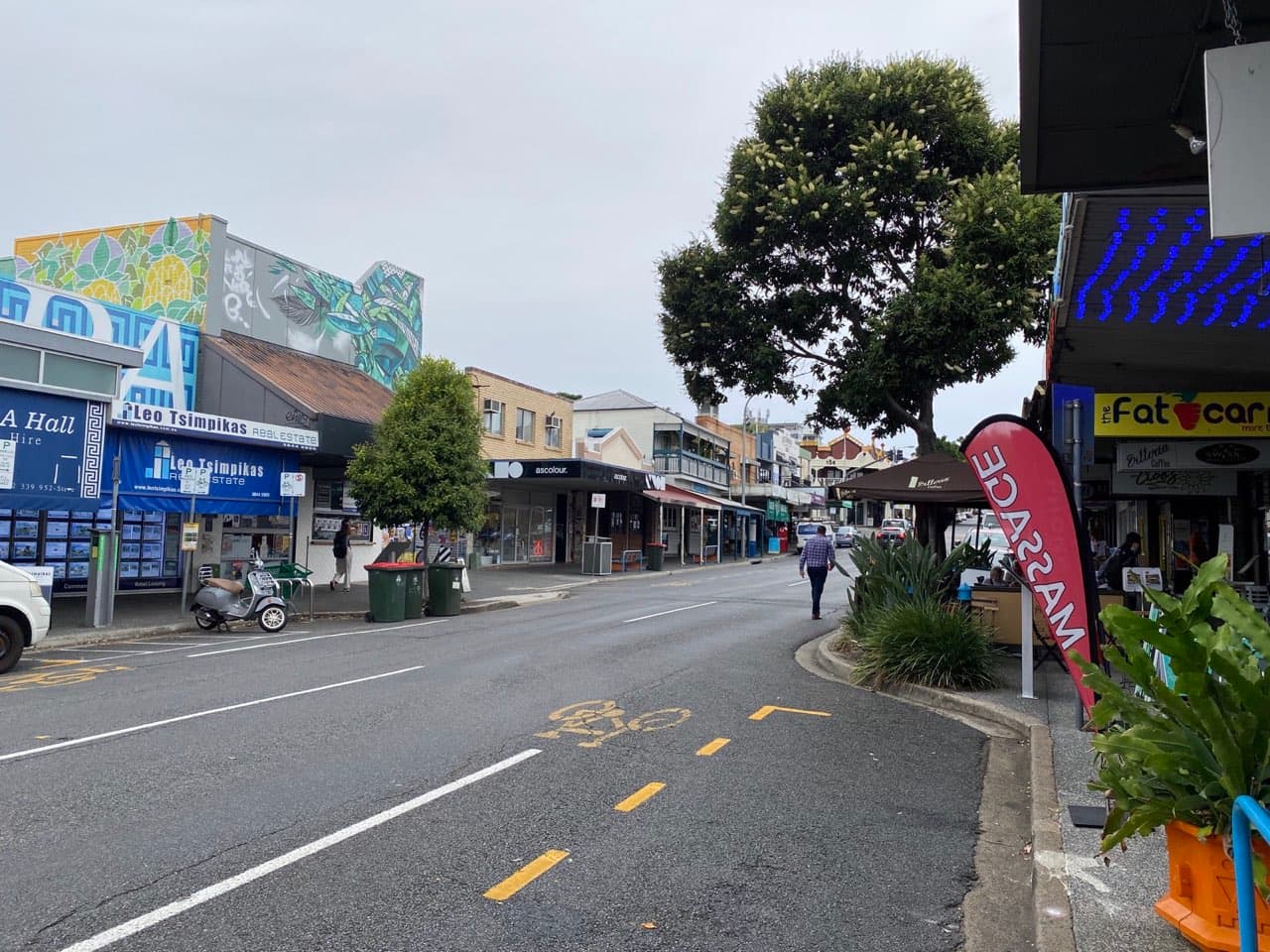
Competitive analysis
West End in 2026 is roughly where Newtown Sydney was around 2014 — past the early gentrification phase but pre-saturation, with rents climbing meaningfully against a supply side that has not fully caught up. The comparison gives a useful frame for the strip's trajectory and breaks down in three specific places that matter for an operator deciding whether to enter now.
West End's commercial arc since 2010 is one of the most legible gentrification stories in Australian urban commercial geography — a working-class-and-creative inner-south precinct, heritage building stock, accelerating residential conversion of warehouse and industrial space, professional in-migration alongside the continuing creative-class core, and a hospitality and specialty retail layer thickening year by year. The Boundary Street and Vulture Street spines have been the visible expression of that arc.
The Newtown comparison is useful for understanding the trajectory and for anticipating what the next five years may demand. It is also incomplete in three structural ways that change the operating reality even within a recognisable gentrification frame. What follows is the comparison, the divergences, and the implications for an operator entering the strip in 2026.
Where West End resembles Newtown 2014
The structural similarities are real. Both precincts have heritage commercial stock in walkable concentration. Both have absorbed a meaningful wave of professional in-migration while retaining a creative-class identity that the broader gentrification has not erased. Both have rents climbing at a measured but persistent pace — West End commercial rents have moved roughly 40–60% over the past five years for prime Boundary Street frontage. Both have customer mixes that combine the long-tenure resident base with a thickening visitor-led layer.
The trajectory expectations applied to West End are typically derived from the Newtown arc and similar precincts. The forecast that today's $5,000-per-month tenancies will be $8,500–$10,000 within five years, that today's mid-tier operator base will be the established names of a thick commercial layer by 2030, and that the strip's hospitality density will roughly double — these are all defensible forecasts based on comparable cycles.
The opportunity rhetoric around West End is largely accurate. Current entry rents are favourable relative to projected trajectory; the operator base is still thin enough that differentiated concepts find unclaimed positions; and the customer base supports new entrants in a way that more saturated strips do not. Early operators are positioning into a multi-year window of asymmetric upside.
Divergence one: the catchment density and metropolitan scale
Newtown sits inside Sydney with a metropolitan catchment of millions, established transport drawing customers from across the inner-west, and a culturally-specific customer base that has defaulted to inner-west precincts for decades. West End sits inside Brisbane with a metropolitan catchment one-quarter the size, weaker transport connectivity to the rest of the metro, and a culturally-specific customer base that is real but smaller.
Operationally this means: an operator opening in West End cannot model against the catchment density that made similar Newtown operators viable at the equivalent gentrification stage. The local resident base and Brisbane-wide deliberate-visitor catchment are real and growing; the metropolitan-wide pull-in trade that supported Newtown's density is structurally lower. Build the model around the local-and-deliberate-visitor catchment and treat broader metro pull-in as supplementary rather than baseline.
Divergence two: the institutional anchor pattern
Newtown's gentrification was anchored by Sydney University producing predictable student-and-young-professional consumption patterns. West End has institutional adjacencies — Queensland University of Technology's Gardens Point and Kelvin Grove campuses are within distance, Griffith South Bank is adjacent, the South Bank cultural precinct produces visitor flow — but no single institutional anchor producing the steady consumption flow that Sydney University produced for Newtown.
The implication is that the customer flow in West End is more deliberate-acquisition and less institutional-default. Operators must invest in customer acquisition more than at strips with institutional anchors. Marketing investment, online presence, deliberate destination identity all matter more in West End than they do in similar precincts elsewhere with university adjacency.
Divergence three: the river-precinct adjacency
West End has something Newtown did not — direct adjacency to a major tourist-and-leisure precinct (South Bank, the river, the cultural precinct) that produces a continuous secondary visitor flow. This is genuinely an advantage. West End operators can capture spillover from South Bank visitors looking for something less heavily touristed, from cultural-precinct attendees seeking dinner before or after events, and from general weekend explorers who use South Bank as a starting point.
This advantage is real but partial. The South Bank spillover is concentrated in weekends and event-days, weighted toward early-evening windows, and is mostly captured by venues on the Boundary Street eastern end closer to the river. Venues on Vulture Street or the southern end of Boundary capture less of this flow. The advantage is geographic rather than uniform across the precinct.
Where the competitive advantage sits in 2026
The West End trajectory is genuine and the asymmetric-upside opportunity is real. Rents are likely to climb materially over the next five to seven years if the trajectory of the past five years extends, and operators entering now are buying into an envelope that is unlikely to be available at comparable rent within a few years. The Newtown comparison is useful for understanding this trajectory.
The model must, however, be calibrated against the three divergences. The catchment is real but smaller than Newtown's. Customer acquisition requires deliberate effort rather than institutional default. The South Bank adjacency is an advantage but is geographically uneven. Operators who calibrate against these three realities build durable positions in a maturing precinct; operators who apply the Newtown template without adjustment routinely under-perform the trajectory's promise.
The opportunity is most viable for operators with strong concept clarity, willingness to invest in customer acquisition through marketing and online channels, and capacity to model unit economics against the current catchment rather than the projected one. The strip is genuinely interesting in 2026; it requires specific execution to capture the interest it produces.
Operator Intelligence
10 dimensions — what matters most here
Scored 1–10 from an operator perspective: higher always means better. Each dimension includes the reasoning behind the score.
Foot Traffic VolumeCritical
Boundary Street and Hardgrave Road generate consistent pedestrian flow from the diverse resident base — the weekly Saturday morning market creates a footfall spike that anchors the week's commercial activity.
7/10
Hospitality & Food DemandCritical
West End has built a genuine independent hospitality culture with depth across breakfast, lunch, and evening trade — the customer base actively seeks quality independents and supports new entrants who earn it.
8/10
Retail ViabilityImportant
Specialty and independent retail has a loyal customer base in West End; the demographic actively prefers local independents over chains, creating genuine retail viability for well-positioned operators.
6/10
Demographic Spend CapacityImportant
West End's demographic is a mix of long-term renters, young professionals, students, and new apartment residents — mid-tier spend capacity with strong quality orientation but not the premium-ticket customer of New Farm.
7/10
Repeat Custom PotentialImportant
Community loyalty is strong for operators who invest in the West End identity — the local-first culture produces habitual repeat from the resident base once established.
7/10
Entry EaseCritical
West End's independent operator culture means the competitive landscape is active but not dominated by established chains — new quality entrants find a market that evaluates on merit rather than incumbent loyalty alone.
5/10
Rent SustainabilityCritical
Rents are rising on the Newtown comparison trajectory but have not yet peaked — 2026 entry is on the correct side of the repricing curve, but the window is narrowing as the gentrification arc progresses.
6/10
Accessibility & Footfall DriversImportant
West End Marketplace Saturday market, Davies Park Saturday market, bus connections, and the Riverside Drive cycling path create multiple weekly footfall drivers across different customer segments.
8/10
Tourism & Visitor OverlaySupporting
Tourism is minimal — West End's identity is residential and cultural rather than tourist-facing. Cross-suburb visitors come via reputation, not tourism infrastructure.
3/10
Growth TrajectorySupporting
West End is on the correct side of the gentrification curve — past early phase but pre-saturation, with the demographic shift continuing to add quality-oriented residents and the operator base not yet fully formed.
7/10
When West End trades
Peak and off-peak trading periods
StrongSaturday 6am–1pm
Davies Park Saturday Market is West End's commercial anchor — the week's most concentrated foot traffic, with operators within radius seeing their highest-volume Saturday morning.
ModerateWeekday 7am–10am
Morning coffee and breakfast from the resident and student base is a reliable daily opener — moderate volume but consistent Monday–Friday.
StrongFriday evening
Friday evening is West End's strongest evening window — the community pub, bar, and restaurant culture activates on Friday with above-average covers and spend.
ModerateWeekday 12pm–2pm
Student, work-from-home, and local office lunch creates a moderate weekday midday window that sustains quality lunch formats.
ModerateSunday afternoon
Sunday leisurely brunch and afternoon activity extends the weekend trading calendar for operators with outdoor seating or a relaxed-stay offer.
Operator fit warning
Who should not open in West End
- ✕
Premium-tier pricing operators who have not calibrated to the West End demographic — the community is quality-oriented but price-aware; CBD premium pricing reads as extractive rather than quality.
- ✕
Chain-format and franchise operators — the West End community actively avoids chains and the neighbourhood actively promotes independents; a branded format is competing against the suburb's cultural disposition.
- ✕
Operators who open without engaging the community identity — West End is a community-first suburb; operators who treat it as a commercial location rather than a neighbourhood find a cooler reception than the hospitality culture suggests.
- ✕
High-fixed-cost formats that need 200+ covers to break even — West End's foot traffic is strong but not CBD-density; formats requiring very high volume are mismatched to the available pedestrian count.
Best business formats for West End
Differentiated cuisine restaurant on Boundary Street eastern end
A 55–80 seat restaurant with clear cuisine identity, positioned on the Boundary Street eastern end with capacity to capture both local and South Bank spillover flow. Format works at $7,500–$10,500 rent with proper beverage program and disciplined operations.
Specialty café with strong food and online presence
A specialty café with disciplined craft expression and strong digital marketing serving the West End local-and-deliberate-visitor customer. Format works at $5,500–$7,500 rent on Boundary Street or Vulture Street prime positions.
Wine bar or licensed small-plates venue
A licensed evening venue with proper beverage program targeting the local-resident and South Bank spillover after-work and after-event customer. Format works at $7,000–$9,500 rent with beverage contribution at 38–48% of revenue.
Specialty grocer or prepared-food retail for resident base
A specialty grocer or prepared-food retailer serving the West End apartment-resident base and broader Brisbane Asian-Australian and culturally-diverse community. Format is structurally under-supplied relative to the customer base and works at $5,500–$7,000 rent.
Boutique fitness and wellness with member-acquisition
Premium pilates, yoga, or specialist fitness studio with member-acquisition discipline serving the West End professional-resident demographic is the format that consistently clears margin in a precinct otherwise dominated by hospitality. The West End resident cohort combines creative-industry professionals, the renovating-and-extending owner-occupier base on the Vulture and Boundary cross-streets, and the apartment-resident professionals on the Montague Road frontage, and that mix supports a member-based studio with a defined identity and a consistent coaching standard. Format insulates against the hospitality competition that defines the main strip because member-based fitness does not compete for the same foot traffic and does not depend on the same daypart economics. Works at $4,500 to $6,500 per month rent on side-street or back-block positions away from the Boundary Street and Montague Road frontages, clears margin at 130 to 200 members at a 220 to 340 dollar monthly rate, and grows through resident word-of-mouth and the local school-and-creative network rather than paid acquisition.
Creative-industry-adjacent specialty retail
Specialty retail aligned with the precinct's creative identity — bookshop, vinyl, design-led homewares, specialist art supplies, plant retail. Format works at $5,000–$7,000 rent with destination-led customer base supplemented by deliberate visitor flow.
Risks specific to West End
Newtown-template miscalibration
The dominant West End failure pattern. Operators import the Newtown operating template without adjusting for the catchment-density, institutional-anchor, and geographic-spillover divergences. The model runs out of customer flow at predictable points the template did not anticipate.
Customer-acquisition under-investment
West End lacks the institutional anchor that produces baseline customer flow on similar gentrification-arc precincts elsewhere. Customer acquisition requires deliberate marketing investment; operators allocating customer-acquisition budget at the rate they would on a more passive precinct find acquisition costs higher than budgeted.
Generic-format entry against thickening competition
The strip's operator base is still thinner than it will be in five years, but the established operators have meaningful customer relationships and the customer base is no longer undersupplied for established categories (café, casual dining, brunch). Generic entrants face longer customer-base build than the strip's reputation suggests.
Common mistakes
How operators get West End wrong
Applying the Newtown playbook too literally
West End resembles Newtown Sydney circa 2014 in trajectory, but the comparison has limits. West End's student population is less concentrated than Newtown's, the ethnic food diversity is different, and the proximity to the Brisbane CBD creates a professional-resident layer that Newtown does not have at the same proportion. Operators who copy the Newtown model without West End-specific calibration find the specifics matter.
Ignoring the student rent ceiling
Griffith University and Southbank TAFE create a student population whose price sensitivity is structural. Operators who price to the apartment-resident demographic find a mixed-response when the café or restaurant is physically located in the student catchment zone. Site selection within West End matters for who actually walks past.
Missing the community-announcement opportunity
West End has one of Brisbane's most active local community media ecosystems — Facebook groups, local newsletters, independent food blogs. Operators who open without a pre-opening community announcement miss the fastest discovery channel available. The community is actively seeking to support new operators; not being findable in those channels is an avoidable error.
Underestimating the weekend market competition for attention
Davies Park Saturday Market is a major community event that draws thousands of attendees — but it also competes with commercial operators for the same Saturday-morning budget. Operators who are too far from the market zone find the Saturday crowd does not extend to their position; operators directly adjacent find the market-day customer is already spent.
Underrated signals
Hidden advantages in West End
The community endorsement network is faster than any marketing
A quality West End operator who genuinely engages with the community finds a word-of-mouth acceleration that is faster and cheaper than any paid channel. The West End community has established channels (Facebook groups, local newsletters, the Saturday market network) and they actively use them to promote businesses they like.
Ethnic food culture creates a category-breadth advantage
West End's diverse residential base creates genuine demand for ethnic cuisines, specialty groceries, and international food formats that the surrounding suburbs cannot match. Operators in Vietnamese, Sri Lankan, South American, and Middle Eastern food categories find a customer base who knows good versions of those cuisines and will travel to find them.
The pre-saturation window is a real early-mover opportunity
In 2026, West End is still in the phase where the quality operator who establishes first in a category can own that category before the rents price out the next wave of entrants. This window closes — Newtown circa 2014 shows the trajectory — and operators who enter in 2026–2027 are still ahead of the peak entry-cost phase.
Rent viability bands for West End
Indicative monthly rent envelopes for typical retail tenancies — what each band buys, where it works, where it does not. Treat these as starting points for negotiation, not as locked quotes.
| Band | Range | What it buys | Works for | Fails for |
|---|
| Boundary Street prime — eastern end | $8,000–$11,500/month | Strongest local-plus-spillover foot traffic with South Bank adjacency advantage | Differentiated restaurant, premium café with food program, wine bar | Operators expecting Newtown-density customer flow at the Newtown-equivalent rent |
| Boundary Street and Vulture Street core | $5,500–$8,500/month | Strip identity at favourable rent relative to projected trajectory | Specialty café, casual dining, specialty grocer, creative-industry retail | Generic versions of existing strip categories without differentiation |
| Side streets and residential-adjacent commercial | $4,000–$6,000/month | Lower rent with reduced visibility, suited to destination-led operations | Boutique fitness, allied health, appointment services, specialty retail | Walk-in formats dependent on strip-front foot traffic |
| Industrial-conversion warehouse format | $5,500–$8,500/month | Larger floor area in heritage industrial stock with creative character | Brewery, roastery, large restaurant, creative studio with public component | Small-footprint formats overscaled for the rent envelope |
Suburb comparison
West End vs nearby alternatives
Better for: established indie community culture with growth still ahead Woolloongabba has been positioned as "Brisbane's next West End" for years but has not completed the gentrification transition at the same pace. West End has a more established independent culture and stronger Saturday market anchor. For operators who need the existing community culture now, West End is preferable. For operators who want to front-run the trajectory at lower rent, Woolloongabba is the argument.
Prefer West End for: existing community culture; Red Hill for: earlier curve at lower cost Red Hill shares the Marrickville/West End trajectory comparison but is at an earlier stage with lower rents. Both are quality residential inner suburbs in pre-saturation phases. West End has more established hospitality culture and stronger foot traffic; Red Hill has lower entry costs. The choice depends on whether the operator can sustain a slower build period.
Decision framework
West End in 2026 is genuinely a gentrification-trajectory opportunity at a favourable rent envelope. The Newtown frame is useful for understanding the trajectory and for calibrating five-year expectations. The trajectory is real; the asymmetric upside is real.
The model must be built against the current catchment, current customer-acquisition dynamics, and the South Bank adjacency as it actually expresses itself geographically — not against a Newtown-equivalent assumption that those variables will arrive at scale. Operators who calibrate against current conditions succeed durably; operators who priced against the projected catchment routinely exhaust working capital before the trajectory delivers.
Related Brisbane reading
How Locatalyze helps
West End's suburb-level scoring tells you the strip is in a favourable trajectory and the rent envelope is moderate. It does not tell you which side of Boundary Street has the South Bank spillover that matches your concept, what the deliberate-visitor flow at your specific address looks like across the week, or whether the competing operator three blocks away has already established the destination identity for your segment. Locatalyze runs the address-level analysis surfacing those specifics: observed foot-traffic patterns by daypart and event-day, competitor mapping at walking radius, rent benchmarks for the specific block, and a format-fit reading against the catchment your address actually serves. For comparison reading on Brisbane's trajectory-strips, see also South Brisbane, Spring Hill, and the developing inner-west analyses.
Analyse a West End address →