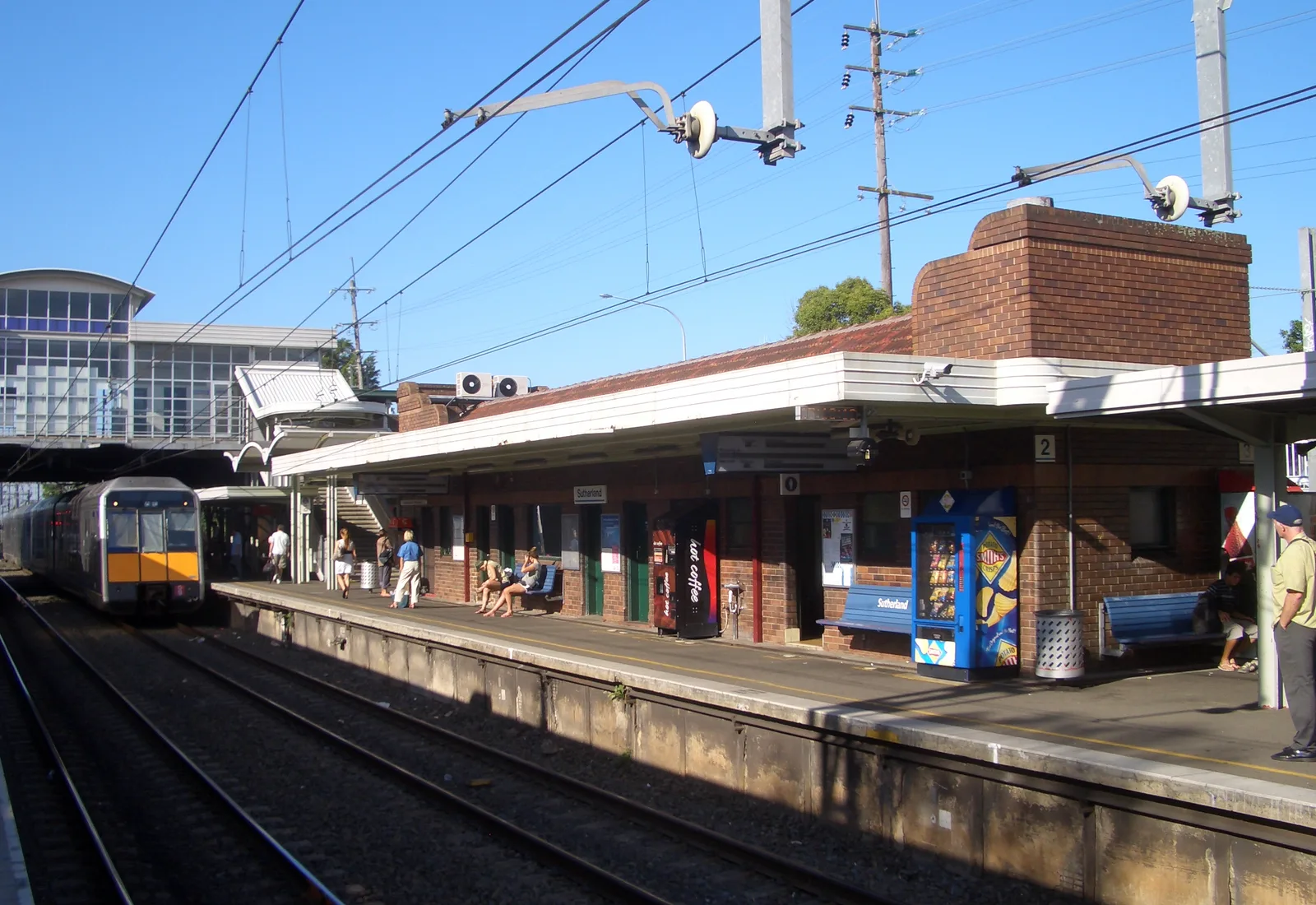
Demand 7/10: the administrative and transport gateway to the Sutherland Shire — a major station interchange where the Cronulla branch leaves the main South Coast line, the Shire council civic centre, and Sutherland Hospital nearby — anchoring a settled, comfortable catchment of 11,570 residents.
VERIFYBest fit: Café (68/100)
Location score
63
out of 100
Recommendation
VERIFY
Potentially viable — important checks remain
BEST FIT
68
Café
6.8/10 category
62
Restaurant
57
Retail
Businesses analysed2
Cache updated27 June 2026
Enginev7.3.0
Low confidence
2 businesses sampled near Sutherland centre (updated within the last 4 months); suburb scores use Locatalyze engine v7.3.0. Suburb-centre snapshots for Sutherland — validate at your lease address before signing.
Demand, rent, competition, seasonality, and tourism — scored and weighted for Australian commercial operators.
7/10
Demand
5/10
Rent cost
5/10
Competition
2/10
Seasonality
2/10
Tourism dep
Business-Type Scores
How each format performs
Café / Specialty Coffee68
Full-Service Restaurant62
Independent Retail57
Scores use engine-derived weights: cafés weight demand and rent most heavily; restaurants factor tourism; retail factors tourism and demand equally.
Analyst Notes — Sutherland
What the data says about this location
1
Demand 7/10: the administrative and transport gateway to the Sutherland Shire — a major station interchange where the Cronulla branch leaves the main South Coast line, the Shire council civic centre, and Sutherland Hospital nearby — anchoring a settled, comfortable catchment of 11,570 residents.
2
Competition 5/10: an everyday town-centre strip serving commuters and residents, moderate and category-segmented rather than saturated.
3
Seasonality 2/10: a commuter-interchange and civic-and-hospital town centre trades steadily year-round, with no beach-tourism swing despite its Shire setting.
4
Rent 5/10: moderate town-centre rents for a comfortable, predominantly Anglo-Australian family market (median household income $1,949/week; 55% of dwellings owner-occupied) — steady value-and-volume trade rather than premium spend.
Local insight — Sutherland
On-the-ground read for operators
Editorial notes layered on top of the scored model — same scores and benchmarks above; this section translates strip mechanics into decisions.
Local reality check
Demand 7/10: the administrative and transport gateway to the Sutherland Shire — a major station interchange where the Cronulla branch leaves the main South Coast line, the Shire council civic centre, and Sutherland Hospital nearby — anchoring a settled, comfortable catchment of 11,570 residents.
Competition 5/10: an everyday town-centre strip serving commuters and residents, moderate and category-segmented rather than saturated.
Seasonality 2/10: a commuter-interchange and civic-and-hospital town centre trades steadily year-round, with no beach-tourism swing despite its Shire setting.
Competition is moderate — you are buying into share-of-wallet, not automatic overflow.
Micro-location breakdown
Sutherland main strip / highest visibility
What tends to work: Service-led and neighbourhood concepts with repeat local trade.
What struggles: Formats needing highway visibility or large-format parking ratios.
Rent vs foot traffic: Prime band often near $4,903–$5,883/mo — Rent pressure 5/10 — treat agent ranges as opening positions; model $/sqm and outgoings before emotional commitment.
Secondary street / side pocket
What tends to work: Operators who accept lower passer-by counts but fund discovery through product, hours, or events.
What struggles: Walk-in-only models with no marketing budget or brand recognition.
Rent vs foot traffic: Secondary band often near $4,168–$4,903/mo — savings must fund signage and fit-out amortisation, not disappear into rent alone.
Budget / upstairs / off-strip
What tends to work: Studios, appointment services, niche retail with owned traffic.
What struggles: Full-service dining depending on spontaneous footfall without a booking channel.
Rent vs foot traffic: Lower band near $2,709–$4,168/mo — viable only when customers arrive by intent, not accident.
Real business scenarios
If prime rent clears near $4,903–$5,883/mo, model daily covers at your real average ticket — the engine verdict is VERIFY at 63/100, not a guarantee at your address.
Tourism dependency 2/10: when elevated, January and shoulder weeks need explicit planning, not December extrapolation.
Run competitors within 500m before offer — Competition is moderate — you are buying into share-of-wallet, not automatic overflow.
Competitive reality
Sutherland (VERIFY, 63/100) is a modelled read across demand, rent, competition, and seasonality — validate on-site at quiet and peak dayparts, then reconcile with your accountant before lease execution.
Sharp verdict
Sutherland pays off when rent sits inside $4,903–$5,883/mo at conservative revenue — do not sign on suburb hype; sign on covers you can defend on a Tuesday.
Operator's briefing
Sutherland is the gateway to the Sutherland Shire — the point where the Cronulla branch leaves the main line, the home of the Shire council's civic centre, and a settled, comfortable town centre of 11,570 residents. The rail interchange and civic role give it a steady commuter-and-resident catchment that trades year-round, with seasonality a low 2/10 despite the Shire's beachside reputation. The composite lands at 63/100 with a VERIFY verdict, café the best fit at 68/100. This briefing sets out the catchment and the format that fits.
Sutherland's strength is its role as a hub rather than a destination. It is the Shire's principal rail interchange — where the line to Cronulla branches from the Eastern Suburbs & Illawarra line — so a large commuter flow passes through every weekday morning and evening. It is also the Shire's civic centre, home to Sutherland Shire Council, adding a weekday office workforce, and the everyday town centre for a comfortable residential catchment. The Sutherland Hospital sits a short distance south in neighbouring Caringbah, drawing some of the wider precinct's health trade there rather than to Sutherland itself.
The residents are settled and comfortable rather than affluent: a median age of 37, a median household income of $1,949 a week, and a predominantly Anglo-Australian community (English 34.6%, Australian 33.9%, with Irish and Scottish populations), 28.9% born overseas. Tenure is mixed — 42.4% renting, the rest owner-occupied — and 61.4% are family households. The food and service demand is the everyday trade of a commuter town centre: the morning coffee, the weekday lunch, the local the regulars return to. Read this briefing, then position on the station-and-town-centre desire-lines where that steady flow moves.
Sutherland's numbers describe a settled, comfortable, predominantly Anglo-Australian community rather than an affluent or strongly multicultural one. Incomes sit close to the Greater Sydney medians, the base is family-oriented (61.4% family households) and 28.9% born overseas — mainstream suburban Sydney. The food and retail demand is everyday and value-and-quality driven, not cuisine-specific or premium.
What the resident line understates is the hub role. As the Shire's principal rail interchange and the home of the council civic centre, Sutherland carries a year-round commuter flow and a weekday office base that lift its daytime catchment above its resident numbers. The operator implication is a reliable, fair-value café or eatery on the station-to-town-centre line, priced for a comfortable market and built on steady, season-proof turnover.
Figure 1
Sutherland's settled, family-oriented base
Family households61.4%
A family-majority town centre.
English + Australian ancestry68.5%
A predominantly Anglo-Australian base.
Born overseas28.9%
Below the Sydney average — limited cuisine-specific depth.
Source: ABS Census 2021 — Sutherland (NSW) [1]. The family-household and ancestry shares describe a comfortable, loyal Anglo-Australian market; the rail interchange and Shire civic centre add a year-round weekday catchment on top.
The interchange is the engine — a year-round commuter flow
Sutherland's defining feature is its station. As the Shire's principal interchange — the junction where the Cronulla branch leaves the Eastern Suburbs & Illawarra line — it carries a large, predictable commuter flow every weekday, with passengers changing trains, starting journeys and arriving home. That flow is the foundation of the town-centre trade: a constant morning-and-evening pulse of time-poor commuters who want a fast coffee, a grab-and-go breakfast or a quick dinner solution on the way through.
For an operator, the interchange delivers exactly what a café or quick-service format needs — frequency and predictability. The commuter peaks are reliable, the volume is real, and the trade is year-round: unlike the Shire's beachside suburbs, a commuter-and-civic town centre does not empty out in winter. That is why Sutherland's seasonality reads a low 2/10. The customer is routine-driven rather than leisurely, so the winning format is fast, reliable and positioned squarely on the station-to-town-centre walking line.
A civic centre adds a weekday office base
Layered on the commuter flow is Sutherland's civic role. As the home of the Sutherland Shire Council civic centre, the town carries a weekday office workforce — council staff and the visitors, contractors and services that cluster around a major local-government centre. That base deepens the weekday daytime trade, particularly the lunch window, giving the town centre a working rhythm on top of its commuter pulse.
The operator implication is that Sutherland's weekday daytime market is stronger than its resident numbers alone suggest. A lunch-and-coffee format positioned for the council workforce and the passing commuters banks a genuine weekday catchment. The evening and weekend trade leans more on the residential base — steadier and family-oriented, but without the office-and-commuter intensity of the weekday. A format that reads both rhythms, and prices for a comfortable rather than premium market, fits the town centre well.
The catchment is comfortable, settled and Anglo-Australian
Sutherland's residents define the price point and the character. The 2021 Census records 11,570 residents with a median weekly household income of $1,949 — close to the Greater Sydney $2,077 — and a personal income of $1,109, above the metropolitan $881. They are a settled, predominantly Anglo-Australian community (English 34.6%, Australian 33.9%, Irish 11.8%, Scottish 8.8%), with only 28.9% born overseas and 61.4% family households. This is comfortable, mainstream suburban Sydney, not an affluent enclave or a strongly multicultural food market.
The operator implication is a steady value-and-quality market rather than a premium or cuisine-specific one. The catchment supports a well-run café, a family-friendly eatery or a quality everyday food offer, but the cultural-cuisine depth of an inner-city suburb is not the play here. The community is loyal and routine-driven — it returns to the places it trusts — so an operator who delivers a reliable, fair-value offer on the commuter-and-town-centre line can build durable repeat trade.
Rent and the economics of a town-centre hub
Sutherland's rent reads 5/10 — moderate town-centre rents, well below the affluent harbourside and inner-ring villages, which suits a steady value-and-volume model. That cost base is workable because the interchange and civic centre supply reliable weekday footfall, and the residential base holds the evenings and weekends. There is room for a fair-value format to make margin on consistent turnover rather than premium spend.
The discipline is to match the format and the cost to a comfortable market. A well-run café or family eatery sized for commuter-and-civic volume can do well at Sutherland's rent; a premium, destination-priced concept overestimates a mainstream suburban catchment. Model the rent on town-centre comps and the break-even on steady year-round turnover — the flow is reliable, but the ticket is comfortable rather than high, so volume and consistency carry the economics.
The format that fits, in plain terms
The strongest fit is a fast, reliable café or quick-service food business on the station-to-town-centre line (café 68/100) — built for the year-round commuter flow and the council workforce, priced for a comfortable market and run for consistency and repeat trade. A family-friendly casual eatery serving the residential base fits the same catchment (restaurant 62/100). Everyday convenience retail and services — pharmacy, allied health, the trades a town centre supplies — benefit from the steady commuter-and-resident footfall.
What does not fit: a premium, destination-priced concept that overestimates a comfortable suburban market; a cuisine-specific format relying on a multicultural depth this predominantly Anglo-Australian catchment does not have; or a position off the station-and-town-centre desire-lines, away from where the commuter flow moves. Sutherland is a steady, year-round, value-and-quality town-centre market for an operator who serves the commuter, the council worker and the loyal local well — one of the Shire's most reliable everyday catchments for the right-priced format.
Zone-by-zone breakdown
Station interchange
Sutherland station and the walk to the town centre — the year-round Shire commuter pulse. Works for: fast coffee and grab-and-go banking the morning and evening peaks. Fails for: leisurely formats needing dwell time the commuter lacks.
Town centre & civic precinct
The main shopping strip and the Shire council civic centre — the weekday workforce and everyday resident trade. Works for: lunch-and-coffee formats, family eateries and convenience retail. Fails for: premium concepts overestimating a comfortable market.
Residential edge
The streets beyond the centre serving the settled family base. Works for: neighbourhood eateries and resident-serving services. Fails for: formats needing commuter-and-civic volume the centre concentrates.
Operator Intelligence
10 dimensions — what matters most here
Scored 1–10 from an operator perspective: higher always means better. Each dimension includes the reasoning behind the score.
Year-round commuter demandCritical
The Shire's principal rail interchange (Cronulla branch junction) carries a reliable, year-round weekday commuter flow.
8/10
Demand spend (ticket size)Critical
Comfortable, mainstream suburban incomes (household $1,949/week) — a steady value-and-quality market, not a premium one.
5/10
Civic / weekday workforceImportant
The Sutherland Shire Council civic centre adds a weekday office base, deepening the lunch window.
6/10
Trading stabilityImportant
A commuter-and-civic town centre trades steadily year-round, with none of the beach-tourism swing of the Shire (seasonality 2/10).
8/10
Cultural-market depthSupporting
A predominantly Anglo-Australian base (28.9% born overseas) lacks the cuisine-specific market of an inner-city area.
3/10
When Sutherland trades
Peak and off-peak trading periods
Strong
Weekday morning & commute (06:30–09:30)
The interchange commuter pulse on the station-to-centre line — the daily coffee peak.
Strong
Weekday lunch (11:30–14:00)
The Shire council workforce plus town-centre trade.
Moderate
Weekday evening commute (16:30–18:30)
Commuters arriving home — grab-and-go and dinner-solution trade.
Moderate
Weekends
The settled family base holds steady residential trade through the year.
Operator fit warning
Who should not open in Sutherland
✕
Premium, destination-priced concepts that overestimate a comfortable suburban market.
✕
Cuisine-specific formats relying on a multicultural depth this Anglo-Australian catchment lacks.
✕
Formats positioned off the station-and-town-centre desire-lines, away from the commuter flow.
Best business formats for Sutherland
Fast coffee for the year-round commuter flow
The best-fit format (café 68/100). A major Shire interchange delivers a reliable, year-round commuter pulse. A fast, well-run coffee offer on the station-to-centre line banks the daily habit through every season.
A weekday lunch for the civic workforce
The Sutherland Shire Council civic centre adds a weekday office base. A quality, fair-value lunch format catches the council workforce and passing commuters in the midday window.
A reliable local for a loyal community
A settled, family-oriented, Anglo-Australian base returns to the places it trusts. A well-run, fair-value café or eatery builds durable repeat trade on consistency.
Risks specific to Sutherland
It is comfortable, not affluent
Incomes sit around the Greater Sydney median; the catchment is mainstream suburban. A premium, destination-priced concept overestimates the market and will not hold trade.
Limited cultural-cuisine depth
A predominantly Anglo-Australian base (28.9% born overseas) lacks the cuisine-specific market of an inner-city area. The winning play is a well-run everyday format, not a niche-cuisine destination.
It is a hub, not a destination
Sutherland trades on commuter and civic flow, not leisure pull. A format off the station-and-town-centre desire-lines relies on destination visits a routine-driven catchment rarely makes.
Rent viability bands for Sutherland
Indicative monthly rent envelopes for typical commercial tenancies — what each band buys, where it works, where it does not.
Rent freshness: 2026 indicative benchmarksValidate against the exact lease before signing
Band
Range
What it buys
Works for
Fails for
Station-to-centre prime
Indicative — town-centre tier
A frontage on the commuter desire-line where the interchange flow moves.
Fast coffee and grab-and-go sized for year-round commuter volume.
Premium concepts the comfortable catchment will not pay for.
Town-centre / civic
Indicative — mid tier
Proximity to the council workforce and the everyday shopping strip.
Lunch-and-coffee formats, family eateries and convenience retail.
Cuisine-specific concepts relying on a multicultural depth the catchment lacks.
Residential edge
Indicative — lower-to-mid tier
A position near the settled family base off the prime line.
Neighbourhood eateries and resident-serving services.
Formats needing the commuter-and-civic volume the centre concentrates.
Decision framework
Is your model fast and reliable, built for the year-round commuter and civic flow rather than leisure pull?
Are you positioned on the station-to-town-centre desire-line where the interchange flow moves?
Is your offer priced for a comfortable, mainstream suburban market rather than a premium one?
Can your format bank both the weekday commuter-and-council base and the steady residential evenings and weekends?
Have you modelled rent on town-centre comps and the break-even on steady, year-round turnover?
Sutherland offers a steady, year-round commuter-and-civic catchment — but only for a reliable, fair-value format positioned where the flow moves. Locatalyze runs an address-level analysis on the exact tenancy: the real foot traffic on the station-to-town-centre line, the competing café-and-eatery set, indicative rent against your format, and a break-even built on consistent commuter-and-resident turnover rather than premium spend. Before you sign in the Sutherland town centre, get the catchment-and-geography read right.
For a fast, reliable café aimed at the commuter flow and the council workforce, yes — café is the best-fitting format at 68/100. As the Shire's principal rail interchange and civic centre, Sutherland has a steady, year-round weekday catchment (seasonality just 2/10). The composite is 63/100 (VERIFY) because the market is comfortable rather than affluent and the food strip is everyday — it rewards a well-run, fair-value operator and not a premium one.
Why is the verdict VERIFY?
Because Sutherland is a steady but comfortable market, not a high-spend or high-growth one. It has reliable year-round demand (demand 7, seasonality 2) but mainstream suburban incomes and limited cuisine-specific depth. The composite of 63 reflects a dependable commuter-and-civic town centre that works for a fair-value, well-positioned format and not for a premium concept.
What rent should I expect in Sutherland?
Moderate town-centre rents (5/10), well below the affluent inner-ring villages — which suits a steady value-and-volume model. Station-to-centre frontages are the dearest; civic and residential-edge positions are lower. The bands here are indicative envelopes — verify comps for the specific tenancy. The moderate rent is what lets a fair-value format make margin on consistent turnover.
Who is the Sutherland customer?
A blend of year-round rail commuters changing trains at the Shire's main interchange, the Sutherland Shire Council weekday workforce, and a settled, comfortable, predominantly Anglo-Australian resident base of 11,570 (median age 37, household income $1,949, 61.4% family households). Routine-driven and loyal rather than aspirational — a steady repeat-trade market.
Does the Sutherland Hospital drive trade here?
Less than you might expect for the suburb itself — The Sutherland Hospital sits a short distance south in neighbouring Caringbah, so much of the wider precinct's health trade clusters there rather than in the Sutherland town centre. Sutherland's own demand engine is the rail interchange and the Shire civic centre, not the hospital.
How does Sutherland compare to Cronulla or Miranda?
Sutherland is a commuter-and-civic hub rather than a beachside destination (Cronulla) or a regional shopping centre (Miranda). Its demand is steadier and more weekday-driven, with far lower seasonality than the beach suburbs, but a more everyday, comfortable ticket than the affluent or retail-anchored centres.
Who should not open in Sutherland?
Operators with a premium, destination-priced concept that overestimates a comfortable suburban market; a cuisine-specific format relying on a multicultural depth this predominantly Anglo-Australian catchment lacks; or a position off the station-and-town-centre desire-lines, away from where the commuter flow moves.
Transport for NSW, Sutherland station — Eastern Suburbs & Illawarra line / Cronulla branch interchange, accessed June 2026. https://transportnsw.info/
Data provenance & limitations. Demographic figures are from the ABS 2021 Census for the Sutherland (NSW) suburb (SAL13716), with Greater Sydney (1GSYD) as benchmark; the 2021 Census is the most recent available. Owner-occupied share (55.1%) combines owned-outright and owned-with-mortgage from the published tenure data. The rail-interchange and civic-centre roles are from Wikipedia and Transport for NSW, secondary links to primary reporting; The Sutherland Hospital is noted as being in neighbouring Caringbah, not the Sutherland suburb. Rent bands are indicative envelopes, not achieved rents — informed by Sutherland's town-centre positioning; verify comps for the specific tenancy. Factor scores are relative estimates calibrated across all Locatalyze suburbs, not guarantees of outcome.
Methodology: Scores are engine-derived from five observable inputs (demand strength, rent pressure, competition density, seasonality risk, tourism dependency — each 1–10). These feed into business-type-specific weighted composites via a single scoring engine used across all markets. Scores are relative estimates calibrated across all Sydney suburbs — a score of 80 indicates materially better conditions than 65; it is not a success probability or guarantee.
Frequently Asked Decision Questions
Have a specific address in Sutherland?
Run a full competitor map, rent benchmark, and location score, data confidence, and proceed / verify / avoid screening recommendation for any Sutherland address. Free.
·4.3★ and 703 reviews — customers actively recommend this café.
·Mid-range positioning with strong review depth — balanced offer, not discount-led.
·Benchmark incumbent — new entrants in this category are measured against this operator.
If you are opening nearby: Audley Dance Hall Cafe & Events is the benchmark café here — 4.3★ with 703 reviews signals repeat custom, not novelty traffic — $$ positioning is validated by review depth in this catchment.
Possible market opportunities
Derived from venue counts and formats in our Google Places snapshot — not a guarantee of demand at your exact address.
High confidenceNeighbourhood specialty coffee + pastry counter
Reason: Only 1 café surfaced near the centre with strong demand signals — room for a quality daily ritual spot.
High confidenceAll-day workspace café
Reason: No dominant high-rated café in the top results — first mover with reliable Wi‑Fi and power can capture remote workers.
Who wins in Sutherland — Restaurants
Ranked by success score (rating, review depth, centrality) within ~1000m of the suburb centre.
What winners have in common
·Review depth averages 703 — operators with under 150 reviews read as unproven next to incumbents.
·4.3★ and 703 reviews — customers actively recommend this restaurant.
·Mid-range positioning with strong review depth — balanced offer, not discount-led.
·Benchmark incumbent — new entrants in this category are measured against this operator.
If you are opening nearby: Audley Dance Hall Cafe & Events is the benchmark restaurant here — 4.3★ with 703 reviews signals repeat custom, not novelty traffic — $$ positioning is validated by review depth in this catchment.
Possible market opportunities
Derived from venue counts and formats in our Google Places snapshot — not a guarantee of demand at your exact address.
High confidenceCounter-service Asian or Mediterranean bowls
Reason: Thin restaurant supply (1 venues) with solid demand — fast casual can fill the lunch gap without full-service overheads.
High confidenceWine bar with small plates
Reason: No clear 4.5★+ destination restaurant in local results — evening trade may be underserved.