Demand 7/10: an affluent, established inner-west café and dining village on Great North Road, with the highest median personal income of the new cohort ($1,079/week, well above the Greater Sydney $881) supporting premium positioning across a compact 9,823-resident catchment.
VERIFYBest fit: Café (67/100)
Location score
63
out of 100
Recommendation
VERIFY
Potentially viable — important checks remain
BEST FIT
67
Café
6.7/10 category
62
Restaurant
58
Retail
Businesses analysed30
Cache updated27 June 2026
Enginev7.3.0
Medium confidence
30 businesses sampled near Five Dock centre (updated within the last 4 months); suburb scores use Locatalyze engine v7.3.0. Suburb-centre snapshots for Five Dock — validate at your lease address before signing.
Demand, rent, competition, seasonality, and tourism — scored and weighted for Australian commercial operators.
7/10
Demand
5/10
Rent cost
5/10
Competition
3/10
Seasonality
3/10
Tourism dep
Business-Type Scores
How each format performs
Café / Specialty Coffee67
Full-Service Restaurant62
Independent Retail58
Scores use engine-derived weights: cafés weight demand and rent most heavily; restaurants factor tourism; retail factors tourism and demand equally.
Analyst Notes — Five Dock
What the data says about this location
1
Demand 7/10: an affluent, established inner-west café and dining village on Great North Road, with the highest median personal income of the new cohort ($1,079/week, well above the Greater Sydney $881) supporting premium positioning across a compact 9,823-resident catchment.
2
Competition 5/10: a genuine, historically Italian café strip (23.5% Italian ancestry) with real venue density for its size — differentiation on quality and consistency beats another generic offer.
3
Rent 5/10: inner-west premium, but below the peninsula villages of Balmain and Rozelle for a comparable owner-occupier demographic.
4
The proposed Sydney Metro West station at Five Dock is a structural catalyst — it should lift both catchment and rents over the coming years, but the current read is a settled, high-spend residential village, not a transport hub yet.
Local insight — Five Dock
On-the-ground read for operators
Editorial notes layered on top of the scored model — same scores and benchmarks above; this section translates strip mechanics into decisions.
Local reality check
Demand 7/10: an affluent, established inner-west café and dining village on Great North Road, with the highest median personal income of the new cohort ($1,079/week, well above the Greater Sydney $881) supporting premium positioning across a compact 9,823-resident catchment.
Competition 5/10: a genuine, historically Italian café strip (23.5% Italian ancestry) with real venue density for its size — differentiation on quality and consistency beats another generic offer.
Rent 5/10: inner-west premium, but below the peninsula villages of Balmain and Rozelle for a comparable owner-occupier demographic.
Engine factors for Five Dock: demand 7/10, rent pressure 5/10, competition 5/10, seasonality risk 3/10, tourism dependency 3/10 — line scores café 67/100, restaurant 62/100, retail 58/100.
Competition is moderate — you are buying into share-of-wallet, not automatic overflow.
Micro-location breakdown
Five Dock main strip / highest visibility
What tends to work: Service-led and neighbourhood concepts with repeat local trade.
What struggles: Formats needing highway visibility or large-format parking ratios.
Rent vs foot traffic: Prime band often near $4,903–$5,883/mo — Rent pressure 5/10 — treat agent ranges as opening positions; model $/sqm and outgoings before emotional commitment.
Secondary street / side pocket
What tends to work: Operators who accept lower passer-by counts but fund discovery through product, hours, or events.
What struggles: Walk-in-only models with no marketing budget or brand recognition.
Rent vs foot traffic: Secondary band often near $4,168–$4,903/mo — savings must fund signage and fit-out amortisation, not disappear into rent alone.
Budget / upstairs / off-strip
What tends to work: Studios, appointment services, niche retail with owned traffic.
What struggles: Full-service dining depending on spontaneous footfall without a booking channel.
Rent vs foot traffic: Lower band near $2,709–$4,168/mo — viable only when customers arrive by intent, not accident.
Real business scenarios
If prime rent clears near $4,903–$5,883/mo, model daily covers at your real average ticket — the engine verdict is VERIFY at 63/100, not a guarantee at your address.
Tourism dependency 3/10: when elevated, January and shoulder weeks need explicit planning, not December extrapolation.
Run competitors within 500m before offer — Competition is moderate — you are buying into share-of-wallet, not automatic overflow.
Competitive reality
Five Dock (VERIFY, 63/100) is a modelled read across demand, rent, competition, and seasonality — validate on-site at quiet and peak dayparts, then reconcile with your accountant before lease execution.
Sharp verdict
Five Dock pays off when rent sits inside $4,903–$5,883/mo at conservative revenue — do not sign on suburb hype; sign on covers you can defend on a Tuesday.
Historical arc
Five Dock is one of inner-west Sydney's enduring café villages — an Italian-heritage high street on Great North Road that has traded on coffee, food and a settled, affluent owner-occupier base for decades. It is small (9,823 residents) but high-spending: median weekly personal income of $1,079 sits well above the Greater Sydney $881. Demand reads 7/10 and the composite is 63/100 with a VERIFY verdict — a genuinely good café village whose ceiling is its catchment size, with a Sydney Metro West station on the horizon that could change the arithmetic. This is the arc of a village strip, and where an operator fits within it.
Five Dock's strength is consistency, not scale. The Great North Road strip has a real café culture rooted in the suburb's Italian community (23.5% Italian ancestry, 10.5% speaking Italian at home), an older and wealthier resident base (median age 41), and the loyalty that comes with an owner-occupier majority (only 36.7% of dwellings are rented). Café scores 73/100 here — the demand quality is high; what caps the composite is simply that there are fewer people than in a major centre.
The whole strip runs along Great North Road between Parramatta Road and the residential heart, a walkable village high street rather than a transport hub. The defining future variable is the proposed Sydney Metro West station at Five Dock: it would add catchment and lift rents, but it is a forward catalyst, not a current condition. Build for the village as it trades today, and treat the Metro as upside you position for, not a base case you bank.
Five Dock's numbers describe a wealthy, settled, low-churn village. Household income sits above the Greater Sydney median and personal income well above it, the population is older (median 41), and the owner-occupier majority (only 36.7% renting) means the customer base is stable year on year. That is ideal for a loyalty business — but the same numbers show a catchment of fewer than 10,000 people, which is the ceiling on volume.
The Italian heritage (23.5% ancestry, 10.5% speaking Italian at home) is the strip's commercial DNA: it sets the coffee and food standard and explains why the village rewards quality and consistency over novelty. Size the offer to a high-spend, discerning local base and Five Dock is a durable market; treat it as a volume play and the arithmetic does not support it.
Figure 1
Five Dock's income premium over Greater Sydney
Five Dock — household income$2,328
Median weekly household income.
Greater Sydney — household income$2,077
Benchmark.
Five Dock — personal income$1,079
Median weekly personal income (vs $881 Greater Sydney).
Source: ABS Census 2021 — Five Dock (NSW) [1] and Greater Sydney [2]. Median weekly figures.
The village high street — affluent, loyal, and consistent
Great North Road is a classic inner-west village strip: a continuous run of cafés, delis, restaurants and specialty retail serving a catchment that mostly walks to it. The customer is older and wealthier than the Sydney average — median age 41, median household income $2,328 against the Greater Sydney $2,077, and a personal income premium that signals professional, established residents with discretionary spend. This is a base that supports quality and consistency over novelty: a well-run café with a loyal morning crowd can trade profitably for years here, because the catchment does not churn.
The Italian heritage is not decoration — it is the strip's commercial identity. The espresso-bar culture, the delis and pasticcerie, and the customer's genuine coffee literacy set the quality bar. An operator who respects that standard and executes against it is rewarded with loyalty; an operator who treats Five Dock as a generic suburban strip and under-delivers on coffee or food will find a discerning, unforgiving customer.
The ceiling is the catchment — size, not quality
Five Dock's honest constraint is arithmetic. At 9,823 residents it is a fraction of the size of a major centre, and it has no large daytime worker or student influx to supplement the resident base — the trade is overwhelmingly local. That is why the composite lands at 63 despite a café sub-score of 73: the demand quality is excellent, but the demand volume is village-scale. A high-fixed-cost format that needs large covers to clear its rent will feel the ceiling; a tight, high-margin operation calibrated to a loyal local base will not.
This shapes format economics directly. The strip rewards operators who size to the catchment — a focused café, a quality single-concept restaurant, a specialty retailer with a clear niche — and punishes those who over-build seating or stock for a volume that the suburb cannot supply. Five Dock is a margin-and-loyalty market, not a volume market. Plan the unit economics around steady, repeat local trade, not destination crowds.
Competition — established and capable, not oversupplied
Competition reads 5/10. The strip is not saturated, but it is capable: the incumbent cafés and Italian food operators are long-established and good at what they do, with deep customer loyalty. The competitive challenge in Five Dock is not finding a gap in a thin market — it is displacing habit in a market where the customer already has a trusted morning coffee and a regular Saturday lunch. A new entrant needs a genuine point of difference and the consistency to convert trial into routine, because the default is the place the customer has gone for years.
The opportunity sits in categories the established strip under-serves or in execution that genuinely exceeds the incumbents. A specialty-coffee operator lifting the bar, a cuisine the village lacks done well, or a contemporary retail concept aligned to the affluent demographic can carve a position. What does not work is a me-too café opening next to three good ones and competing on nothing but being new.
The Metro West variable — position for it, do not bank it
The single biggest forward variable for Five Dock is the proposed Sydney Metro West station. A station would transform the suburb's structural position — adding a commuter catchment to a village that today has none, lifting both foot traffic and rents, and potentially shifting Five Dock from a local village into a connected centre. For an operator taking a long lease, that prospect is genuine upside and worth positioning for: a site near the future station footprint could appreciate substantially in trade.
The discipline is to separate the timeline from the model. The Metro is a multi-year horizon, and rents on a long lease may rise ahead of the catchment that justifies them. Build the break-even on Five Dock as it trades now — an affluent local village — and treat the Metro as the option value that makes a well-chosen site a strong hold, not the assumption that rescues a marginal one. Operators who pay Metro-era rent for a pre-Metro catchment carry the risk; those who secure a good site at today's economics keep the upside.
The unit economics of a village strip
Five Dock is a market where the unit economics have to be designed around loyalty and margin rather than rescued by volume, and that changes the model in concrete ways. With a catchment under 10,000 residents and no daytime worker influx, the realistic ceiling on covers is set by repeat local trade — the same customers, several times a week, for years. The operators who do well here run lean: a footprint sized to the genuine demand, a roster matched to the real peaks rather than an aspirational all-day crowd, and a menu tight enough to hold quality and margin without carrying dead stock.
The affluence of the catchment is the lever that makes this work. A median personal income of $1,079 a week, well above the Greater Sydney $881, and an older, settled demographic mean the customer will pay for quality and is not chasing the cheapest option. That supports a higher average transaction and a premium-but-consistent positioning — the espresso done properly, the produce visibly good, the service that remembers the regular. The mistake is to read 'village' as 'budget'; Five Dock's customer rewards the opposite.
Where operators come unstuck is fixed cost. A long lease at a prime Great North Road frontage, a fit-out scaled for crowds, and a roster built for volume will all strand cash that the catchment cannot turn over. The disciplined model takes a right-sized site at sustainable rent, invests the fit-out budget in the things the discerning customer actually values, and builds the break-even on a conservative, loyalty-driven cover count. Get the fixed cost right and Five Dock is one of the more durable small markets in the inner west; get it wrong and the affluence will not save an over-built site.
The format that fits, in plain terms
The strongest fit is a quality, tightly-run café calibrated to a loyal local base (café 73/100) — specialty coffee that meets the strip's Italian-heritage standard, with a focused food offer and unit economics sized to repeat local trade rather than volume. A single-concept restaurant filling a cuisine gap, or a specialty retailer aligned to the affluent, older demographic, both work where they respect the catchment's size and spending power (restaurant 62, retail 58).
What does not fit: a high-fixed-cost, high-volume format that needs destination crowds the village cannot supply; or a me-too café with no point of difference opening against capable incumbents. Five Dock rewards quality, consistency and right-sizing — it is a market to run a good business in for the long term, not a market to chase volume in.
Zone-by-zone breakdown
Great North Road (café and dining core)
The heart of the village — the continuous café, deli and restaurant strip. Highest pedestrian trade and the strongest loyalty, but the most capable incumbents. Works for: quality specialty coffee, cuisine-gap restaurants, affluent-aligned retail with a clear point of difference. Fails for: me-too cafés competing on novelty alone.
Parramatta Road end (through-traffic)
The northern end toward Parramatta Road carries vehicle traffic and larger or destination-led formats at lower rent. Works for: services, larger-format retail and destination dining with parking. Fails for: walk-up café formats that need the village pedestrian density.
Future Metro West station footprint
The area around the proposed Sydney Metro West station — today residential and village-scale, potentially a connected centre in future. Works for: long-lease operators positioning for catchment growth. Fails for: anyone banking the Metro catchment in a near-term break-even.
Operator Intelligence
10 dimensions — what matters most here
Scored 1–10 from an operator perspective: higher always means better. Each dimension includes the reasoning behind the score.
Demand quality (spend & loyalty)Critical
High incomes (personal $1,079/week vs $881 Greater Sydney), café literacy and owner-occupier loyalty make for premium, low-churn demand.
8/10
Demand volume (catchment size)Critical
Only 9,823 residents and no daytime worker or student influx — a margin market, not a volume one.
5/10
Café-culture fitImportant
A genuine Italian-heritage espresso and food culture (23.5% Italian ancestry) sets a high, rewardable quality standard.
8/10
Competitive displacement difficultyImportant
Incumbents are capable and loyal; the challenge is displacing habit, not filling a gap.
5/10
Metro West option valueSupporting
A proposed Sydney Metro West station is genuine long-term upside to position for — but a multi-year horizon, not a current catchment.
7/10
When Five Dock trades
Peak and off-peak trading periods
Strong
Weekday morning (06:30–10:00)
The loyal local coffee crowd — the village's most reliable trade.
Strong
Weekend daytime
Resident brunch and Italian-food trade along Great North Road.
Moderate
Weekday evening
Local dining holds a base but without a worker influx to amplify it.
Moderate
Weekday mid-afternoon
Steady local and services trade between the morning and evening peaks.
Operator fit warning
Who should not open in Five Dock
✕
High-fixed-cost, high-volume formats that need destination crowds a 9,823-resident village cannot supply.
✕
Me-too café concepts opening against capable, loyal incumbents with no genuine point of difference.
✕
Operators banking the proposed Metro West catchment in a near-term break-even rather than treating it as long-term option value.
Best business formats for Five Dock
A quality café sized to the local base
The best-fit format (café 73/100). Meet the Italian-heritage coffee standard, keep the food offer focused, and size the unit economics to loyal, repeat local trade rather than volume. Consistency wins a catchment that does not churn.
A cuisine-gap restaurant
A single-concept restaurant filling a category the established strip does not already do well, calibrated to an affluent, older customer (median age 41, household income $2,328) with discretionary spend and high standards.
Specialty retail for an affluent demographic
A contemporary retail concept aligned to the village's wealth and owner-occupier stability can hold a position the major centres cannot serve as personally — provided it respects the catchment's size.
Risks specific to Five Dock
The catchment caps volume
At 9,823 residents with no daytime worker or student influx, Five Dock is a margin-and-loyalty market, not a volume one. A high-fixed-cost format needing large covers will feel the ceiling. Right-size to the local base.
Incumbents are capable and loyal
Competition is established rather than oversupplied — the challenge is displacing habit, not filling a gap. Without a genuine point of difference and consistent execution, a new café will not convert the loyal local trade.
Metro West can outrun the catchment
Rents on a long lease may rise ahead of the Metro that justifies them. Model on the village as it trades today and treat the station as positioned-for upside, not a banked base case.
Rent viability bands for Five Dock
Indicative monthly rent envelopes for typical commercial tenancies — what each band buys, where it works, where it does not.
Rent freshness: 2026 indicative benchmarksValidate against the exact lease before signing
Band
Range
What it buys
Works for
Fails for
Great North Road prime village frontage
Indicative — highest tier
A walk-up frontage on the established café and dining strip with the strongest local pedestrian trade.
Quality cafés, cuisine-gap restaurants and affluent-aligned retail with a clear point of difference.
Me-too formats with no differentiation against capable incumbents.
Secondary village position
Indicative — mid tier
Proximity to the core at lower cost and visibility.
Established concepts with their own draw, and services trading on the resident base.
New cafés relying on passing density to build a base off the prime strip.
Parramatta Road end / through-traffic
Indicative — lower-to-mid tier
Larger floor area and parking access on a through-road position.
Services, larger-format retail and destination dining with parking.
Walk-up café formats needing the village pedestrian density.
Decision framework
Have you sized the unit economics to a village catchment of under 10,000 residents with no daytime worker influx — a margin-and-loyalty model, not a volume one?
Do you have a genuine point of difference against capable, loyal incumbents, and the consistency to convert trial into routine?
Does your offer meet the strip's Italian-heritage coffee and food standard? The customer is discerning and will not reward an under-delivered product.
Are you treating a future Sydney Metro West station as positioned-for upside rather than a near-term catchment you can bank in the break-even?
Have you matched the format to the right end of Great North Road — walk-up village core versus through-traffic at the Parramatta Road end?
Five Dock rewards a well-run, right-sized business held for the long term — and punishes volume assumptions a village cannot supply. Locatalyze runs an address-level analysis on the exact tenancy: the real local foot traffic on that block of Great North Road, the capable incumbents within walking distance, indicative rent against your format, and a break-even built on loyal repeat trade rather than destination volume — with the Metro West prospect framed as option value, not a banked catchment. Before you sign on Great North Road, get the village-scale read right.
Yes, for the right model — café is the best-fitting format here, scoring 73/100. The Great North Road strip has a genuine Italian-heritage coffee culture and an affluent, loyal local base. The composite is 63/100 (VERIFY) because the catchment is small (9,823 residents) with no daytime worker influx, so it is a margin-and-loyalty market rather than a volume one. Size the business accordingly.
Why is the verdict VERIFY when the demographic is so strong?
Because the constraint is size, not quality. Five Dock has excellent demand quality — high incomes, café literacy, owner-occupier loyalty — but village-scale demand volume and capable incumbents. The composite of 63 reflects a genuinely good café village whose ceiling is its catchment, not a weak market.
What rent should I expect in Five Dock?
Prime Great North Road village frontages are the highest tier; secondary village positions are mid; the Parramatta Road through-traffic end is lower-to-mid with parking access. The bands here are indicative envelopes — verify comps for the specific tenancy. Watch for rents rising ahead of the proposed Metro West catchment.
Who is the Five Dock customer?
An affluent, established, older local base: 9,823 residents, median age 41, median weekly household income $2,328 (above the Greater Sydney $2,077) and a high median personal income of $1,079. The suburb's Italian heritage (23.5% ancestry, 10.5% speaking Italian) defines its café and food culture and its quality standard.
How will the Sydney Metro West station affect Five Dock?
A proposed Metro West station would add a commuter catchment the village currently lacks, lifting foot traffic and rents and potentially shifting Five Dock from a local village to a connected centre. It is a multi-year horizon, so treat it as upside to position for on a long lease, not a catchment to bank in a near-term break-even.
How does Five Dock compare to Drummoyne or Balmain?
Five Dock is a comparable affluent inner-west village with a stronger established café-and-Italian-food identity than Drummoyne, at rents below the peninsula premium of Balmain and Rozelle. All three are loyalty-driven local markets where right-sizing and consistency matter more than chasing volume.
Who should not open in Five Dock?
Operators with a high-fixed-cost, high-volume format that needs destination crowds the village cannot supply; and me-too café concepts with no point of difference opening against capable, loyal incumbents. Five Dock is a market to run a quality business in for the long term, not to chase volume.
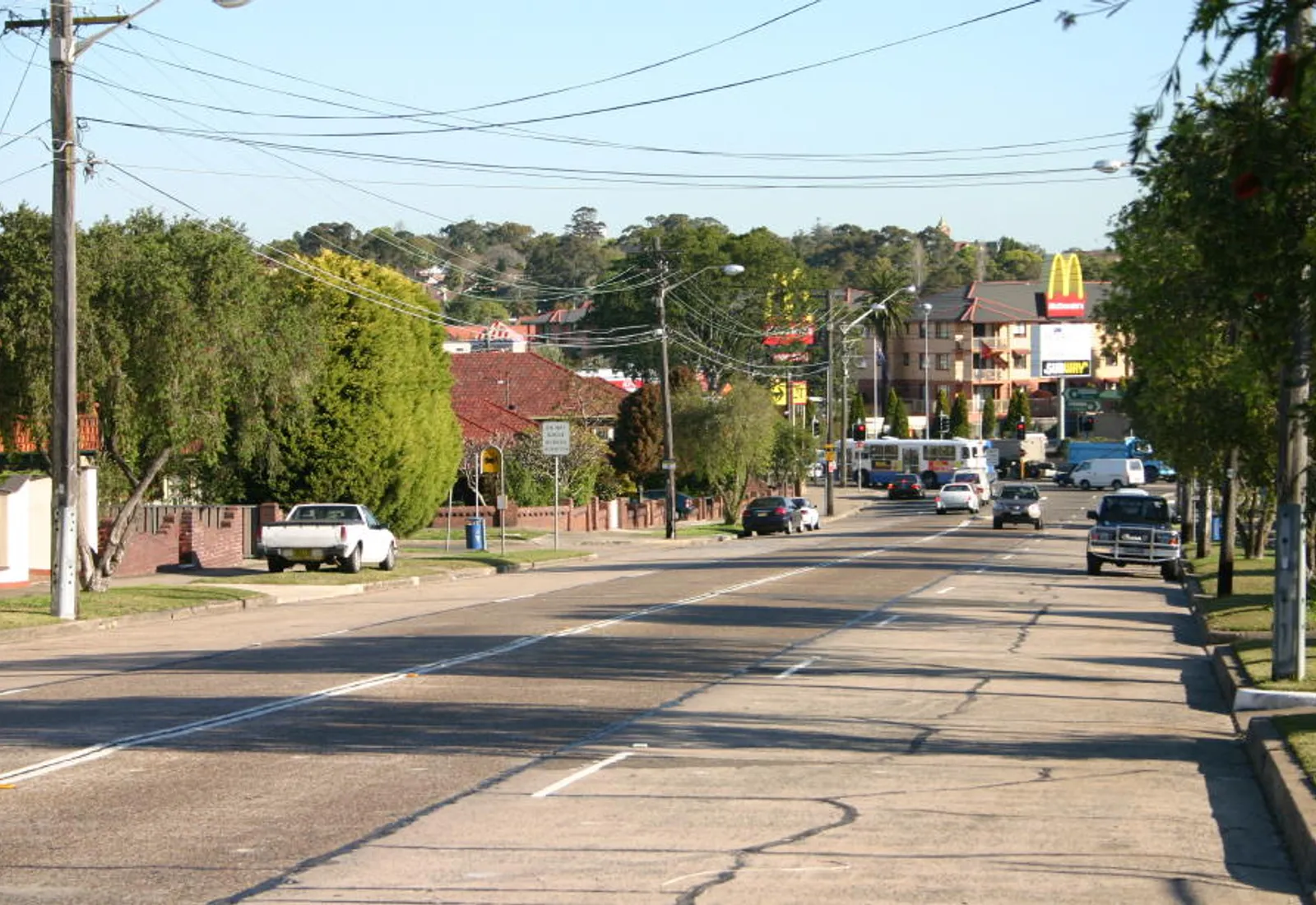
Data provenance & limitations. Demographic figures are from the ABS 2021 Census for the Five Dock (NSW) suburb (SAL11533), with Greater Sydney (1GSYD) as benchmark; the 2021 Census is the most recent available. The proposed Sydney Metro West station is a planned future project, not an operating service — it is treated throughout as forward upside, not a current condition. Rent bands are indicative envelopes, not achieved rents — informed by current commercial-lease listings on Great North Road and the village's affluent positioning; verify comps for the specific tenancy. The photograph dates from 2004 and shows the Great North Road strip; confirm current streetscape before use. Factor scores are relative estimates calibrated across all Locatalyze suburbs, not guarantees of outcome.
Methodology: Scores are engine-derived from five observable inputs (demand strength, rent pressure, competition density, seasonality risk, tourism dependency — each 1–10). These feed into business-type-specific weighted composites via a single scoring engine used across all markets. Scores are relative estimates calibrated across all Sydney suburbs — a score of 80 indicates materially better conditions than 65; it is not a success probability or guarantee.
Frequently Asked Decision Questions
Have a specific address in Five Dock?
Run a full competitor map, rent benchmark, and location score, data confidence, and proceed / verify / avoid screening recommendation for any Five Dock address. Free.
·4.8★ with 871 reviews — repeat local demand, not one-off visits.
·0.4★ above the 4.4★ average among top local peers.
·Review volume 100% above peer average (436).
If you are opening nearby: Buttercrumbs Croissant Five Dock is the benchmark café here — their 4.8★ and 871 reviews beat the 436-review peer average — 327m from centre — frontage on the walkable strip matters.
·4.7★ with 480 reviews — repeat local demand, not one-off visits.
·0.3★ above the 4.4★ average among top local peers.
·Mid-range positioning with strong review depth — balanced offer, not discount-led.
If you are opening nearby: The Lab - Black Poison (Dominant) shows what execution looks like at this score tier — 4.7★ with 480 reviews signals repeat custom, not novelty traffic — $$ positioning is validated by review depth in this catchment.
·4.2★ and 785 reviews — customers actively recommend this café.
·Rating sits below the 4.5★ peer average — volume or convenience may be doing the work.
·Review volume 76% above peer average (446).
If you are opening nearby: Club Five Dock RSL (Dominant) shows what execution looks like at this score tier — 4.2★ with 785 reviews signals repeat custom, not novelty traffic — 115m from centre — frontage on the walkable strip matters.
4. McDonald's Croydon
★★★½☆ 3.6 (1,634 reviews) · $ · 625m from centre
54 · Growing
·1,634 reviews place it on the local shortlist even where ratings are mixed.
·Rating sits below the 4.5★ peer average — volume or convenience may be doing the work.
·Review volume 365% above peer average (351).
If you are opening nearby: $ positioning is validated by review depth in this catchment — For new entrants: McDonald's Croydon is beatable on single-origin filter led — avoid matching incumbents' full menu breadth.
5. Dino’s Five Dock
★★★★½ 4.8 (185 reviews) · 402m from centre
80 · Dominant
·4.8★ and 185 reviews — customers actively recommend this café.
·0.4★ above the 4.4★ average among top local peers.
If you are opening nearby: Dino’s Five Dock (Dominant) shows what execution looks like at this score tier — 4.8★ with 185 reviews signals repeat custom, not novelty traffic — For new entrants: Dino’s Five Dock is beatable on pastry-forward with a limited hot menu — avoid matching incumbents' full menu breadth.
Who wins in Five Dock — Restaurants
Ranked by success score (rating, review depth, centrality) within ~1000m of the suburb centre.
What winners have in common
·5 of 10 top venues sit at 4.3★+ — customers reward consistent execution, not novelty alone.
·Review depth averages 804 — operators with under 150 reviews read as unproven next to incumbents.
·Typical positioning is $$ (6 venues report Google price tiers).
·3 benchmark operators combine 4.4★+ ratings with 150+ reviews — new entrants need a clear niche, not a me-too menu.
·4.1★ rating beats the typical restaurant baseline in this catchment.
·Review volume 225% above peer average (657).
·Mid-range positioning with strong review depth — balanced offer, not discount-led.
If you are opening nearby: Wagyu House Croydon is the benchmark restaurant here — $$ positioning is validated by review depth in this catchment — For new entrants: Focus on a specific occasion (date night, quick lunch, or group dining) that Wagyu House Croydon does not dominate.
·4.6★ with 836 reviews — repeat local demand, not one-off visits.
·0.4★ above the 4.2★ average among top local peers.
·Mid-range positioning with strong review depth — balanced offer, not discount-led.
If you are opening nearby: Filicudi Restaurant Five Dock (Dominant) shows what execution looks like at this score tier — 4.6★ with 836 reviews signals repeat custom, not novelty traffic — $$ positioning is validated by review depth in this catchment.
·4.1★ rating beats the typical restaurant baseline in this catchment.
·Review volume 72% above peer average (750).
If you are opening nearby: For new entrants: Focus on a specific occasion (date night, quick lunch, or group dining) that Canada Bay Club does not dominate.
·4.2★ and 785 reviews — customers actively recommend this restaurant.
·Central location (115m from suburb centre) captures pass-by and destination traffic.
If you are opening nearby: 4.2★ with 785 reviews signals repeat custom, not novelty traffic — 115m from centre — frontage on the walkable strip matters — For new entrants: Focus on a specific occasion (date night, quick lunch, or group dining) that Club Five Dock RSL does not dominate.
5. McDonald's Croydon
★★★½☆ 3.6 (1,634 reviews) · $ · 625m from centre
54 · Growing
·1,634 reviews place it on the local shortlist even where ratings are mixed.
·Rating sits below the 4.3★ peer average — volume or convenience may be doing the work.
·Review volume 129% above peer average (712).
If you are opening nearby: $ positioning is validated by review depth in this catchment — For new entrants: Focus on a specific occasion (date night, quick lunch, or group dining) that McDonald's Croydon does not dominate.
Who wins in Five Dock — Retail
Ranked by success score (rating, review depth, centrality) within ~1500m of the suburb centre.
What winners have in common
·6 of 10 top venues sit at 4.3★+ — customers reward consistent execution, not novelty alone.
·No single venue dominates on both rating and review depth — the category may still be contestable.
1. Inner West Dress Hire
★★★★★ 5.0 (9 reviews) · 527m from centre
65 · Established
·5.0★ rating beats the typical retail baseline in this catchment.
·0.6★ above the 4.4★ average among top local peers.
·Review volume 88% above peer average (5).
If you are opening nearby: their 5.0★ and 9 reviews beat the 5-review peer average — For new entrants: A service-heavy or experiential retail concept can win where product-only formats like Inner West Dress Hire look interchangeable.
2. Ciel Collection
★★★★½ 4.8 (9 reviews) · 369m from centre
61 · Growing
·4.8★ rating beats the typical retail baseline in this catchment.
·0.4★ above the 4.4★ average among top local peers.
·Review volume 88% above peer average (5).
If you are opening nearby: their 4.8★ and 9 reviews beat the 5-review peer average — 369m from centre — frontage on the walkable strip matters — For new entrants: A service-heavy or experiential retail concept can win where product-only formats like Ciel Collection look interchangeable.
3. Bayside Golf Shop
★★★★☆ 4.0 (10 reviews) · 863m from centre
36 · Emerging
·4.0★ rating beats the typical retail baseline in this catchment.
·Rating sits below the 4.5★ peer average — volume or convenience may be doing the work.
·Review volume 114% above peer average (5).
If you are opening nearby: For new entrants: A service-heavy or experiential retail concept can win where product-only formats like Bayside Golf Shop look interchangeable.
4. Velani by Nicky
★★★★★ 5.0 (4 reviews) · 278m from centre
66 · Established
·5.0★ rating beats the typical retail baseline in this catchment.
·0.6★ above the 4.4★ average among top local peers.
·Central location (278m from suburb centre) captures pass-by and destination traffic.
If you are opening nearby: 278m from centre — frontage on the walkable strip matters — For new entrants: A service-heavy or experiential retail concept can win where product-only formats like Velani by Nicky look interchangeable.
5. The First Gown
★★★★★ 5.0 (4 reviews) · 237m from centre
66 · Established
·5.0★ rating beats the typical retail baseline in this catchment.
·0.6★ above the 4.4★ average among top local peers.
·Central location (237m from suburb centre) captures pass-by and destination traffic.
If you are opening nearby: 237m from centre — frontage on the walkable strip matters — For new entrants: A service-heavy or experiential retail concept can win where product-only formats like The First Gown look interchangeable.
Possible market opportunities
Derived from venue counts and formats in our Google Places snapshot — not a guarantee of demand at your exact address.
Medium confidenceService-led retail (phone repair, alterations, or plant studio)
Reason: Product-only retail is crowded online — hands-on services tied to a high-street address defend against e-commerce.